«A master painter is one who knows how to paint well and imitate natural things well.» — Caravaggio, 1603. [8]
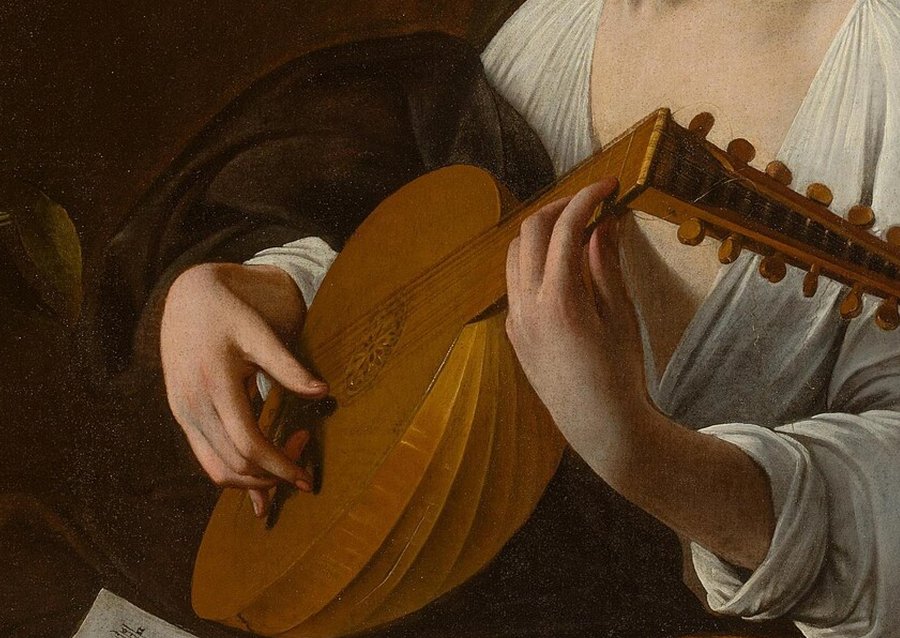
Michelangelo Merisi da Caravaggio — «Lute Player» (1596)
Concept
Caravaggio’s creativity is often linked to the sharp contrast between light and darkness, yet his painting is equally built upon gesture. In his works, emotions are conveyed not only through faces but also through hands: they point, hesitate, hold, attack, and recognize. This is especially evident in the works from the 1590s–1600s, ranging from early domestic scenes to later tragic compositions, where the hand becomes the thematic center of the painting [1; 2].
This study is interested in how the artist utilizes gesture as a primary dramatic device. His religious subjects unfold not in an idealized space, but alongside the viewer: the figures resemble ordinary people [4], and their hands convey confusion, fear, surprise, and determination. The context of Rome around 1600 is crucial here, where painting commissioned for churches was expected not only to decorate but also to involve the believer in the event, making it understandable and emotionally persuasive [2; 3].
Unlike many masters of the preceding tradition, Caravaggio does not strive for idealized gestures. His contemporary and critic Bellori chastised the artist for his commitment to naturalism and his rejection of «sublime» beauty [4]. For Caravaggio, the hand is neither beautiful nor conventional; it is tense, clenched, or extended, and it is this physical veracity that brings the scene to life.
The hypothesis of this research is that Caravaggio’s hand gestures function as a «language of the stage»: they dictate the direction of the gaze, illustrate the relationships between the characters, and allow the narrative to be read without captions or explanations. To describe this approach, I employ the metaphor of a «silent dialogue”—not as a scientific term, but as a way to designate a situation where characters communicate through their bodies rather than their words.
The work also examines the connection between gesture, light, and framing: the hand often appears on the boundary between light and shadow, thrust toward the foreground, or directed toward the viewer. This is not about a single, unified system, but about recurring compositional decisions observable across various works by the artist.
The objective of this research is to trace how hand gestures transform the dramaturgy of a scene and how Caravaggio uses them to turn biblical and domestic narratives into vibrant, almost theatrical action.
«There is no doubt that Caravaggio contributed to the development of painting: he emerged at a time when fidelity to nature was not highly valued, and figures were created according to convention and manner, responding more to a taste for grace than to truth.» — Giovanni Pietro Bellori, 1672.
The foundation of this study is a visual analysis of Caravaggio’s paintings from 1590–1600s. The selected material consists of works where hand gestures play a significant narrative role—ranging from early domestic scenes to later tragic compositions. The description of the scenes is based directly on the images themselves; figure references (Fig. N) point to illustrations, and their sources are listed at the end of the paper.The research draws upon the biography of Helen Langdon [1], the monograph by Catherine Pulizzi [2], Sebastian Schütte’s complete corpus of works [3], Giovanni Pietro Bellori’s «Lives of the Artists» as an early source on the painter [4], the description of «Shulers» in the Thwaytes v Sotheby’s court ruling [5], the Gospel texts and the Book of Judith, upon which the plots are based [6], and the Breuer Museum’s information regarding the second version of «The Supper at Emmaus» [7]. The primary method employed is the analysis of the visual field—comparing gestures, light direction, composition, and framing.The study is divided into five sections, each dedicated to a distinct type of gesture:— The gesture of deceit and seduction. — The gesture of choice. — The gesture of doubt. — The gesture of recognition. — The gesture of violence.
Gesture of Deception and Seduction
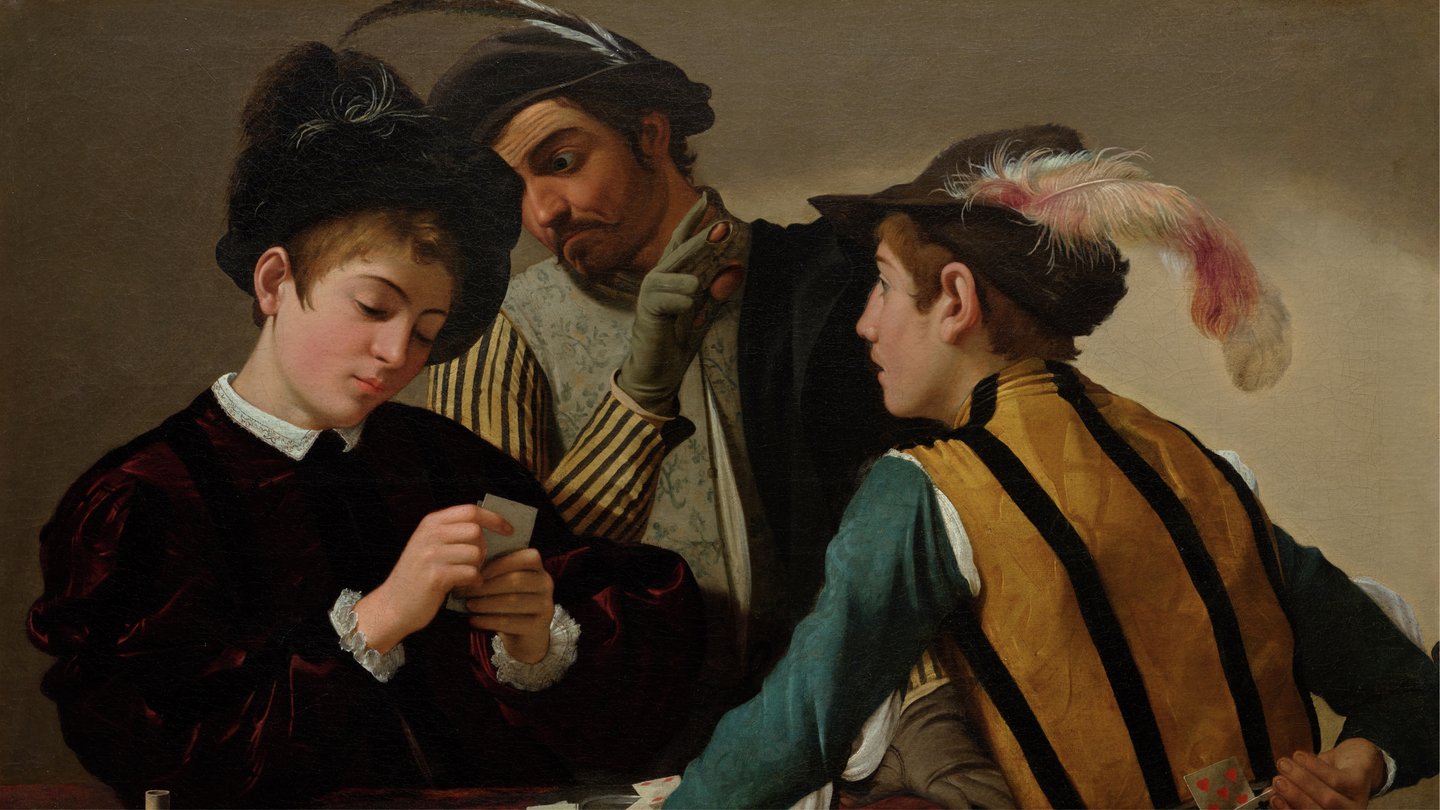
Michelangelo Merisi da Caravaggio — «The Bari» (1594)
In Caravaggio’s early works, he is not yet painting large religious scenes, but he is already constructing narratives around hands. In «Cheat Game» (Fig. 1), the main action does not occur on the faces but in the lower part of the canvas: one player hides a card behind his back while the other intently watches his partner. The hand pulling the card from the belt becomes the key moment of the plot—a moment the viewer notices, but the deceived youth does not [5, p. 1].
Gestures in the Artwork:
The raised hand of the senior accomplice conveys a coded signal.
The young cheat reaches for the hidden card.
The hands of the honest player are occupied with the game itself; he is not participating in the secret exchange of signals.
Pictorial and compositional techniques:
The half-figure composition brings the hands and cards closer to the viewer.
The turn of the young cheat allows the scene of the open game and the hidden action behind him to be displayed simultaneously.
The directions of gazes and the movement of hands connect the accomplices.
The contrast between light and dark areas of the clothing helps distinguish overlapping figures and their actions.
The gesture creates an inequality of knowledge. The viewer sees the mechanism of the deception, while the deceived player remains unaware of it.
Michelangelo Merisi da Caravaggio — «The Good Fortune» (1595)
In «The Fortune Teller» (Fig. 2), the gesture is executed more subtly. The fortune teller holds the youth’s palm as if reading his fate, while simultaneously slipping a ring off his finger. The gentle touch and the theft are combined in a single motion. The viewer perceives the deception before the hero, which creates a light irony in the scene.
The joined hands are positioned between the figures, binding them within the painting rather than directing the action beyond its frame. Here, the expressiveness of the gesture is built upon the contrast between the evident interaction of the faces and the inconspicuous action of the hands.
Gestures in the Work:
The fortune teller holds the young man’s hand under the pretext of reading his fortune.
The hand contact has a dual function: visible fortune-telling and hidden theft.
Unlike in «The Tricksters, ” the deception here is not distributed among several figures but concentrated in a single touch.
Pictorial and Compositional Techniques:
The proximity of the two half-figures makes their relationship the main subject of the scene.
The light background and illuminated hands allow the viewer to discern the small action.
The characters’ eye contact distracts attention from the movement of the fingers.
The restraint in external dynamics enhances the significance of the subtle gesture.
So, deception can manifest not only through a secret signal but also through a seemingly trustworthy touch. While the young man gazes at the gypsy woman in fascination, she smiles and removes the gold ring from his finger.
The Gesture of Invitation and Allure
Michelangelo Merisi da Caravaggio — «Bacchus» (1598).
In «Bacchus» (Fig. 4, Fig. 5), the gesture functions as an invitation. The young god extends a shallow wine goblet to the viewer with one hand while touching a dark sash on his waist with the other. Natalia Apchinskaya notes that Caravaggio uses mirrored reflection in these early works: Bacchus holds the cup not in his right but in his left hand [9]. The painting aims to bring the conditional world closer to the viewer, and the hand holding the goblet becomes the intermediary between them. The lighting unifies Bacchus’s face, bare shoulder, and the hand with the cup, causing the offered drink to become part of a direct address to the viewer. The hand with the goblet reaches forward, while the other hand, touching the garment’s sash, anchors the viewer’s attention to the character’s body. These two movements create a distinction between an open invitation and a more contained, self-referential gesture.Gestures in the work:Bacchus extends the cup toward the viewer.The other hand touches the garment’s sash.The offered object transforms the hand’s movement into an address outside the painting.Pictorial and compositional techniques:The frontal position of the figure maintains a sense of immediate contact.The goblet thrust forward connects the image space with the space in front of it.The light accentuates the skin, glass, wine, and fabric, emphasizing the sensual materiality of the objects.The still life in the foreground reinforces the theme of sensory perception.Here, the main action is the offering and the invitation; «temptation» can be used as an interpretation of the nature of this address.
The Gesture of Calling and Choice
Michelangelo Merisi da Caravaggio — «The Calling of Saint Matthew» (1599–1600)
The subject of the painting is taken from the Gospel of Matthew: Christ calls the tax collector Matthew to follow him [6, Mt 9:9]. In «The Calling of Matthew» (Figure 5), everything is built around a single movement. Christ stands at the edge of the composition, in semi-darkness, and extends his hand toward the group of people at the table. This gesture sets the direction for the entire scene: the figures respond to it, and the light falling from the upper right guides the viewer toward it [1; 2]. The old man and the youth on the left are absorbed in counting money [9], and Christ’s commanding hand interrupts their activity like a sudden shift in rhythm.Gestures in the Work:Christ’s outstretched hand is directed toward the group at the table.Peter’s gesture mirrors the direction of this appeal.The pointing movement of the bearded man creates a responsive query—a question about who the call is addressed to.The hands of the figures occupied with money depict a different action—the continuation of everyday life.Pictorial and Compositional Techniques:The sidelight and Christ’s outstretched hand establish a unified reading direction for the scene.The contrast between the illuminated group and the darkened space emphasizes the suddenness of the arrival.A semantic distance emerges between the right and left groups, which the gesture bridges.The varied hand positions illustrate the asynchronous nature of the reaction: the call has been made, but not everyone has responded to it.Thus, the gesture does not merely point to a figure; it creates a situation of address and response. The ambiguity of the pointing movement cannot be substituted with the certainty that the man is pointing specifically at himself.
The Gesture of Doubt and Assurance
Michelangelo Merisi da Caravaggio — «The Incredulity of Saint Thomas» (1601–1602)
The scene is taken from the Gospel of John: Thomas does not believe in the resurrection of Christ until he touches his wounds [6, John 20:24–29]. The hand is at the very center of the composition. Christ pulls back the edge of his garment and takes the apostle’s hand, guiding his finger to the wound on his side. Bellori describes this similarly: The Lord draws Thomas’s hand closer to himself and pulls back the covering from his chest [4]. The gesture here is almost physiological. Caravaggio does not soften the moment: the finger enters the wound (Fig. 12), the skin around it rises, and Thomas’s brow bunches up. Faith transforms from an abstract concept into a physical experience. It is also important whose hand guides the movement. Christ holds the wrist and directs the finger inward himself. The invitation becomes a direct invitation to verify, and the question of faith is resolved not by a word, but by touch.Gestures in the work:Thomas touches Christ’s wound.Christ holds and directs his hand.Christ’s other hand draws back the cloth, revealing the site of contact.Painting and compositional techniques:The figures, brought close, almost entirely fill the space.The tilt of the heads and the direction of the gazes converge toward the point of contact.Light highlights Christ’s body, hands, and wound.The dark background minimizes distracting details.The detailed rendering of skin and fingers makes the touch physically convincing.Doubt is shown not only through facial expression but also through the action of testing.
Recognition Gesture
Michelangelo Merisi da Caravaggio — «The Supper at Emmaus» (1601)
The narrative is drawn from the Gospel of Luke: two students recognize the risen Christ during a meal in Emmaus [6, Luke 24:13–35]. In «The Meal in Emmaus» (Fig. 13), the moment of recognition is conveyed through full-body gesture. The two students suddenly realize who is sitting before them: one recoils sharply, bracing his hands on the armrests of his chair, while the other throws his arms wide, with one nearly extending beyond the frame [1; 3].
The outstretched arms (Fig. 14) function as a visual effect suggesting movement toward the viewer. They deepen the scene and create a sense that the space continues outward toward the audience. The basket of fruit on the edge of the table reinforces this effect—it appears poised to spill toward us.
Gestures in the work:
One student braces his hands on the armrests, as if preparing to stand.
The other spreads his arms wide.
Christ’s gesture during the meal contrasts sharply with the students' sudden reactions.
Painterly and compositional techniques:
The perspective of the extended arm creates movement into the depth of the scene and toward the viewer.
The overlaps of figures, the table, and objects form an intimate space.
The basket on the edge of the table intensifies the feeling of an unstable image boundary.
The contrast between the calm center and the dynamic peripheral figures makes the reaction particularly striking.
Recognition is expressed as a sudden shift in physical state. The use of the hands allows the work to show the transition from an ordinary meal to astonishment.
Gesture of Revelation Acceptance
Langdon H. Caravaggio: A Life. London: Chatto & Windus, 1998.
Puglisi C. Caravaggio. London: Phaidon, 1998.
Schütze S. Caravaggio: The Complete Works. Cologne: Taschen, 2009.
Bellori G. P. Le vite de’ pittori, scultori et architetti moderni. Rome, 1672.
Thwaytes v Sotheby’s [2015] EWHC 36 (Ch). High Court of Justice of England and Wales, January 16, 2015, p. 1. caselaw.nationalarchives.gov.uk/ewhc/ch/2015/36
Bible: Matthew (9:9), Mark (6:17–29), Luke (24:13–35), John (20:24–29); Book of Judith (Chapter 13).
Brera Gallery. Supper at Emmaus (Caravaggio). Museum’s online collection: pinacotecabrera.org/en/collezioni/collezione-on-line/supper-at-emmaus; artwork page
Caravaggio’s testimony during the trial in the lawsuit of J. Balone, 1603. Text from the article «Caravaggio (1571–1610): a provident inquiry»: filodiritto.com; English translation: Encyclopaedia Britannica, «Caravaggio, ” section „Continued successes and the murder of Tomassoni“: britannica.com.