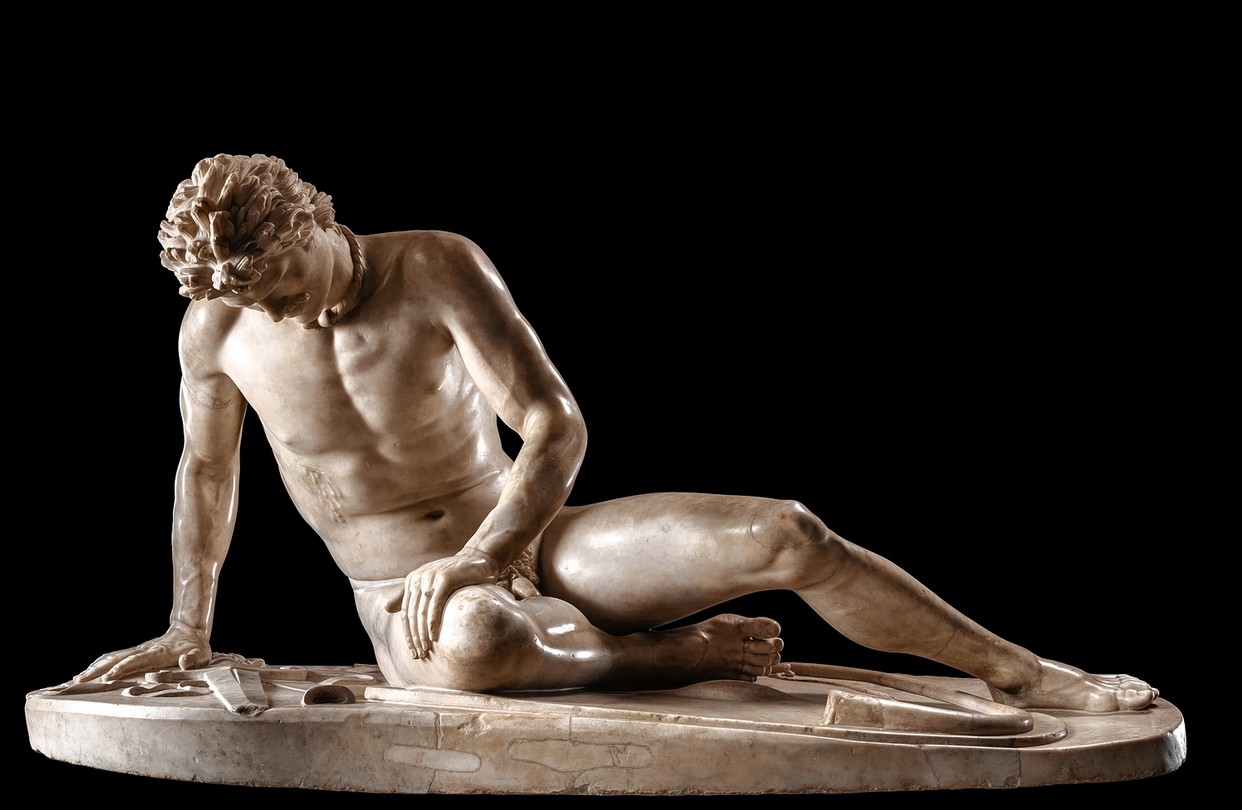
Канон пропорций человеческого тела в древнегреческой скульптуре: от архаики к эллинизму
Как и почему строгий канон пропорций в греческой скульптуре уступил место экспрессии и реализму?
Categorization
- Concept
- Part I. Archaic: The Body as a Geometric Schema
- Part II. Classical: The Mathematics of the Ideal Body
- Part III. Hellenism: The Destruction of the Canon for Emotion
- Conclusion
- Bibliography of Textual Sources
- List of Image Sources
Concept
Rationale for Topic Selection
My choice of the topic, the evolution of the physical canon in ancient Greek sculpture, was deliberate. While studying environmental design at the Higher School of Economics, I work daily with concepts of composition, ergonomics, and proportion. It became critically important for me to understand where the visual ideals of harmony—the very benchmarks upon which all contemporary European culture is based—originate. To me, ancient sculpture is a unique historical blueprint, reflecting global philosophical and social shifts through its treatment of the human body. I am interested in tracing this trajectory: from the conventional, geometry-bound forms of the Archaic period to the mathematically precise Classicism, and finally, to the dramatic and expressive Hellenism.
Principle for selecting materials for visual research
For my research, I selected key monuments that most vividly demonstrate the transition of epochs. My analysis focused on both early Kouros statues and Polyclitus’s mathematically precise «Doryphoros.» Concluding this evolution of Hellenism are «Laocoön» and the «Dying Gaul» (the latter was chosen as the visual dominant piece and featured on the cover).
The selection principle was based on the availability of high-quality museum reproductions and textual sources (such as Polyclitus’s treatise, «Canon»). This allows me to analyze not only the external plasticity of the statues but also the mathematical logic of their construction—a detail particularly relevant to a designer.
Research Structuring Principle
The work is structured chronologically and comprises three sections, each corresponding to a specific stage in the evolution of the human body:
I. Archaic (7th–6th centuries BCE)—the body as a geometric schema. The search for the first ideal through frontality, rigidity, and conventional symmetry. II. Classical (5th–4th centuries BCE)—the body as a mathematical formula. The triumph of Polykleitos' canon, the emergence of the chiastic structure, and contrapposto. III. Hellenistic (late 4th–1st centuries BCE)—the body as an instrument of expression. The dismantling of the strict canon in order to convey suffering, dynamism, and drama.
Principles of Selecting and Analyzing Textual Sources
For the research, academic textbooks and monographs on Ancient Greek art were selected. The selection principle was based on the authority of the authors (B. R. Viper, L. I. Akimova, G. I. Sokolov), who rely on primary sources and archaeological data.During the literature analysis, special attention was paid to Polykleitos’s treatise «Canons» (as interpreted by ancient authors) to understand the mathematical logic of proportions. Furthermore, scholarly articles and museum catalogs were utilized, which allowed us not only to describe the appearance of the statues but also to trace how philosophical views on the body evolved—from the schematic conventions of the Archaic period to the dramaticism of Hellenism.
Key Research Question and Hypothesis
How and why did the strict canon of proportions in Greek sculpture give way to expression and realism?
I hypothesize that the transition from the static symmetry of the Archaic period to the ideal proportions of Polykleitos and the subsequent dramaticism of Hellenism was not merely a change in artistic technique. It is a direct reflection of a transformation in philosophical focus—shifting from the search for the divine, the ideal, and the immutable to the acceptance of the real, the vital, and the suffering human existence. In my research, I plan to prove that the alteration of proportions in sculpture mirrored the evolution of humanity itself and its place in the world.
Archaic: The body as a geometric schema
First Steps Toward Excellence
The Archaic period (7th–6th centuries BCE) was a time when Greek sculpture was just beginning its journey toward understanding the human form. During this era, sculptors did not yet strive for portrait likeness or anatomical accuracy. Their primary goal was to create a monumental, majestic figure that could symbolize strength and beauty. It was then that the first concepts of proportion originated—concepts that would later lead to the creation of the great canon.
Frontality and Conventional Proportions
The main figures in the Archaic period were the kouros—nude, athletic youths—and the kore—women in richly adorned garments. When you look at a kouros, its absolute stillness and symmetry immediately catch the eye.
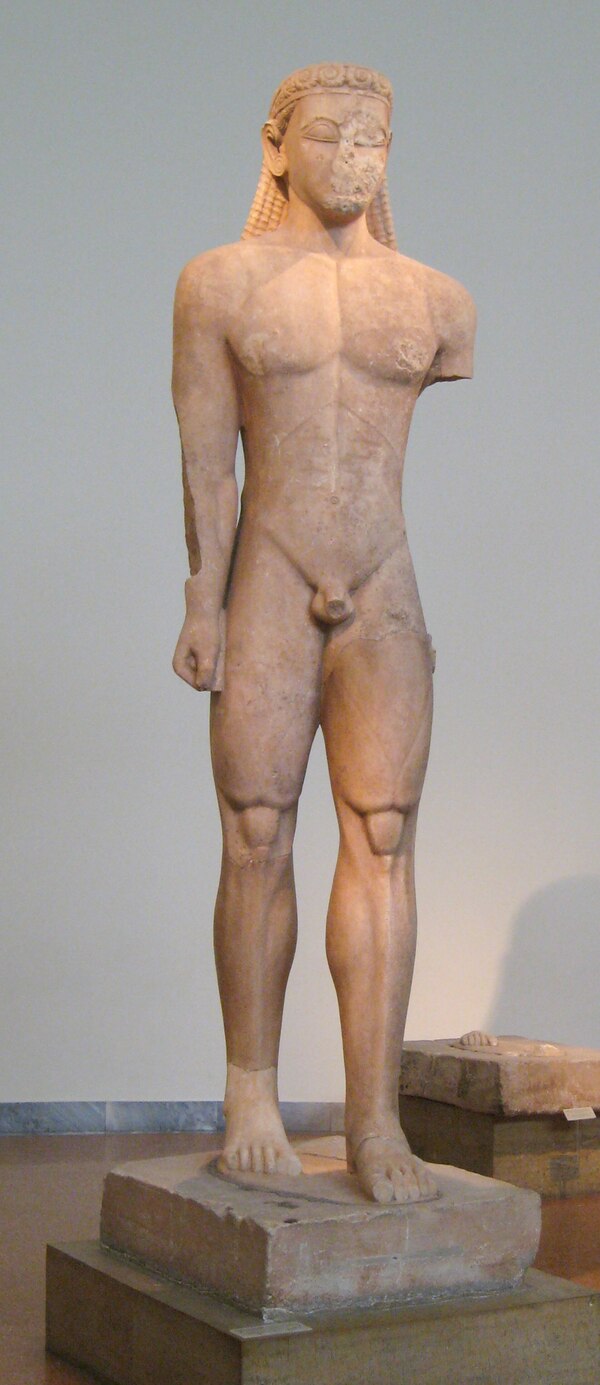
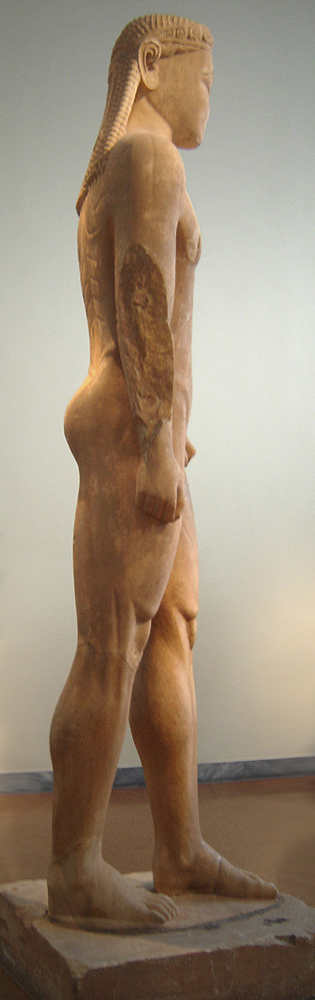
Unknown artist. Koros from Sunion (front and side view). Approx. 600 BCE. Marble (Naxos). National Archaeological Museum, Athens.
The figure stands strictly frontally, arms pressed firmly to the hips, and legs planted on the ground. This pose is reminiscent of Egyptian statues—it lacks movement and internal tension. The body proportions are still stylized: the figure appears slightly elongated, the muscles are sketched schematically, and the knees and elbows are delineated with geometric precision. For the archaic style, the body is not a living organism, but an ideal, mathematically precise schema governed by the laws of symmetry.
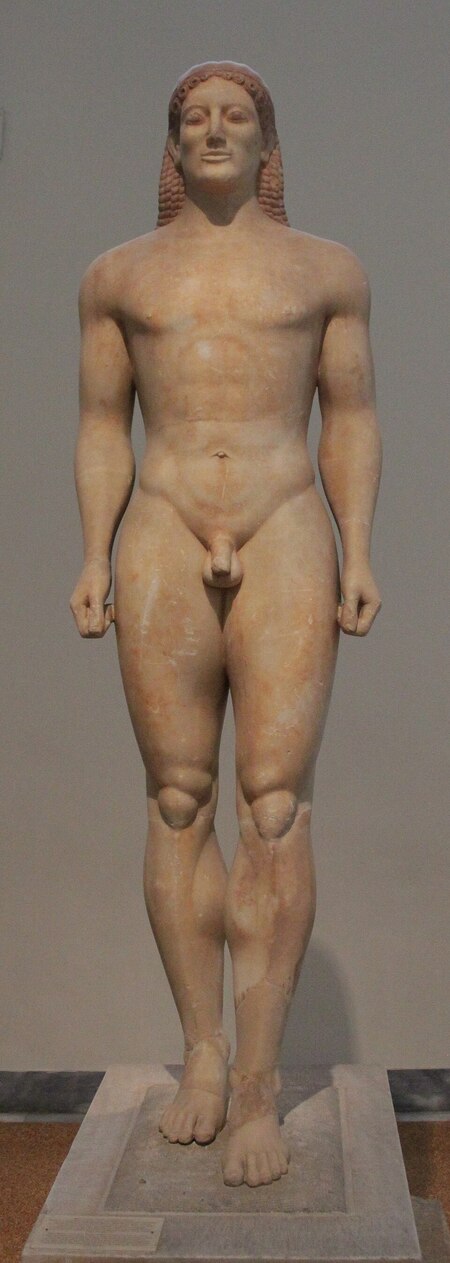
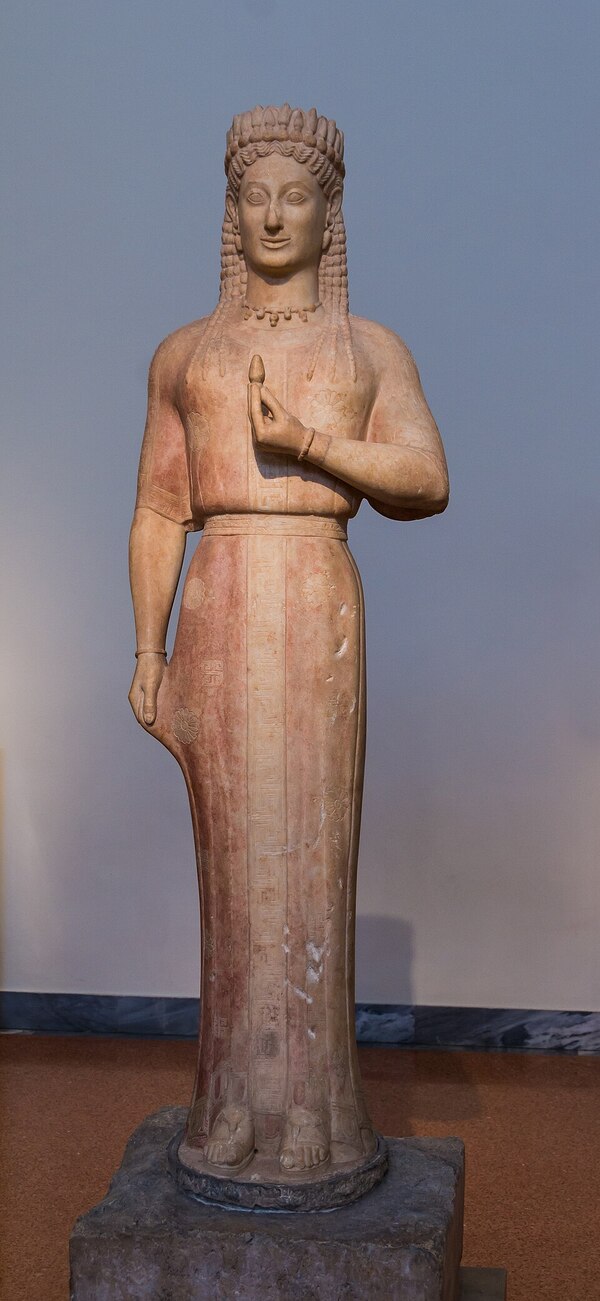
1. Unknown Artist. Koros from Anavissos (Tomb of Croesus). Circa 530 BCE. Marble (Parosian). National Archaeological Museum, Athens. 2. Aristion of Paros. The Ship of Phrasicles. Circa 550–540 BCE. Marble (Parosian). National Archaeological Museum, Athens.
The Kuros from Anavyssos and the Cora Phaskyleia clearly demonstrate the central principle of Archaic sculpture—strict frontality and symmetry. Their figures are static, with their arms pressed to their sides, which transforms the body into an idealized geometric schema. However, the «Archaic smile» and the detailed rendering of musculature and drapery reveal the sculptors' initial attempts to animate the stone and move toward the Classical style.
«The Archaic Smile»: An Attempt to Animate Static Stone
Despite an apparent stiffness, Archaic sculptors sought ways to breathe life into stone. The most vivid and recognizable technique was the so-called «Archaic smile.»The corners of the statues' lips are slightly upturned, and dimples appear on their cheeks. This smile is present in everyone—young athletes, stern warriors, and even dying heroes. To a contemporary viewer, it might seem strange or unnatural, but for the Greeks of that era, it was a crucial symbol. It signified that the statue was alive, that it possessed an inner vitality. It was the first, albeit a very tentative, attempt to convey an emotion that would later become central to the Hellenistic period.
Unknown artist. Moschophoros (Taurus). Circa 570 BCE. Marble. Acropolis Museum, Athens.
The Statue of Moschophor clearly demonstrates the «archaic smile.» Although the youth is carrying a heavy calf, his face maintains a serene, almost ritualistic expression with upturned corners of the mouth. This smile was less a reflection of emotion than a symbol of vital energy and the «animacy» of the stone—a crucial step for archaic art on its path toward future classicism.
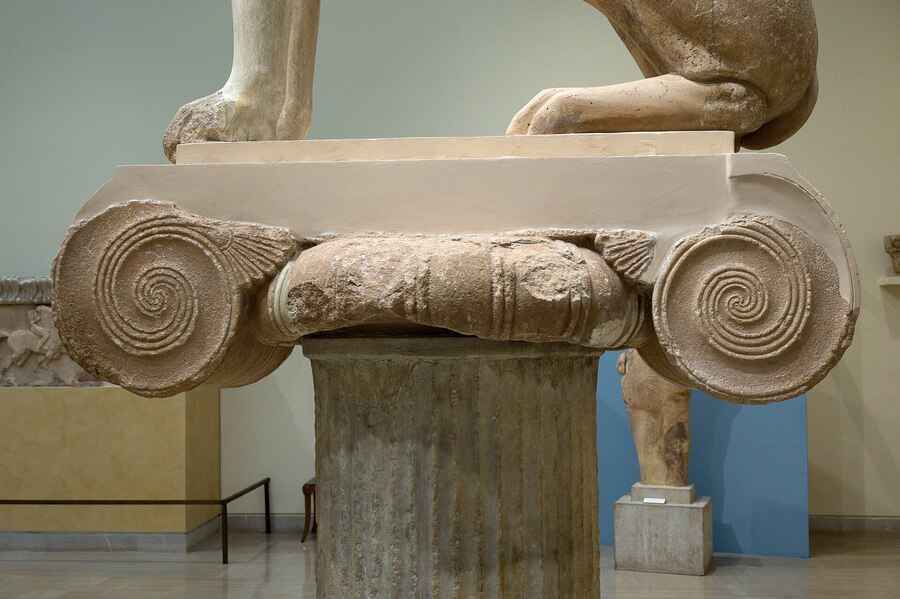
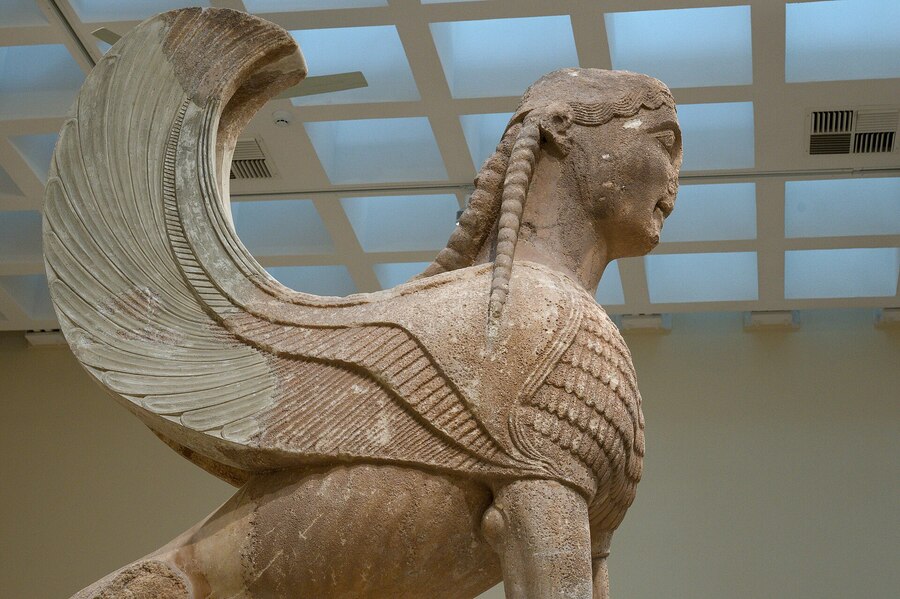
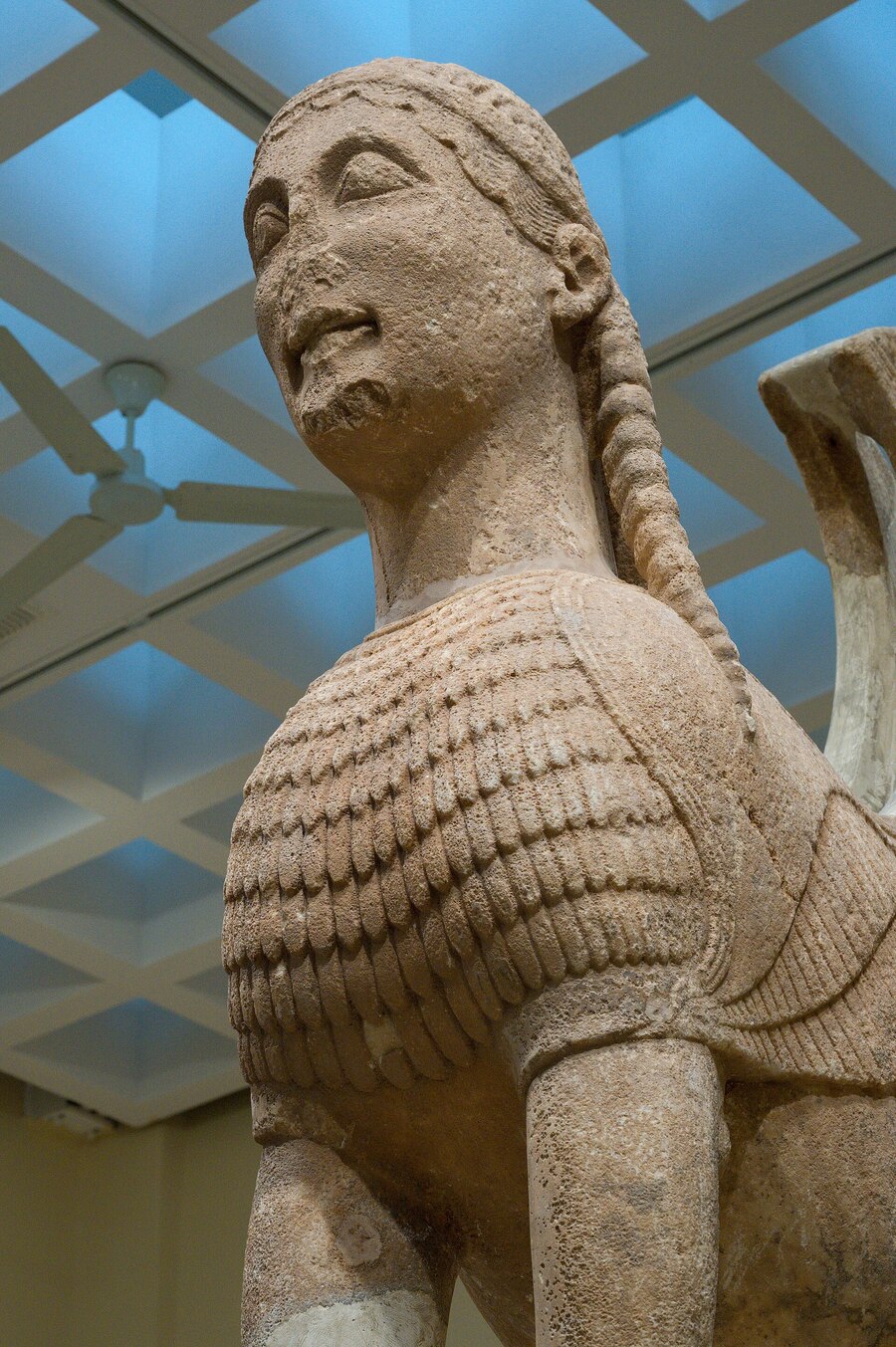
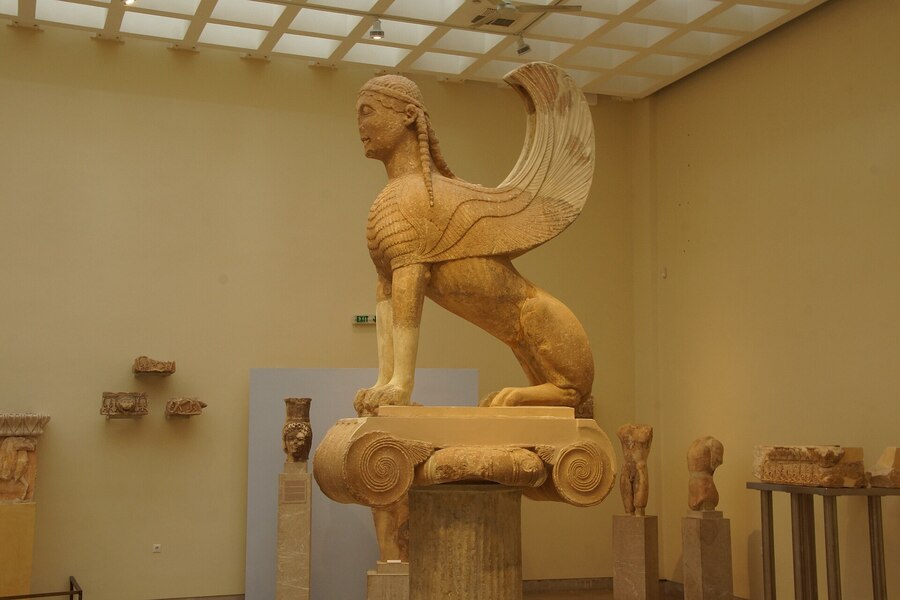
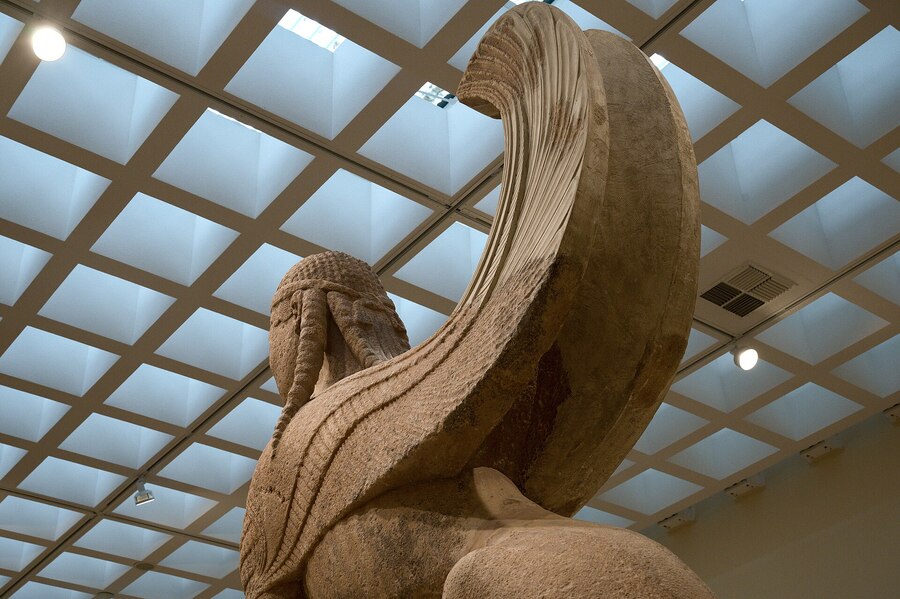
Author unknown. Sphinx of the Naxians. Circa 560 BCE. Marble (Naxian). Archaeological Museum of Delphi.
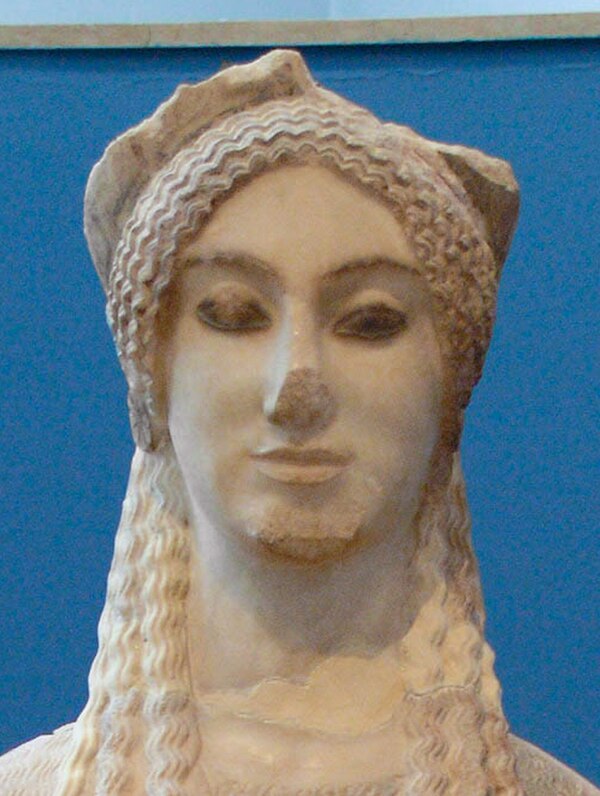
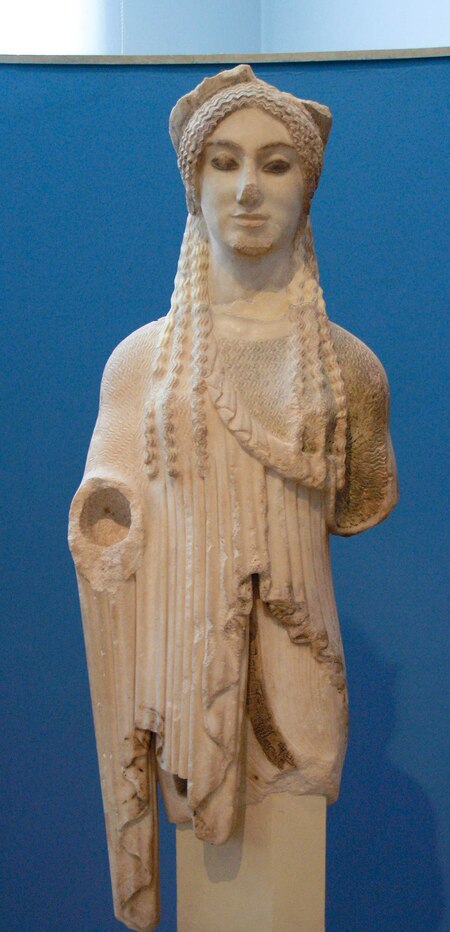
Author unknown. Kore No. 674 (Kore 674, «La Delicata»). Approx. 500 BCE. Marble (Paros). Acropolis Museum, Athens.