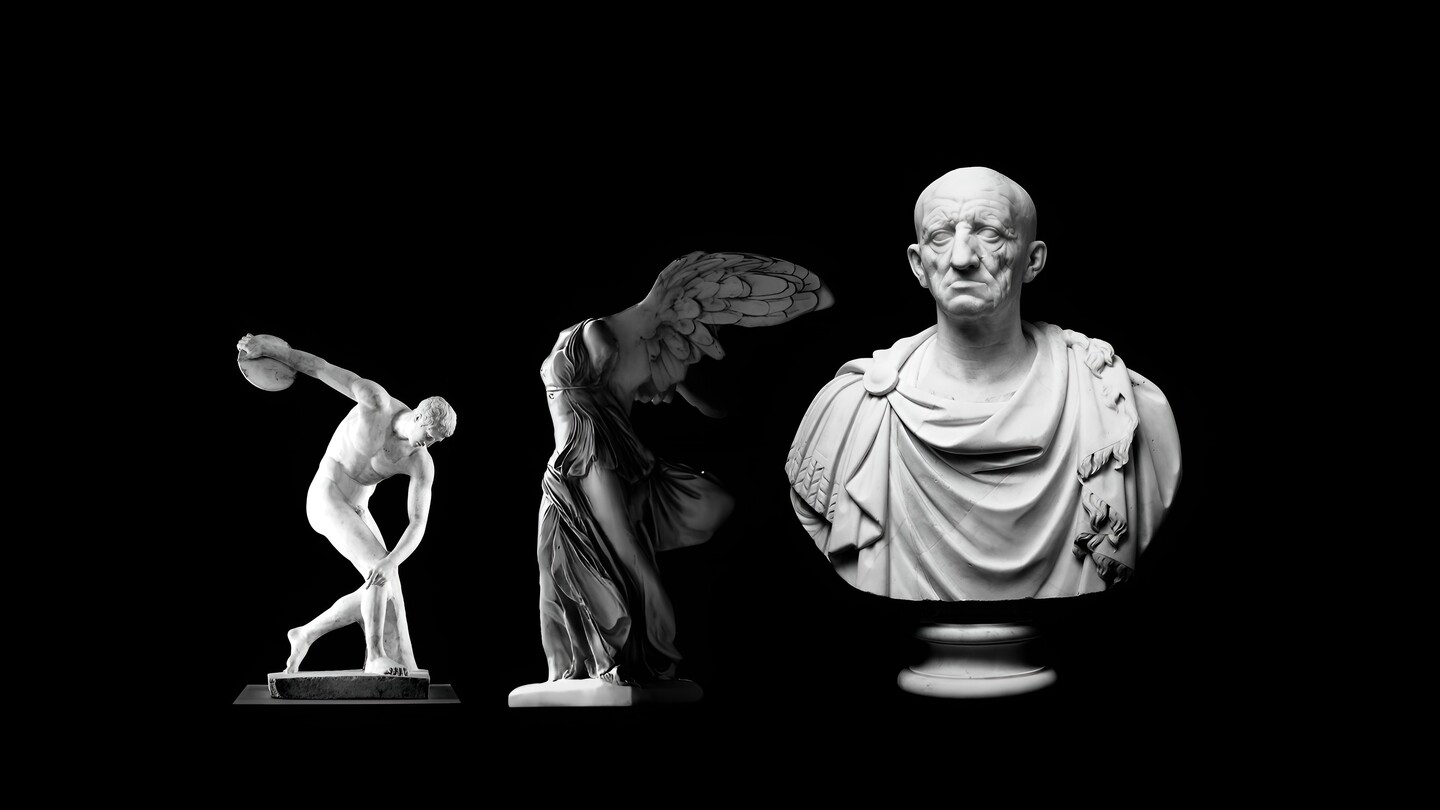
Navigation Menu
1. Concept
2. Ideal
3. Human and Society
4. Face and Emotion
5. Portrait and Personality
6. Conclusion
7. Bibliography
Concept
The human figure occupies a special place in art history. By depicting the human body and face, many artists expressed their era’s concepts of beauty, strength, dignity, social standing, and inner life. I chose this topic for my research because I am interested in the shifting attitudes of ancient artists toward the human figure. The research covers the 5th–1st centuries BCE—the period spanning from the flourishing of Classical Greek art to the late Roman Republic. This time frame allows for a comparison of several important stages of ancient culture and allows me to trace how the artists' perception of the human figure evolved. In Classical Greece, the body becomes the embodiment of harmony and order. The human figure is often portrayed as an idealized archetype of physical perfection.
In the 4th century BCE, the classical image became more sensual. During the Hellenistic era, artists became interested not only in youth and strength but also in other qualities. The human body became a means of conveying complex emotional experience. In Roman art, particularly during the late Republican period, the focus on individual facial features intensified. Imperfections in the face served to emphasize a person’s age, character, life experience, and social authority.
The key question is: why did artists choose specific methods of representation during different periods?
The core hypothesis is that between the V and I centuries BCE, the artistic representation of the human being becomes more multifaceted: art gradually moves from a predominantly idealized body toward emotional states, individual characteristics, and social roles. In this process, idealization and realism do not completely replace one another; instead, they coexist and perform different functions.
The research object is the depiction of the human figure in Ancient Greek and Ancient Roman sculpture and vase painting. The research subject is the artistic methods used to convey human appearance: body proportions, the plasticity of movement, facial expressions, age characteristics, and individual facial features.The visual study is composed of four chapters: the first, «The Ideal, ” is dedicated to the transition from archaic to classical sculpture and the formation of the concept of the perfect image; the second, „Man and Society, ” examines vase painting that reveals everyday activities, family relationships, and social roles; the third, „Face and Emotion, ” addresses Hellenistic sculpture, which vividly portrays human movement, physical vulnerability, and emotional experience; and the fourth, „Portrait and Personality, ” investigates the Roman tradition of portraiture and the interest in individual physical traits. The main research method is comparative visual analysis: juxtaposing poses, proportions, gestures, facial expressions, methods of conveying movement, and details of appearance. This approach allowed for the examination of the artworks as reflections of the historical and cultural perceptions of their time. The primary goal of the study is to demonstrate that ancient art gradually expanded the representation of the human figure.
Ideal
During the Archaic period (750–480 BCE), the primary forms of monumental sculpture emerged—images of nude male athletes, the kouroi, and of young women in long garments, the korai. Kouroi were depicted in full height, usually in a striding pose: one leg was brought forward, and a characteristic «archaic smile» graced their faces. However, these sculptures had not yet achieved realism. It gave the impression that the youths were merely illustrating movement, as the positioning of their arms and legs appeared somewhat unnatural. Furthermore, the kouroi sculptures largely lacked individual characteristics; they were very similar to one another, and their facial expressions remained consistent.
Course Statue (c. 590–580 BCE (No. 32.11.1) New York, The Metropolitan Museum of Art)
Statues were often commissioned as offerings to the gods or as monuments, which necessitated the depiction of the idealized human form. When creating funerary statues and stelae, ancient Greek masters employed specific artistic conventions. They depicted several common types of figures, and for each archetype, there existed characteristic poses, drapery styles, gestures, hairstyles, and attributes that helped underscore their social standing and societal role.
Delphic Charioteer (2nd Quarter of the 5th Century BCE, Delphi, Archaeological Museum.)
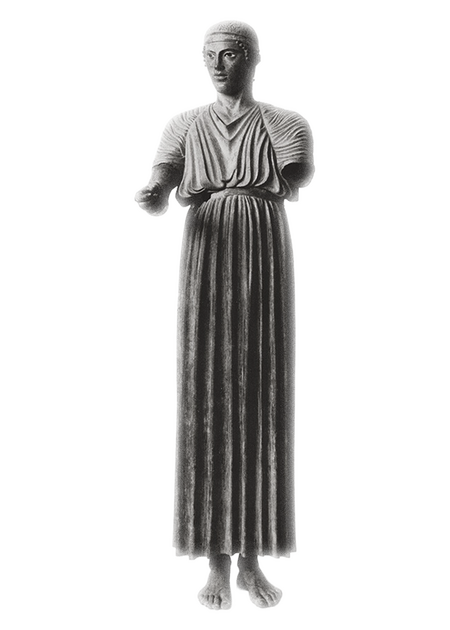
«The Delphic Rider» is an example of strict early Classicism infused with archaic elements. The youth stands upright, supported equally by both feet; only a slight turn of the head and the arms extended forward with reins break the absolute symmetry, but the torso itself remains static and designed to be perceived strictly from the front.
Dorphoros (Roman copy, late 1st century BCE — early 1st century CE, based on Polycleitus’s Greek bronze original from the 5th century BCE, Naples, National Archaeological Museum.)
The 5th century BCE marks a time of significant change in Greek sculpture. Artists begin to study the structure of the human body more closely—its ability to maintain balance and distribute weight naturally.
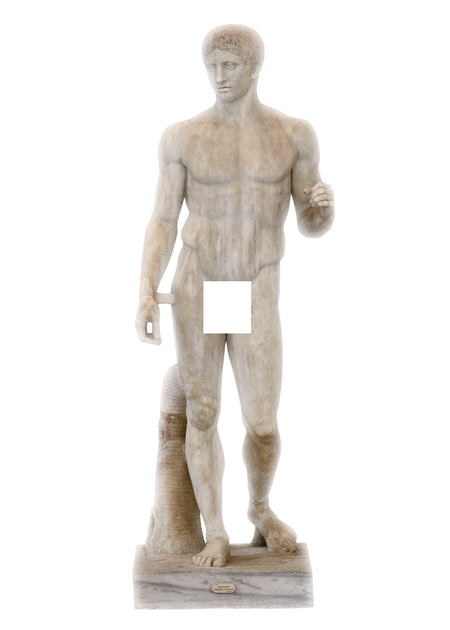
Based on Polycleitus’s work, it is clear that the sculptor, by employing the contrapposto technique, sought to convey the naturalness of movement and the harmony of the human form. Furthermore, the musculature of the «Doryphoros» is depicted in an idealized manner, demonstrating the continuation of Archaic period ideals regarding the perfect human image.
«Nika Untying Her Sandal» (c. 410 BCE. Athens, Acropolis Museum)
If the male figure in Greek art of the 5th century BCE was typically depicted as a nude, athletic body, the female figure was more often clothed. Her beauty was revealed through the imitation of fabric folds, the smoothness of the silhouette, and the positioning of her hands.
Aphrodite of Knidos (Torso — Roman copy from the 2nd century AD, the rest is a restoration by the 17th-century sculptor Ippolito Bacci (1562–1634). Rome, National Museum of Rome)
In the mid-4th century BCE, the sculptor Praxiteles created the «Aphrodite of Knidos.» This work is considered the first monumental depiction of a nude Greek goddess.
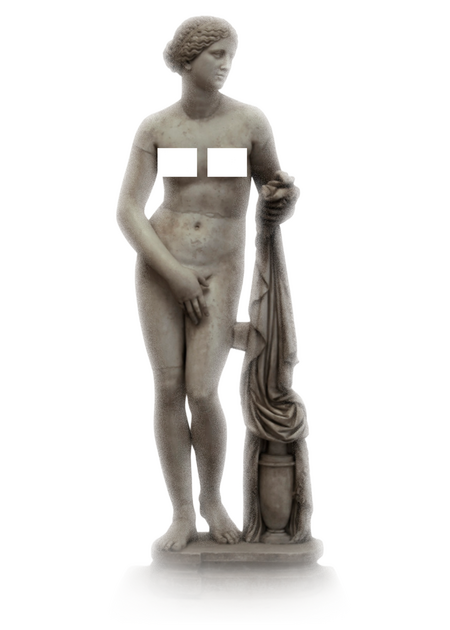
The artist proposed a new way of depicting the female divine body. Aphrodite is shown in the moment she is preparing for a ritual cleansing or has just emerged from the water. The gesture covering the body creates a sense of a scene unexpectedly revealed to the viewer—giving the impression of an intrusion into private space. Nevertheless, the idealization of the human form is maintained—the goddess’s appearance conforms to the beauty standards of that era.
Chapter Conclusion: The transition from archaic and early classical sculpture to the art of the 4th century BCE demonstrates that the ideal body was not a static form. It became more natural, more plastic, and more sensuous. However, the primary goal of art remained the same: to create not a portrait of an individual person, but an elevated archetype.
Identity and Society
Unlike monumental sculpture, which often depicted gods, heroes, and distinguished citizens, vase painting allowed viewers to see people in various situations. Ceramic vessels were decorated with scenes of festive ceremonies, athletic competitions, mythological narratives, love scenes, and daily life.
Terracotta wedding lebes (c. 430–420 BCE, Inv. No. 07.286.35a, b, The Metropolitan Museum of Art, New York)
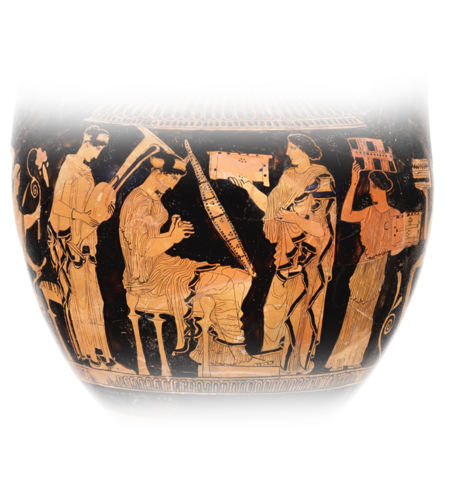
On the Terracotta wedding swan, a scene of wedding preparations is depicted—the bride (a woman seated on a chair) surrounded by her attending assistants. Of particular note is the depiction of a lutrophore (to the left of the bride)—a vessel containing water intended for the bride’s ritual cleansing before the wedding.
The artist conveys human relationships through the positioning of hands, head turns, and the distance between bodies. The female figure here is associated with specific social functions and notions of daily life.
Panathenaic Amphora (c. 332–331 BCE (No. 1873,0820.370), London, The British Museum)
The Panathenaic amphora allows us to view two scenes: one side of the vessel depicts the goddess Athena, in honor of which the Panathenaic Games were held, and the other side shows a scene from a sporting competition, featuring an athlete passing one stage of the contest to move to the next, two duelists, and a judge observing the athletes.