Как художник прячет человека: скрытая идентичность в живописи возрождения
Navigator
I. Concept and Topic Selection II. Research Question III. Hypothesis IV. Research Objective V. The Face as a Starting Point: What Lies Beyond the Portrait VI. The Animal as an Extension of the Human Image VII. Objects as a Way to Narrate Personality VIII. The Mirror: Reflected and Hidden Presence IX. Conclusion X. Bibliography and Image Sources
I. Concept and Topic Selection
The human figure has always been a primary subject in art. Artists have strived not only to capture an individual’s appearance but also to convey their character, mood, social standing, and unique identity. The portrait, in particular, has played a crucial role in this endeavor. It allowed for the preservation of a specific person’s likeness while simultaneously shaping a particular perception of them. However, the portrait does not always reveal the subject’s personality directly. Sometimes, facial expression and physical resemblance only provide a general impression, while deeper insights are embedded within the details that surround the figure in the painting.
This very contradiction became my starting point. I became curious about how Renaissance artists constructed a portrait using details that might, at first glance, seem secondary.
At the core of my work is the concept of hidden identity. By this, I do not mean the literal concealment of a person’s identity, but rather a specific way of artistically presenting it—a manner in which information about the individual is conveyed through supplementary visual elements. The subject’s persona is not confined solely to their physical appearance; it is constructed from gestures, costume, accessories, objects, animals, and the surrounding space. Each of these elements can carry specific information, and together, they form a more complex and layered image.
This approach is particularly compelling when studying Renaissance art. During the 15th and 16th centuries, the influence of the individual—their uniqueness and place in the world—gained strength within European culture. The scholar L.M. Batkin, in examining the evolution of the concept of individuality in European culture, notes that «anything, in artistic terms, of merit was equated with novelty, with a 'face with an uncommon expression’» [1]. This thought helps explain why, in Renaissance art, it became important not only to capture external likeness but also the particularity of a specific person’s image. The portrait gradually evolved from merely a means of documenting appearance into a medium for conveying social status, lifestyle, cultural interests, and the person’s self-perception. Artists increasingly utilized details and symbolic elements to imbue the image with additional meanings. Moreover, the significance of these details is not always immediately apparent: some are tied to historical context, others may have multiple possible interpretations, and some only become evident upon close examination of the painting.
For me, it is important to consider these elements not in isolation, but in their interaction with the depicted human figure. For instance, an animal might not just be near the model—it could influence how we perceive her character and status. Objects in the surrounding environment can suggest the person’s activities, interests, or intellectual depth. A mirror, meanwhile, can expand the picture’s space, introduce an additional perspective, and compel the viewer to contemplate the boundary between the visible and the concealed. Thus, every detail is examined as part of a visual system through which the artist constructs the portrait of an individual.
The structure of the work is organized based on a principle of gradual transition, moving from prominent elements to more complex modes of revealing personality. Initially, the interaction between the person and the animal is examined, followed by the significance of the environmental props. In the concluding section, the focus shifts to optical distortion, which alters the familiar structure of the image and complicates the relationship among the person, the space, and the viewer.
II. Research Question
How can an artist convey a person without depicting their identity directly?
III. Hypothesis
My hypothesis is that in Renaissance painting, the depiction of the human figure is shaped not only by their appearance but also by the surrounding details—objects, animals, and reflections. These elements become crucial tools of artistic expression, helping to reveal the depicted person’s social standing, character, interests, and relationships. Furthermore, their significance is not always obvious; certain details may carry a hidden symbolic meaning or create ambiguous images. Thus, the artist does not merely depict a person; they invite the viewer to gradually study the individual’s personality through a careful analysis of all the painting’s elements.
IV. Research Objective
Explore how Renaissance artists utilized supplementary visual elements to construct a more complex and multilayered depiction of the human figure.
V. The Face as a Starting Point: What Lies Beyond the Portrait
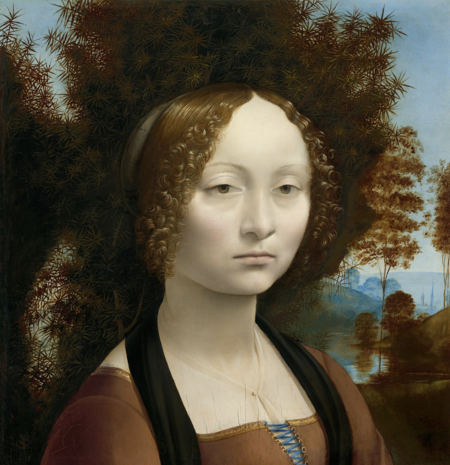
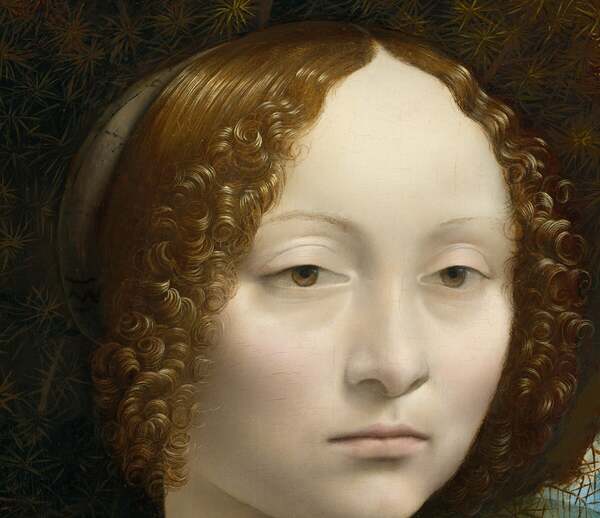
Leonardo da Vinci, «Mona Lisa, ” circa 1474–1476
One of the most compelling examples of how an artist reveals personality through more than just appearance is Leonardo da Vinci’s painting, «Portrait of Ginevra de' Benci.» At first glance, it is a rather restrained depiction of a young woman: the artist shows her from the waist up, with her body slightly turned and her face angled toward the viewer. Unlike many female portraits of that era, Ginevra is not shown in a strict profile. Because of the head’s turn, the viewer can examine the features of her face, yet the model’s expression remains ambiguous.
Ginevra’s face does not convey open joy or cheerfulness. Her lips are closed, her gaze is directed slightly away, and the expression seems thoughtful and detached. Art historian E. I. Rotenberg notes that the model’s face is «marked by an expression of pensive concentration» [2]. This characteristic is especially important for understanding the painting: Leonardo does not attempt to show the heroine’s emotional state in a definitive way. On the contrary, her calm and almost impassive expression creates a sense of inner life that the viewer does not have direct access to. The face becomes the starting point for perceiving the personality, but it does not provide a complete answer to the question of who the depicted woman is.
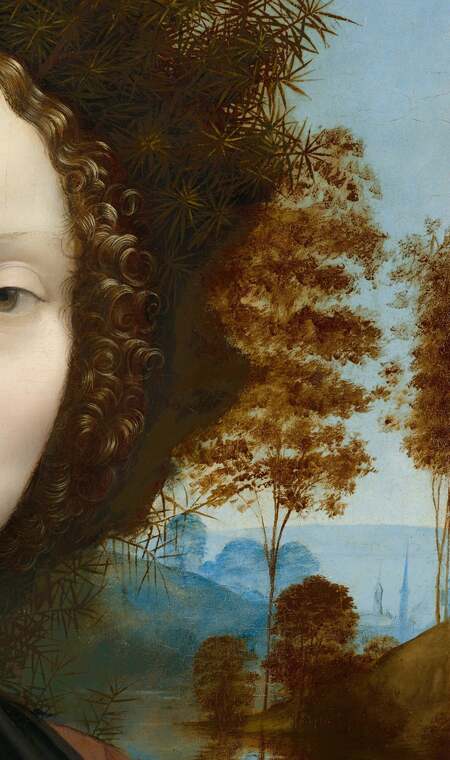
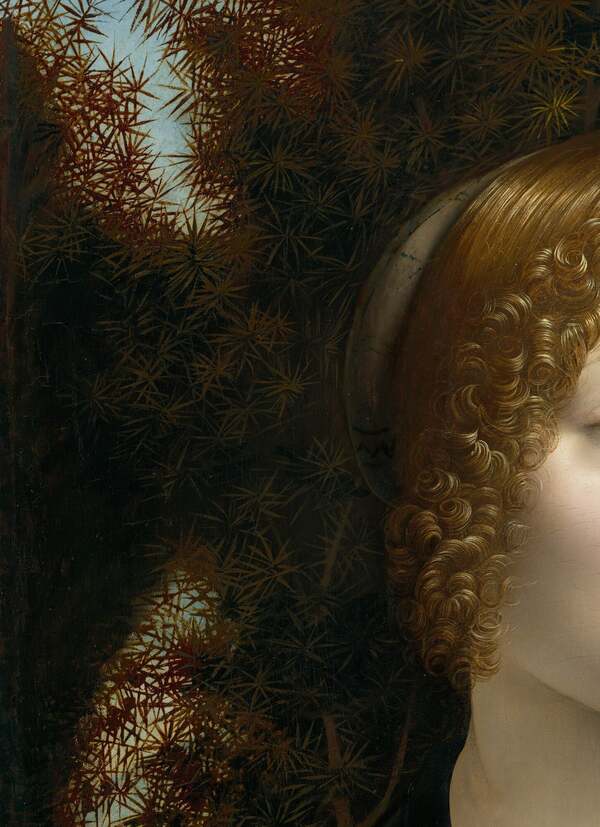
Leonardo da Vinci, «Mona Lisa, ” circa 1474–1476
The contrast between Ginevra’s light complexion and the dark landscape behind her takes on particular significance. In the background, one can discern a body of water, a distant landscape, and a dense juniper bush. It does not appear to be a random decorative element—its dark mass sets off the model’s face while simultaneously linking the portrait to the surrounding nature. B. R. Vipper notes that the landscape background is in psychological resonance with Ginevra’s appearance [3]. Thus, nature here does not merely fill the space behind the figure, but becomes part of the work’s overall mood.
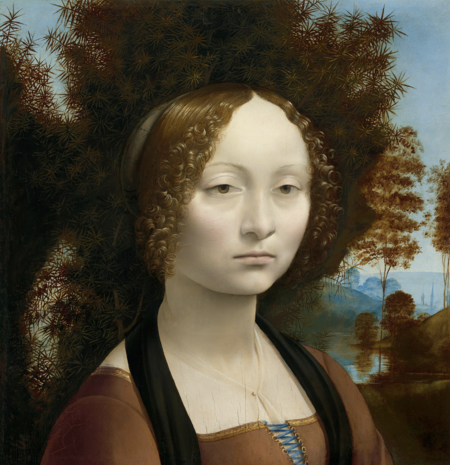
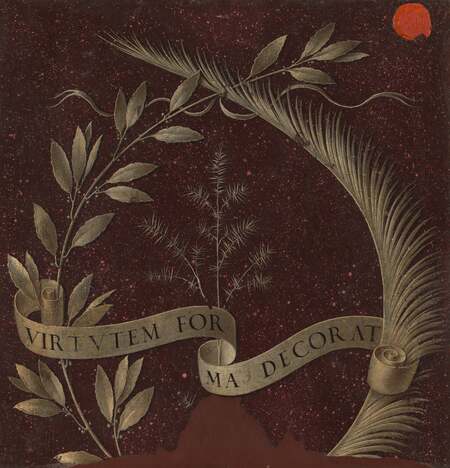
Leonardo da Vinci, «Mona Lisa, ” c. 1474–1476 (obverse and reverse)
The juniper also holds an additional symbolic significance. Its Italian name, «ginepro», sounds like the name Genevra. Furthermore, this motif appears not only on the front of the painting but also on the reverse side of the wooden panel, which features an emblem with a juniper branch encircled by laurel and palm fronds. This is complemented by the inscription «Virtutem forma decorat», which translates to «Beauty adorns virtue.» Thus, the image of Genevra is revealed not only through her appearance and facial expression but also through symbolism that alludes to her name and underscores the connection between beauty and virtue.
Thus, in Leonardo da Vinci’s «Portrait of Ginevra de’ Benci, ” he demonstrates that the depiction of a personality extends beyond mere physical appearance. While the face establishes the initial impression of the subject, a more complex image emerges through the landscape, the symbolism of the juniper, and the emblem on the reverse side of the painting. It is precisely for this reason that this portrait can be considered an example of how an artist moves beyond simple external likeness to create a multifaceted portrayal of a person.
VI. The Animal as an Extension of the Human Image
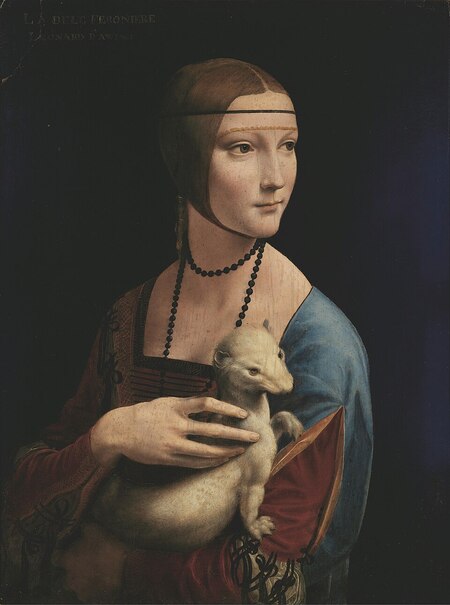
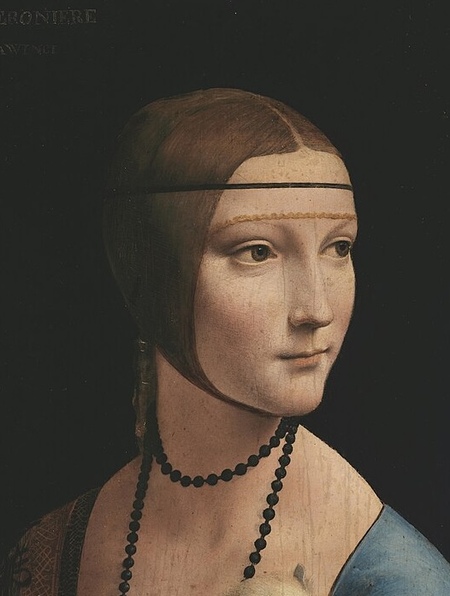
Leonardo da Vinci, «Lady with an Ermine,» c. 1489–1490
In Leonardo da Vinci’s painting, «Lady with the Ermine,» the animal functions as more than a mere decorative element; it becomes an essential component of Cecilia Gallerani’s persona. The compositional interplay between the woman and the small beast plays a particularly crucial role. As noted in one study, «the turn of her head to the right while her shoulders turn to the left creates a dynamic portrait structure characteristic of Leonardo» [4]. The ermine mirrors the model’s movement, causing the two figures to be perceived as a single compositional unit. Thus, the animal not only enhances the heroine’s image but also sustains the overall dynamic of the composition. Because of the close relationship between their poses and movements, the ermine is experienced as an extension of the woman’s figure, intensifying its integrity and expressiveness.
Leonardo da Vinci, «Lady with an Ermine, ” circa 1489–1490
The choice of animal holds particular significance. The marten symbolizes several concepts. During the Renaissance, this animal was associated with purity, innocence, and virtue. However, its presence in the painting can be explained by more than just symbolism. The Greek name for the marten, «galê, » corresponds to the first two syllables of the surname Gallerani, allowing us to view the animal as a kind of visual pun connected to the model’s name [5]. Furthermore, the marten was the emblem of the Milanese Duke Ludovico Sforza, with whom Cecelia was connected. Thus, the creature simultaneously references the woman’s identity, her status at the Milanese court, and her relationship with the duke.It is especially important that Leonardo depicts the marten not as a static attribute, but as a living creature engaged in interaction with the heroine. The woman holds it with her hands, yet the animal retains its own expressiveness, seemingly reacting to what is happening outside the canvas. Their poses and movements form a unified composition where neither figure can be perceived independently of the other. The marten seems to amplify Cecelia’s inner character—its restraint and noble appearance echo her calm, focused expression.
Thus, in the «Lady with an Ermine, ” the animal becomes a peculiar reflection of the human figure. Through it, Leonardo reveals not only the model’s external characteristics but also her social standing, personal connections, and symbolically significant qualities. The ermine ceases to be a secondary detail of the portrait and transforms into an independent artistic image closely tied to the identity of the subject.
VII. Subjects as a Means of Narrating the Self
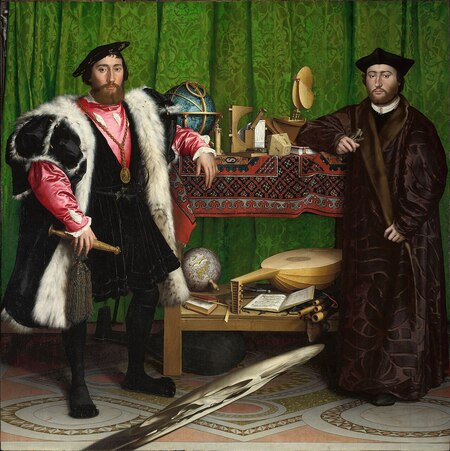
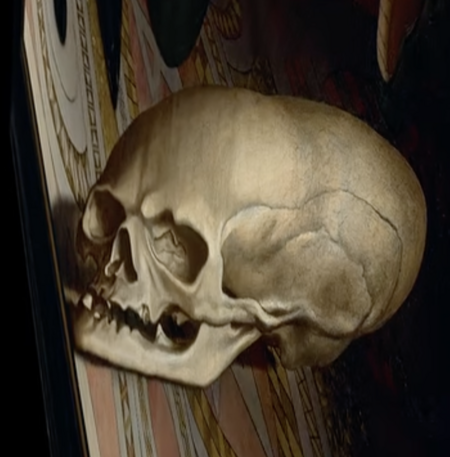
Hans Holbein the Younger, «The Ambassadors, ” 1533
In Hans Holbein the Younger’s painting, «The Ambassadors, ” the surrounding objects become one of the primary means of revealing the characters. The canvas depicts two French diplomats—Jean de Dantenville and Georges de Selve. These two men were involved in a complex and ultimately unsuccessful diplomatic mission to mend the rift between Henry VIII and the Roman Church, hence the title „The Ambassadors“ [6]. However, the viewer’s attention is drawn not only to the appearance and attire of the characters but also to the numerous objects arranged on the two-tiered shelf between them. The books, musical instruments, globes, and scientific apparatus do more than just complement the composition; they construct a unique narrative about the heroes' interests, education, and worldview.