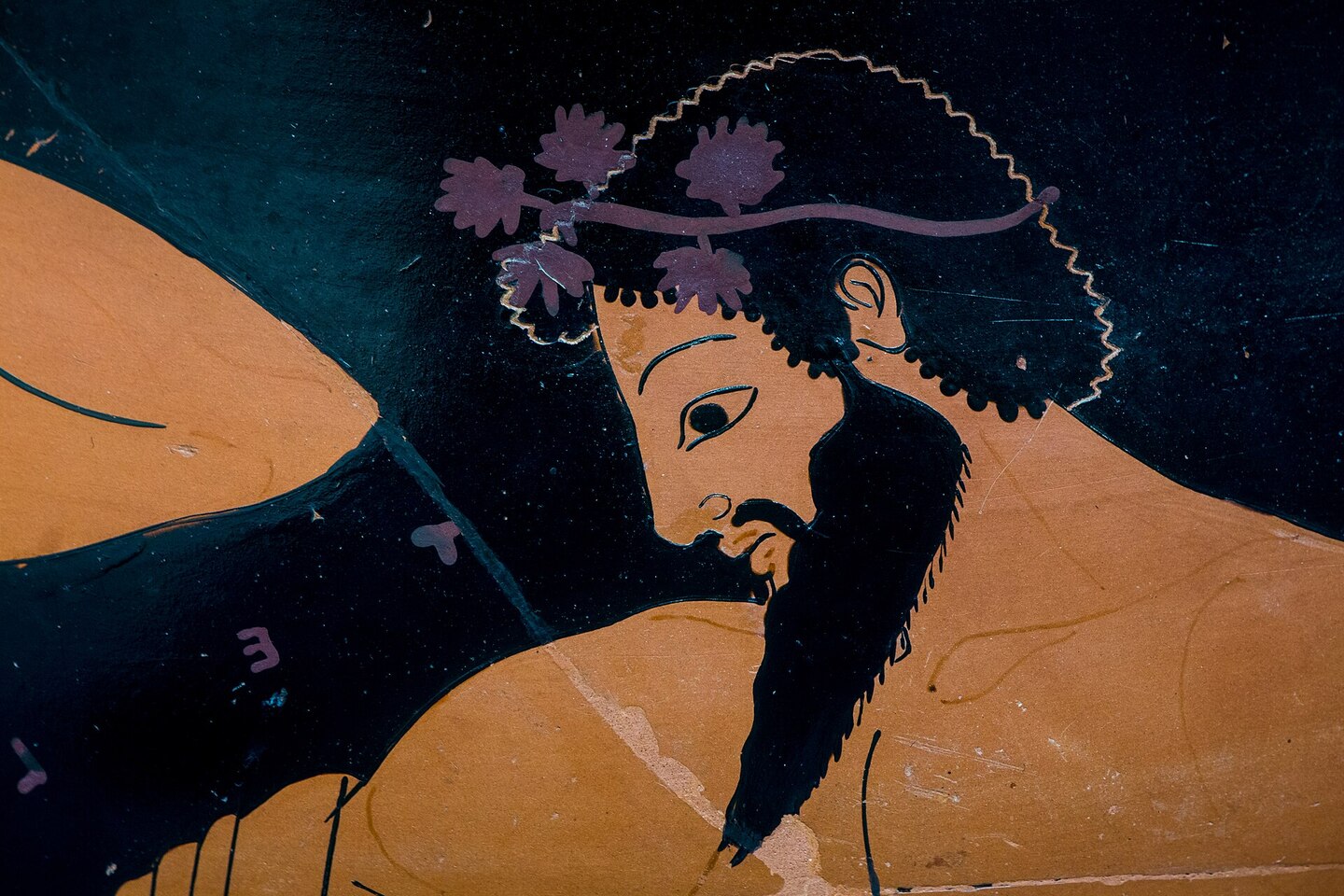
In 530 BCE, a revolution occurred in Athenian workshops. For centuries, vase painters had perfected the black-figure technique—dark silhouettes against a light clay background. Suddenly, they began to do the opposite: they covered the background with black slip, leaving the figures in the color of the fired clay. This gave rise to the red-figure technique, which nearly completely supplanted the former within one or two generations. Why did the masters abandon this refined language, and what did they gain in return—this is the main focus of this study.
How was the vase made?
The Attic vase was born from clay and «lacquer.» Lacquer is not a glaze, but an ultra-thin suspension of the same clay. The secret to the black and red colors lies in a three-stage firing process. Initially, the kiln operated with air access, and everything turned red. Next, the potter sealed off the air intake and tossed raw fuel into the furnace: in the smoky environment, the vessel darkened completely. In the third stage, air was reintroduced—the porous clay turned red again, while the fused, dense lacquer remained black.

Three-stage firing process for an Attic vase.
Black and red are not two paints, but one material in two states. The artist decided on only one thing: where the boundary between them would run.
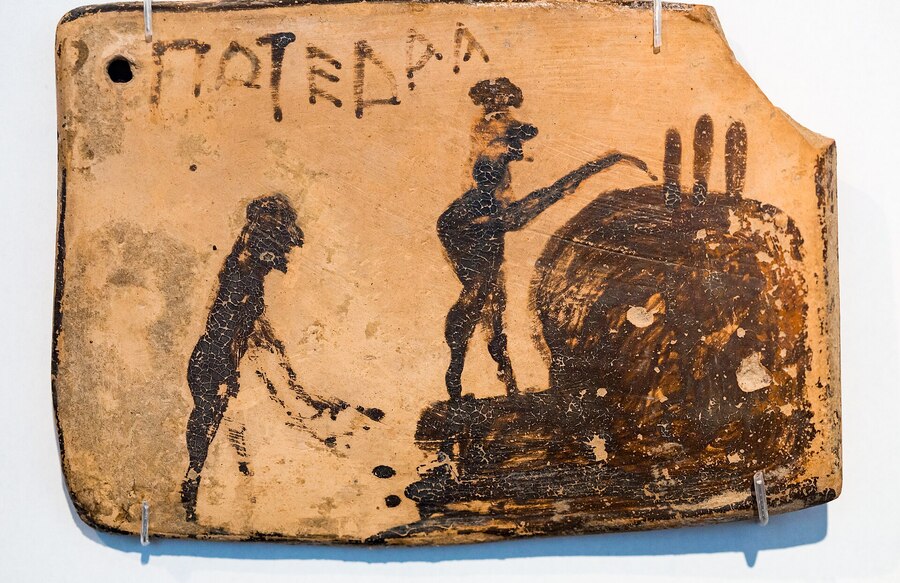
Corinthian Pinyakes: Potters by the Kiln. 6th Century BCE. Berlin, Antique Collection, F 608
We learn about craftsmanship not only through texts but also through the images themselves. Corinthian pinakes—terracotta dedication tablets from Poseidon’s sanctuary in Penthesicus—depict potters by the kiln: one feeds fuel into the fire while another peers into the viewing window. A flaw in the airflow could ruin the entire batch, so the masters requested divine patronage.
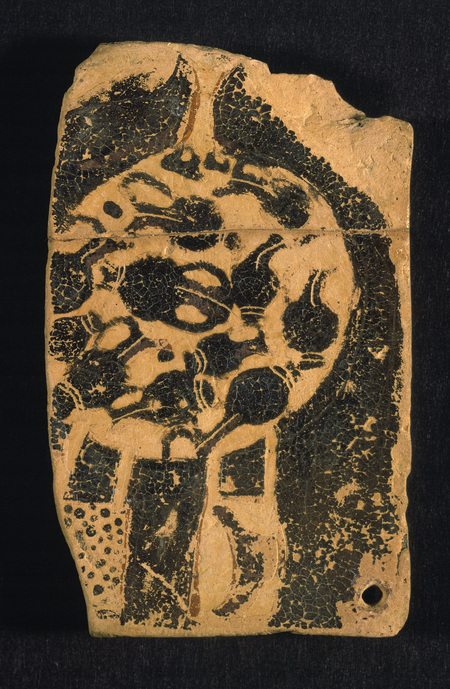
The pinaka from Penthesicus reveals a moment never seen on a finished vase—the moment of its birth. Inside the kiln, vessels are stacked in dense rows, one above the other, with the chamber’s vault growing darker above. Hundreds of such tablets have been found near Corinth: potters dedicated them to Poseidon, asking him to protect the kiln from cracks and fire. Interestingly, the pinaka itself is painted in black-figure technique: dark silhouettes on light clay—the very language that originated in such a kiln and which will be discussed in the first chapter.Pinaka from Penthesicus: Vessels inside the kiln. 6th century BCE. Berlin, Ancient Collection, F 893
Silhouette: The figure as a shape
In the black-figure technique, the figure is a silhouette. The artist fills it with glaze on a light clay background, and everything inside—eyes, hair, muscles, fabric patterns—is incised with a stylus down to the light clay. Purple and white paint are applied on top: white is usually used for women’s skin, and purple for beards, manes, and clothing details. The technique arrived in Athens from Corinth and became the dominant language of Attic vase painting by the middle of the 6th century BCE.
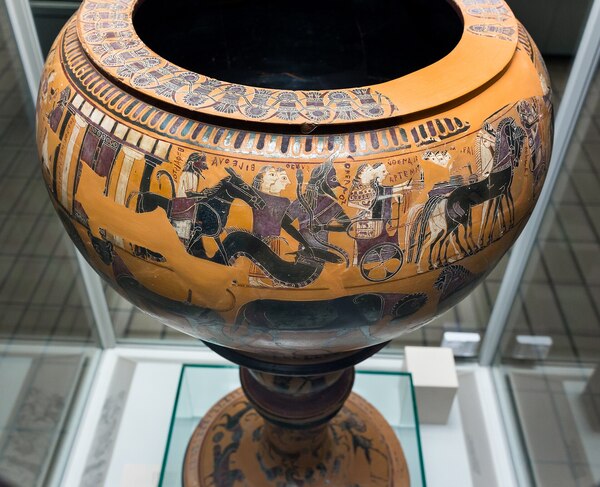
Sofilos. Dinus, «Wedding of Peleus and Thetis.» Circa 580 BCE. London, British Museum, 1971, 1101.1
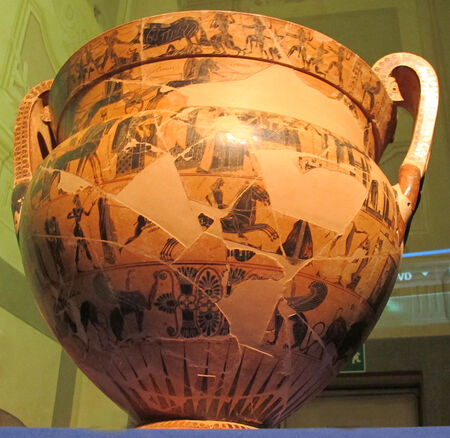
Clitius (painting), Ergothym (potter). Francois Vase. Circa 570 BCE. Florence, National Archaeological Museum, 4209
Early masters—Sophilos and Clytie—adorn the vessel with friezes, akin to ribbon ornamentation. The figures are small and numerous, read like lines of text. The silhouette here functions like a letter: recognizability is paramount, not volume.
Klitios. The François Vase: The Battle of Pygmies and Cranes (fragment). c. 570 BCE.
On the Vatican amphora, Achilles and Ajax leaned over a game board. Two dark figures are almost mirrored; their spears meet in a wedge toward the center, and the entire composition rests on the geometry of the spots. The scratched cloaks are covered in patterns finer than a hair—a burin yields a precision unattainable by a brush.
Exeky. Amphora «Achilles and Ajax Playing Dice.» 540–530 BCE. Vatican, Gregorian Etruscan Museum, 16757
Eksekii. Amphora «Achilles and Ajax Playing at Dice» (fragment): scratched pattern of cloaks
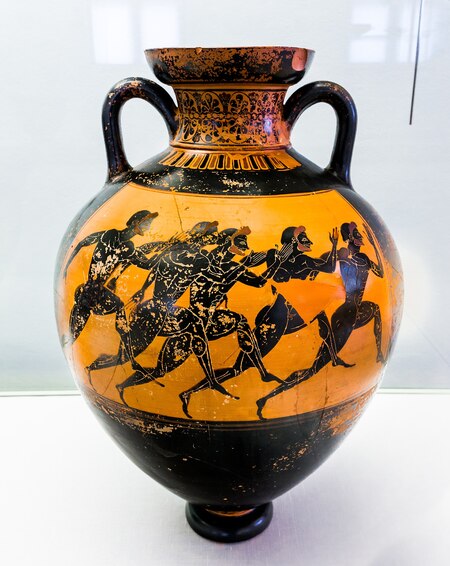
But this precision has its limit. A scratch line is always of uniform thickness; it cannot become softer, it cannot convey roundness. The form remains a flat sign—clear, beautiful, but static.
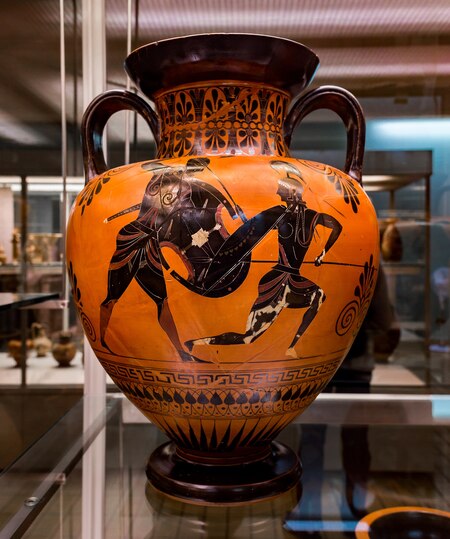
Exekias. Amphora of «Achilles Killing Penthesilea.» Circa 530 BCE. London, British Museum, 1849,0518.10
Master Euphtelus. Panathenaic amphora: Running. Circa 530 BCE. Munich, Staatliche Antikensammlungen, 1453
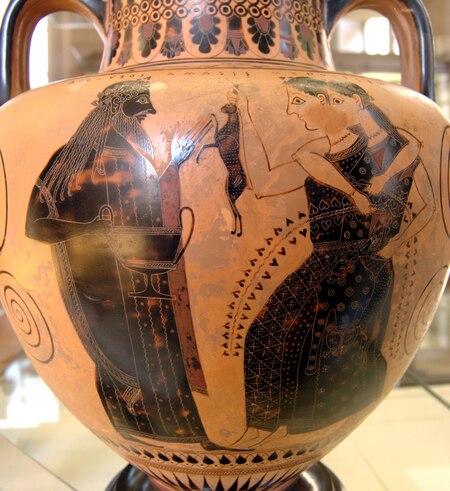
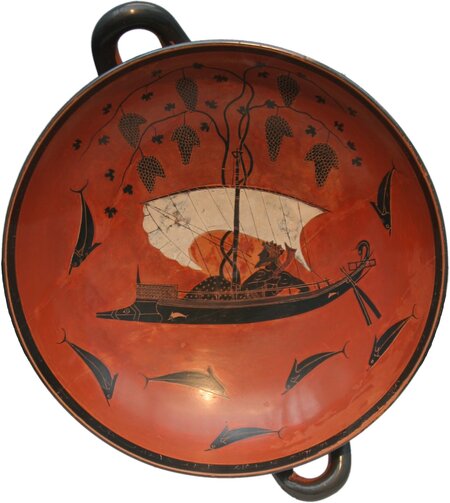
Exekias. Kylix «Dionysus in a Boat.» c. 530 BCE. Munich, Staatliche Antikensammlungen, 8729 (2044)
Master Amasis. Amphora «Dionysus and Maenads.» c. 540 BCE. Paris, Cabinet des Médailles, 222
Black-figure vase painting perfected the language of the spot. Its power lies in the contrast and clarity of the silhouette; its limit is the scratch that describes the body as a pattern, rather than a form.
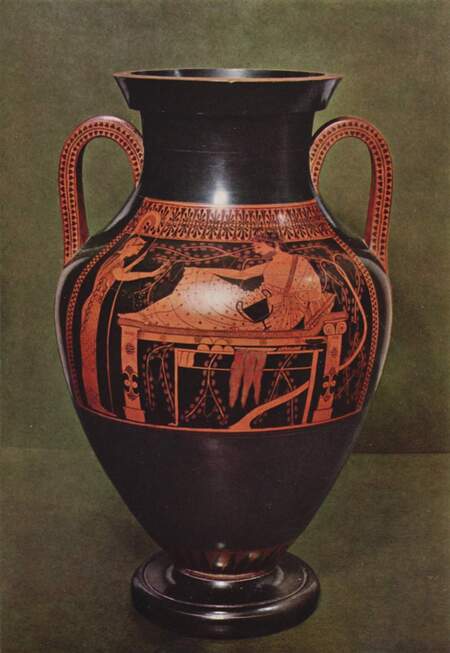
Around 530 BCE, a new technique emerged in the workshop of the potter Andokides: the background was covered with lacquer while the figures were left in the color of the clay. While we do not know the name of the inventor—he is conditionally known as the Master of Andokides, according to the potter’s signature—the most eloquent evidence of the transition from one technique to another is found in the bilingual amphorae. These bilingual vases feature one side rendered in black-figure and the other in red-figure.
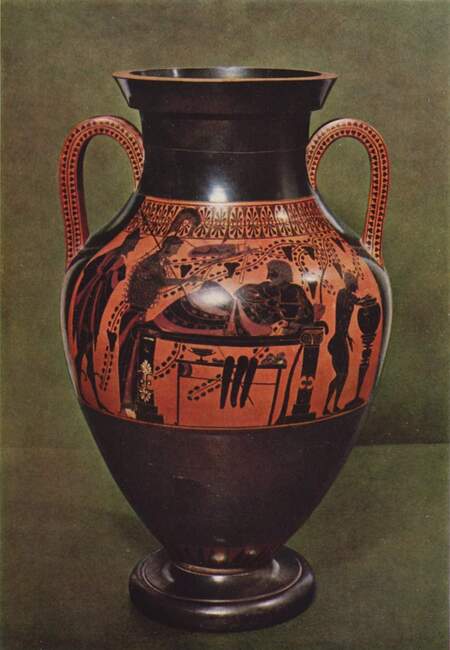
Lysippides Painter. Bilingue Amphora «Hercules at a Banquet, ” black-figure side. 520–510 BCE. Munich, 2301
Andokides Painter. The same amphora, red-figure side. 520–510 BCE. Munich, State Antiquities Collection, 2301
The Munich amphora — almost a laboratory experiment. On both sides, the subject is the same: Heracles reclining at a banquet, Athena before him. The composition and poses coincide; only the technique differs, and that is enough to change everything. The black Heracles is a dense silhouette into which a muscle diagram has been scratched. The red one is a light figure where the same muscles are rendered with a brush: the line thickens and then dissolves.
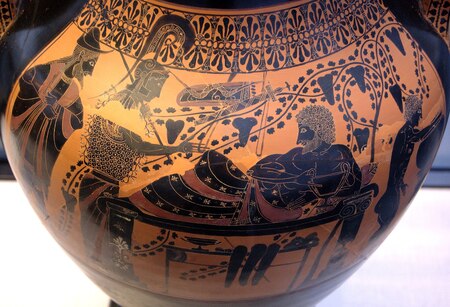
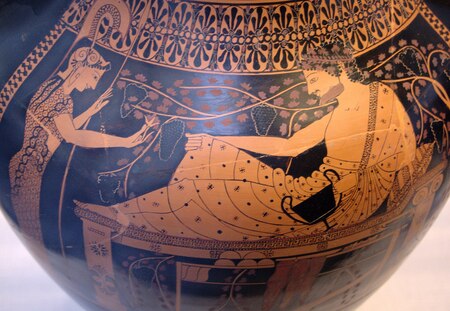
Amphora-bilingual 2301, black-figure side (fragment): Hercules and Athena
Amphora-bilingual 2301, red-figure side (fragment): Hercules and Athena
Many researchers attribute the black-figure sides to a specific artist—Master Lysippides; others believe that one person painted both sides. But the important thing is different: a single workshop that experiments with two techniques on one subject and displays the results side-by-side.
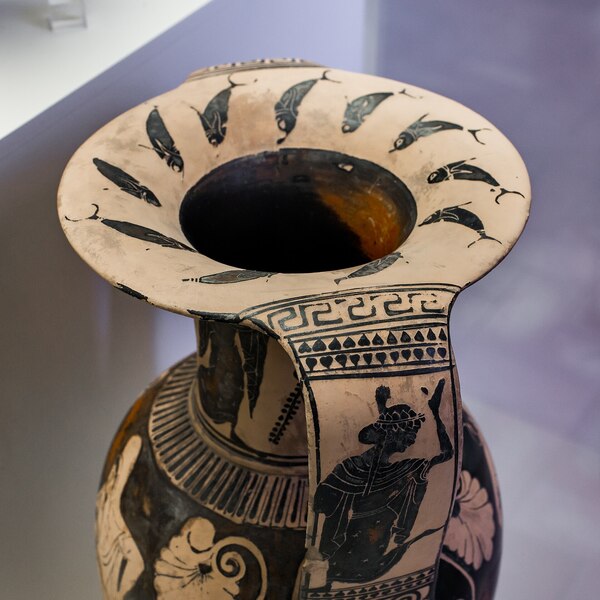
Bilinguality didn’t last long—about one generation. Masters tested what the new techniques could offer, but they weren’t yet ready to abandon the old ways. Bilingual designs began to appear on other forms, such as the neck amphorae from the potter Niksfen’s workshop.
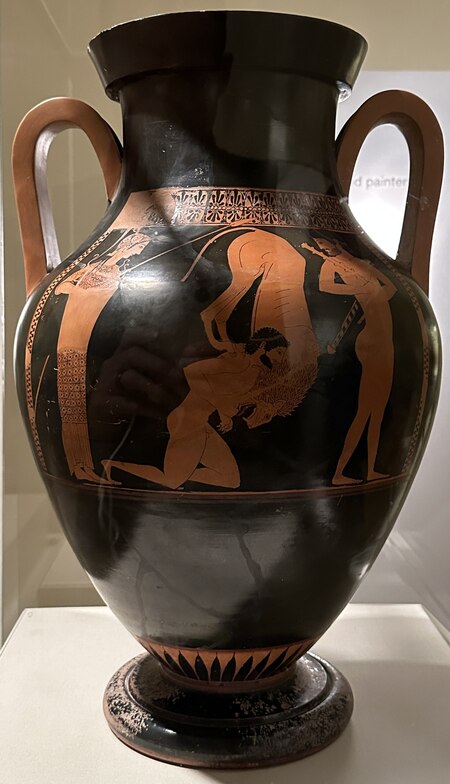
Amphora-bilingual: Hercules and the Nemean Lion, red-figure side. Circa 520 BCE. London, British Museum, 1839,1109.2 (B 193)
Workshop of Nikosphenus. Neck amphora-bilingual. Late 6th century BCE. Rome, National Etruscan Museum, Villa Giulia, 50560
The change in technique was a deliberate choice. The two sides of the vase argue that the point is not the subject matter or the composition, but how the body is described by the instrument.