Navigation
-Primitive Art
-Ancient India
-Mesopotamia
-Ancient Egypt
Concept
Throughout the history of art, there has always been one inseparable element. From the most ancient works known to us to most drawings today, the human body has predominantly been depicted in art. The appearance of the body can be noticed in different eras, throughout all time, by most artists.
Throughout human history, the worldview of society has rapidly changed—whether regarding views on individuals who deviate from the norm, on the origins of humanity, on the meaning of existence, or on life in general. In this context, I would like to examine the image of the human being and the attitude toward the human body across different eras.
Primitive Art
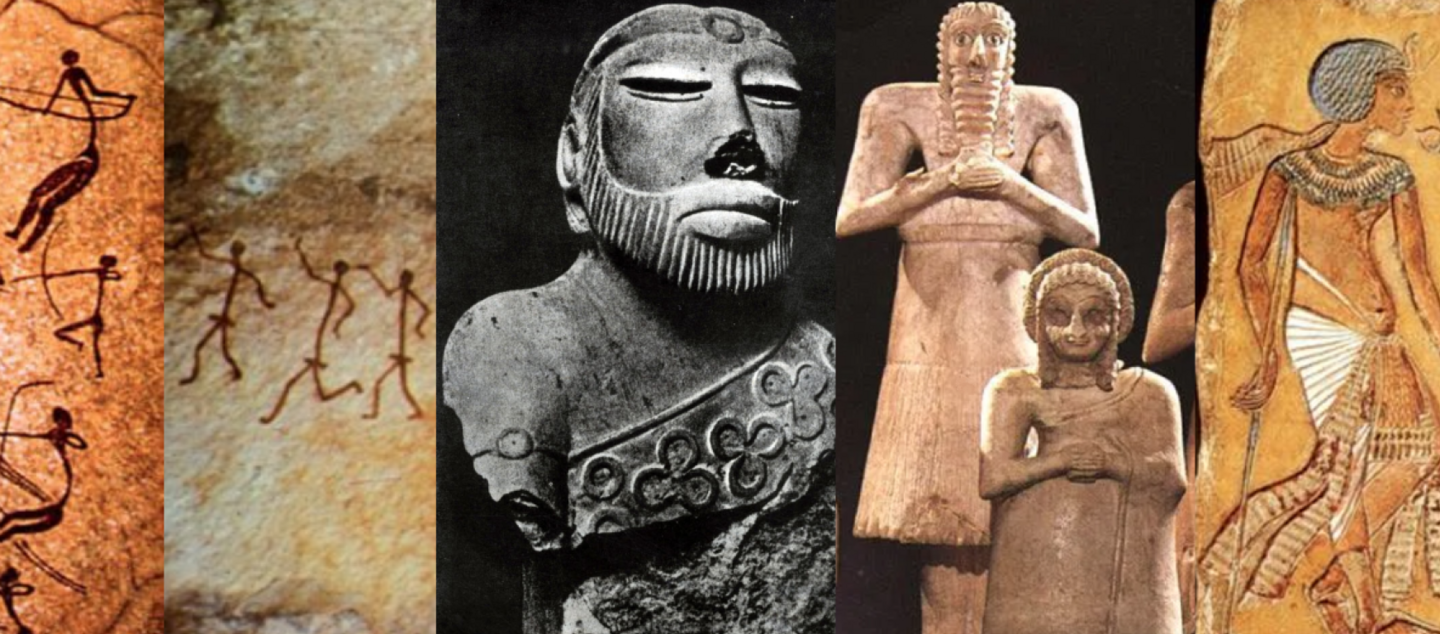
Primitive art was limited to silhouettes, and early figurative painting lacks specific detail. Despite this, the silhouettes effectively convey the narrative of what is happening.
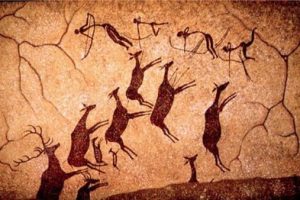
Primarily, humans in prehistoric art are depicted in the most simplistic manner, almost without detail. At that time, the overall picture was more important; everything else faded into the background, along with the human form. People were concerned only with the most superficial aspects.
Ancient India
In ancient India, one can observe a high degree of detail in everything, in contrast to primitive works—for instance, the Priest Figurine from Mohenjo-Daro.
The increased level of detail may be associated with the emergence of religion or cults. More time might have been dedicated to the works out of reverence for higher powers. Artworks unrelated to religion resemble prehistoric art. However, overall, the detailing of human bodies, and indeed all art, has improved. People began dedicating more time to their creations.
Mesopotamia
A fine example of the evolution of human representation is the Sumerian sculptures of adorants, or «prayers.» These figurines were placed in homes so that they would pray for the residents. The figures were rendered according to a canon, featuring folded hands and large ears.
It is worth noting the reliefs, which, again, focus more on narratives. Despite this, it is visible that more time is dedicated to people, especially those of high rank (kings), who are depicted higher than ordinary people.
More detailed intricacies can also be noticed on the standard from the tomb in Ur.