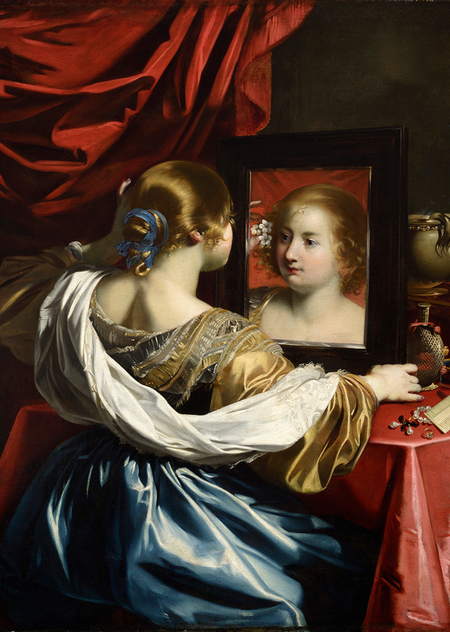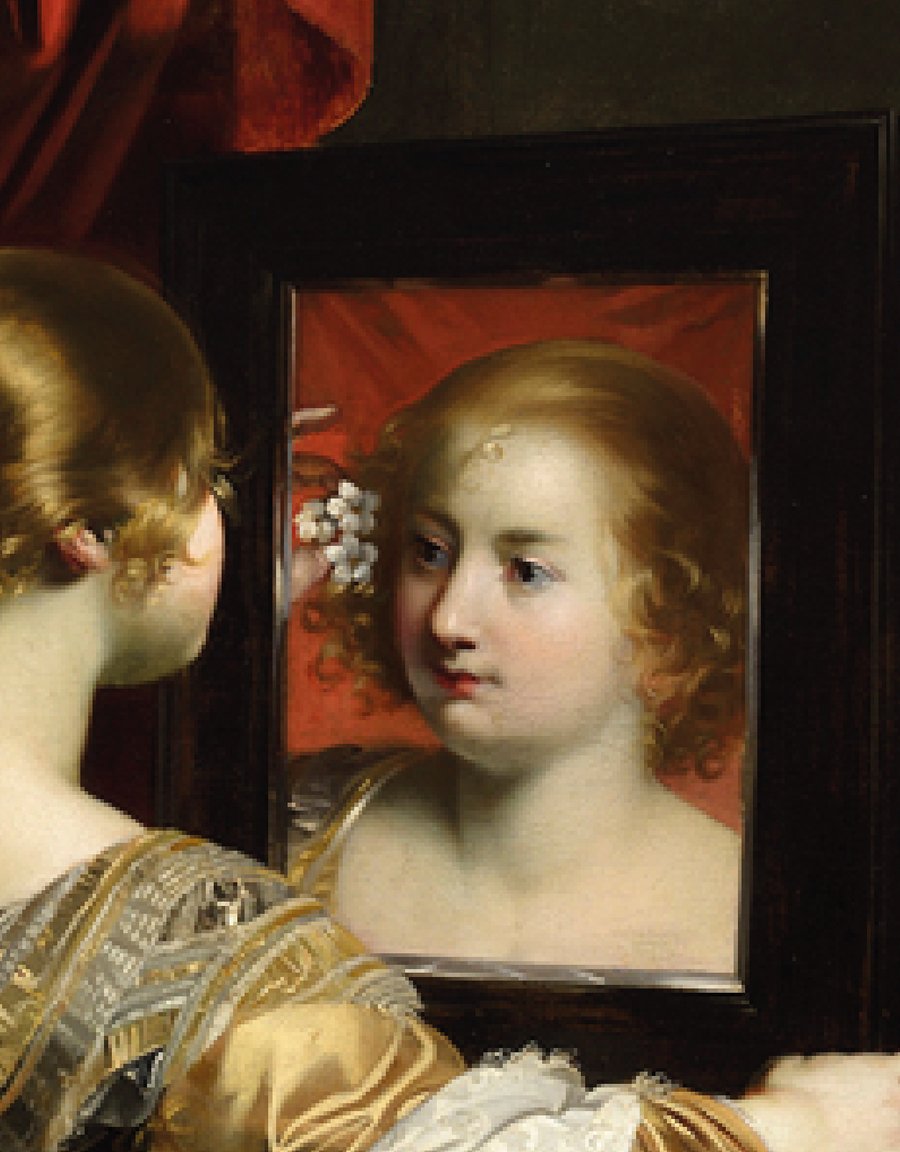
«Young people should look into the mirror more often: because what is reflected there is not so much a face as a soul…» [1]
I. Concept and Topic Selection
Objects designed for everyday use often come to signify more than their creators originally intended. Depending on the context, they may be perceived not merely as useful items, but as symbols and images. This is also true of the mirror. It reflects the world, but it does not reproduce it without alteration: the reflected space is inverted, confined by a frame, and separated from the familiar surroundings. The mirror is simultaneously connected to reality and distinct from it—which is precisely why it has become a source of countless interpretations and a significant element of allegorical language.
In painting, a mirror does more than just depict a reflection—it becomes an integral part of the artistic statement itself. Its properties can be used to construct the space of the painting, convey a character’s emotions, or establish multiple layers of meaning simultaneously. Therefore, it rarely functions merely as a decorative element; at times, the mirror expands the boundaries of the depicted world, and other times, it prompts the viewer to contemplate life and hidden meanings.
While working on the course materials, I noticed how ambiguously the mirror manifests itself in art. My interest in how its meaning has changed in painting led me to choose this topic.
Navigation Menu
I. Concept and Topic Selection
II. Historical Context
III. The Mirror—A Tool for Space Expansion
IV. The Mirror as an Embodiment of Vanity
V. The Mirror—A Symbol of Life’s Transience
VI. Conclusion
VII. Bibliography
II. Historical Context
In the 15th century, a strong interest in the accurate depiction of the surrounding world began to flourish in European painting. This is particularly evident in the Dutch painting tradition. Artists sought to convey the subtleties of light reflection on metal and glass, the texture of mirrored surfaces, the spatial depth of interiors, the finest details of objects, and optical effects that made the image convincing. It is important, however, not to forget that even within this meticulous realism, «hidden symbolism» was often present—many everyday details carried an additional meaning. But the interest in visual veracity—in how the real world appears—represented a genuine breakthrough.
The mirror acquires special significance because it allows the demonstration of the painter’s technical mastery while simultaneously expanding the composition’s space.
III. The Mirror — A Tool for Spatial Expansion
Perhaps the most striking example of using the mirror as a tool for expanding space in painting can be found in the work of Jan van Eyck.
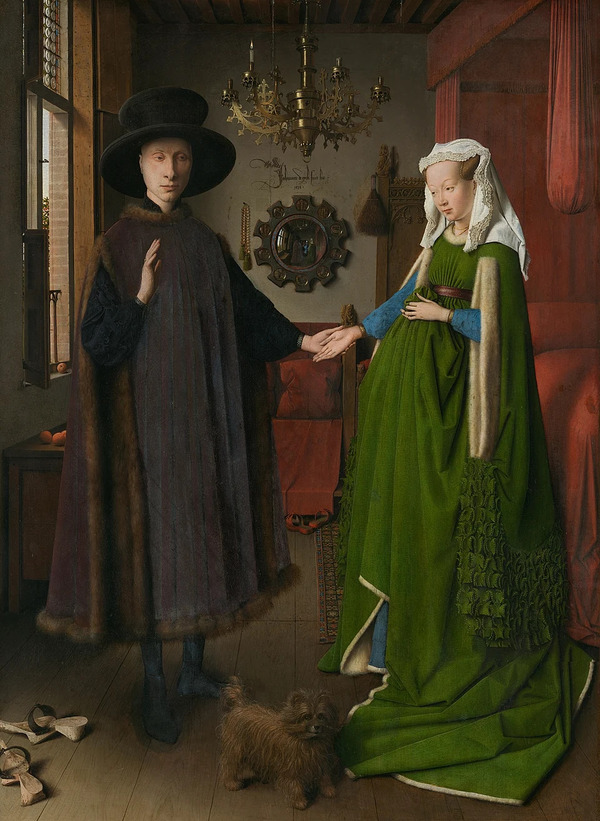
Jan van Eyck. «The Arnolfini Portrait, ” 1434. National Gallery, London.
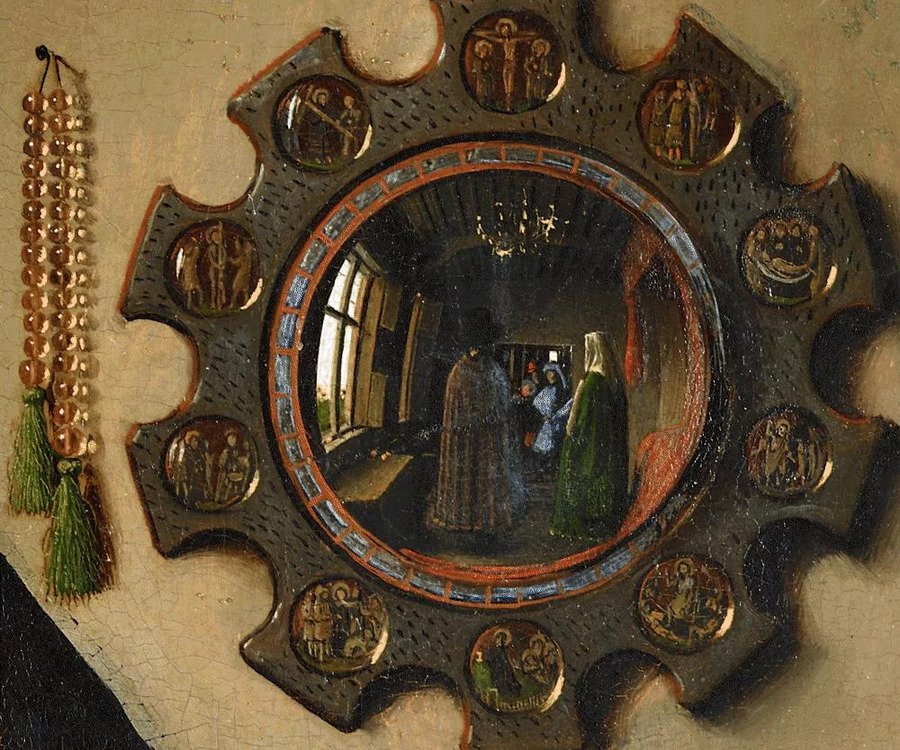
In the painting, the mirror is placed on the back wall of the room and occupies a relatively small area, yet its compositional significance is disproportionately large. It reflects: the backs of the main characters, the door, and the space behind them, as well as two additional figures near the room entrance.
The effect of the convex mirror is particularly interesting. It allows several areas of the room to be combined in a single reflection. The depicted space takes on a panoramic character.
The mirror seems to rupture the plane of the back wall—a second level of space is revealed behind it.
Jan van Eyck. Fragment from «The Arnolfini Portrait,» 1434. National Gallery, London.
Around the mirror are miniature depictions of the Scenes of the Passion of Christ. This adds a religious layer to the interpretation.
The mirror here can be interpreted simultaneously as: an optical instrument, a demonstration of craftsmanship, the boundary between the visible and the hidden, or a compositional center connecting various viewpoints.
It cannot be asserted that the reflected figures are precisely Jan van Eyck himself and his assistant, but this remains the most well-known interpretation.
Key takeaway: The mirror in «The Arnolfini Portrait» does not merely replicate the depicted reality. Instead, it reveals an additional space, suggesting that the viewer is only witnessing a segment of a larger event.
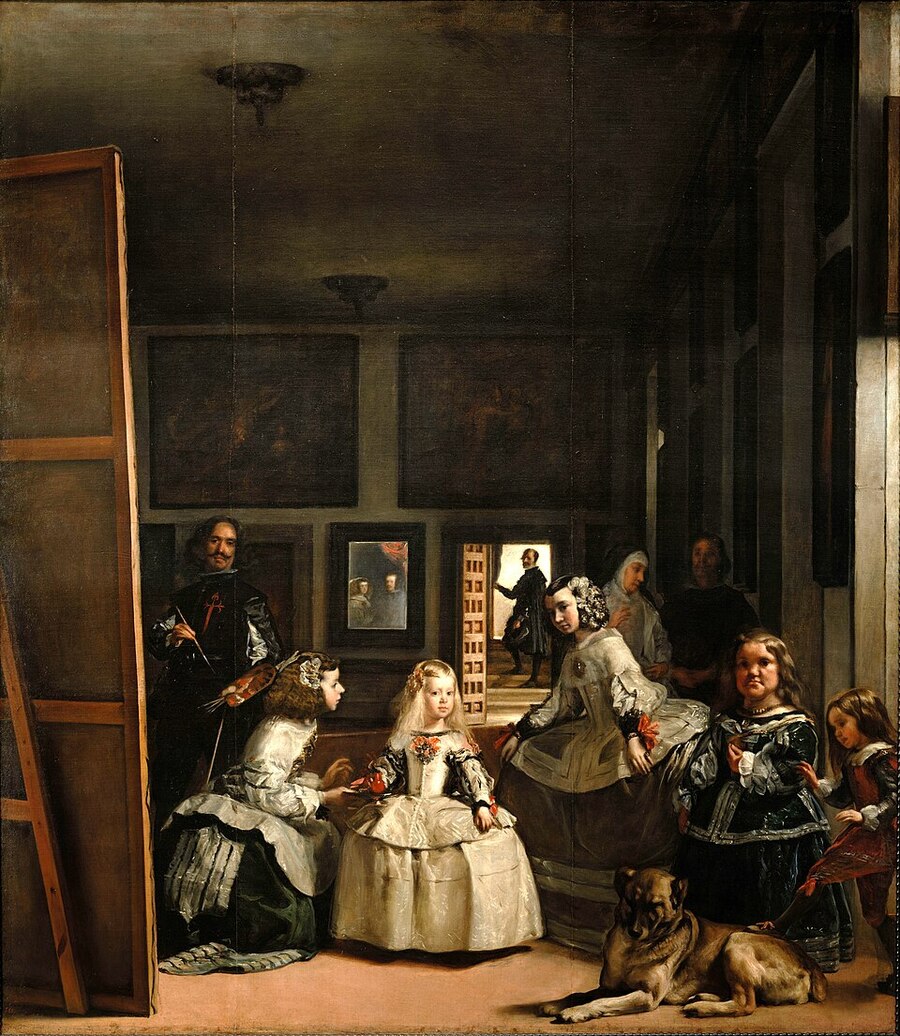
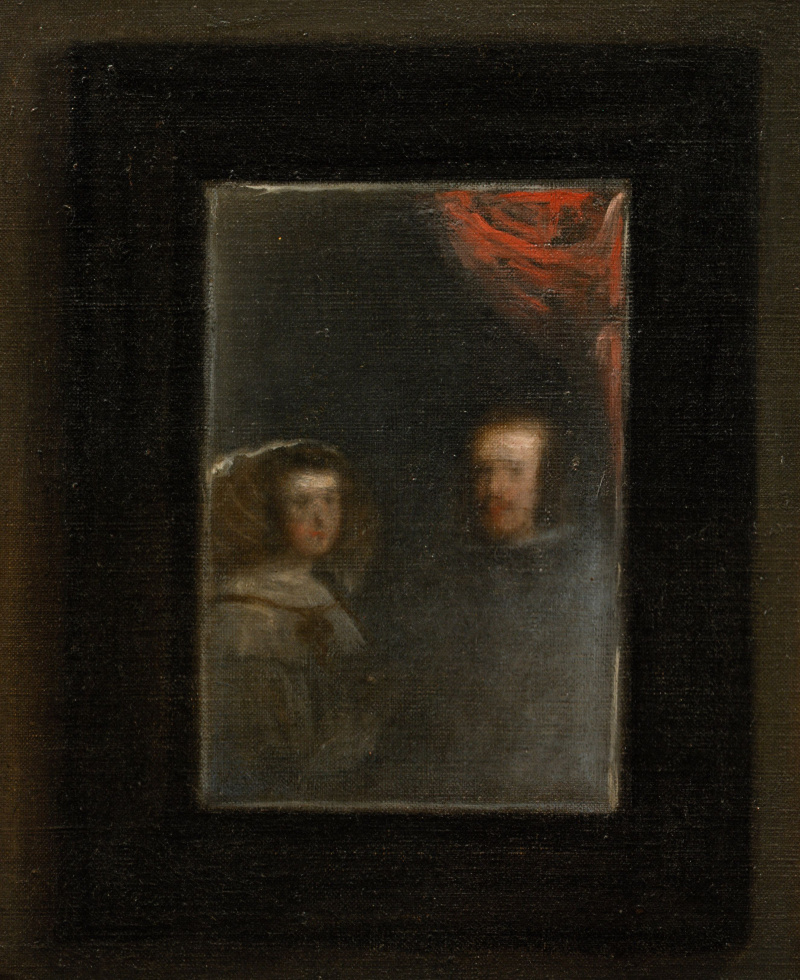
Diego Velázquez. «Las Meninas, ” 1656. Prado Museum, Madrid.
At the center of the composition of the painting «Las Meninas» is the infant Margarita Teresa, surrounded by court members. On the left, Velázquez himself is depicted working on a large canvas. On the back wall is a small mirror reflecting King Philip IV and Queen Mariana of Austria.
In Words and Things, Foucault [2] examines «Menippean» literature as a work where the customary relationship between observer and observed is disrupted. He notes that the mirror reflects characters existing outside the main image, and the gazes of other characters are directed toward the viewer. Foucault describes this effect through the image of «the enchantment of the double.»
Velázquez creates a situation in which the viewer cannot remain a neutral observer. Instead, they become integrated into the system of relationships within the painting. The viewer’s position gains significance, even though they are not physically depicted.
The mirror becomes a sort of portal, linking the space of the painting to the space in front of it.
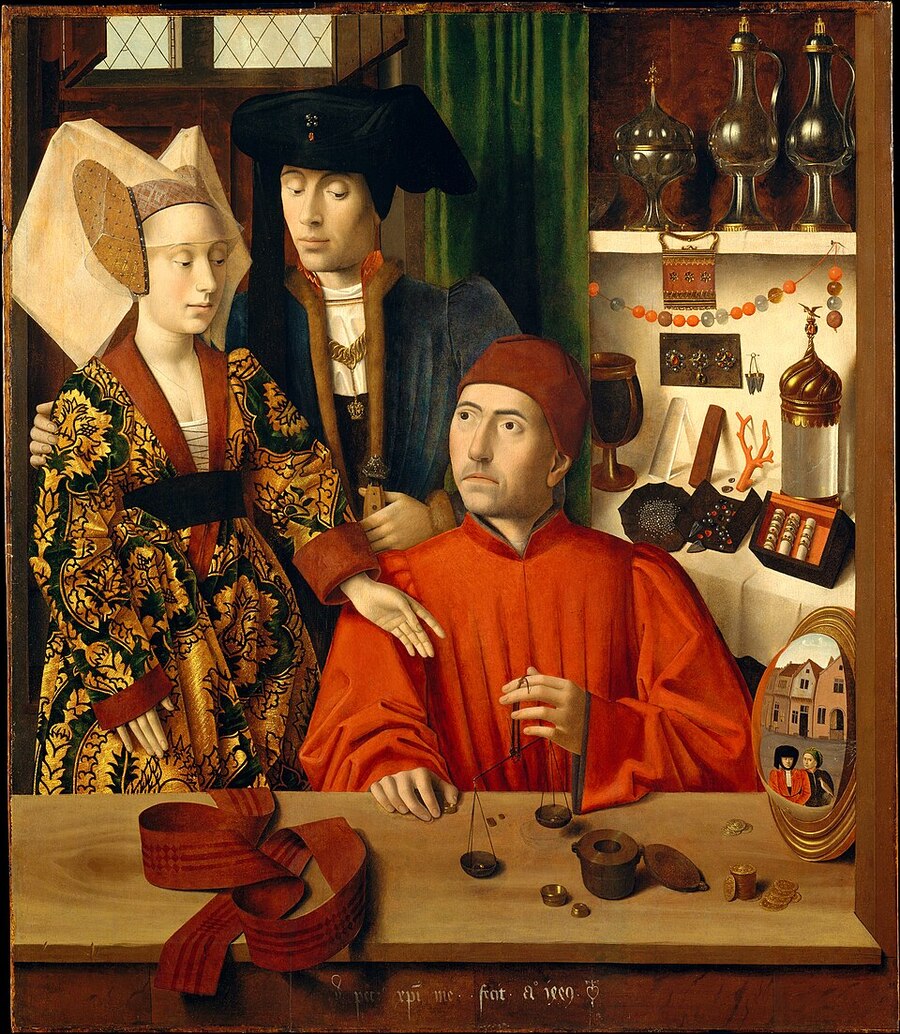
Petrus Christus. «Saint Eligius in His Workshop» / «Goldsmith in His Shop, ” 1449. Metropolitan Museum of Art, New York.
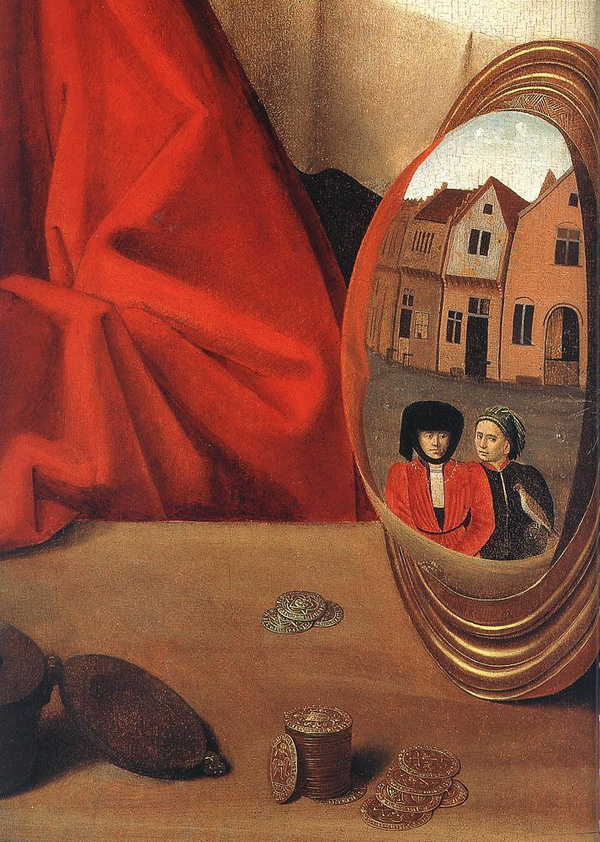
Sometimes a mirror does what seems impossible for something contained within an interior to do—it shows the outside world. The painting «Saint Eligius in the Workshop» is interesting because the mirror is used differently than in works by Jan van Eyck or Diego Velázquez.
In the foreground, a jeweler and a couple of customers are depicted. Within the reflective surface, an additional fragment of the surrounding world can be discerned.
Here, the mirror does more than simply expand the interior; it establishes a visual link between the depicted scene and what is happening outside the room. Instead of one isolated episode, the viewer gains a sense of a broader urban environment.
IV. The Mirror as an Embodiment of Vanity
Mirror and vanity—perhaps the most enduring pairing in the history of painting. After all, the mirror often becomes a source of self-admiration.