Vittorio Carapacci: The Dream of St. Ursula
Concept
A dream cannot be observed directly from an outside perspective. A viewer can see the sleeping person, but they cannot see the content of the dream. This presents a unique challenge for the artist: how to depict an invisible event through painting without reducing it to a mundane action occurring before the character’s eyes? In Western European religious painting of the 15th–17th centuries, this question becomes particularly evident in scenes of visionary dreams. An angel, a cross, a ladder to heaven, or some other sign appears near a character who remains physically asleep.
The research theme is «Making the Invisible Visible: The Boundary Between Dream and Reality in Western European Painting of the 15th–17th Centuries.» The object of study is religious dream scenes in Western European painting from this period; the subject is the compositional, spatial, and lighting techniques by which the dream becomes discernible to the viewer. This specifically concerns dreams linked to the posture of the sleeping body, not all mystical visions in general. Plots without a sleeping character are included only when there is an obvious comparative necessity.
Main research question: What visual means do artists employ to simultaneously depict the everyday world of the sleeping person and the supernatural content of their dream? Additional questions allow for a more nuanced answer. How does the viewer recognize a state of sleep? How is a messenger or sign that does not belong to the familiar world denoted? Finally, must the artist make the dream explicit, or is a nearly imperceptible hint sometimes enough? A preliminary hypothesis suggests that Western European painting of the 15th–17th centuries does not develop a singular image of the «dream world.» Instead, artists use several interchangeable methods to make the internal event visible: they introduce an angel into the general scene, connect figures through gesture, organize the threshold between the interior and exterior space, highlight a source of unusual light, or attenuate the materiality of the vision itself. In all these cases, the depiction of the sleeping body remains the most crucial anchor, allowing the viewer to understand that one of the depicted realities is not a universally accessible experience.
Materials and Selection
The visual array features paintings by Master Osservanz, Piero della Francesca, Vittore Carpaccio, Paolo Veronese, Philippe de Champaigne, Giuseppe de Ribera, and Francesco Solimena. Their dating, titles, and attribution have been verified against the museum catalogs of the Louvre, the National Gallery in London, the Vatican Museums, and official works catalogs. Several works depicting the same subject are intentionally included to showcase varied approaches to representing dreams. We examine only those elements that are clearly discernible in the image.
Husepe de Ribera: The Sleep of Jacob
Method and Principle of Rubrication
The research moves from observation to interpretation. First, I analyze how the sleeping body is depicted and why the viewer perceives its state as sleep. Next, I examine how the artist makes the messenger or the content of the revelation visible. The third section is dedicated to the boundary between two worlds: light, doorway, landscape, and the relationship between visible spaces. In the fourth section, these decisions are compared across works by different masters, including several scenes from Joseph’s dream and two versions of Helen’s dream.
Navigation
I. The Sleeping Body // How to Recognize Dreams. II. Phenomenon // How to Depict the Invisible. III. Boundary // Light and Space. IV. Comparison // Why Identical Subjects Look Different. V. Conclusion and Bibliography
CHAPTER I. THE SLEEPING BODY
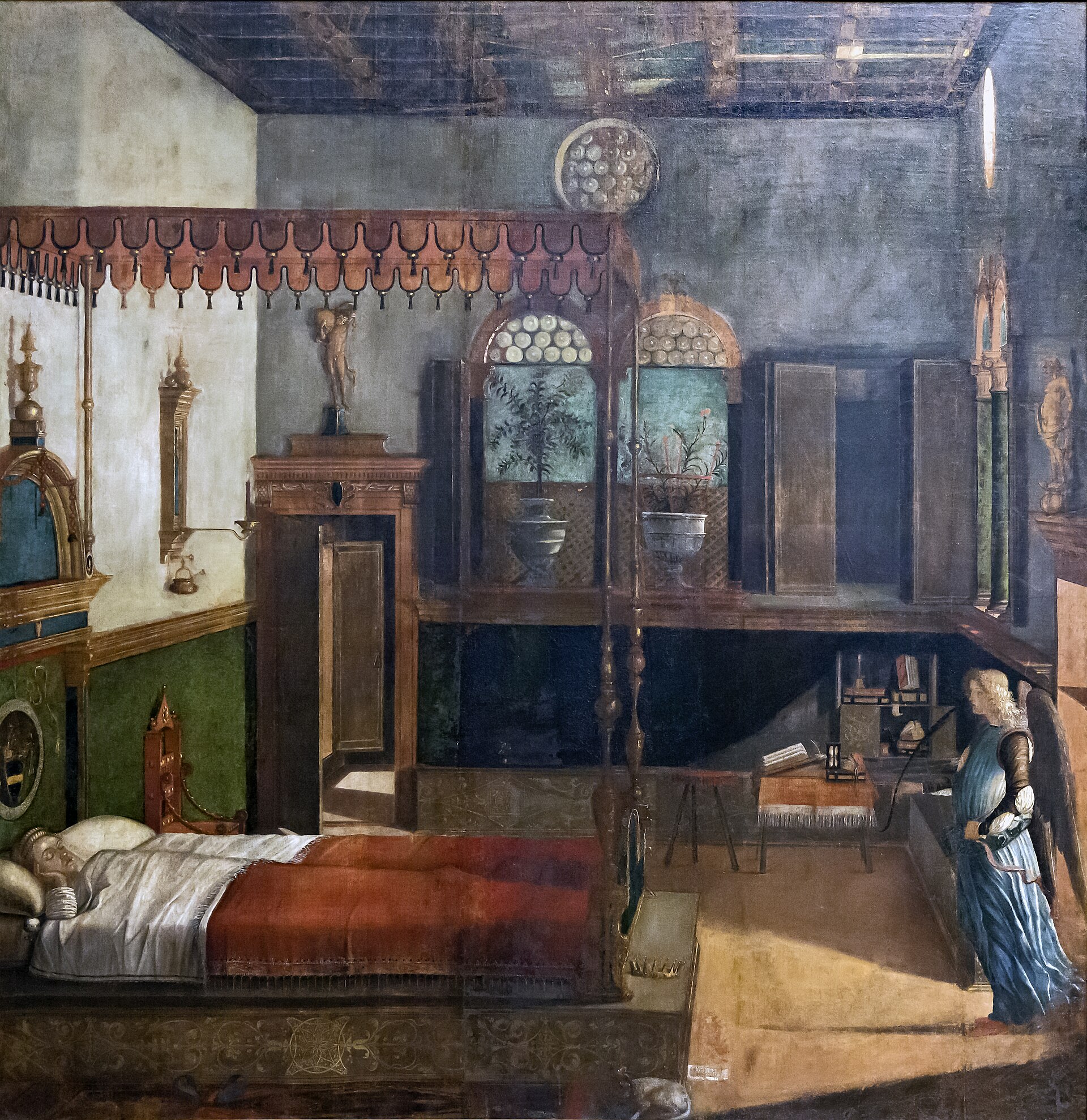
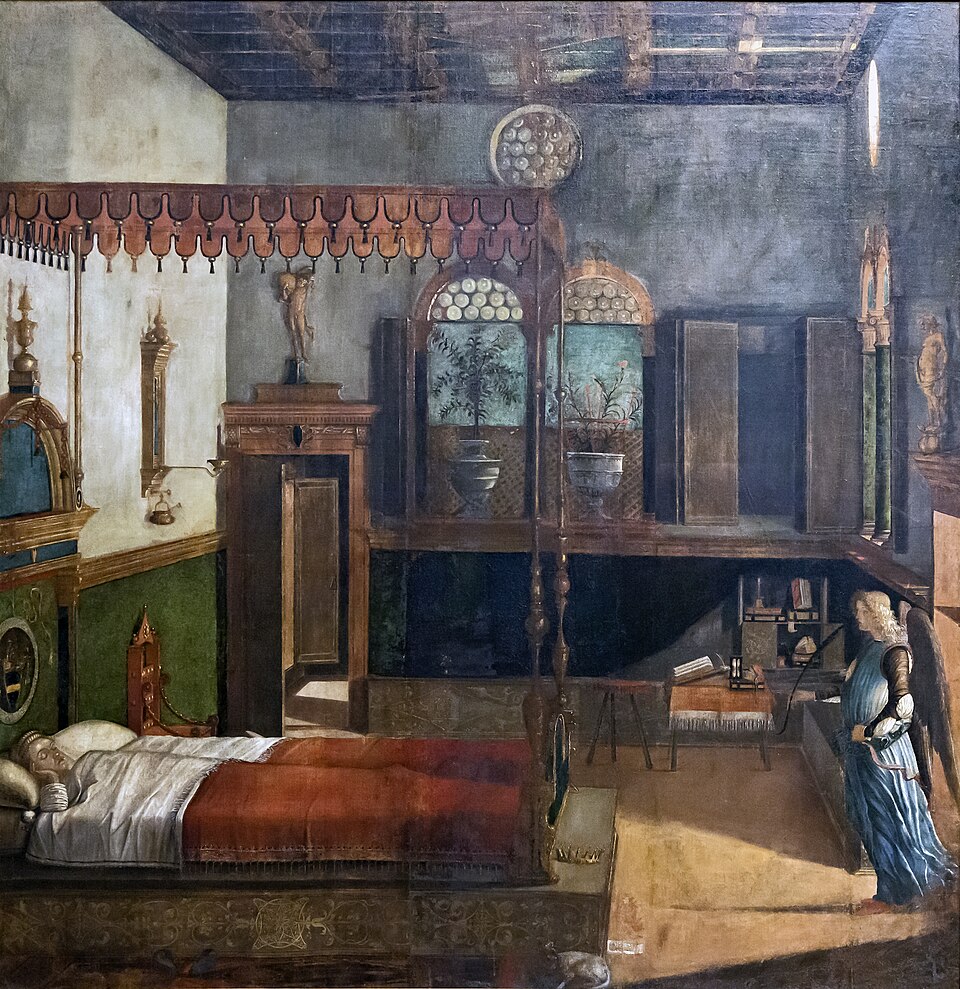
Vittore Carpaccio, «The Dream of Saint Ursula, ” 1495. Gallerie dell’Accademia, Venice
The first visual sign of a dream is not an angel, but a body that does not respond to what is happening.
Carpaccio places the sleeping figure in a recognizable room filled with everyday objects. Ursula’s closed eyes and stillness contrast with the presence of the entering angel. The room’s objects continue their ordinary lives, but the heroine does not react to the messenger’s appearance.
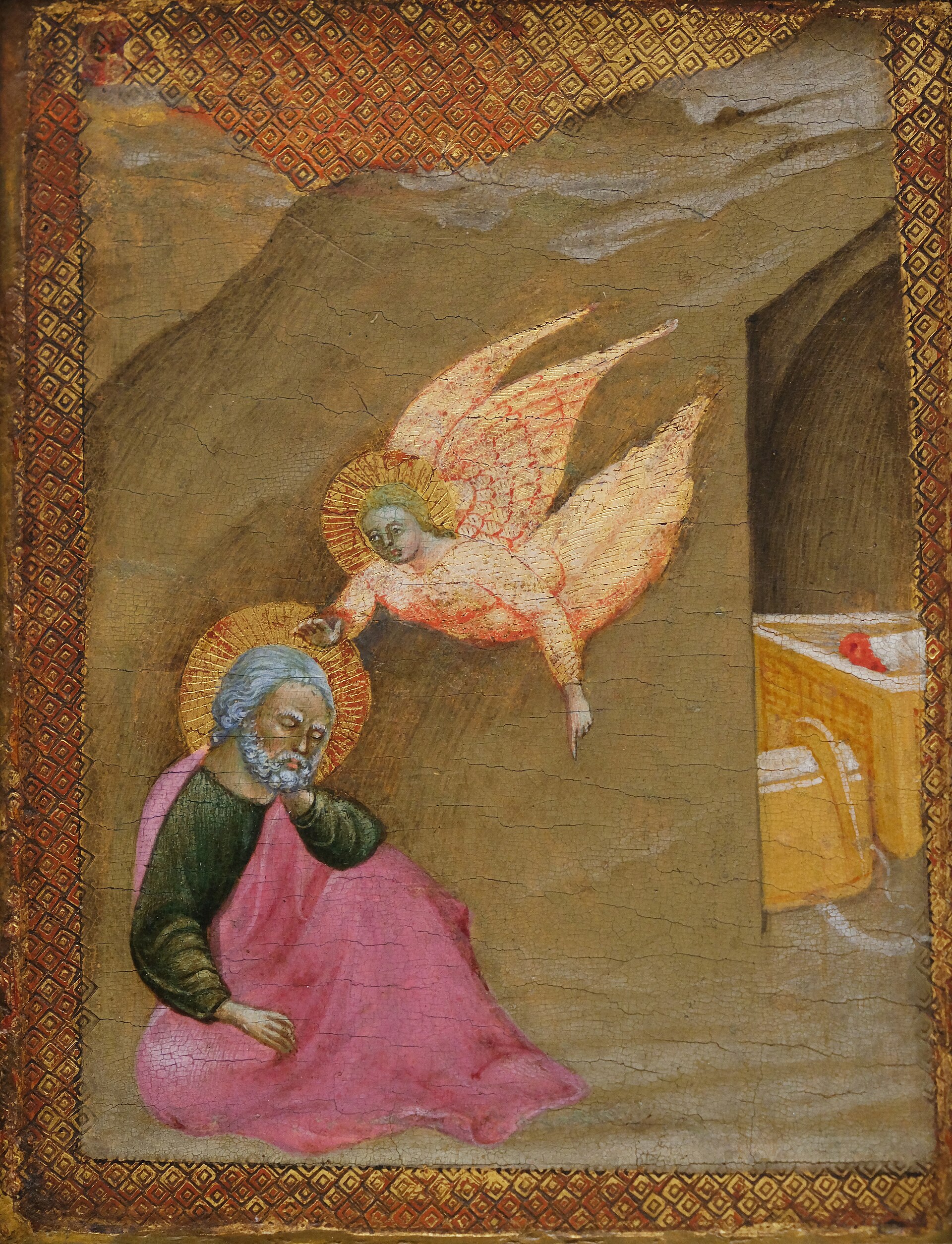
Master Ossenwand, «The Dream of Saint Joseph, ” c. 1430–1440. Louvre, Paris
Joseph is shown in repose; his posture renders the angel’s appearance an event belonging to a dream. The bent figure and lowered head separate the sleeper from the active heavenly messenger.
Paolo Veronese, «The Feast in the House of Levi,» c. 1570. National Gallery, London
Veronese depicts the sleep of a seated woman: her state is conveyed by the weight of her head resting on her arm. The sleep does not require a traditional bed; through the positioning of her head and closed eyes, the artist conveys the loss of wakefulness. The hand supporting her head is a motif repeated across works from different centuries. It signifies relaxation while simultaneously keeping the figure in a discernible, almost portrait-like pose.
Husepe de Ribera, «The Dream of Jacob, ” 1639. Museo del Prado, Madrid
In Ribera’s work, the material, heavy body of the sleeping figure takes center stage, while the content of the dream recedes into the background. Jakob’s large figure is contrasted with a barely discernible celestial event.
Three positions of sleep: lying down, sitting, and on the ground. Sleep in art is recognized by the body’s posture.
CHAPTER II. PHENOMENON
Philippe de Champaigne, «The Dream of Saint Joseph,» 1642–1643. National Gallery, London
How to make visible what only exists in a character’s dream?
Master Ossenwein, «Dream of St. Joseph, ” c. 1430–1440. The Louvre, Paris
In Siena’s «The Nativity of St. Joseph,» the angel is very close to the sleeper, though it belongs to a different plane of existence. What is important is not merely its recognizable winged figure, but also its directionality—it is approaching a specific individual.
The wings, the body’s tilt, and the gesture directed toward Joseph establish the trajectory from the angel to the sleeper. The content of the dream is not contained by a frame; the two figures are connected by a compositional action that is understood by the viewer regardless of the legend’s text.