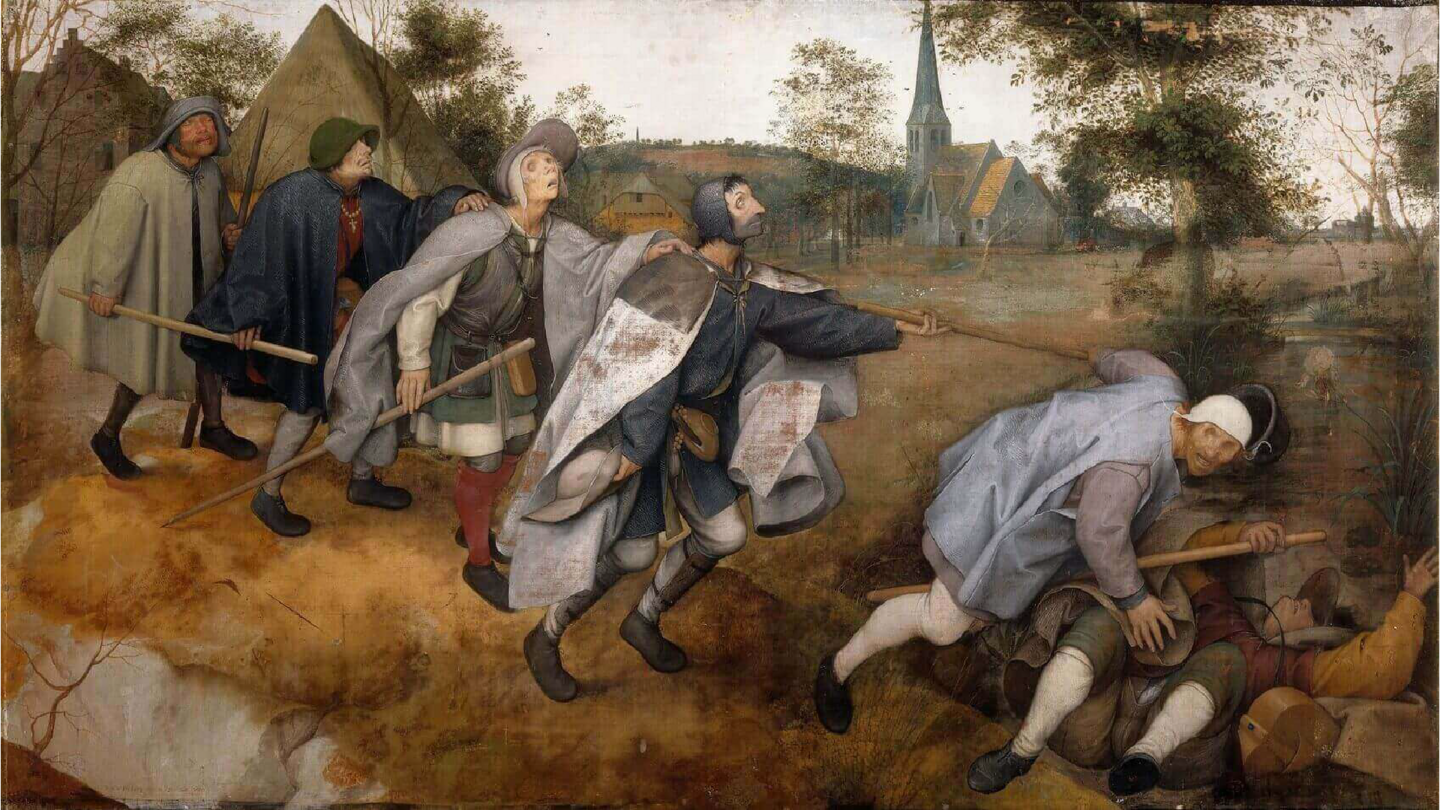
They had an eye for their suffering…
Concept
Pieter Bruegel the Elder (1525–1569) was a Netherlandish painter and draftsman of the 16th century. He was highly sought after, collaborated with a major publishing house, achieved the status of a master of the St. Luke’s Guild, and later worked on drawings intended for reproduction in engravings by Hieronymus Cock.[2] Art historian Jacob Wisse notes that Bruegel did not merely reference traditional subjects but also strived to present them in an original manner. His work contains numerous mythological and religious scenes, as well as depictions of various aspects of everyday life. The artist’s keen observation allowed him to assemble numerous figures and related events onto a single canvas.As I study Bruegel’s work, I will often discuss the multi-layered nature, the complexity of the figures, and the merging of multiple narrative threads. We will examine how the composition and the painting’s color influence the perception of the subject, creating a sense of anxiety, threat, or human helplessness.
I chose this topic because I was interested in the techniques and symbols the artist uses to make the viewer experience, empathize with, or at least feel affected by the characters. In Bruegel’s works, the human figure is often part of serious events whose power surpasses human capacity or which result in dreadful consequences for humanity. These experiences and sufferings are revealed through both central and secondary characters, the latter of whom the viewer might notice only upon careful inspection of the painting.The main research question is: How does Pieter Bruegel the Elder use narrative and artistic devices to convey human fear, suffering, and helplessness in the face of threat? The research hypothesis is that the sense of threat in the artist’s works is created not only by the plot of the depicted events but also by the meticulous rendering of details, composition, and the interplay of colors.The multitude of figures, the multi-layered nature of the composition, the scale of the space, the accumulation of small elements, the direction of the characters' movement, and the color contrasts are capable of intensifying anxiety, emphasizing human helplessness, or illustrating how insignificant personal suffering can appear against the backdrop of other dreadful actions.

Pieter Bruegel the Elder, «The Fall of the Rebel Angels, ” 1562; „Mad Greta, ” 1563; „Triumph of Death, ” 1562–1563; „Suicide of Saul, ” 1562; „Bearing the Cross, ” 1564; „The Beating of the Infants, ” 1565–1567; „Parable of the Blind, ” 1568; „The Fall of Icarus, ” c. 1558.
Eight works by Pieter Bruegel the Elder were selected for this study. The designated theme is explored through a variety of narratives: confrontation with supernatural forces, violence and death, and powerlessness in the face of danger. During the selection process, I considered not only the plot and history of the paintings but also the specific artistic techniques used to create a powerful emotional impact on the viewer. Thus, the works are united by a common theme but are revealed from different angles through diverse methods. At first glance, some paintings will differ greatly, yet they will reveal similarities during analysis.
The analysis of these works is built upon a sequential examination of the overarching narrative, significant details, and artistic methodologies employed. Some pieces were viewed using a black-and-white filter to better observe the contrasts in shading and highlight vivid fragments. Special attention is paid to the interaction between figures and the details that can alter the perception of the scene upon prolonged viewing. This approach allows the work to be perceived simultaneously as a story of a specific biblical, mythological, or other event, and as an entire system that shapes a particular impression in the viewer.
Textual sources are chosen based on their accessibility, relevance, and the reliability of the information. The foundation consists of museum materials and scholarly publications dedicated to Bruegel’s work, the stories behind the paintings, and their artistic characteristics. However, the core of the visual research will be the independent analysis of the works, with textual sources serving to substantiate observations and distinguish verified information from my personal interpretations.
Overall, this research aims to find a connection between the content of Pieter Bruegel the Elder’s works and their visuals. By comparing the paintings, it will be possible to understand how various artistic devices convey fear, suffering, and helplessness, and how the image of an individual relates to the scale of the depicted events.
Navigator
— Concept
— Fear of destruction and the supernatural
— Suffering in the face of violence and death
— Human helplessness
— Conclusion
— Bibliography
— Image Sources
This categorization allows one not only to understand the content of specific events but also to more clearly see the ways certain emotions are conveyed. Furthermore, comparing the images within each theme helps trace common visual techniques and note certain differences.
Fear of destruction and the supernatural
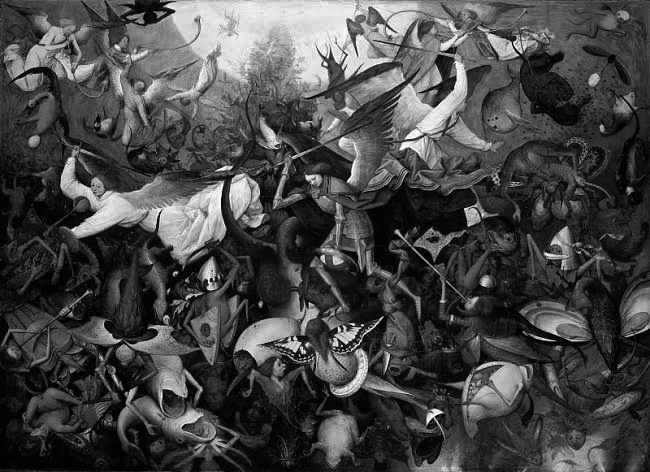
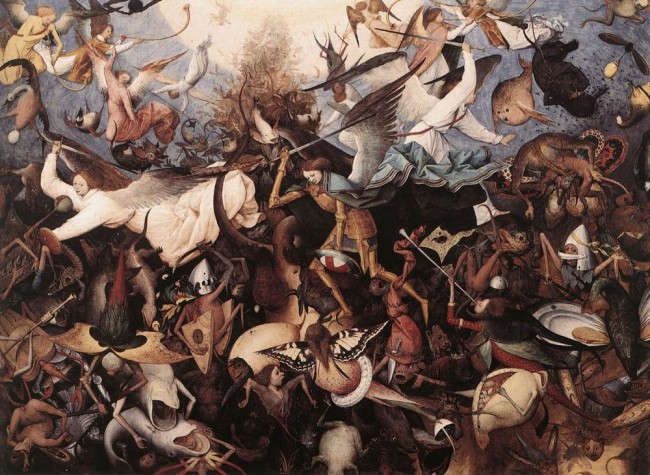
Pieter Bruegel the Elder, «The Fall of the Rebel Angels,» 1562.
In this painting, Bruegel references the biblical narrative of the struggle between heavenly forces and evil, specifically the expulsion of rebellious angels. The artist depicts the moment of confrontation. At the center stands an archangel battling a monster. Around him, the rebellious angels fall and transform into demonic creatures. This creates an image of an entire world consumed by the collision of two opposing forces. The familiar order is replaced by turmoil and horror.
Details. Pieter Bruegel the Elder, «The Fall of the Rebel Angels, ” 1562.
When examining Bruegel’s works, one should pay close attention to the details. In this piece, chaos is created through the detailed depiction of fallen angels who are gradually losing their recognizable forms and taking on features of fish, insects, and birds. Some of the creatures are difficult to identify because they intermingle with other figures. The description of the painting, published by the Royal Museums of Fine Arts of Belgium, provides a rather precise characterization, noting a «seemingly inseparable mixture of figures and forms.» [3] Amidst all the disorder, the archangel stands out, though not overwhelmingly. He wears golden armor, his wings are spread wide, and his posture is relatively calm and discernible. Other depicted objects do not obscure him.
Fragment. Pieter Bruegel the Elder, «The Fall of the Rebel Angels, ” 1562.
The pictorial space is conceptually divided horizontally: the upper section connects with the heavens and is rendered in light, delicate hues, while the lower section is dark and saturated. This color contrast reflects the transition from a tranquil, divine world to terror and chaos.However, it is the movement of the figures that intensifies the discord. Their limbs merge to form a unified mass that simply collapses downward. With such a dense filling of the space, Bruegel represents evil as a force that disrupts peace, creating an inescapable, pervasive chaos.
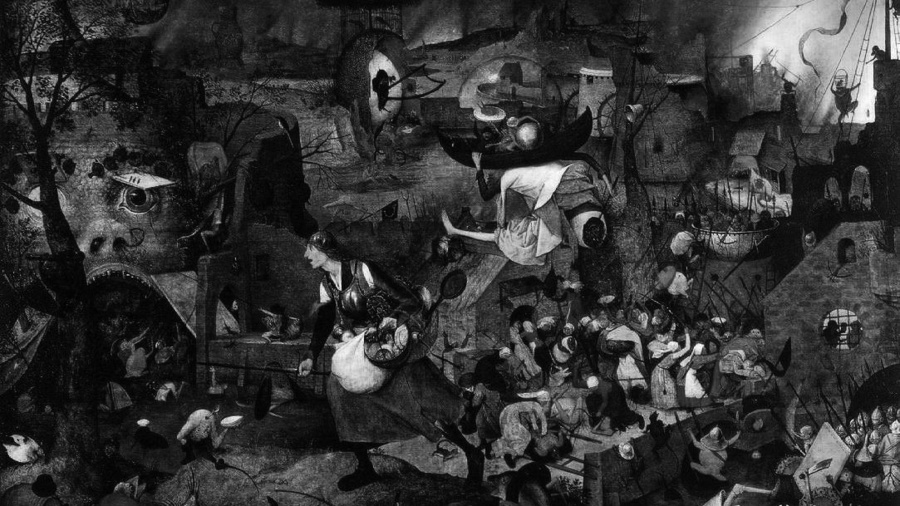
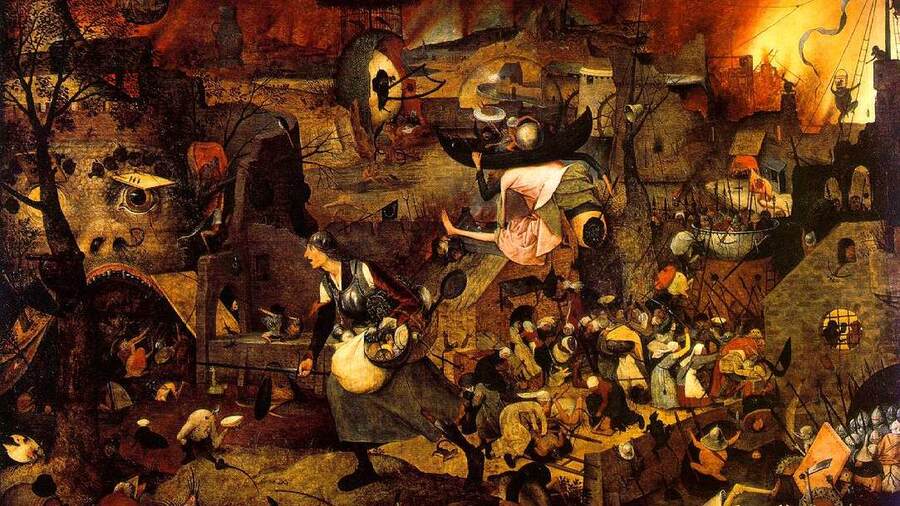
Pieter Bruegel the Elder, «Mad Greta, ” 1563
«Mad Greta» can be considered one of Pieter Bruegel the Elder’s most enigmatic paintings.
At the center of the composition is a woman in armor, holding a sword and a spoils of war. She is moving toward a massive maw resembling the entrance to hell, while dreadful, fantastical events unfold around her. The narrative is linked to Dutch folklore, where the heroine’s figure is associated with recklessness and greed.
[4] The description of the painting at the Mayer van den Bergh Museum states that the work reflects a hell that is not separated from the familiar world, but rather is an integral and readily accessible part of it. One observes violence and horror displacing order.
Details. Pieter Bruegel the Elder, «The Mad Greta,» 1563.
The main character, much like the archangel in the previous painting, stands out from the background due to her foreground placement. However, she does not disrupt the overall composition, as the viewer’s gaze is constantly shifted from her to the monstrous maw and to the background, where numerous other women fight and attack the beast.
Various noticeable wreckage and the sharp spears raised upward create a sense of turmoil in the backdrop, adding a layer of unease to the work.
Black and white fragment. Pieter Bruegel the Elder, «Mad Greta,» 1563.
Viewing the painting through a black-and-white filter makes it obvious that the desired atmosphere isn’t created solely by the color scheme. There is virtually no color contrast; the different planes almost merge into one. Everything suggests an bleak terror. Only a bright, fiery background stands out far in the distance. Max Friedländer described the painting as «volcanic, ” creating the impression of all-consuming discord and fear. [5]
The painting remains cohesive, yet the observer cannot reduce the events to a single, understandable incident.
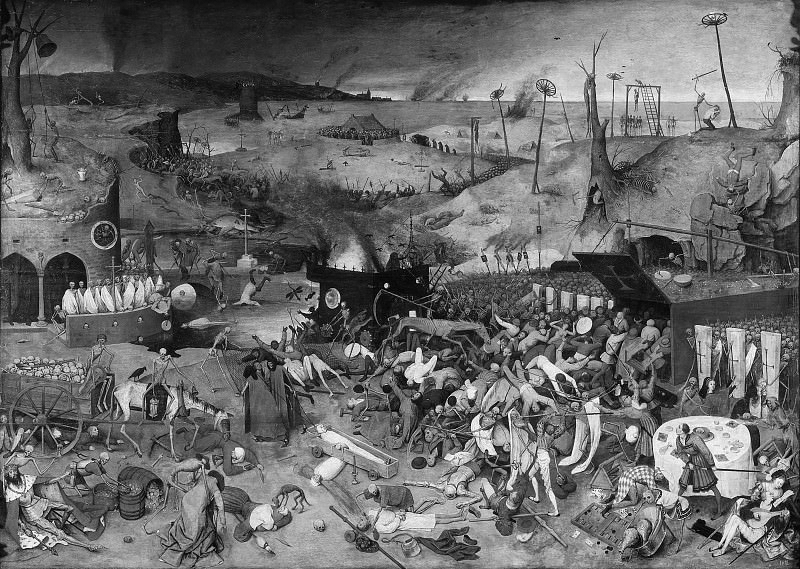
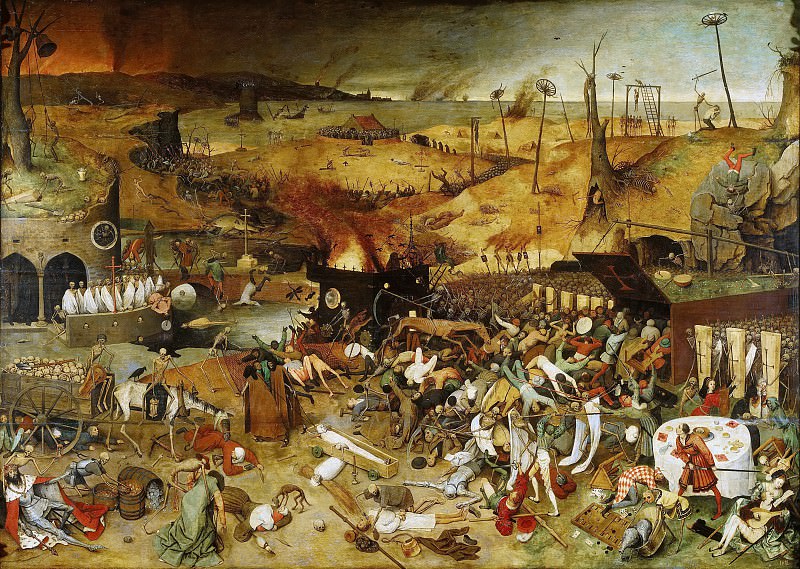
Pieter Bruegel the Elder, «The Triumph of Death, ” 1562–1563.
The artist depicts a battle between an army of skeletons and living people. The skeletons attack the defenseless, destroy the settlement, and drive the doomed into a massive crate resembling a coffin. There is no safe place left on the field—chaos reigns everywhere.
Details. Pieter Bruegel the Elder, «The Triumph of Death, ” 1562–1563.
Bruegel depicts people from various social strata, including a king, warriors, and a loving couple. The king seems drawn to his treasures, while the lovers continue to play music, oblivious to the skeleton behind them. The details illustrate different attitudes toward the approaching death. Some people try to fight, some flee, others cling to earthly possessions, and some prefer to ignore it. Yet, the fate for all is the same.
Black and white fragment. Pieter Bruegel the Elder, «Triumph of Death,» 1562–1563.
When viewing the monochromatic work, one can notice that most of the details lack contrast. However, the skeletons observing the events and the deceased figures whose bodies litter the ground are the focal points. The composition is overloaded with elements; the skeletons blend into the crowd of people. The entire piece presses down on the observer—even the empty spaces do not convey serenity. The prevalence of brown and reddish hues, combined with the scorched earth, intensifies the feeling of desolation.
Suffering in the face of violence and death