Navigation
I. Concept
II. Commissioned Works
III. Forest and Beasts
IV. Death and Salvation
V. Later Works
VI. Conclusion
I. Concept
The starting point for the study was the characterization of Piero di Cosimo, provided by Giorgio Vasari: the artist «lived a life more pastoral than human» [1]. The primary source of information about his life remains the book, Lives of the Most Excellent Painters, Sculptors, and Architects: the master was supposedly confined indoors, subsisted on hard-boiled eggs—which he boiled in batches of fifty—refused to have fruit trees pruned in his garden, and was extremely afraid of thunder and lightning.
The theme struck me as interesting for two reasons. Firstly, Vasari wrote almost thirty years after Piero’s death, creating work beautifully and with evident enjoyment of the peculiarities of others, and his version was recounted many times afterward. Secondly, paintings featuring unusual natural phenomena, animals, and mythological figures make one ponder: is the distinctiveness of the works connected to the author’s supposed «madness,» or are we witnessing a unique artistic method?
The study includes thirteen works. The primary criterion for selecting the paintings is the ability to correlate the image with episodes in Vasari’s text and generally accepted motifs and symbols. For instance, «The Discovery of Honey» and «Forest Fire» were included. Some works were selected for comparative purposes. Botticelli’s «Portrait of a Young Woman» and Piero’s «Visit with Saint Nicholas and Anthony» demonstrate the artist within established genres—where he must meet expectations—and without them, it is difficult to contextualize the unusual elements. The «Innocent Conception» from the Uffizi serves the same function.
The dates attributed to Piero are approximate and vary across different sources: «The Immaculate Conception» is cited as being from either 1490 or 1510. Therefore, the qualifier «circa» is used everywhere.
The study is composed of four parts, each revealing a separate aspect of Piero’s creativity. The first, «Commissioned Works,» presents the artist through the eyes of the patrons and serves as a baseline for comparison. The second, «Forest and Beasts,» is dedicated to Piero’s fears and gardens, as well as the search for panic and chaos within his paintings. The third, «Perishing and Salvation,» examines scenes of loss and liberation, exploring the viewer’s position and the possible presence of the artist himself. The fourth, «Late Works,» contrasts the myth of the master-creator with the traditional altarpiece, revealing the relationship between creative freedom and patronage.
I approached Vasari as an author with his own interest in Piero, not merely as a witness, and I read his book, «Lives of the Most Excellent Painters, Sculptors, and Architects, ” in the Russian edition translated by Gabrichevsky and Benediktov. For Vasari himself, the word „madman“ is not a diagnosis but rather someone else’s opinion: „Piero was considered madman for his wildness, although in the end he did nothing bad to anyone except himself“ [2].
Can one discern in Piero di Cosimo’s paintings the madness attributed to him by Vasari, or is it merely the artist’s exceptionally acute attention to detail, which might be better termed an obsession?
I don’t think the madness in the paintings reads through. I don’t find the chaos, the disintegration of form, or the uncertain drawing you might expect from a person described in Vasari’s book. The strangest subjects are rendered very clearly and contained within a narrow, horizontal frame, much like a stage where one wants to examine every detail. The «imprisonment» then appears not as punishment or illness, but as a methodological condition. The enclosed workshop, where Piero «constantly lived in confinement» [3], could have been a place where he could closely study nature, animals, and not share this experience with anyone.
«He leaves alone, he arrives alone, and therefore he is called a 'lonely dweller.' Yet, there is nothing in the world more valuable than a person who lives alone.»
II. Commissioned Projects
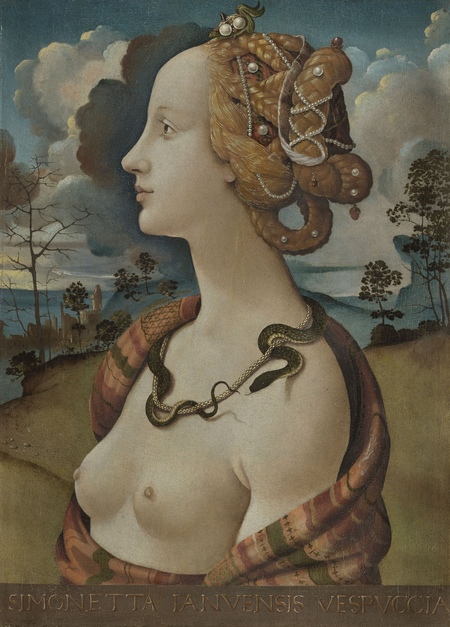
Пьеро ди Козимо. Портрет Симонетты Веспуччи, ок. 1485-1490
Сандро Боттичелли. Портрет молодой женщины, 1476-1480
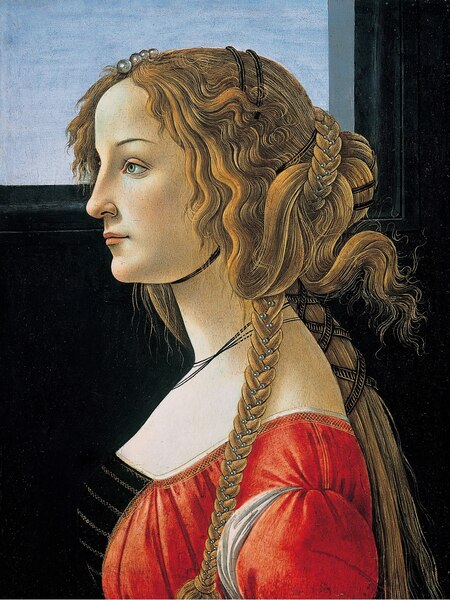
A comparison of the works of these two masters reveals how differently they painted similar portraits, presumably of the same model around the same time period.
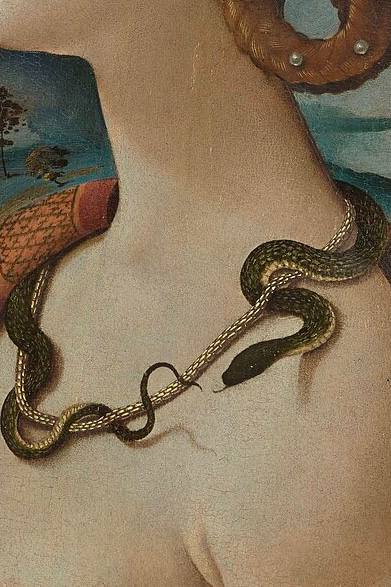
Botticelli’s portrait can be described as idealized. Individual features have been smoothed over. Because of this, the face appears generalized, much like in the master’s religious paintings. The profile, the hair adorned with pearls and ribbons—everything Botticelli aimed to do was elevate beauty beyond the constraints of time. Piero also chooses a profile and an elaborate hairstyle with braids, but he weaves symbols into his work alongside it. His chest is bare, and around his neck, entwined with an elegant, thin chain, is a black snake. This snake is painted with the same meticulous care as the pearls and is integrated into the system of adornments—it turns out to be part of the jewelry itself. According to Vasari, it is a symbol of death. He refers to the episode of Cleopatra’s demise, who was bitten by a snake, which caused her death: «This same Francesco also has in the hands of Piero a magnificent head of Cleopatra with an asp winding around her neck…”[4]
The background works in the same vein. The landscape is structured as a dialogue between life and death: on the right, dense foliage and green hills, and above the horizon, a dark cloud; on the left, a bright sky alongside a bare, dry tree. In mythology, art, and religion, this imagery most frequently symbolizes decay and death.
Змея
Сухое дерево
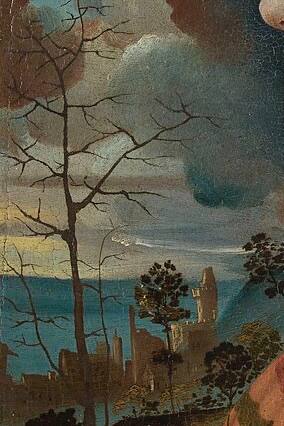
Simonetta died long before the portraits were painted by both masters, which Piero may have intended to depict in the painting by reference to symbolism. For my topic, two observations are important. The snake and the image of the dry tree do not look like a flash of fancy or madness: they possess clear iconography and are integrated into the format of a genre portrait. The fact that such symbols are used attests to Piero’s awareness, rather than a symptom of illness.
Piero di Cosimo. Visit with Saint Nicholas and Anthony, 1489–1490
A bright landscape opens up between the women: on the left, a rocky hill with buildings, and on the right, a street with a crowd and tall houses.
The crucial element of the scene is that the saints are not looking at the encounter: one is reading a book, the other is bent over a sheet of paper with a pen. Two elderly men, absorbed in reading and writing, anchor the lower edge, and it is they—not Mary or Elizabeth—who emerge as the most isolated figures in the painting. Vazari notes the spectacles on Anthony’s nose and the shiny globes, which, according to him, were in Nicholas’s hands; on the reproduction, the globes lie on the floor by his feet, meaning that even Vazari’s attention to detail is mixed with inaccuracy. I interpret this as a sign of a peculiar mind, whereas I see a precise, objective gaze concealed within the canonical composition.
Vazary writes that Piero himself loved solitude and found it his only pleasure, and it seems to me that the two figures lost in reading depict such seclusion as a worthy state, a choice, thus reflecting Piero’s own sentiment.
II. Forest and Animals
Piero di Cosimo. Discovery of the Bee, c. 1505–1510
The entire scene revolves around one central element: a huge, bare trunk with hollows, inside one of which sits a child, while in the branches above, a nude figure strikes one dish against another.
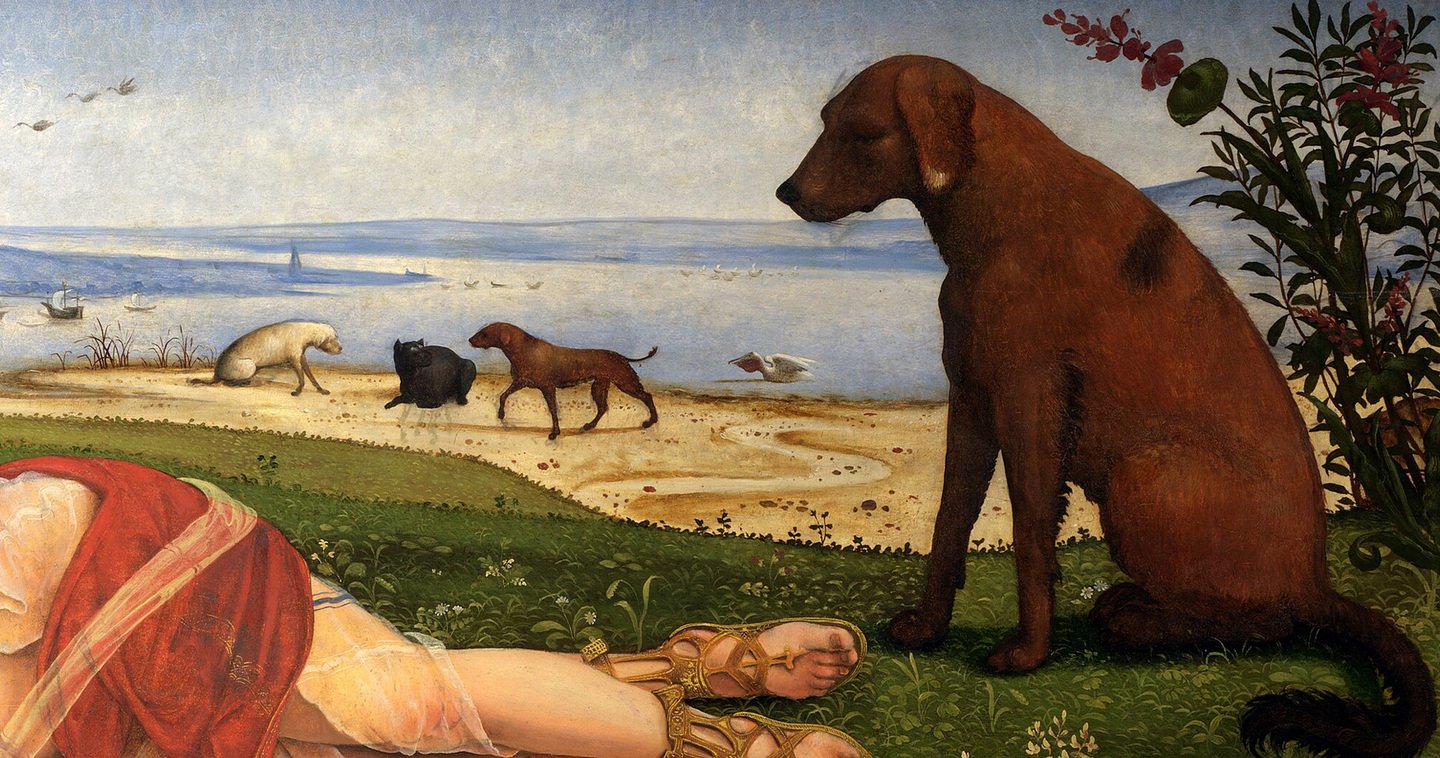
Groups are arranged in a circle around the trunk. On the left are nude youths, satyrs, and women with staffs and dishes; on the right, a donkey with gray hair, children, and in the bottom left, a woman feeding a child next to a reclining centaur. The hybrids are depicted as ordinary members of society—they are sitting, feeding, and drinking, not frightening. The hustle and bustle is painted without frantic energy. Each figure has its own posture, and the gestures converge toward the tree. In the upper left background, on a hill, there is a town with a tower and a clear sky; on the right, a rugged cliff with a path and a dark cloud. The trunk stands as a transition between the town and the wilderness. This is how I envision a garden where, according to Vasari, trees were not pruned and grapes were left untouched [5]. As noted on Wikipedia, Piero’s mythological subjects derive from Vitruvius’s tale of how humanity learned to live, and often feature hybrids of humans and animals [6].
The individual Vasari found irritated by the crying of children and the sound of church bells [7] writes a scene where noise itself is the plot, framing it as a well-structured ritual rather than a frenzy.
Piero di Cosimo. Forest Fire, 1488–1507
Vazary writes about Pierrot’s fear of lightning and thunder[8], about silence concerning fire. Here is a painting where the forest is burning, but the first thing visible is not the flame.