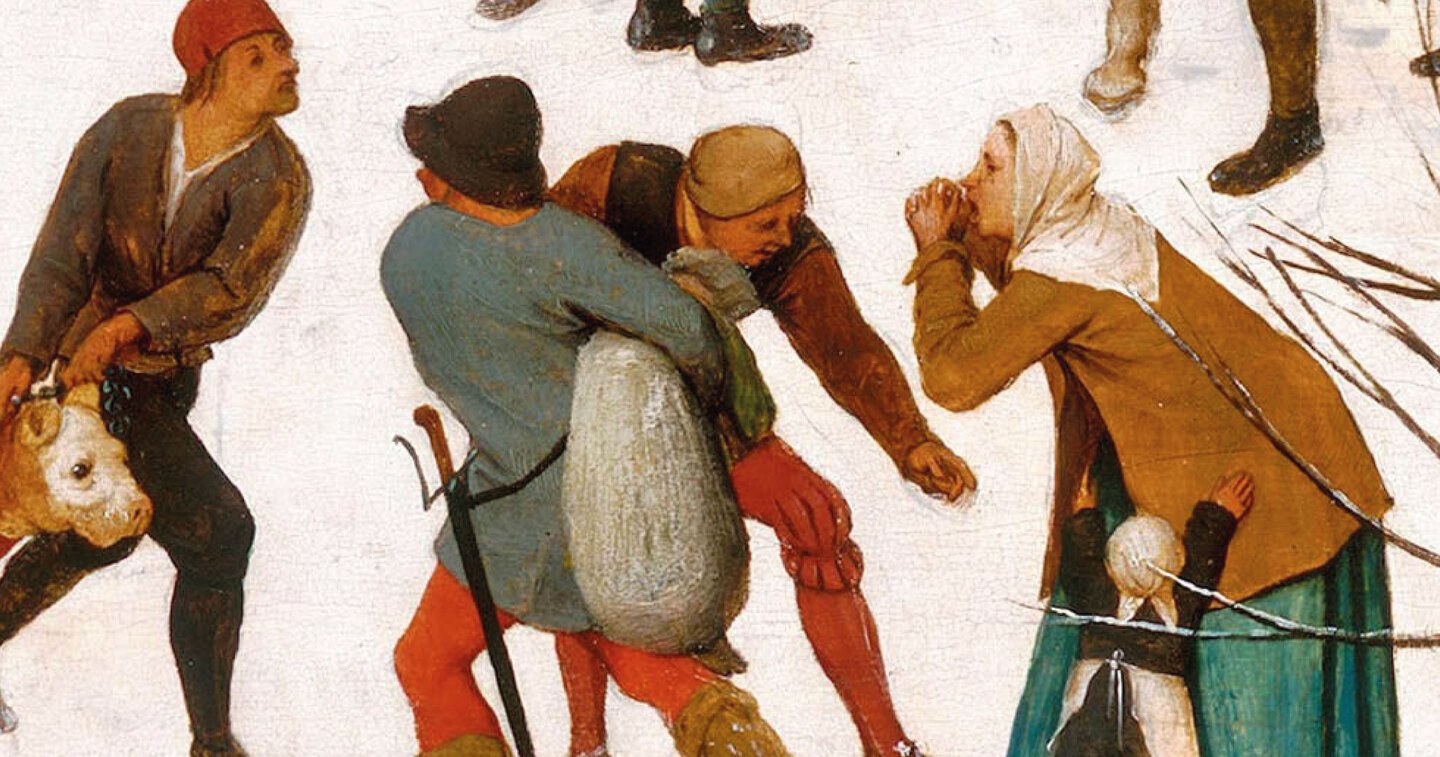
Concept
Content:
- Concept
- Pieter Bruegel the Elder
- Pieter Bruegel the Younger
- Jan Brueghel the Elder
- Other members of the dynasty
- Comparison of artists
- Influence on art
- Conclusion
Topic Selection
Upon first viewing the paintings by the Breugel family, I thought they all depicted the same world: small people, bustling villages, fields, animals, and hundreds of details one could endlessly examine. It later became clear that these similar paintings were not created by one individual. They share a surname, subjects, and even names. It is from this very confusion that my research interest began. I wanted to understand where familial resemblance ends and how the individual style of an artist manifests.Dynasties are often described as a place where talent passes from parent to child, but I suspect it does not work that way. One artist devised compositions that became recognizable for centuries. Another returned to those compositions dozens of times, making them accessible to a new generation. A third moved away from peasant scenes and learned to depict nature with an attention to detail reminiscent of looking through a magnifying glass. It is this contrast that drew me in—a shared surname does not imply the copying of a worldview.
Relevance of the Study
In the modern world, we can easily recognize an image, but we rarely know who created it. We see variations and entire visual styles that exist independently of any single author. The history of Bruegel is remarkably similar to this situation; we can observe how in the 16th and 17th centuries, a subject could exist in an engraving, an original painting, a copy made by his son, and numerous workshop variations. Therefore, the question of originality here is not abstract—it helps us view contemporary visual culture through old painting without equating the copy merely to mechanical duplication.
Research Question
The central question of my research is how one artistic language could transform into three or more distinct ways of perceiving the world. By «language, ” I do not mean only color or a style of brushwork. It encompasses the choice of subject matter, the composition’s structure, the scale of the human figure in the painting, the relationship to nature, the manner of storytelling, and the way existing imagery is employed. I am interested in what elements within this system were inherited and what each artist changed for their own reasons.
Working Hypothesis
My hypothesis is that what unites the Brueghel dynasty is not a singular style, but a tendency to depict the world as a complex system of numerous simultaneous events. For Pieter the Elder, this system more often serves as contemplation on humanity and its place in society. For Pieter the Younger, it evolves into a recognizable artistic repertoire. For Jan the Elder, the focus shifts toward the organization of nature and the beauty of individual objects. I will test this idea through specific compositions and biographies.
Goals and Objectives
The objective of this research is to unravel the familial connections and illustrate how art evolved within a single dynasty. To achieve this, I need to map out all kinship ties, analyze the education and social circles of three principal artists, locate works where they address similar themes, and compare their visual approaches to those themes. A separate goal is to understand the role of imitation: while it is often perceived today as a sign of a lack of originality, we will determine whether a similar situation existed within the Bruegel dynasty.
System within the research
I have divided the work into eight sections: concept; Pieter Bruegel the Elder; Pieter Bruegel the Younger; Jan Bruegel the Elder; other family members; a comparison of the three main artists; the dynasty’s influence; and conclusion. I am not using the biography as a separate reference, but rather as a way to interpret the paintings. For instance, a certain journey is important because, afterward, Peter’s landscapes begin to feature mountains; Jan’s encounter with Rubens is significant because they painted a work together.
For each image, a specific question is posed: what exactly does it help to prove? Sometimes the entire composition is paramount, and other times it is a barely perceptible detail—a person, a bird, a figure on the ice, or an individual flower. Therefore, some parts of the work will be displayed in full, while others will be presented in enlarged fragments, with some placed side-by-side to compare variations by different Bruegels.
Introduction
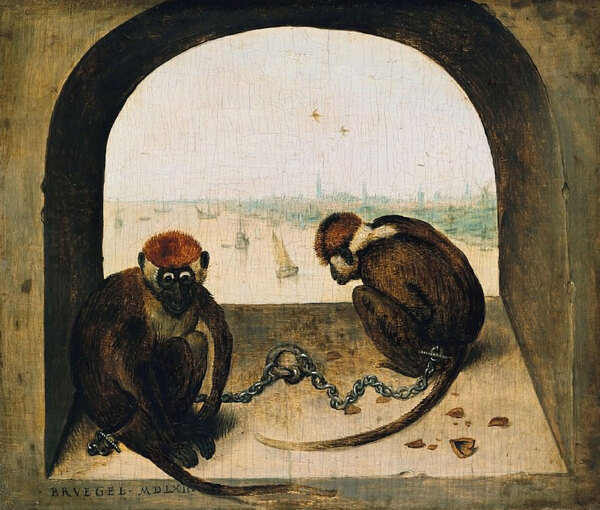
The Brueghels worked in the Southern Netherlands during an era when an artistic workshop served as a space for learning, production, and sales. Success could belong not only to a single painting but to an entire composition that clients wished to see repeated. Before us is a family history spanning several generations—one that lasted over a century—yet within it lie entirely different ways of creating and disseminating imagery. I will subsequently examine Pieter Bruegel the Elder, his elder son Pieter the Younger, and his younger son Jan the Elder. These are the three central figures of this study.
Pieter Bruegel the Elder, «Two Chain Monkeys.»
Pieter Bruegel the Elder
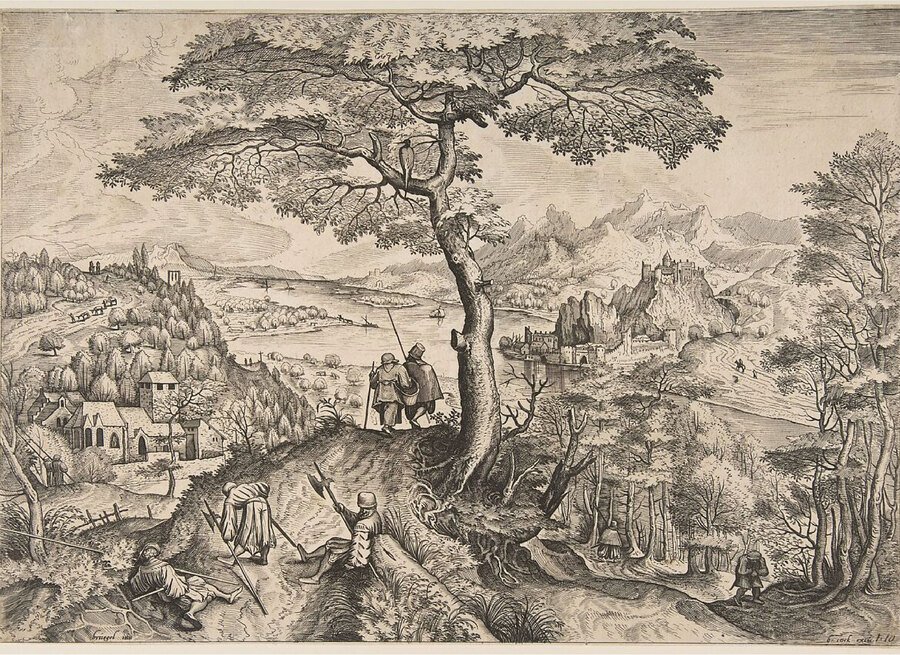
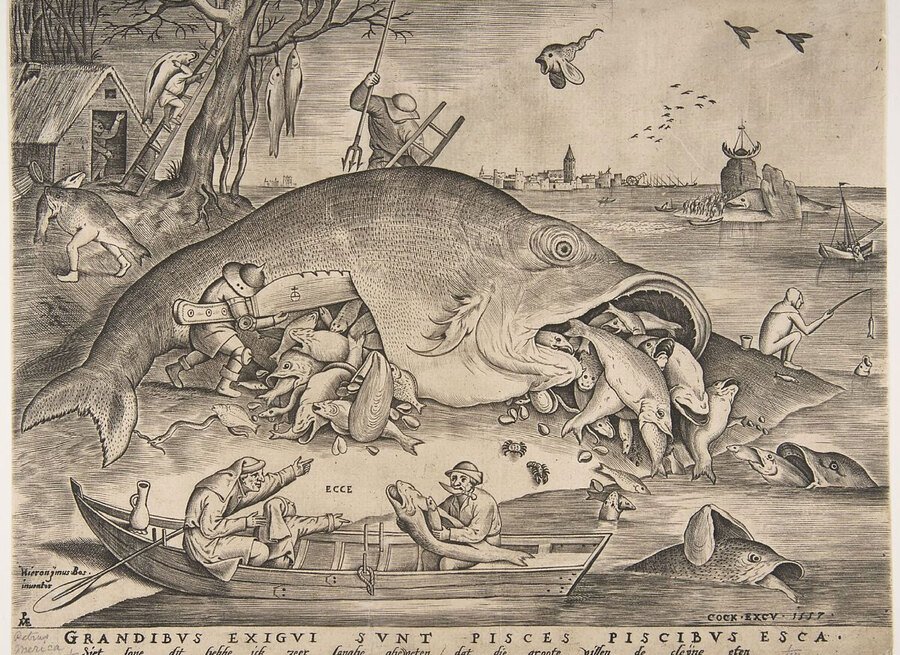
Pieter Bruegel the Elder — Two Chain Monkeys https://gallerix.ru/storeroom/1029566649/N/794014841/
Early Engravings by Pieter Bruegel the Elder https://www.metmuseum.org/de/essays/pieter-bruegel-the-elder-ca-1525-1569