Categorization
- Concept
- Body Diagram
- Blind Anatomy
- The Renaissance: An Unveiled Revolution
- Baroque Anatomy Lesson
- Waxen Flesh
- Russia
- Experiments
Concept
Often, we view a portrait merely as an object created by a skilled master, yet we seldom consider how, over the centuries, artists evolved to depict the human form with anatomical precision. The truth is that anatomy was almost the only field where science and art literally worked on the same table. Year after year, century after century, the depiction of the body transformed from schematic and simplified to scientifically accurate, and subsequently to an aestheticized, inert form where art and science finally diverged. But how exactly was this transition expressed in art? This central question drives this study, so it is structured to trace the process of understanding the living—starting from Paleolithic «body schemas» and extending to works where anatomy itself becomes part of the art. Based on this, the research hypothesis can be articulated as the assertion that art has always sought to look inside the human being and comprehend its inner substance, much like reading a book.
Body Diagram
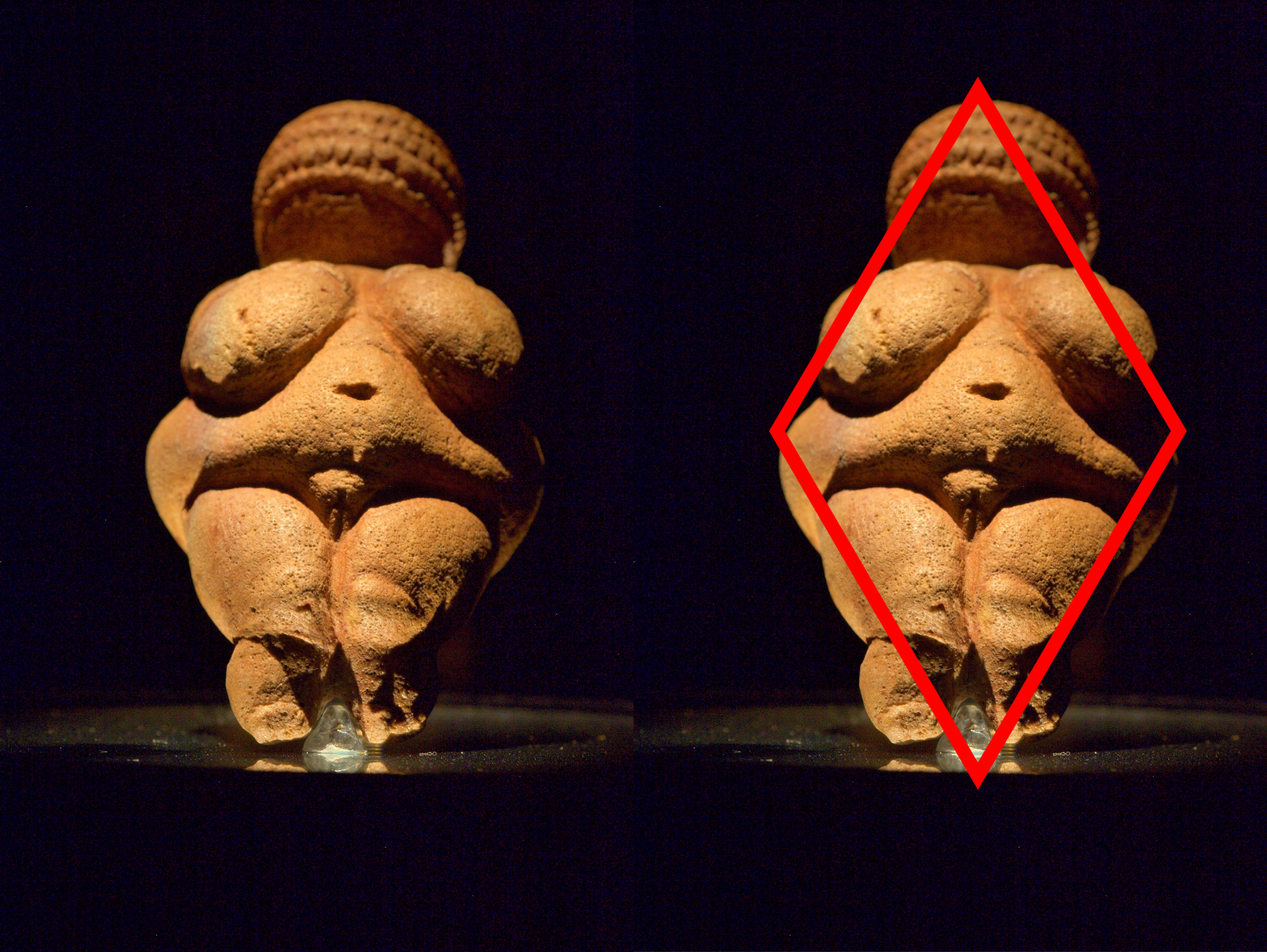
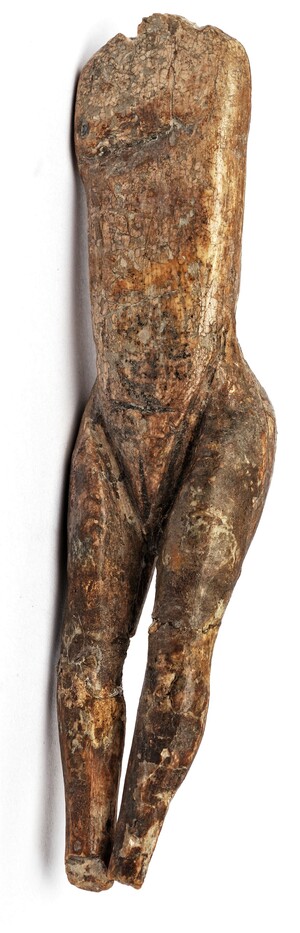
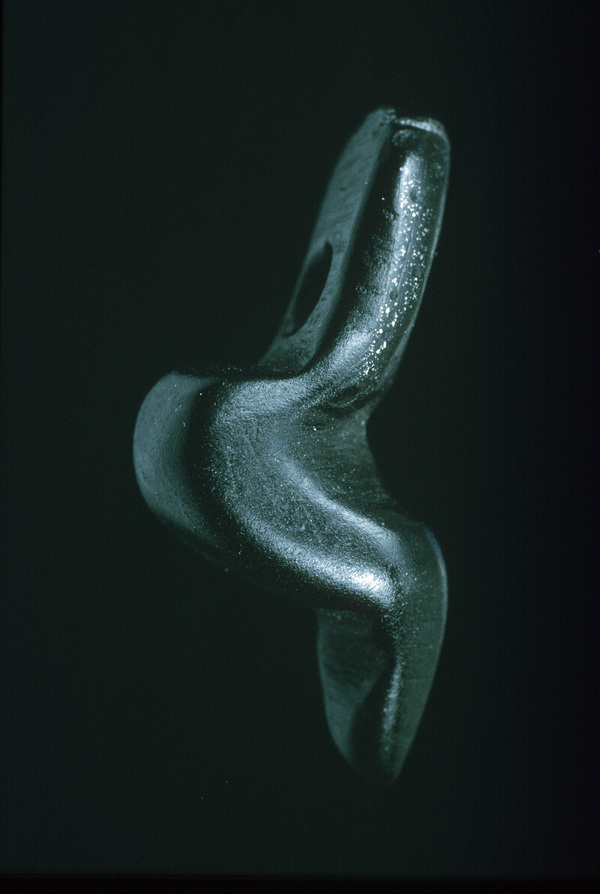
The body schema is a conventional representation of a human being whose physiology is depicted schematically. The works presented in this section reference a time when such depictions of the human form served not only an aesthetic purpose but also a cognitive, ritual-religious, astrological, or utilitarian one. This applies primarily to the so-called «Paleolithic Venus figures» from the Upper Paleolithic period (specifically La Madeleine, less frequently Aurignac). «Paleolithic Venus figures» are simplified, depersonalized female figurines with hypertrophied reproductive organs, illustrating different stages of pregnancy, ranging from 4 to 25 centimeters. It is noteworthy that the schematic nature of these figures is expressed through a diamond shape, where the narrowed sections—the head, arms, knees, and legs—contrast with the wider sections—the bust, abdomen, hips, and vulva. Alongside the theories suggesting that the «Paleolithic Venus figures» were intended for ritual or religious purposes connected to the cult of fertility or maternal kinship structures, there is a prevailing view that the figurines were schematic self-portraits created by women for other women who lacked a clear understanding of what occurs in the body during pregnancy. It is hypothesized that this form arose because women viewed their bodies from top to bottom and highlighted what possessed the greatest visual impact.
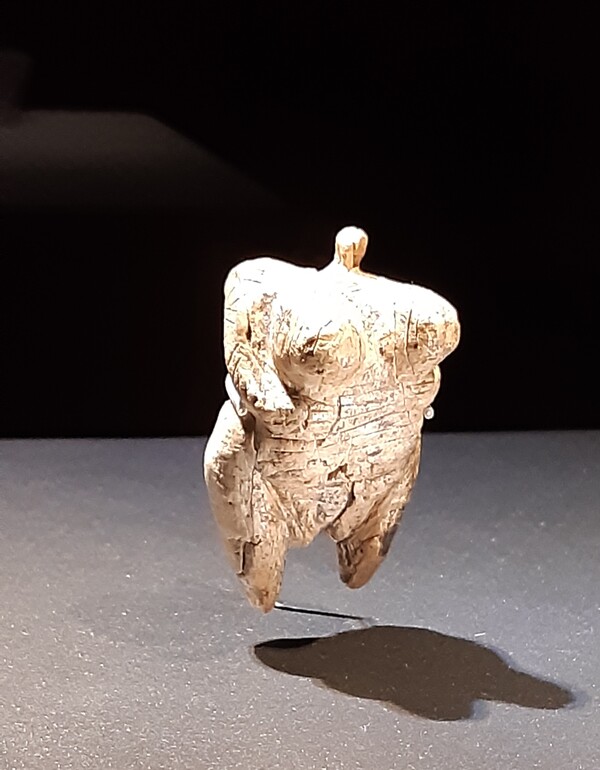
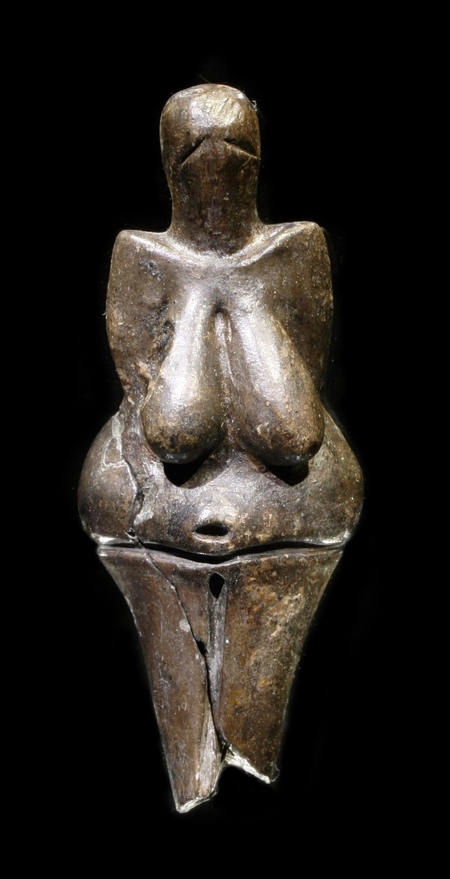
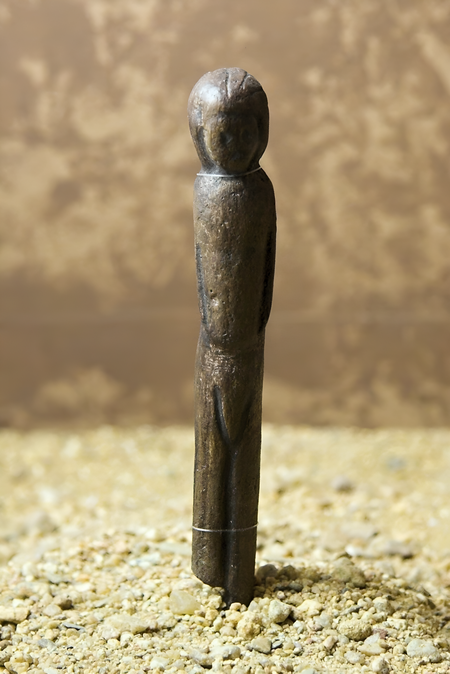
It should be noted that the most robust «Paleolithic Venus» figures were created during the coldest periods, which can be explained by the theory that a «plump» woman had a greater chance of continuing the lineage. Many researchers have also found another pattern: as the climate warmed and the glaciers retreated, the proportions of the figurines decreased. Although the emphasis on reproductive organs or even on natural curves was not as pronounced as, for instance, in the Venus of Willendorf, the principle of schematic simplicity and the emphasis on the feminine essence remain.
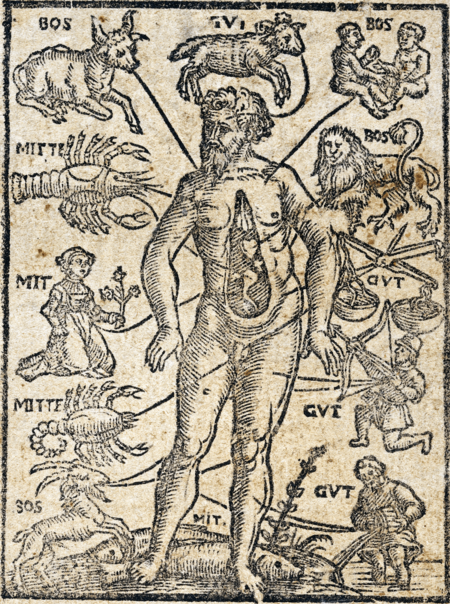
The medieval «microcosms, ” which function more as symbols than as objective observations, undoubtedly fall into the category of „tel-schemes.“ It is worth noting that while there were examples in art—for instance, in ancient Egyptian civilization where art literally extended beyond the human form (reliefs depicting the mummification of pharaohs)—this sharp transition from the Paleolithic to the Middle Ages is due to two factors: first, the scope of the research (Western Europe), and second, the canonical and aesthetic trends that rarely involved depictions of human anatomy or structure. While ancient Greek art developed a philosophical current like mimesis—meaning imitation of nature (according to Democritus) or reality (according to Plato)—this had nothing to do with physiological interest in a medical sense. However, we see a similar principle in the „microcosms“ of the Middle Ages.
The concept of a «microcosm» itself denotes a small system or model that resembles the larger whole object (the universe) or is a constituent part of it—and humans are no exception; they themselves become a «diagram.»
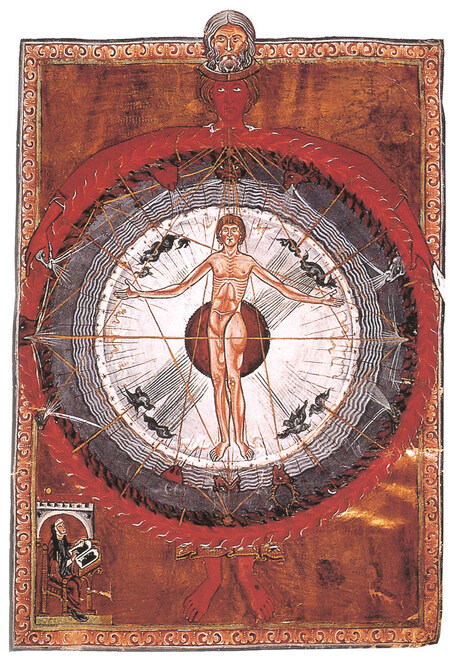
Using the miniature from the «Book of Divine Works» as an example, we see how the author’s mystical vision is reflected in the work of an unknown artist. In the miniature, for instance, the human figure is centered within so-called cosmic circles, where the body is interpreted as a representation of the world’s structure, rather than its anatomy or dissection. The schematic nature of the body is evident in the pose of the nude figure with outstretched arms: he seems to become a part of the cosmos into which he is inscribed. Similarly, all rays pass through his body, which also expresses the classical visualization of the microcosm idea—the human is unimaginably small compared to the entire universe in which he resides, yet the human body itself serves as a mirror to that universe. Interestingly, the author of the book, Hildegard, is also depicted in the lower left corner: she is taking notes at a desk; this kind of self-portrait composition helped legitimize the authorship of a woman.
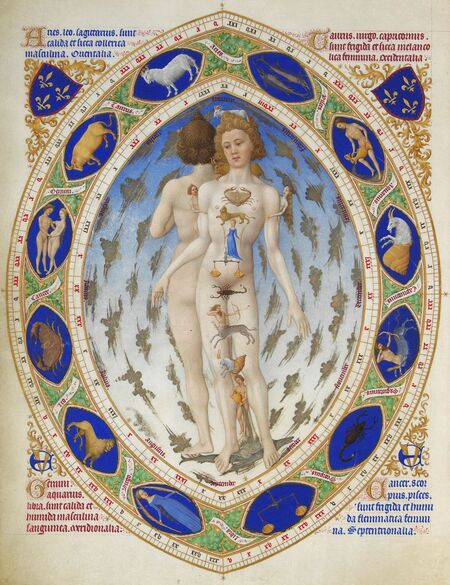
In later works featuring «schema bodies, ” the microcosms transform, continuing to converge with melotezy—an ancient occult-astrological system positing that parts of the human body are connected to something higher, such as elements of the macrocosm, planets, or zodiac signs. „Homo signorum, ” or the „Zodiacal Man, ” is precisely this continuation, approaching anatomical knowledge. Thus, the „Anatomical Man“ by the Limburg brothers presents us with a similar central composition: in the center is a figure that merges feminine and masculine principles, and on its body are zones of influence for each sign: Aries—the head, Taurus—the neck, Gemini—the arms, Cancer—the chest, Leo—the heart, Virgo—the abdomen, Libra—the kidneys, Scorpio—the genitals, Sagittarius—the hips, Capricorn—the knees, Aquarius—the shins, Pisces—the feet. The zodiacal circle illustrates the 12 zodiac signs, which form an infinite cycle by which the body is measured. In the corners are four blocks of Latin inscriptions that connect to the four temperaments, the four elements, the cardinal directions, and the earth/floor. This miniature is a vivid example of how in the late Middle Ages, science, medicine, faith, and art had already merged into a single whole, just like the central figure of two principles.
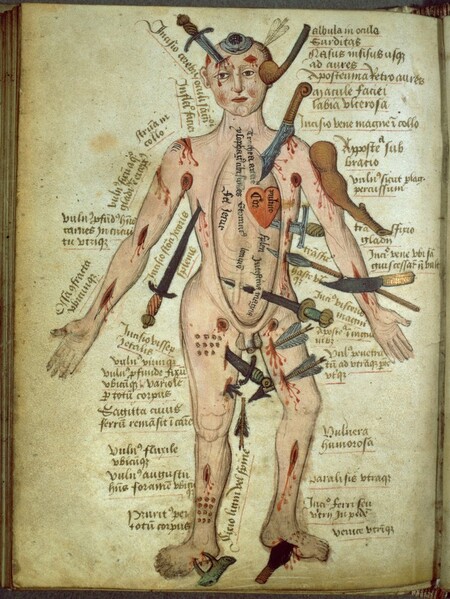
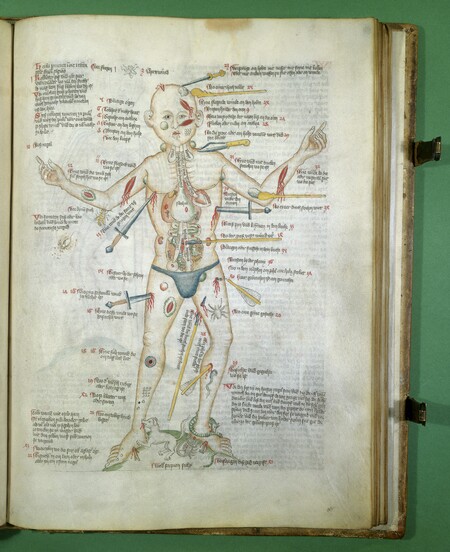
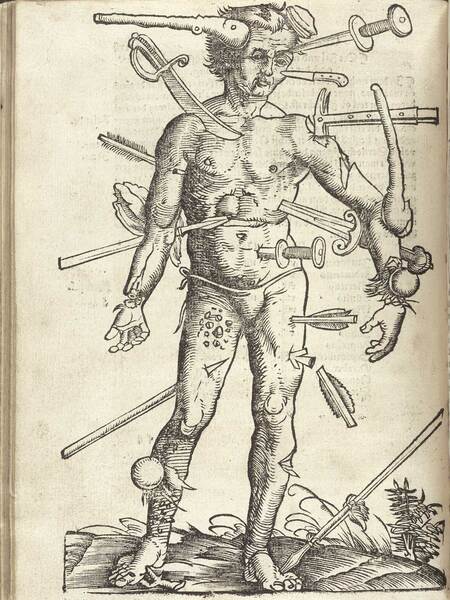
In this work, we encounter a kind of effigy of a severely wounded person; in reality, it is also a «body diagram.» On one hand, it recalls the rigidity between people, and on the other, it is intended as a field medical reference guide for «graphic medicine.» The inscriptions no longer reflect an occult system—they possess practical value: they explain the wounds and suggest possible treatments. This is not anatomy, which will be depicted later, but it is a symbolic hint that art will «look inside» a person only when it reveals this surface.
Blind Anatomy
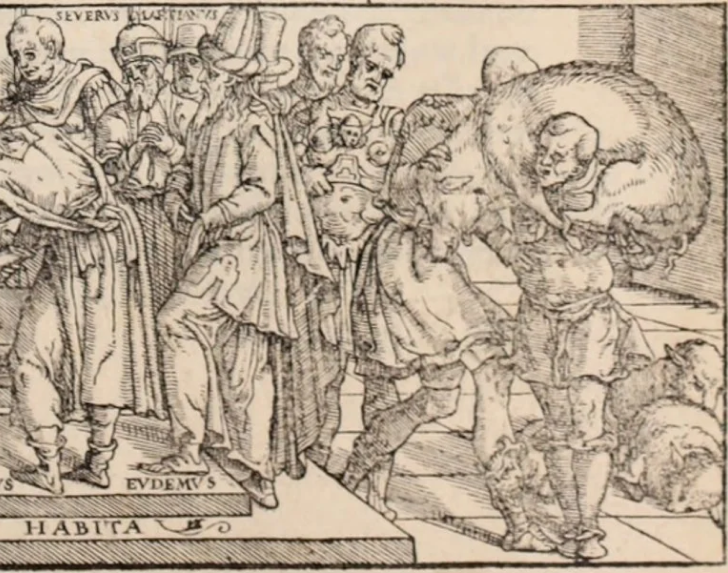
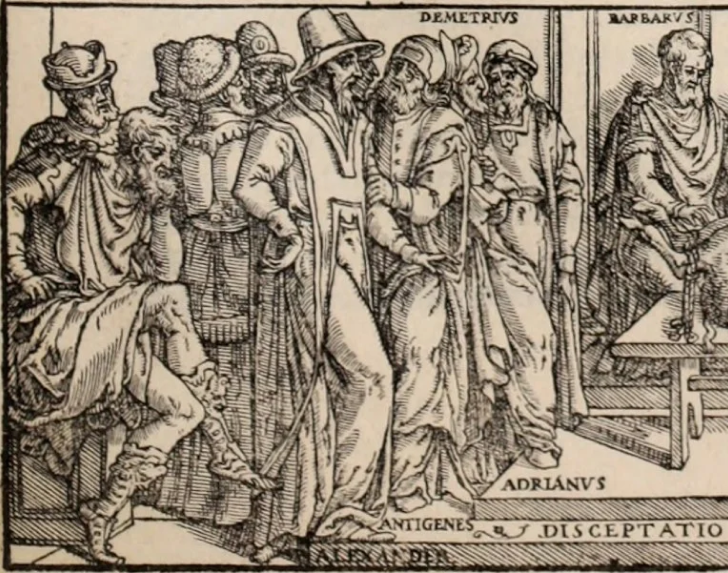
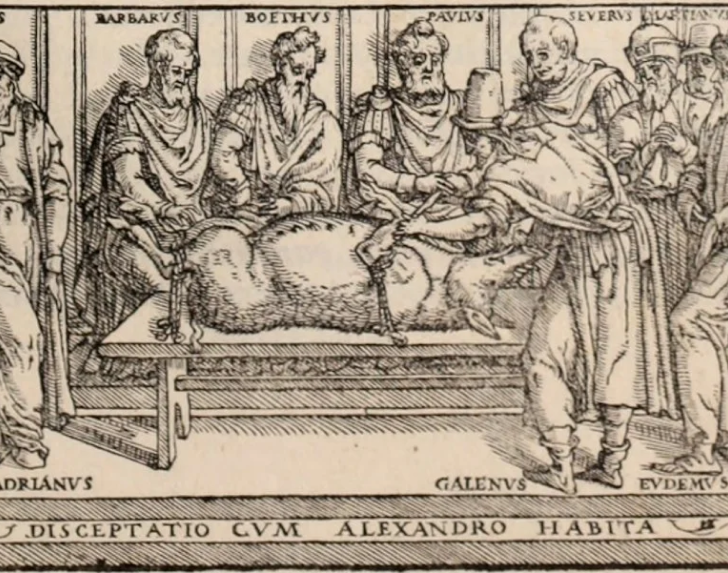
First and foremost, when discussing anatomical discoveries, it is important to recall a figure like Galen. Galen—a physician-philosopher, writer, surgeon, and neuroscientist—was born in the Roman Empire in the city of Pergamum in the second century CE. In the context of this study, and specifically this section, his figure is interesting as an example of why, at a certain point, the human body in art ceased to be merely a schematic representation and began to manifest in a dissected state, which would later become a recurring motif.