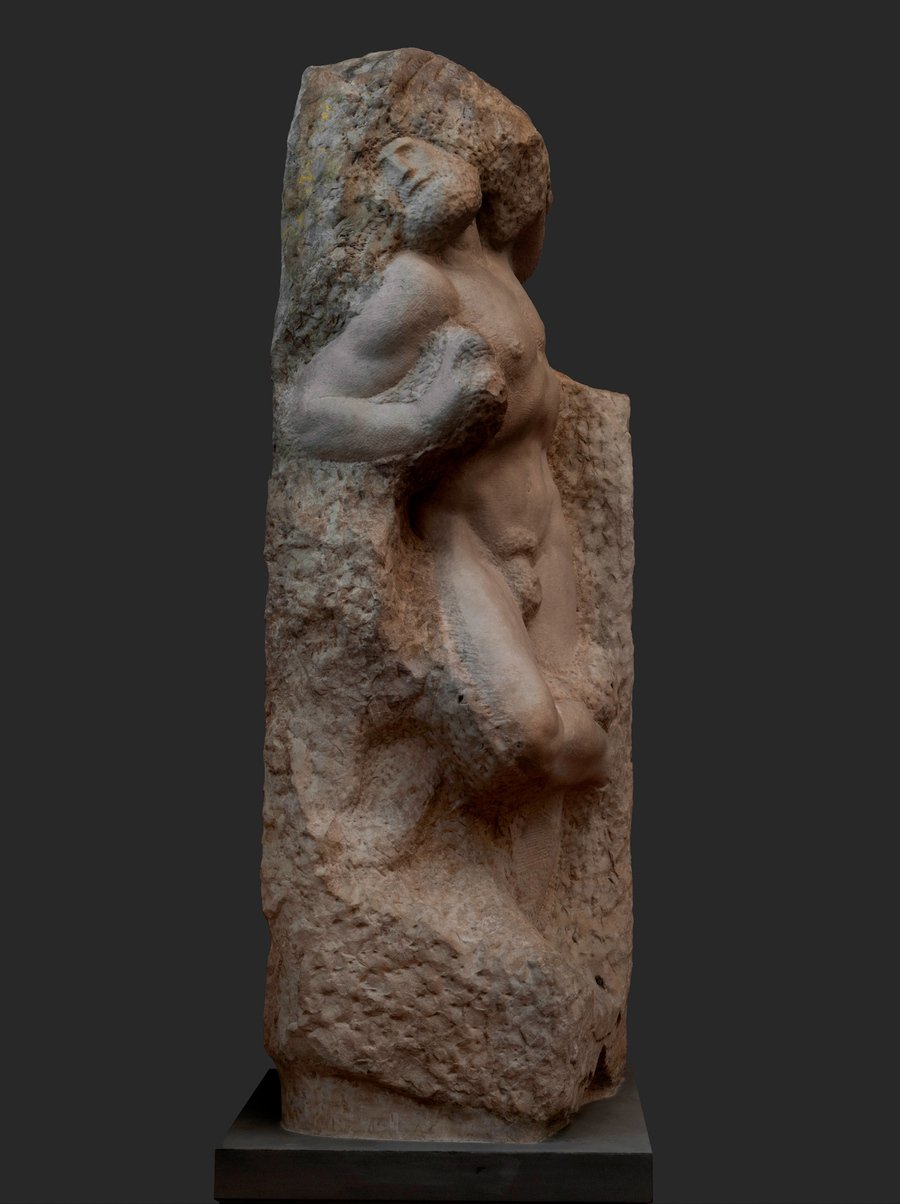
«The arts attained in him a perfection that is not found in ancient or modern people for many and many years. He possessed such perfect imagination, and the things that appeared to him in concept were so grand that it was impossible to bring such great and astonishing visions into reality with his hands; he often discarded his creations—indeed, he destroyed many…» — Giorgio Vasari. 16th century.
Concept
In the traditional conception, sculpture involves the gradual freeing of form from the material: the artist works the stone, removes the extraneous, and strives toward a finished image. However, in the unfinished works of Michelangelo Buonarroti, this process seems to halt halfway. Human bodies remain confined within marble blocks; their movements are only partially delineated, and the marks of the chisel are not concealed beneath a smooth surface.This study seeks to explore how a work, where the form has not reached a final state, can be perceived as a complete artistic image, and at what point the traces of sculptural work transform into an expressive medium.The hypothesis is that in Michelangelo’s sculpture, incompletion gradually acquires independent artistic significance. If in the earlier works it is perceived primarily as a confrontation between the human figure and the mass of stone, in the later works it becomes a means of expressing internal tension, spiritual searching, and a rejection of the idealized bodily form.
The goal of this research is to trace how the artistic meaning of incompleteness changes in Michelangelo’s sculpture, and to determine how raw marble, tool marks, and the absence of a final form become integral parts of the artistic statement.
Form Development
«Saint Matthew» holds a unique place in research because it is the first sculpture by Michelangelo that was left unfinished.
«Saint Matthew» gives the impression of a monumental figure that still belongs to the stone block. The apostole’s silhouette is only partially separated from the surrounding marble. Individual parts of the body have already gained volume, while others remain connected to the mass of stone. Consequently, the figure is not perceived as a completely independent object—the viewer simultaneously sees the human body and the material from which it emerges.
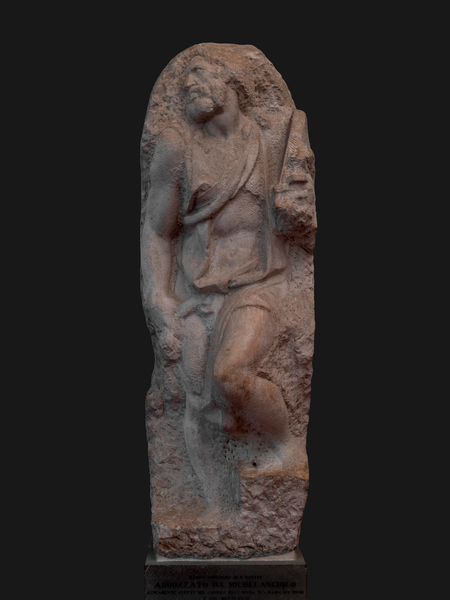
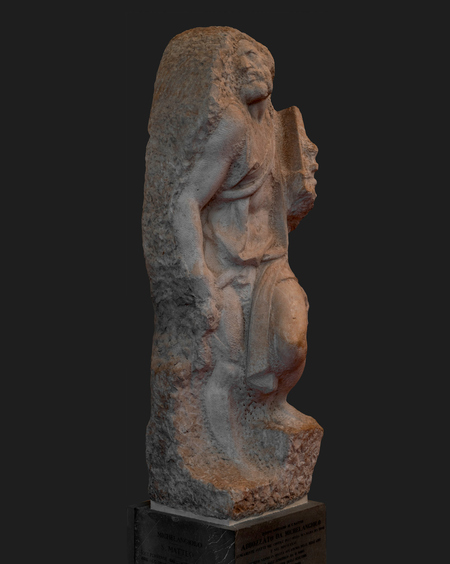
Michelangelo Buonarroti, «St. Matthew, ” 1505–1506.
The composition of the upper part of the figure is particularly expressive. The head is turned relative to the torso, creating a diagonal movement that prevents the body from becoming static. The shoulders, ribcage, and head form a complex system of opposing directions. This movement seems almost impossible because the figure is still held by the mass of stone.
Michelangelo Buonarroti, «St. Matthew,» 1505–1506.
Visual incompleteness manifests in the uneven treatment of surfaces. In some areas, the anatomy is already quite discernible—the volume of the muscles, the curves of the torso, and the tension of the body can be made out. Other parts remain roughly carved. The transition between these sections is not smoothed out, allowing the viewer to trace the sculptor’s process.
Michelangelo Buonarroti, «Saint Matthew, ” 1505–1506.
«The saint’s pose is quite unusual; it seems as though Matthew is trying to break free from the stone, but the stone holds him and does not release him.» — V.N. Lazarev, 1983.
What is particularly interesting is the contradiction between body movement and its immobility. The figure seems to be attempting to turn, yet it cannot fully break free from the stony shell. Moreover, it is impossible to definitively determine whether it expresses physical exertion, inner tension, or if it is merely an intermediate state during the sculpting process. Consequently, the incompleteness here becomes not just a condition of the object, but also a feature of how it is perceived.
At the «Saint Matthew, ” the incompletion is intrinsically tied to the sculptural creation process. However, it is here that a crucial artistic effect emerges for Michelangelo: the human body is perceived as a form that simultaneously exists and is being formed. The marble ceases to be a neutral substrate and becomes an active component of the composition.
Figure as an extension of material
Unlike «Saint Matthew, ” where incompletion is perceived as a result of a halted commission, the series of unfinished sculptures titled „Slaves“ allows us to examine different degrees of interaction between the human figure and the stone. It is important to compare them: all the works were created for a single architectural project, executed in marble, and united by a common principle of plastic representation of the body, yet the degree of finish on each figure varies.
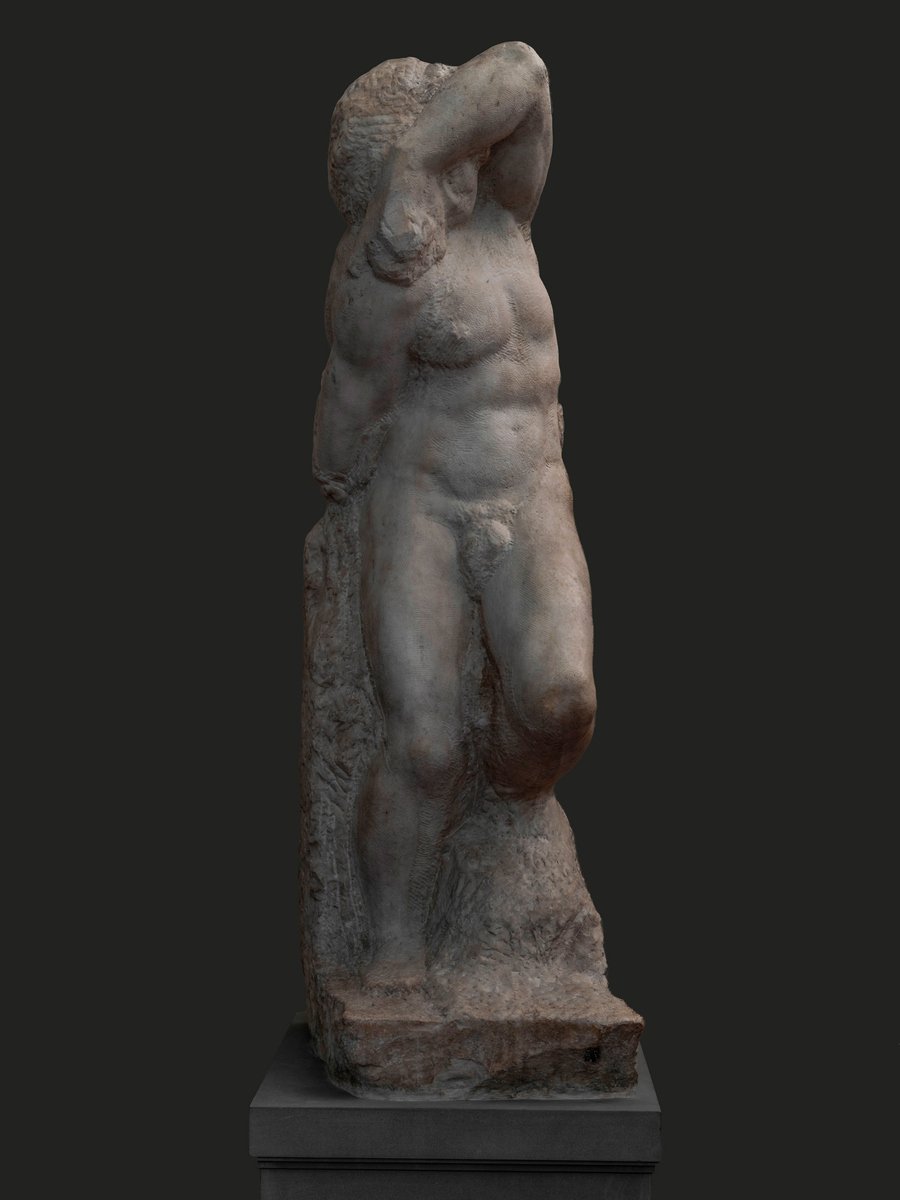
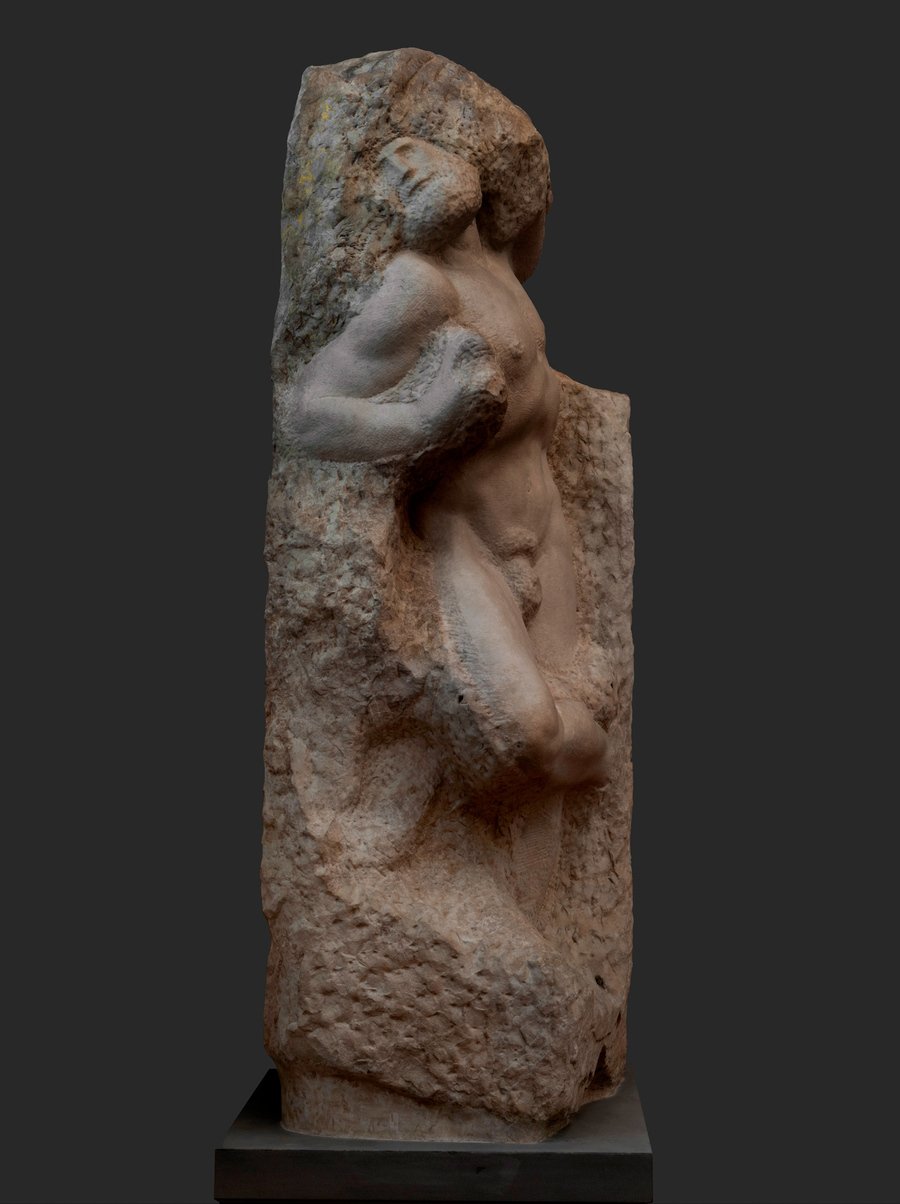
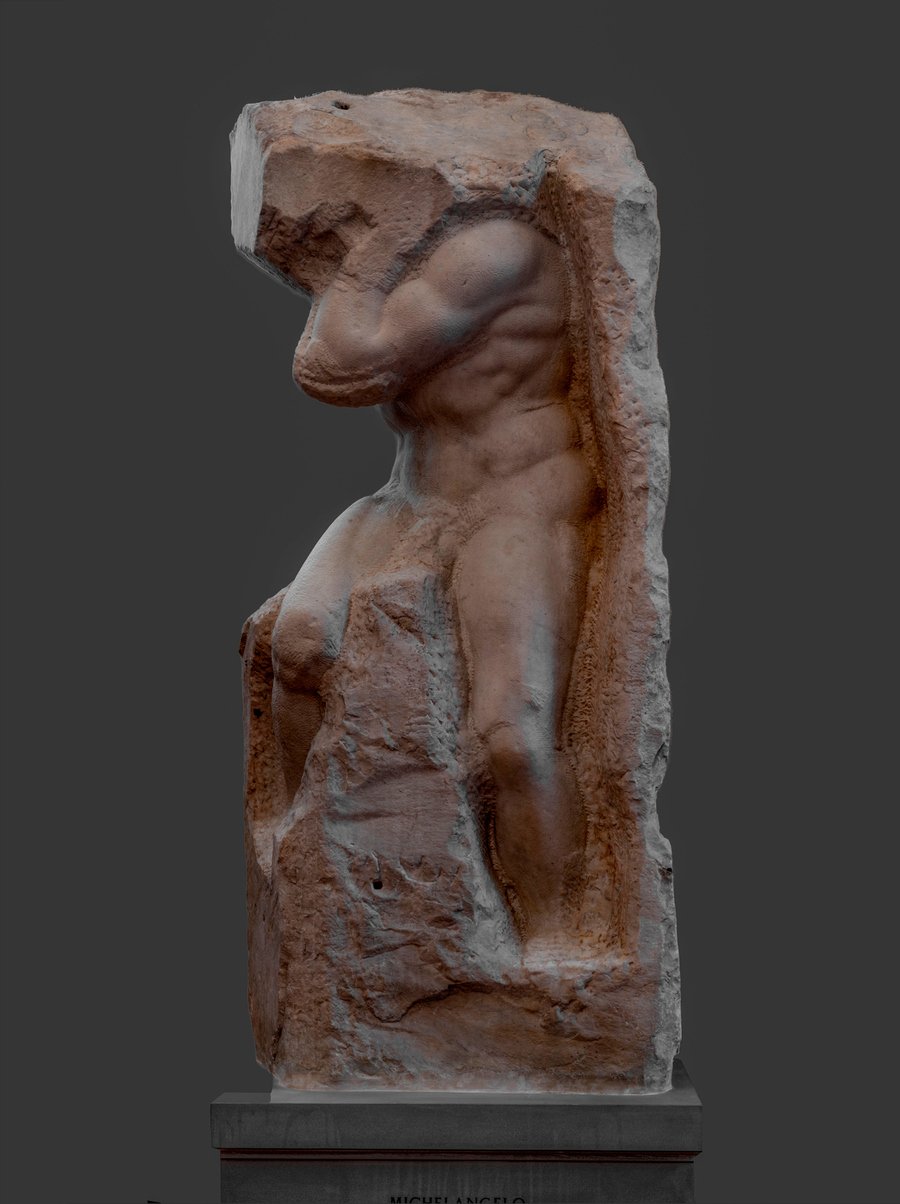
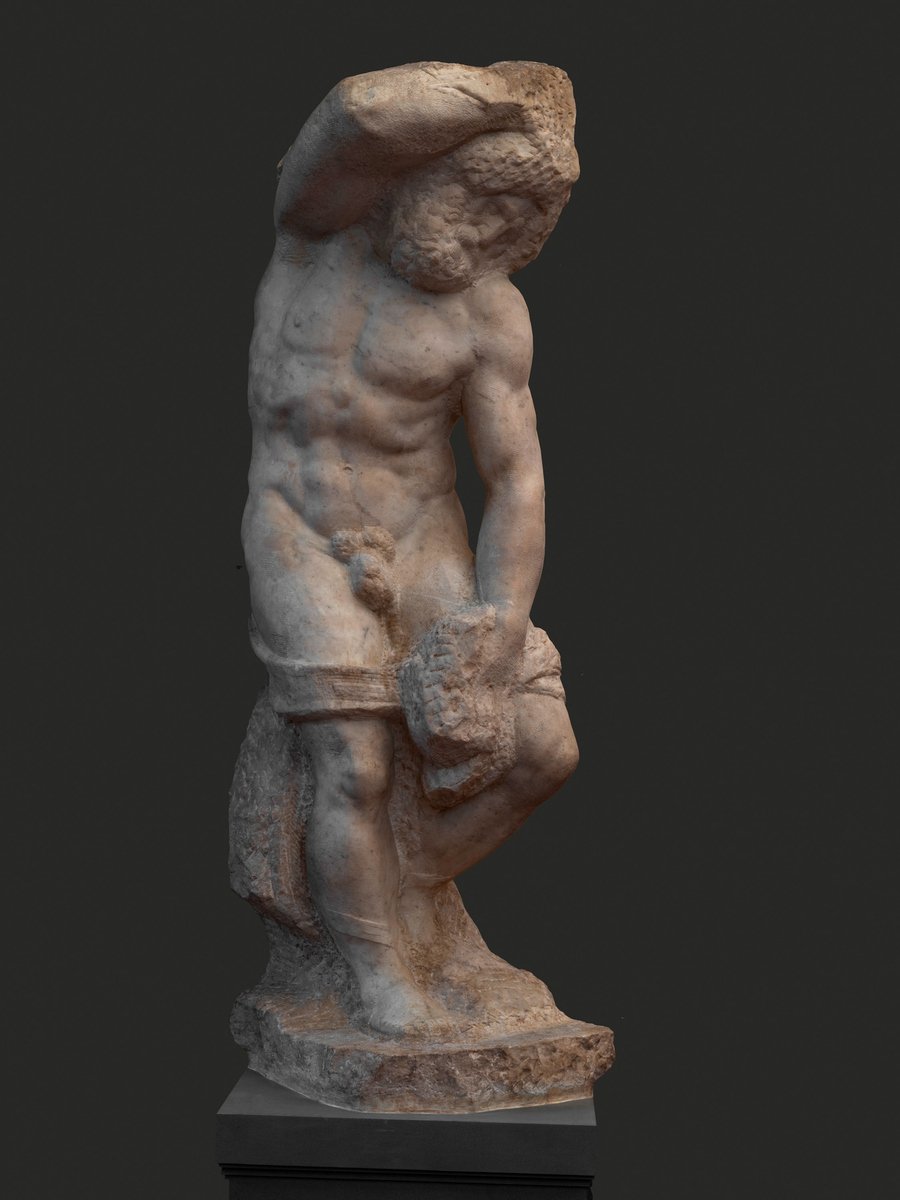
Michelangelo Buonarroti, «Awakening Slave,» «Atlas,» «Bearded Slave,» «Young Slave,» 1525–1530.
The Awakening Slave
«Atlas»
«Bearded Slave»
«Young Slave»