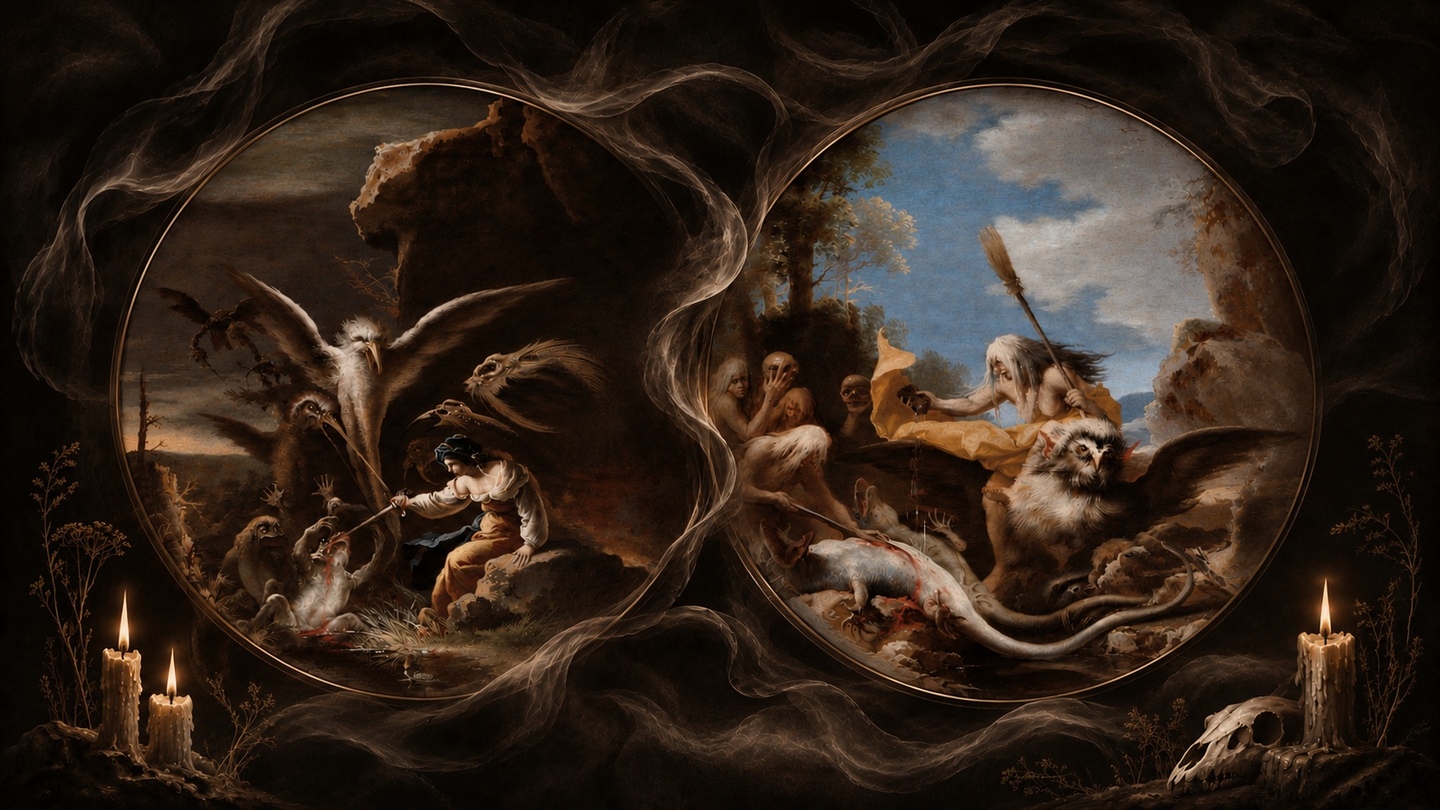
In European art, the witch could take on completely contradictory forms. Some artists depicted her as young, attractive, and almost indistinguishable from an ancient goddess. Others portrayed her as an old crone with a wrinkled face, a deformed body, and frightening attributes. But did beauty and old age truly represent two different ways of depicting evil? Or did the witch’s appearance depend on the action she was performing and the role she played in the composition? This contradiction is precisely what serves as the starting point for the research.
Navigation
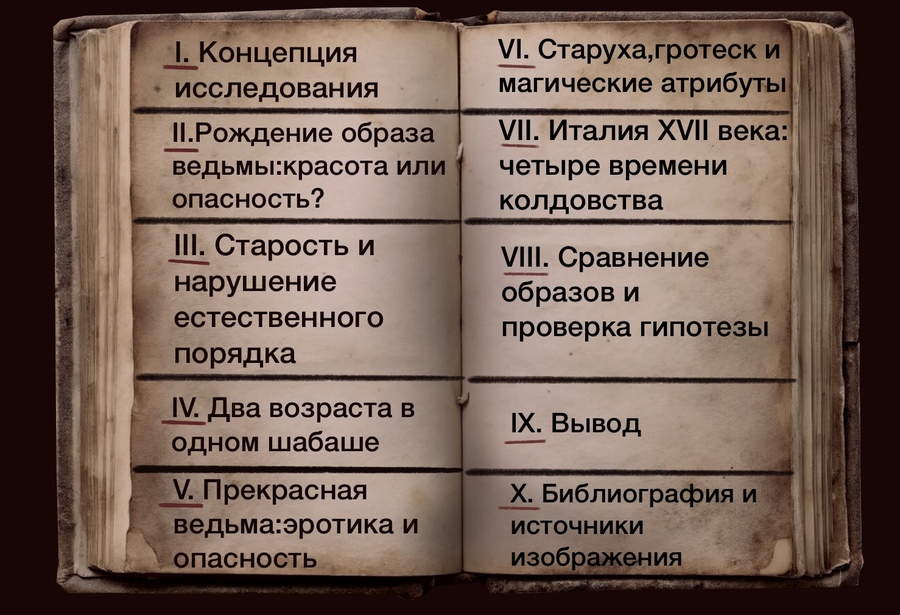
I. Concept
In European art from the late 15th to the 17th century, the witch did not possess a fixed appearance. Artists depicted her sometimes as a young woman with idealized body proportions, and other times as an old woman with a wrinkled face and pronounced signs of decay. Occasionally, these two types appeared in the same composition, participating in a shared ritual and interacting with identical objects.
I was intrigued by why a character associated with danger and forbidden knowledge could appear attractive. In Hans Baldung Grien’s images, young nude women coexist with old women, and the beauty of the human body merges with magical acts. In Salvador Rosa’s series «Scenes of Witchcraft, ” he also addresses contrasting types of female appearance. This raises the question: did youth and old age truly signify different forms of evil, or were artists using them to address other artistic objectives?
The focus of this research is not the history of actual witchcraft accusations, but rather the methods of constructing the witch archetype. I examine facial features, anatomy, hair, gestures, poses, and the surrounding props. Particular attention is paid to how age interacts with the composition. Wrinkles may be visible to the viewer, but by themselves, they do not transform a woman into a witch. Similarly, a young nude body acquires a sense of unease only within a specific narrative context.
The study begins with German engravings from the late 15th to early 16th centuries, primarily the works of Albrecht Dürer and Hans Baldung Grien.
Fragment of a painting. Albrecht Dürer. «The Witch on the Goat.» c. 1500–1501. Engraving on copper.
I then turn to 17th-century Italian painting and compare various methods of depicting magical acts. This comparison allows me to trace not only age differences but also the influence of artistic techniques—graphic contour, hatching, tonal woodcut, painterly lighting, and spatial organization.
The ambiguity of the images themselves plays a crucial role. The 'devilish' narrative could be linked to fear, eroticism, satire, or an interest in ancient mythology. Therefore, I do not interpret every old woman as a symbol of death, nor every young woman as an embodiment of seduction. These meanings must be examined based on specific works and historical sources. Images have been selected for comparison that illustrate the interplay between age, physicality, and action. Complete compositions allow for the determination of a character’s role, while enlarged fragments enable closer examination of facial expressions, hand positioning, and body modeling. Particular attention is paid to instances that contradict the presumed dichotomy of ages.
The objective of this research is to determine which visual attributes make a witch recognizable and how significant age is among those attributes. Comparing works by different artists allows us to view beauty and aging not as immutable characteristics of good and evil, but as artistic devices whose meaning depends on the entire image.
Hypothesis
The young and old witch represent two distinct ways of visualizing supernatural danger. Youth can create a contradiction between an attractive appearance and cruel action, whereas age allows the artist to emphasize physical decay, grotesque features, and connection to a frightening world. However, age is not considered an inherent trait of a witch—her image is formed through a combination of appearance, gesture, magical attributes, and composition.
II. The Birth of the Witch Image: Beauty or Danger?
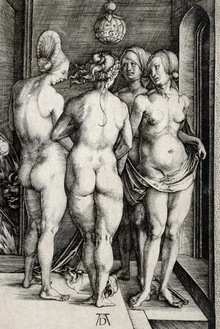
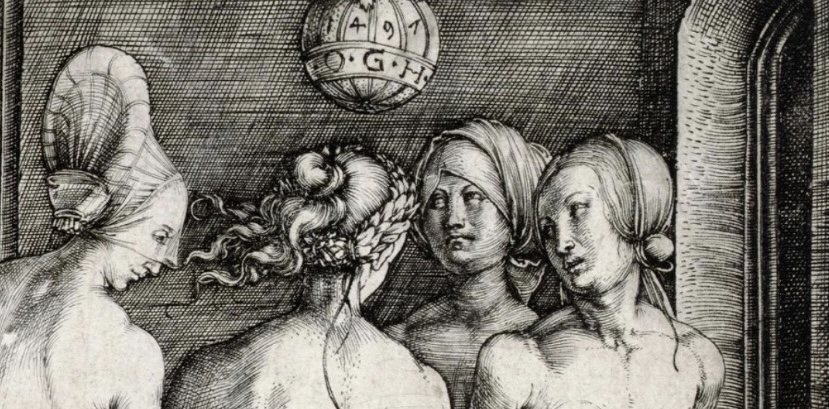
Dürer, Albrecht. «The Four Witches» 1497 Engraving.
I decided to start with this engraving because its title immediately raises a question. Without knowing that the work is traditionally called «The Four Witches, ” can one determine who is depicted on their own? At first glance, we see four nude women. They are standing close to each other, and their bodies are shown from various angles. One figure is turned away, another in profile, while the others allow for different views of the female form. It is particularly interesting that the women do not appear frightening. The artist pays close attention to body proportions, hand placement, and head orientation. The nudity here is more reminiscent of the Renaissance artists' interest in human anatomy and classical models.
Consequently, we have an example where the image itself does not allow us to unequivocally identify the characters as witches. This ambiguity is important for the study: beauty does not contradict the witch archetype, nor does it prove its presence.
What I found out?
Before comparing young and old witches, one must first understand what characteristics allow a depicted woman to even be considered a witch. Identifying a witch requires supplementary elements, primarily action and attributes.
III. Old Age and the Disruption of Natural Order
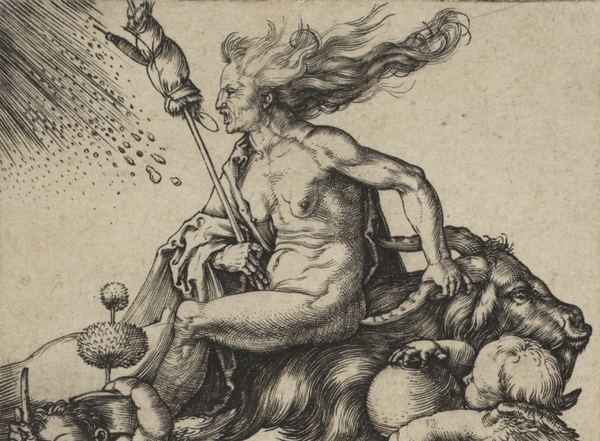
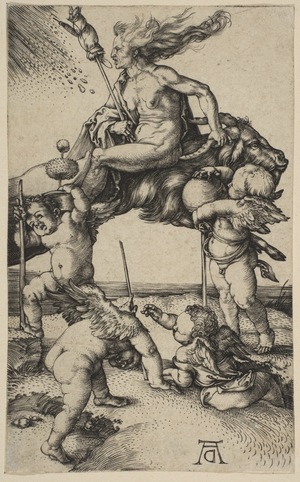
Albrecht Dürer. «The Witch on the Donkey.» c. 1500–1501. Engraving on copper.
After «The Four Witches, ” I felt compelled to see how the same artist depicted a woman whose connection to witchcraft was far more explicit. What immediately catches the eye in this engraving is the sense of movement. An elderly woman sits backward on a goat. Her hair flies out, and the animal seems to rush through space.
How does an artist portray old age?
Dürer does not idealize the witch’s body. Unlike the women in the previous engraving, age-related changes are noticeable here. The artist uses them as part of the figure’s plastic characterization.
Animal as an attribute
The goat becomes part of the magical action. Its movement connects the human figure with the world of fantasy.
Comparison with the previous engraving