Navigation
- Concept
- Bruegel’s Artistic Method: A World of Multiple Stories
- «Dutch Proverbs»: The Character as Visual Metaphor
- «Children’s Games»: Everyday Life as Infinite Visual Narrative
- «The Battle of Maslenitsa and Lent»: Supporting Characters as Participants in Social Conflict
- «Peasant Wedding»: Supporting Characters as a Source of Humor and Observation
- «Peasant Dance»: Individual Gesture Within Collective Action
- How Bruegel Manages Viewer Attention
- Conclusion
- Bibliography
- Image Sources
Concept
In the history of art, there are works whose meaning is revealed almost instantaneously: the viewer immediately understands what is happening, who the main character is, and what event is depicted. But the paintings of Pieter Bruegel the Elder are organized differently. At first glance, his paintings seem to be simple depictions of everyday life. People gather for holidays, play, work, converse, eat, dance, and carry out routine activities. However, beneath this superficial simplicity lies an extraordinarily complex organization of the image.
This research explores how secondary characters evolve into independent elements of visual storytelling and how they affect the overall perception of the artwork.
The primary materials examined are works by Pieter Bruegel the Elder: «The Netherlandish Proverbs, ” „Children’s Games, ” „The Battle of Maslenitsa and Lent, ” „Peasant Wedding, ” and „Peasant Dance.“
The Artistic Method of Bruegel: A World of Many Stories
Unlike many artists of the era who built compositions around a single central character or event, Bruegel often created images where meaning was distributed across numerous vignettes.
His compositions resemble a theatrical stage where different actions unfold simultaneously. In one area, characters participate in a festive parade; in another, they argue, play, or perform daily chores. Each vignette possesses its own dynamism, yet all exist within a single visual space.
Pieter Bruegel the Elder. «Bearing the Cross,» 1564
Bruegel’s primary artistic device is the organization of an image as a multitude of interconnected, yet not always overtly related, narratives.
In this context, the secondary character ceases to be merely background filler. They become the carrier of a distinct action that the viewer can discover and interpret on their own.
«Dutch Proverbs»: Character as a Visual Metaphor
Pieter Bruegel the Elder. «The Dutch Proverbs, ” 1559
In the painting «Dutch Proverbs,» a village is depicted where dozens of people perform strange, illogical, or contradictory actions. One character literally embodies a well-known expression, another commits a senseless act, and a third is involved in a mundane situation that holds a metaphorical meaning.Bruegel translates language into imagery: proverbs, sayings, and fixed expressions become human actions.
In the painting, one can observe a character banging their head against a wall. At first glance, this action seems absurd. However, it illustrates an expression related to persistence in a useless or clearly futile endeavor. Such episodes demonstrate an important principle of Bruegel’s artistic method: a character may be depicted not so much for their own character as for the visualization of a specific model of human behavior. Moreover, the action does not necessarily require explanation. The viewer must independently establish the connection between the depicted act and its possible meaning.
Many characters in «Netherlandish Proverbs» perform actions that can be viewed as independent micro-narratives. They do not form a single narrative in the traditional sense. Instead, the painting presents numerous discrete situations connected by a shared interest in human folly, habits, mistakes, and contradictions. It appears that Bruegel is not simply illustrating individual proverbs, but organizing them into a complex system of visual relationships. It is the interrelation of the episodes, rather than merely their quantity, that becomes an important component of the work’s meaning.
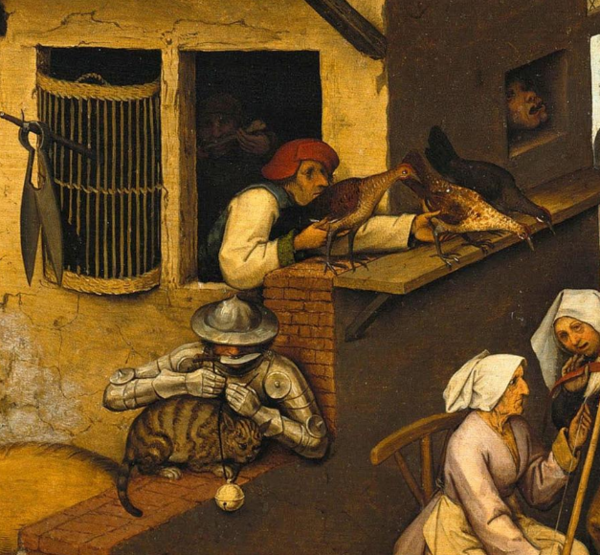
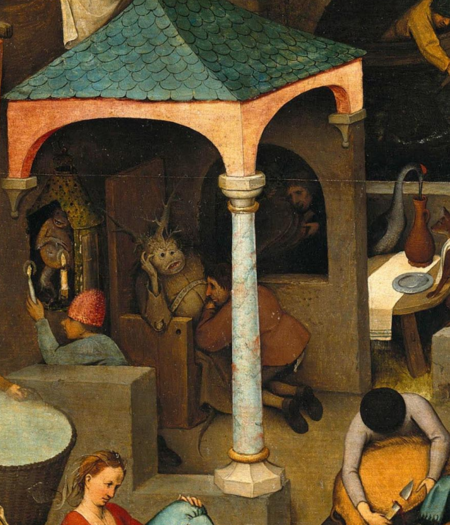
In «Dutch Proverbs,» the viewer cannot be satisfied with a single episode. Each new figure unlocks another layer of meaning. Mundane actions take on a metaphorical significance, characters become carriers of human mistakes and habits, and a multitude of individual vignettes coalesce into a unique portrait of human behavior—the viewer himself becomes an investigator of the imagery.
Thus, the secondary characters here do not merely supplement a pre-existing plot; they create the narrative of the work itself.
«Children’s Play»: Everyday Life as Endless Visual Narrative
Pieter Bruegel the Elder. «Children’s Games,» 1560
«Children’s Games» is one of Bruegel’s most vivid works, demonstrating his ability to transform everyday activities into a complex composition.
The painting depicts a vast number of children engaged in various games. They are running, jumping, rolling, building play structures, imitating adults, participating in contests, and interacting with one another.
However, the work is not organized around a single main event. There is no single character demanding the viewer’s exclusive attention.
Instead, the entire composition functions as a kind of encyclopedia of human activity.
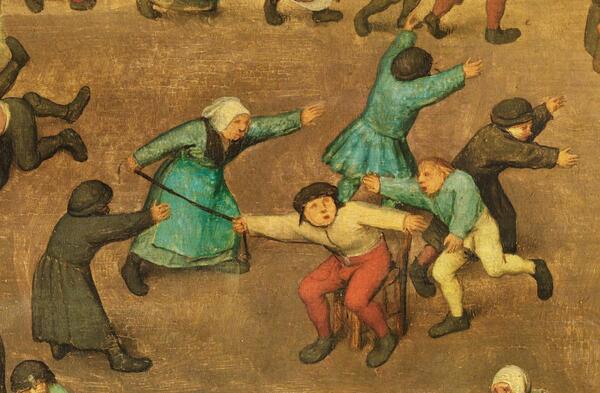
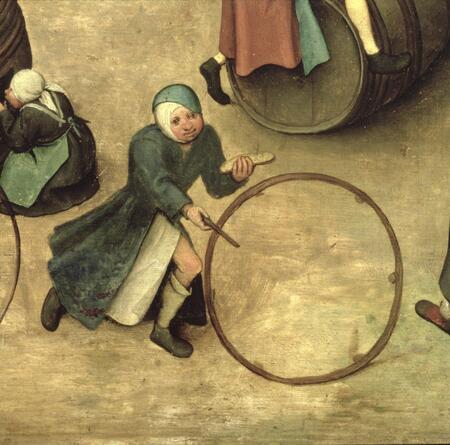
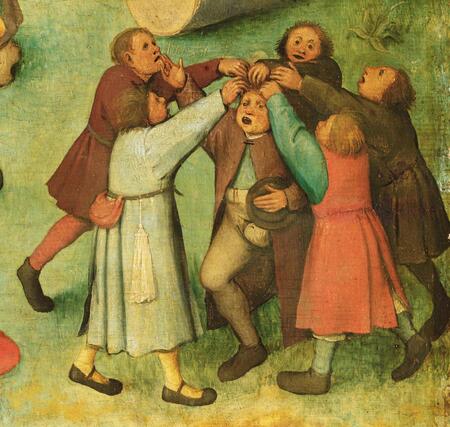
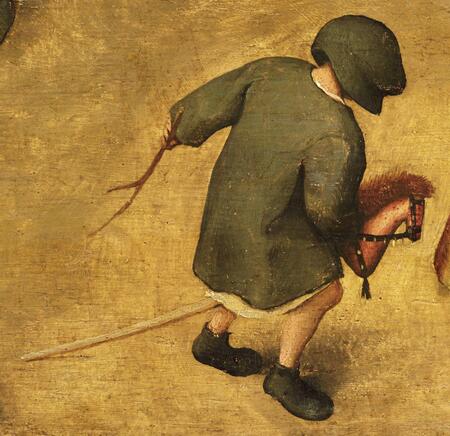
Each group of children creates a distinct scenario.
For example, playing with a hula hoop requires movement and coordination. Walking with a walker demonstrates an attempt to maintain balance. Tug-of-war transforms into a competition where collective effort and role distribution are crucial.
At first glance, these activities seem unrelated. But Bruegel unites them in a single painting, illustrating the diversity of human activity.
The difference between the characters is also important. Even within a single game, the children behave differently: some participate actively, some observe, some showcase their abilities, and some remain on the sidelines.
This reveals that the artist is depicting not merely a collection of games, but a system of human interaction.
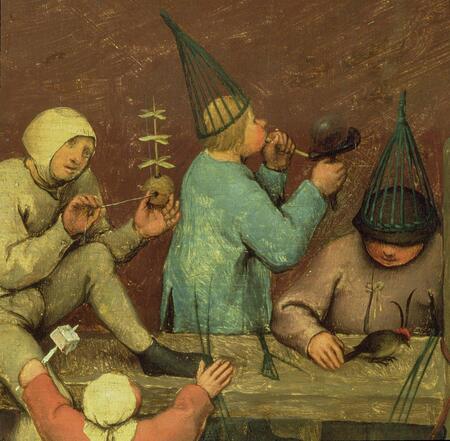
If individual groups of children were removed, the composition would lose a significant part of its content.
Each figure introduces a new type of action, a new rhythm, and a new behavioral variant. Collectively, they form a sense of a rich, continuously active environment.
The viewer doesn’t just look at the painting—they navigate through it, choosing their own paths of attention and discovering new scenes.
A secondary character may be important not only for symbolic meaning but also for contributing to the overall visual structure of the work.
An important aspect is that children’s games resemble adult activities. Some episodes depict wedding ceremonies, competitions, domestic tasks, and rituals.
The children seem to be reproducing society in miniature.
This allows the painting to be interpreted not only as a depiction of recreation but also as an observation of how human habits are assimilated through play.
«The Battle of Maslenitsa and Lent»: Secondary Characters as Participants in a Social Conflict