Table of Contents
1. Concept
2. Hypothesis
3. Symbol of Morality
4. Window into Another Space
5. Attribute of Beauty and the Feminine Image
6. Tool for Optical Experimentation and Self-Knowledge
7. Conclusion
8. Sources
Concept
The mirror—an object that at first glance appears to be a common piece of interior decor or an everyday attribute that we often fail to notice. However, in 15th–16th-century European painting, it acquires a much more complex and multifaceted meaning. Artists use it not only to depict a person’s appearance but also as a symbol capable of revealing hidden meanings within the work, expanding the picture space, and creating additional visual connections.
Interest in this subject stems from the fact that the mirror in painting can perform several functions simultaneously. It becomes a symbol of vanity and human weakness, a reminder of life’s transience, and an attribute of beauty and prudence. Furthermore, the reflection allows the artist to depict what cannot be seen directly within the main composition: the space behind the viewer, figures outside the painting, or interior details. In some works, the mirror transforms into a tool for exploring optics and the possibilities of pictorial representation.The study examines works by European artists from the 15th–16th centuries in which the mirror occupies a significant place in the composition and fulfills a specific semantic or artistic function. Primary focus is placed on the painting of the Northern Renaissance and the Italian Renaissance, as it was during this period that artists experimented most actively with conveying space, light, reflections, and symbolic details.The material was selected based on the principle of visual similarity and difference: in each section, works are juxtaposed where the mirror is used to express a similar idea. This approach allows us to see how the same object could acquire entirely different meanings depending on the subject matter, the positioning of the characters, and the surrounding details.
The research is divided into four thematic directions: the mirror as a moral symbol, the mirror as a means of spatial expansion, the mirror as an attribute of beauty, and the mirror as a tool for optical experimentation. Each section examines several works, allowing a trace of the development and transformation of the mirror’s image and its symbolism over two centuries.
Why did painters of the 15th–16th centuries include mirrors in their works, and how did their meaning change depending on the artistic and narrative context?
Hypothesis
In Renaissance painting, the mirror transcends its function as a depiction of an ordinary object to become an independent artistic instrument. It can reveal a person’s inner state, serve as a memento mori, accentuate beauty, expand the pictorial space, or demonstrate the artist’s mastery. Its meaning is determined not by the object itself, but by the beholder—what is reflected, and what role the reflection plays within the overall composition.
The Mirror as a Moral Symbol: Vanity, Prudence, and Death
In European painting, the mirror was often used as a symbol connected to human qualities and moral choice. It could represent vanity, self-admiration, and an excessive focus on one’s own appearance. However, in other works, the mirror acquired the opposite meaning—becoming an attribute of prudence, self-knowledge, and the ability to foresee the consequences of one’s actions.
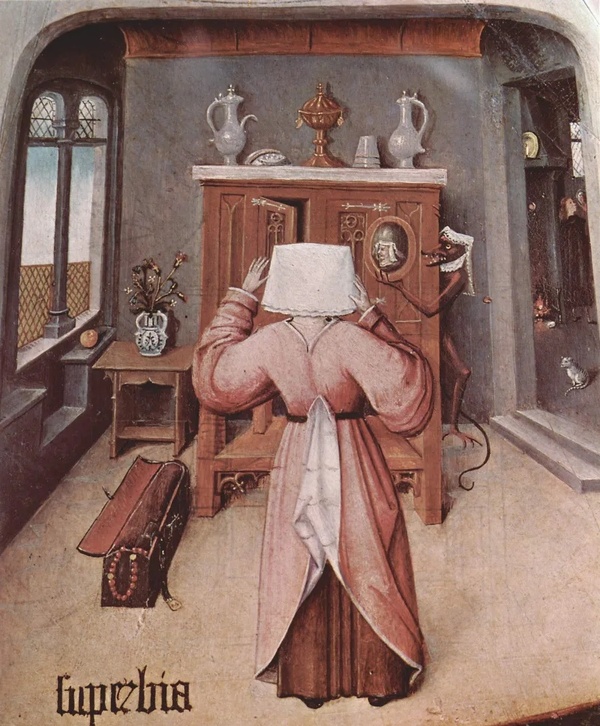

Hieronymus Bosch—“The Seven Deadly Sins, ” «Pride, ” circa 1480.
In Hieronymus Bosch’s work «The Seven Deadly Sins,» a mirror appears in the scene associated with pride. A woman is viewing her reflection, while a demon stands behind her, holding the mirror. It becomes a symbol of vanity and human obsession with one’s own appearance because she sees only herself, unaware of the demonic presence.
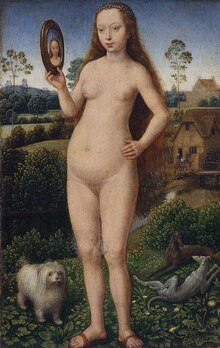
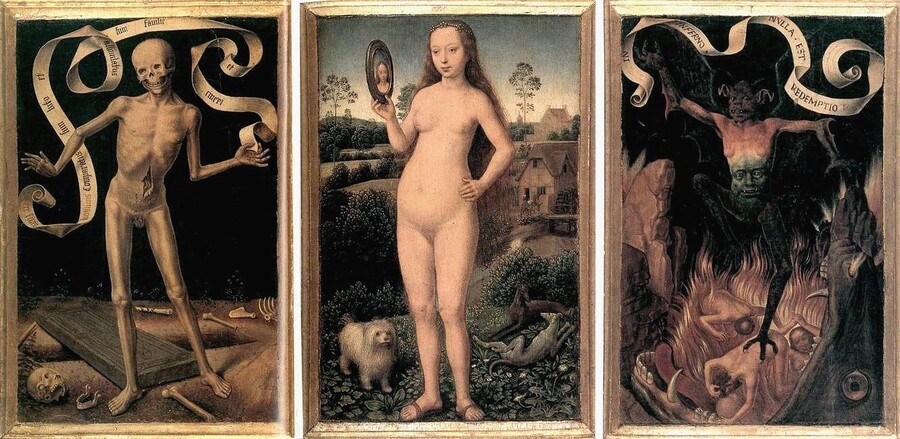
Hans Memling—"Earthly Vanity and Divine Salvation,» on the right—the front side of a triptych; on the left—"Vanity,» circa 1485.
A similar meaning is reflected in Hans Memling’s work, «Earthly Vanity and Divine Salvation.» The nude female figure holding a mirror personifies earthly beauty and its transience. Here, the mirror emphasizes the link between outward attractiveness and vanity, serving as a reminder that physical beauty is not eternal.
Philips Galle after Pieter Bruegel the Elder’s drawing—“Prudence, ” c. 1559–1562.
However, the mirror could also carry a positive significance. In Phillips Galle’s engraving, based on a drawing by Pieter Bruegel the Elder, «Prudence, ” it becomes an attribute of the virtue itself. The figure holds the mirror as a symbol of circumspection and self-knowledge: one must carefully evaluate the surrounding world and one’s own actions.
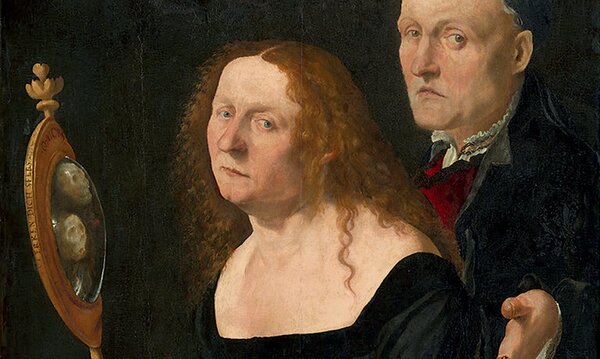
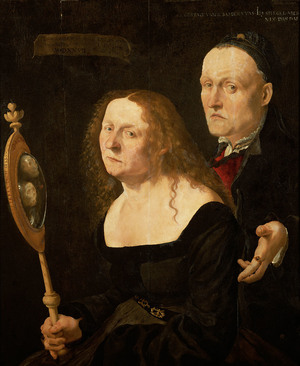
Laurs Fürtenagel — «Hans Burgkmair and his wife Anna, ” 1529.
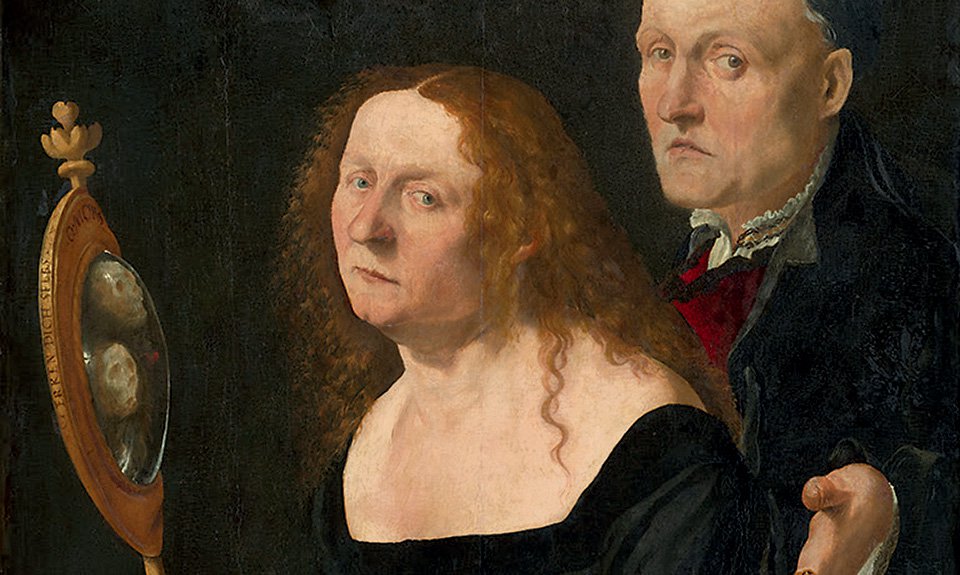
The mirror takes on a darker significance in the portrait of Hans Burgkmair and his wife Anne, created by Lukas Furtenagel. Instead of reflecting living faces, two skulls appear in the mirror. This unusual image transforms the mirror into a reminder of the inevitability of death and the fleeting nature of human life. Outer beauty and earthly prosperity prove to be transient.
The mirror in moral painting does not carry a single meaning. It can signify vanity, prudence, or serve as a reminder of death. Its significance is shaped through the comparison of the reflection with the figure of the person and the overall concept of the artwork.
The Mirror as a Window into Another Space
One of the most unusual functions of the mirror in 15th–16th-century painting is its ability to depict space existing beyond the main composition. Through reflection, the artist can incorporate additional figures, objects, and parts of the interior into the painting that would otherwise be invisible.
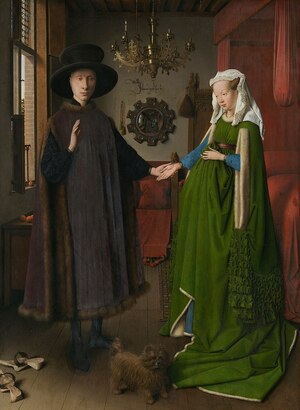
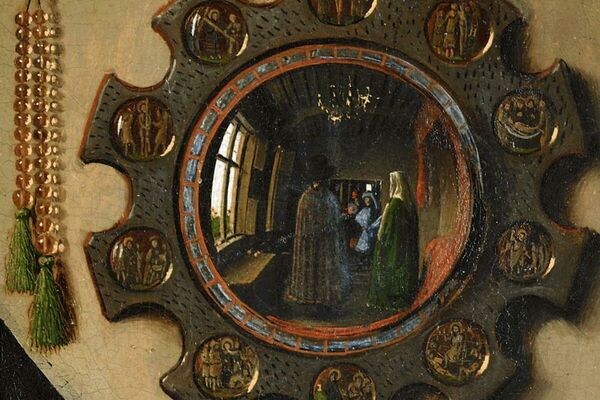
Jan van Eyck — «The Arnolfini Portrait, ” 1434. On the right is a detail of the mirror.
This technique is especially vividly demonstrated in Jan van Eyck’s «The Arnolfini Portrait.» Positioned in the center of the back wall is a small convex mirror, which reflects the figures of the couple from behind and two people standing at the room’s entrance. Thus, the mirror does not merely reproduce the already depicted scene; it expands it, allowing the viewer to perceive the space from a different vantage point.
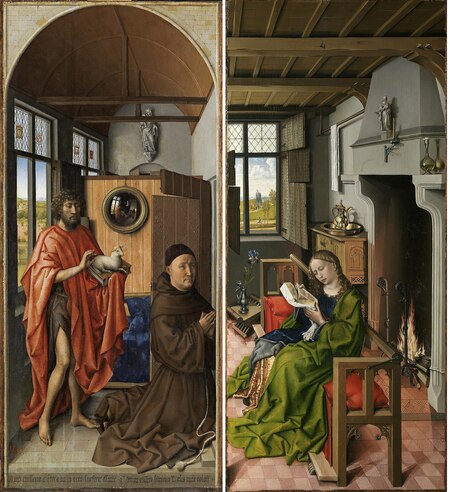
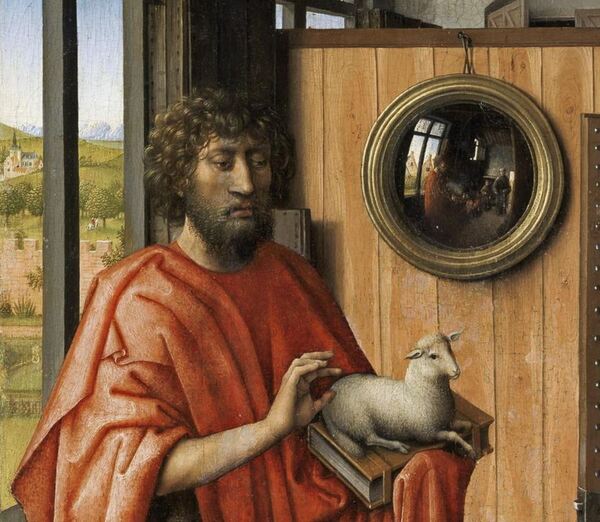
Robert Campin or the Campin workshop — «The Verle Triptych, ” 1438. To the left are two surviving wings of the Verle Altarpiece; to the right is a detail of the mirror.
A similar technique is used in Robert Campin’s work, «Saint John the Baptist and the Donor Henry van der Velde.» A small convex mirror reflects the room’s space and the figures situated outside the main image. This allows the viewer to gain additional information about the surrounding environment, as if looking into the depicted interior.
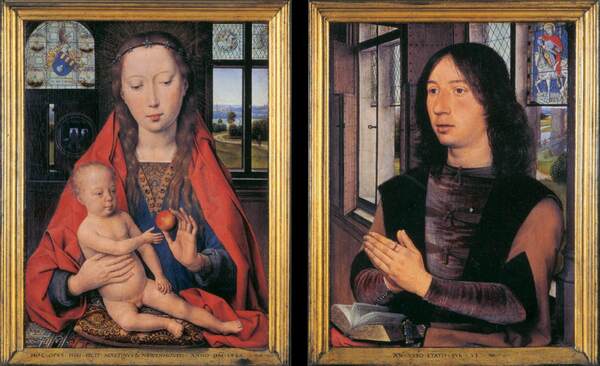
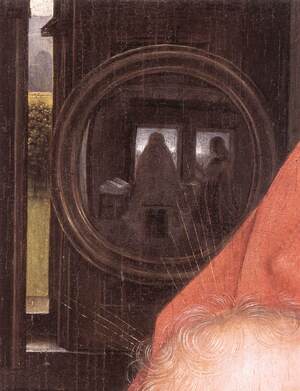
Hans Memling — «Diptych of Maarten van Nieuwenhove,» 1487. On the right is a detail of the mirror.
In Hans Memling’s «Diptych of Martin van Nieuwenhove, ” the mirror also plays a crucial spatial role. Within its reflection, the Virgin Mary and the patron are visible within the chamber. This reflection connects the separate sections of the diptych and creates a sense of unified space, despite the composition being divided into two panels.
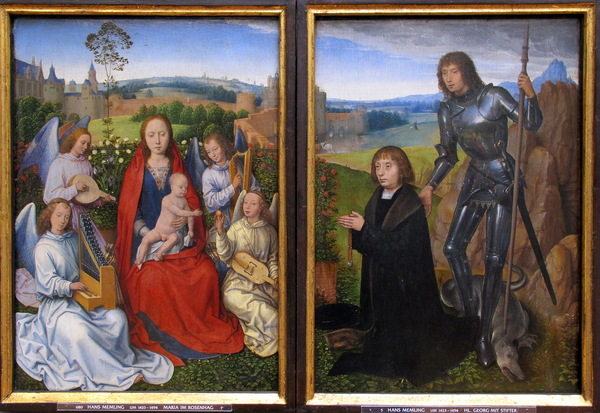
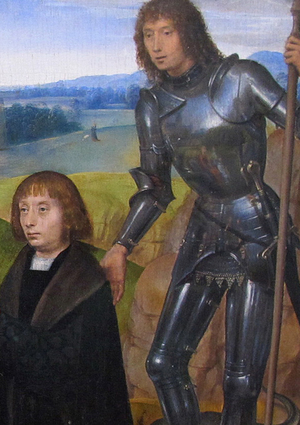
Hans Memling — «Diptych from Munich,» right panel «Saint George and the Donor,» c. 1480. To the right is a reflection detail.