«…so that through the means of a straight line one might grasp with reason an invisible line, because in this way the internal concept finds expression in the external work» [1]
The Northern Renaissance is often studied through its intricate symbols, biblical narratives, and philosophical enigmas. However, beneath the depth of Albrecht Dürer’s imagery lies, first and foremost, his mastery of drawing and printmaking techniques. At the turn of the 15th and 16th centuries, the artist elevated engraving to a new level of expression, transforming line into the primary tool for constructing form. This study is focused on the technique itself: how Dürer uses only line and hatching to convey different materials, light, and spatial depth without employing color.The selection of material serves two purposes. First, the collection includes sheets executed in two distinct techniques—xylography and engraving—to compare the expressive capabilities of line in each. Second, each of the six thematic groups addresses a unique challenge solved through line work: contour and rhythm in the xylography series «Apocalypse»; rendering skin and hair in «Adam and Eve»; depicting metal and wool in «Knight, Death, and the Devil»; conveying light and depth in «Saint Jerome in His Cell»; capturing intense mood in «Melencolia I»; and building texture without a model in «Rhinoceros.» All eight selected sheets were created between 1498 and 1515, meaning they fall within the same period, and are available in high resolution within open museum collections, allowing for detailed examination of individual strokes on large fragments.
Key research question: How does Dürer convey different materials, the volume of space, and the mood of his engravings using only a black line on white paper? The hypothesis is that Dürer’s hatching does not simply outline objects, but rather constructs volume, light, and the emotional structure of the page, acting as the master’s primary artistic language. To visually test this hypothesis, the study uses a direct comparison of two prints. Comparing the horse from the woodcut «Four Horsemen» with the horse from the copperplate engraving «Knight, Death, and the Devil» allows us to demonstrate how the transition from wood to copper alters the possibilities of the line within the same image.
Index
I. Line on Wood: Contour, Rhythm, Parallel Hatching (Leaves from the «Apocalypse» Series, 1498) II. Line on Copper: Skin, Hair, Fur («Adam and Eve,» 1504) III. Metal, Fur, Fabric: Composition and Texture («The Knight, Death, and the Devil,» 1513) IV. Light and Space: Interior Construction («Saint Jerome in His Cell,» 1514) V. Line and State: Chiaroscuro Contrast («Melancholy I,» 1514) VI. Invented Texture: Formal Convention («Rhinoceros,» 1515)
The logic of the sections is built on two principles: the transition from the properties of the wood to artistic problems and the progression from simple physical textures to complex states. The first section examines woodcut engraving, where the line depends on the properties of the wood. The following four sections showcase copper engraving—a more delicate technique that allowed Dürer to sequentially address the challenges of rendering the human form, metal, daylight, and psychological tension. In the finale, the study returns to wood using the example of the «Rhinoceros,» where the texture is constructed using a system of hatching without relying on nature, thus completing the work’s structure.
I. Line in the Tree: Contour, Rhythm, Parallel Hatching
In woodcut, the line remains convex on the surface of the wooden block, so it functions primarily through a clear contour and a dense rhythm of parallel hatching.
The series «Apocalypse,» published in 1498, was executed using woodcut technique. The artist transfers the design onto a smooth wooden block, and then the background around the lines is carved away with a knife: when printed, the ink settles onto the remaining raised ridges. Researchers note that Dürer himself drew the detailed design onto the block, but the carving itself was done by professional wood engravers, who had to precisely cut the complex system of parallel and cross-hatched lines.
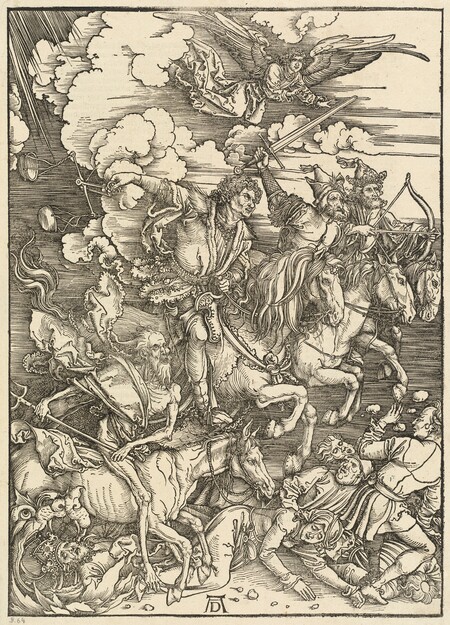
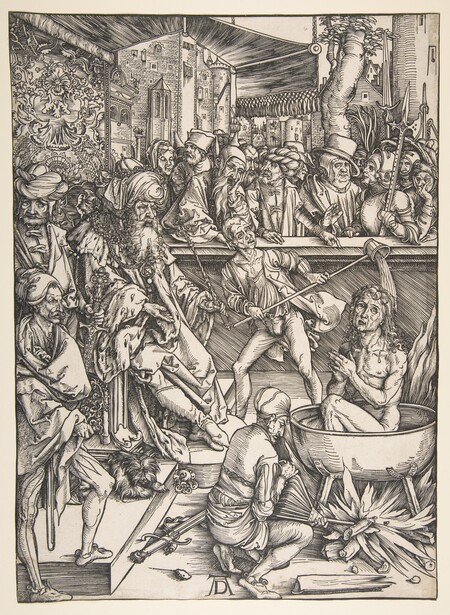
Albrecht Dürer. «The Four Horsemen, ” 1498; Albrecht Dürer. „The Martyrdom of Saint John, ” 1498
In the overall composition of both works, the structure is built upon the contrast between crisp outlines and uneven hatching density. In «The Four Horsemen,» the densest masses of lines are concentrated in the upper part of the sky behind the figures and in the dark lower-left corner, while the riders themselves in the center are accentuated by light areas of paper. In «The Martyrdom of Saint John,» the same principle organizes the multi-figure scene: foreground figures are modeled with short strokes featuring open white passages, while the background, with its architecture and landscape, is densely rendered with frequent parallel lines.
Albrecht Dürer. Fragment of «The Four Horsemen,» 1498
At the top of the page, the sky is constructed from long, parallel horizontal strokes of varying lengths, establishing a motion from left to right. The edges of the clouds are outlined with a continuous contour, while their lower portions are darkened with short, straight strokes, giving the silhouettes volume. The direction of the lines changes on the angel’s wings: long radial strokes radiate from the base of the wing and are complemented by short transverse notches between the feathers. This technique allows for the depiction of the different textures of the clouds and plumage without soft shading, relying solely on the rhythm of the lines on the wooden board.
Albrecht Dürer. Fragment of «The Four Horsemen,» 1498
The figure of the Death horse is constructed using angular contours and short, sharp strokes that emphasize the animal’s gauntness. Parallel lines running along the chest and neck follow the form of the ribs and tendons, while the white gaps between them create a stark contrast. In contrast to the rounded, densely shaded flanks of the neighboring horses, here the line fragments the surface into sharp facets, intensifying the composition’s tension.
Albrecht Dürer. Fragment of the painting «Martyrdom of Saint John,» 1498
In «The Martyrdom of Saint John, ” the varied character of the line work allows for a distinction between the animal’s living fur and the heavy, ornamented fabric. On the dog’s back and paws, short, curved dashes are laid along the direction of the hair growth, creating a soft, uneven surface. In contrast, the ornamented fabric is constructed from a combination of even pattern contours and straight vertical strokes that convey the density of the heavy material.
Albrecht Dürer. Fragment of «The Woman Clothed in the Sun and the Seven-Headed Dragon,» 1498
In the sheet titled «Woman Clad in Sun and Seven-Headed Dragon, ” the juxtaposition of two types of line organizes the entire composition. Rays extend from the central figure with strict, straight lines of varying lengths, leaving wide bands of white paper between them, which are perceived as a bright luminescence. In contrast, the body of the seven-headed dragon in the lower part of the sheet is filled with dense, short strokes and semicircular scales, making the figure appear dark and heavy against the light sky.
Woodcut allows for a crisp contour, expressive rhythm, and sharp contrast between light and shadow, but the thickness of the relief line prevents smooth tonal transitions. Etching on copper overcomes these limitations, as a fine line can convey subtle gradations of light and shadow and complex surface textures.
II. Line on Media: Skin, Hair, Fur
Unlike woodcut, where the line remains raised on the block, in intaglio engraving, the line is cut into the copper plate, and the ink fills these grooves during printing. The burin allows for very fine lines and variation in pressure, enabling the hatching to convey smooth transitions from light to shadow. Dürer demonstrates these capabilities in «Adam and Eve, ” where the composition features skin, hair, bark, foliage, and animal fur side by side.
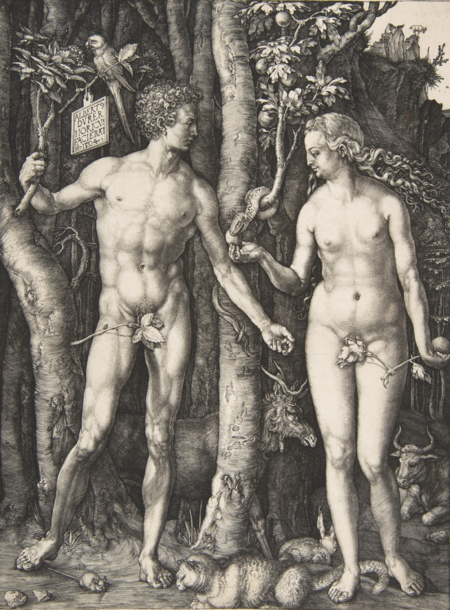
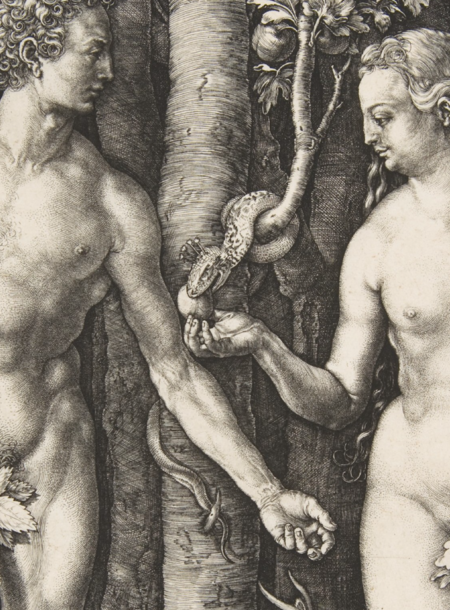
Albrecht Dürer. «Adam and Eve, ” 1504; Albrecht Dürer. Fragment of „Adam and Eve, ” 1504
Even on a general level, the figures of Adam and Eve read as light silhouettes against the dark background of the forest. The bodies are constructed with smooth contours and sparse, fine cross-hatching, while the forest consists of a dense network of intersecting lines. The contrast between the smooth skin and the complex natural textures divides the planes and establishes the main principle of the sheet: with a single tool, Dürer creates diverse surfaces.
Albrecht Dürer. Fragment of «Adam and Eve,» 1504
On Adam’s torso, the hatching follows the form of the muscles: the lines repeat the curve of the chest, abdomen, and shoulders. In illuminated areas, the lines are sparse and fine, and the white paper itself acts as a light source. As the shading progresses, the hatching thickens, and the line directions intersect. Thus, Dürer does not outline the figure; he builds its volume from numerous fine strokes.
Albrecht Dürer. Fragment of «Adam and Eve, ” 1504
Eva’s modeling system yields a different result. The hatching on her torso, chest, and legs is softer and less dense, and the contours are smoother, giving the figure a lighter and calmer appearance than Adam’s tense body. The difference is achieved not through a new technique, but through the density and direction of the same strokes.
Albrecht Dürer. Fragment of «Adam and Eve, ” 1504
The bark of the central tree is constructed from short, horizontal, slightly curved strokes of varying length and density, creating the sensation of a rough surface. The branches and leaves are conveyed with fine, sinuous lines that follow the contours of the forms. The contrast between these two rhythms allows the viewer to distinguish the solid bark from the delicate, uncolored foliage.