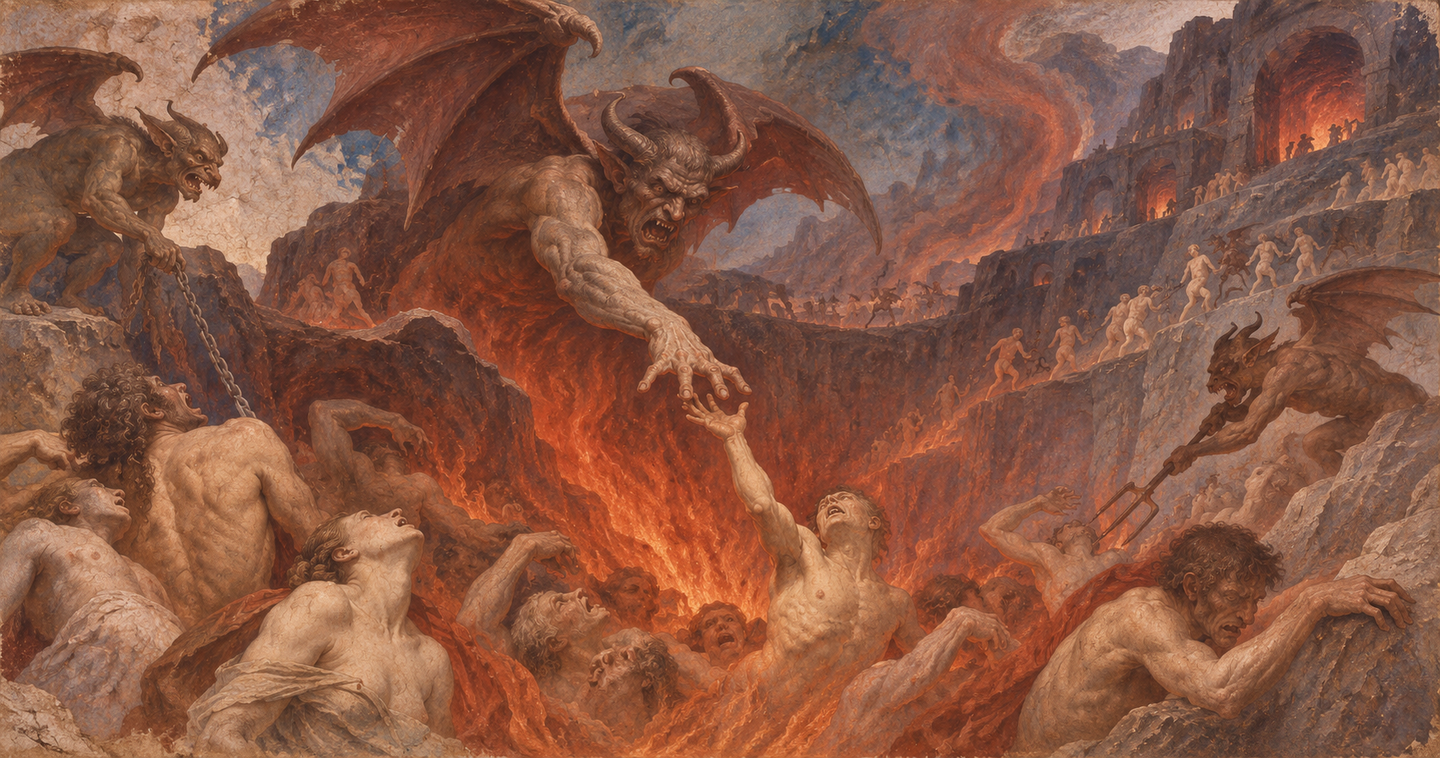
As an image
Representations of Hell and the Punishment of Sinners in Italian Monumental Painting of the 14th–16th Centuries.
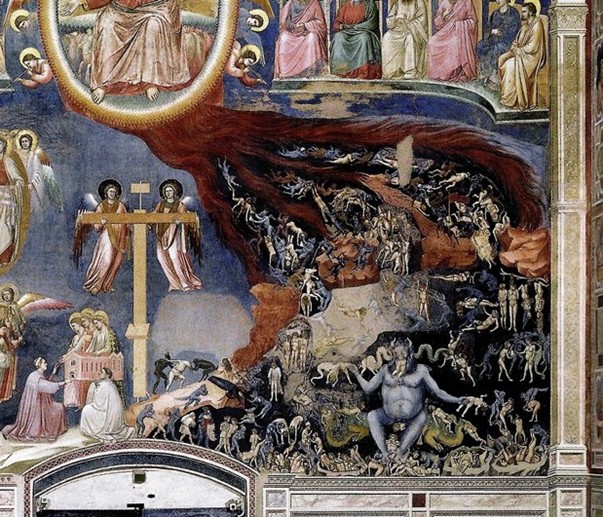
Giotto. «The Last Judgment, ” circa 1305–1306. Scrovegni Chapel, Padua. Fragment of the infernal zone; detail from a reproduction.
Concept and Selection of Works
The same theme, but the depiction of Hell on frescoes looks completely different—that surprised me the most. With Giotto, it turns into a dense, dark section of the «Last Judgment, ” where a single figure captures almost all attention. Narodo di Cione divides the space into distinct areas. Signorelli, on the other hand, is frightening in how one body pulls another along: there is no fire, but it is clear that the figures cannot escape. I was not interested in listing the sins when selecting the theme. It is more interesting to analyze how painting constructs fear: where the artist places the sinners and how large they paint them. The gestures that draw our gaze are equally important. That is what I am specifically tracking. Above all, I want to find out what happens to the role of the human figure from century to century. For comparison, I selected four monumental Italian frescoes from the 14th–16th centuries. Giotto’s „Last Judgment“ in the Scrovegni Chapel in Padua. Narodo di Cione’s „Hell“ in the Strozzi Chapel in Florence. Luca Signorelli’s „The Descent of Sinners into Hell“ in Orvieto. Michelangelo’s „Last Judgment“ in the Sistine Chapel. Religious space and the theme of posthumous judgment connect all four works, but I deliberately chose compositions that were dissimilar. Giotto dedicates a section of an entire wall to Hell, whereas Narodo meticulously unfolds its structure within a single fresco. Signorelli focuses on the torment of the bodies. Michelangelo incorporates the demise of the sinners into a massive picture of judgment. This selection allows for a comparison not only of the subject matter but also of the methods used to portray it.
Question, Hypothesis, and Method
How did the depiction of Hell evolve from the 14th to the 16th century, considering composition above the textual descriptions of punishments? That is the central question of my research. Before comparing, I assumed that artists gradually paid more attention to the human body, and in the later masters' works, the body seems to narrate the story itself—through posture and weight, especially in contact with another body. This premise is too easily oversimplified. Tense gestures were present in Giotto, and even in Michelangelo, despite the multitude of figures, the entire composition is organized with great rigor. Therefore, I do not test the idea of «constant development.» Instead, I investigate the differences between specific artistic choices. This requires examining both the entire fresco and individual scenes. My method begins with simple observation: I view the fresco in its entirety before zooming in on details. From the overall view, I note where the boundaries of the Hellish zone lie and the direction of the main movements, while separately documenting the placement of major figures. Up close, my focus shifts to the action—who is holding whom and which body parts overlap. This is where the feeling of confinement originates. Then, I compare the works based on identical criteria so that the comparison does not reduce to a general impression of «scary» or «not scary.» I verify the dates and locations of the frescoes using catalogs and museum records [1]–[4]. I refer to Dante’s Divine Comedy when I need to understand specific motifs, but I do not seek a precise illustration of his lines on the wall under any circumstances. There is one more caveat. Photography allows for detailed inspection, yet the actual fresco is much larger. Therefore, any conclusions about the impact on the viewer must be verified through the overall experience.
What Counts as Hell
You can discern Hell in Giotto’s fresco through the depiction of Satan, seated among a multitude of tormented figures. Michelangelo’s «Inferno» lacks such clearly defined chambers; at first glance, I see bodies plunging downward. The fate is singular, though the methods of presentation differ. One artist illustrates the place of punishment, while another foregrounds the very act of descent. Therefore, searching only for demons and suffering is insufficient for me. I will track precisely where the hellish portion begins and how it connects to the rest of the composition. Sometimes the meaning is hidden in the boundary between two groups. Other times, it lies in the direction of the falling body.
Giotto
Страшный суд
Giotto. «The Last Judgment, ” c. 1305–1306. Cappella Scrovegni, Padua. Fragment of the infernal zone; detail from a reproduction.
The Contrast of Order and Chaos
If you glance across the entire wall, you can see how clearly Giotto divides the character groups. In the infernal section, the empty spaces are almost gone—the bodies are pressed together so densely that the eye is constantly searching for where one figure ends and the next begins. If you compare it, the left side of the fresco intensifies this effect. You can’t call it absolute chaos here, though. The colossal seated Satan gathers numerous smaller events around himself. The contradiction is curious: the interior of the hellscape is disorganized, yet the composition possesses a very noticeable center.
Giotto. «Last Judgment, ” c. 1305–1306. Scrovegni Chapel, Padua. Fragment of the infernal zone; detail reproduction.
The Figure of Satan
Below, among the sinners, sits Satan, yet his scale vastly overwhelms them. A heavy, dark figure stands out against the backdrop of tiny bodies. Looking at it, I first perceive hell as a space where humanity is profoundly small and defenseless. Satan’s posture and his placement on the wall are clearly visible in the reproduction [6].
As you zoom in on the fresco, the people surrounding the seated Satan appear almost toy-like. Some lie at his feet, while others are dangerously close to his monstrous jaws. It is unnecessary to render every face in detail here. The disproportion itself explains where the power resides.
Giotto. «The Last Judgment, ” detail: Satan and the punishments of sinners. Individual photograph provided for study.
Absorption
Satan devours sinners, and this is visible in the magnified fragment. A human body vanishes into the maw, which appears disproportionately huge next to it. In the general view, the episode is easy to overlook. The violence is no less intense because of this.What struck me wasn’t the monster’s figure itself, but how the human disappears within it. The legs of one body are still discernible, but everything else is already swallowed by the jaws. I would not have noticed this detail without the magnification. Up close, the punishment appears much more visceral.
Giotto. «The Last Judgment, ” c. 1305–1306. Cappella degli Scrovegni, Padua. Fragment of the infernal zone; detail from a reproduction.
The Body of the Sinner
Nothing in the clothing helps distinguish sinners, as many bodies are exposed. One must look at the poses. One person is hunched over, another sharply extends an arm, and a third falls headfirst. These body positions speak volumes—external features remain silent. From a distance, people appear small next to the monsters. In a close-up fragment, the tension of individual bodies emerges. A hand, which appeared merely as a line in the overall mass, turns out to be an attempt to hold on. The viewing distance truly changes the impression of the image here.
Nardo Di Chione
Ад
Nardo di Cione. «Hell,» Strozzi Capella. General view of the fresco, individual photograph.
General view of «Ada»
The light dividers between the tiers and the color variations are noticeable even in the overall image of the fresco. The painting appears as if it were composed of separate sections. I first examine its structure, and only then do I begin to recognize the figures of the sinners within each section. This division is also mentioned in the Web Gallery of Art [7].
At the top, Charon’s boat [10] is visible, followed by dividing bands below, and in the lower portion, darker clusters of figures gather. These sections are read sequentially. The fresco resembles a map of hell, although it is far more loosely organized than a typical diagram.
Nardo di Cione and his assistants. «Ad, ” mid-14th century. Cappella Strozzi, Florence. Light borders between sections; fragment reproduction.
Division by Fields
Charon’s boat is depicted in the upper section of the fresco [10]. From there, the gaze descends to the areas with the sinners, which are separated by light boundaries. Following these lines allows one to trace where one scene ends and the next begins. Without them, many small figures would merge together.
The reddish bands are most noticeable along these light boundaries. They are repeated across different zones, unifying the painting through color. It is difficult to tell from a photograph how vibrantly they appeared in the 14th century—the condition of the surface and the lighting affect our perception.