Concept
When we look at a portrait, our attention is immediately drawn to the face. However, the hands also play a role in constructing the human image. The expressive function of gestures in painting has long been examined in art historical studies [5; 6]. What interested me is that even outwardly similar gestures in different portraits create different impressions. In one painting, folded hands appear as an extension of a calm pose, while in another, the adjacent objects draw more attention to them. This raises the question: what determines the role of hands in Italian portrait painting from the late 15th to the early 16th century? I hypothesize that this role is determined not only by the gesture itself but also by its placement within the composition and its connection to the other details. To test this hypothesis, I will compare works where the hand positioning is similar, but the pose, the space around the figure, and the interaction with objects are arranged differently.
This period was chosen because portrait construction methods changed in Italian painting. In the 15th century, both profile and three-quarter portraiture were used [3]. In bust compositions, hands often remained outside the frame, whereas broader framing allowed for the inclusion of posture and gesture within the image. The role of figure rotation and hand placement in portraiture has also been examined in art historical research [1]. My interest lies not in the history of these techniques, but in how they function within the paintings of Italian artists. The study includes paintings created approximately between 1490 and 1545. This selection allows for a comparison of diverse compositional solutions within a single artistic tradition. Furthermore, these works allow for the observation of static hands, touches, and interactions with objects. This enables an examination of the role of gestures across various situations.
The visual sequence is based on ten portraits by five Italian artists: Domenico Ghirlandaio, Leonardo da Vinci, Raphael Santi, Lorenzo Lotto, and Agnolo Bronzino. The selection includes works where the placement of hands can be correlated with posture, gaze, and surrounding objects. The works are divided into three chapters: «Hands in Composition, ” „Hands and Objects, ” and „Gesture as a Mode of Communication.“ This structure will allow for a smooth transition from static poses to more explicit interaction with objects and people. In each chapter, I will examine the paintings in their entirety, as well as magnified fragments of the hands, to compare the details within the context of the whole composition. To study the historical context, I utilize academic research on Italian portrait painting, and when examining gestures, I refer to studies dedicated to their expressive role in art. The primary focus of this work is the independent comparison of the chosen pieces.
Hands in Composition
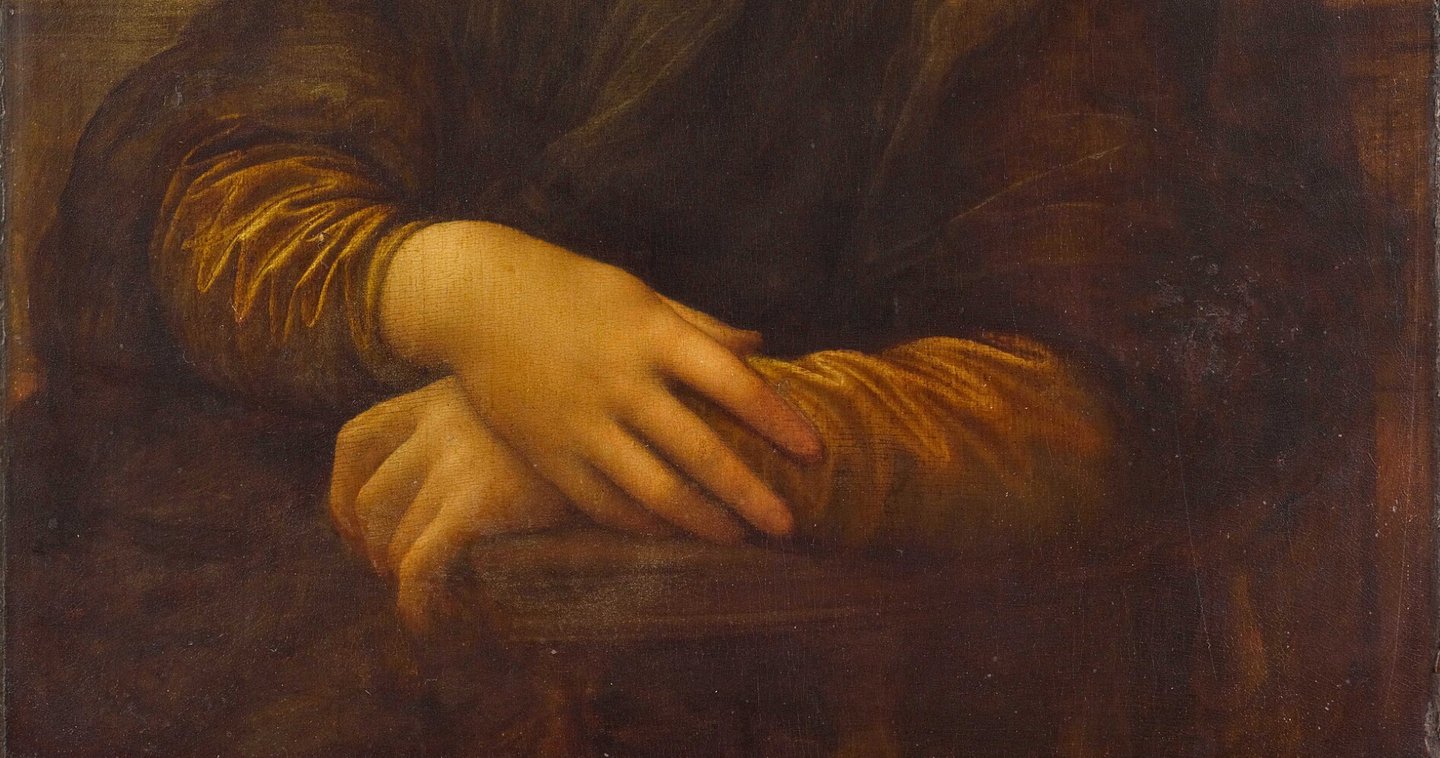
Leonardo da Vinci. «Mona Lisa.» 1503–1519. Fragment
In this chapter, I will examine portraits where the hands are not engaged in any noticeable action. They do not point to an object or address another person, yet their placement influences how the artist constructs the figure. For comparison, I have selected «Portrait of Giovanna Tornabuoni» by Domenico Ghirlandaio, Leonardo da Vinci’s «Mona Lisa,» and the portraits of the Santi couple by Doni Raphael. In all these works, the hand movements are restrained, but the construction of the portraits differs. I will try to determine exactly what changes when moving from a strict profile to a more open pose and whether we can attribute a single function to still hands across all four paintings.
Dominico Girolando. «Portrait of Giovanna Tornabuoni.» 1489–1490
In «Portrait of Giovanna Tornabbuoni, ” the figure is depicted in profile. The line of the forehead and nose, the neck, and the straight back combine to form a crisp silhouette. The arms are bent at the elbows and held together in front of the torso; they are positioned near the lower edge of the painting. Their placement does not imply action or disrupt the overall serenity of the pose.In the close-up fragment, a contrast is visible between the fair skin and the rich ornamentation of the sleeves. Furthermore, the hands occupy significantly less space than the fabric of the dress. Here, the hands are not isolated from the figure; the bent forearms continue its contours and complete the image at the bottom. Therefore, I see their primary role as maintaining the integrity of the silhouette.
Dominico Ghirlandaio. «Portrait of Giovanna Tornabbuoni.» 1489–1490. Fragment
«The depiction of gesture has served as an effective compositional tool for artists since antiquity.» [6]
Leonardo da Vinci. «Mona Lisa.» 1503–1519
In the «Mona Lisa,» the hands are placed in front of the figure, one over the other. Simultaneously, the woman’s torso is turned away from the viewer, while her head faces almost straight ahead. Because of this composition, the hands are perceived not as an extension of the flat silhouette, but as a part of the figure occupying space.
Vera Zakharova, interpreting Heinrich Wölfflin, connects the sense of volume and movement in this portrait to the turn of the body and the incorporation of the hands into the composition [1]. In my view, the relationship between these two directions is particularly important. The turned shoulders lend dynamism to the pose, while the crossed hands create a serene focal point in the foreground. Unlike the portrait of Giovanna Tornabuoni, the viewer sees the hands almost entirely, and they help trace the body’s spatial position.
Leonardo da Vinci. «Mona Lisa.» 1503–1519. Fragment
«The sensation of movement is achieved by using a three-quarter turn […] The inclusion of hand imagery in the composition pursues this same goal.» [1]
Raphael Santi. «Portrait of Anolo Doni» and «Portrait of Madeleine Doni.» c. 1504–1507
The portraits of Anolo and Madalena Doni are best viewed as a pair. In both pieces, the figures are shown in three-quarter profile, and the hands are situated in the lower portion of the composition. This similarity allows for a comparison between two solutions within a similar portrait format. Anolo’s left hand rests on a wooden support, while the other is positioned lower. The lines of the arms support the asymmetrical pose of the figure. In Madalena’s portrait, the hands are folded one over the other in front of the body, forming a more closed grouping. Importantly, both portraits share a common principle: the hands are clearly visible and integrated into the foreground. However, their contours differ. This variation prevents the similar posing of the figures from appearing completely identical.
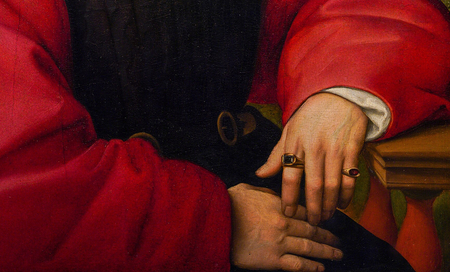
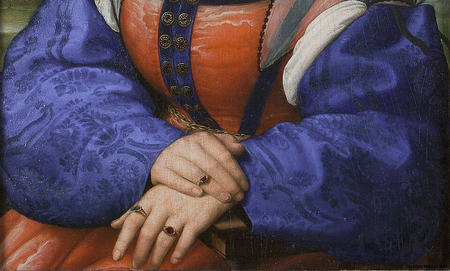
Raphael Santi. Portraits of the Doni Couple. Circa 1504–1507. Fragments
A comparison of the portraits by Girlandaio, Leonardo, and Raphael reveals that the position of the hands cannot be assessed in isolation from the angle of the subject. In Giovanna Tornabuoni’s work, the hands occupy a small area near the lower edge, continuing the closed, profile silhouette. In the «Mona Lisa, ” the brushstrokes project forward, helping to define the body’s turn. Raphael uses a similar approach to placing the hands, but he arranges them differently in the portraits of the Doni couple.A significant difference emerges here. A seemingly calm gesture does not always produce the same effect. Its role in constructing the figure changes depending on the body’s placement, the lines of the clothing, and the boundaries of the image. Therefore, it is insufficient to simply describe the hands as „folded“ or „static“; one must consider what portion of the composition they occupy and what they are visually connected to.
Domenico Ghirlandaio. «Portrait of Giovanna Tornabuoni.» 1489–1490; Leonardo da Vinci. «Mona Lisa.» 1503–1519; Raphael Santi. «Portrait of Maddalena Doni.» c. 1504–1507. Fragments
In the portraits examined, the hands play a role in shaping the figure. Sometimes they supplement the strict outline, and other times they connect the twist of the torso to the foreground. Even in paired images with a similar pose, the positioning of the hands differs. The role of gesture depends not only on the form of the hands themselves; it changes along with the construction of the figure and the surrounding elements of the painting.
Hands and Objects
Lorenzo Lotto. «Portrait of Andrea Odoni.» 1527. Fragments
Objects in portraiture can not only complement the composition but also reveal information about the person depicted. Irina Danilova examines the relationship between the human figure and objects in her study, «The Problem of Genres in European Painting» [2].
In this chapter, I will focus on portraits where hands interact with other elements of the image. For the analysis, I have selected works by Leonardo da Vinci, Lorenzo Lotto, and Agnolo Bronzino. I will explore different ways of interacting with animals and objects to determine how the placement of hands influences their role within the composition.
Leonardo da Vinci. «Lady with the Ermine.» Circa 1490
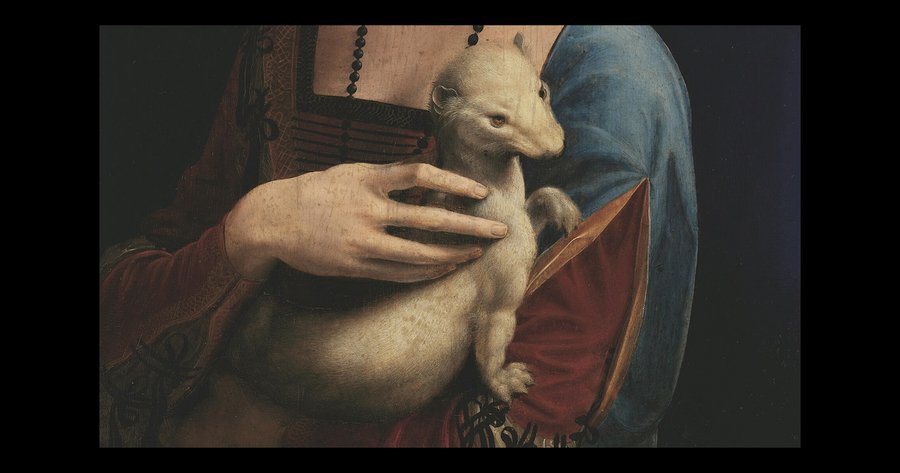
In «The Lady with the Ermine, ” the heroine’s hand rests on the animal’s back. The fingers, gently touching the creature, stand out against the light fur, and their placement helps unify the two figures into a single composition.The lady gazes to the side, and the marten’s head is directed in the same direction. However, the direction of her hand differs from the direction of her gaze. Thanks to this combination, the figure does not appear static, even though the heroine is seated in a calm pose. The touch unites the human and the animal, and their coordinated turns create a sense of shared movement.
Leonardo da Vinci. «Lady with an Ermine.» c. 1490. Fragment
«The object preserved, and indeed preserves, an internal connection with the human.» [2]