Секунда до
Как художники создают ощущение события, которое ещё не произошло.
Index
- Concept
- Form and Proportion
- Gesture and Direction of Action
- Gaze, Silhouette, and Detail
- Plasticity, Space, and Context
- Conclusion
Concept
The core of my research is the brief interval between preparation for an action and the action itself. I intend to examine works in which movement has not yet begun, or is only just about to materialize, but where the viewer already senses what is about to happen next. Using paintings and sculptures from the 15th and 16th centuries as my examples, I will study how artists convey this sensation through body posture, gestures, gazes, the distance between characters, and spatial organization.
Can one view an event that has not yet happened?
Иногда мы смотрим на неподвижное изображение, но уже представляем, что случится через мгновение.
Why do some paintings feel utterly tranquil, while others evoke a sense that something is about to happen? A person hasn’t taken a step, a hand hasn’t touched an object, the action is incomplete. Yet, we are already beginning to anticipate it. I became interested in this specific state: the brief interval between preparation and the event itself.
Гипотеза
I hypothesize that to evoke the sensation of an impending event, the artist does not necessarily need to depict the action itself. Sometimes, simply choosing a moment when the motion is poised but not yet complete is enough. During this study, I will pay close attention to body posture, gestures, gaze direction, distance between characters, and spatial arrangement. It is important to examine how these details function across different works and whether their role shifts from one era to the next.
Form and Proportion
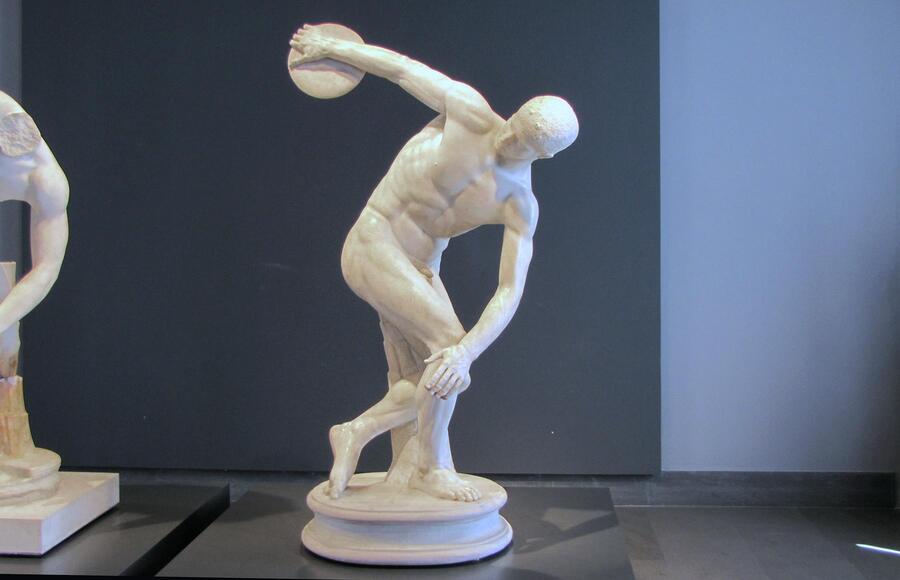
Miron. «Diskobolos» (Roman marble copy of a lost bronze original). Original—c. 450 BCE; copy—c. 140 CE.
We are presented with an athlete preparing to throw a discus. Their torso is twisted, the arm is drawn back, and the legs are anchoring the body’s weight. The throw has not yet occurred, but the pose already suggests the direction of the movement. I find it intriguing that the sculptor chose precisely this moment. The athlete is not in a typical relaxed stance, nor have they completed the throw. They seem to be suspended in the point of maximum tension during preparation.
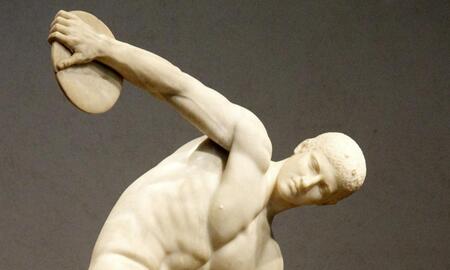
Upon closer inspection of the figure, one can observe how the individual body parts function. The shoulders are spread, the torso is inclined, one leg bears the primary weight, and the other helps maintain balance. The sculptor seems to have assembled the body from several opposing directions. Because of this, we can sense the effort required for the next movement.
Michelangelo. «David.» 1501–1504
Michelangelo depicts the biblical David before his battle with Goliath. The hero has not yet thrown the stone or engaged in combat, but his posture already conveys his preparation to face his adversary. David’s pose appears calm, yet his body is not relaxed. His weight is shifted onto one leg, his head is turned, and his gaze is directed toward the unseen opponent. The sculptor captures the moment just before action begins—a moment of complete focus on the impending event.
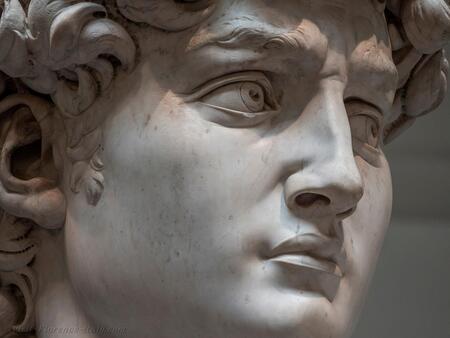
Close inspection reveals a concentrated gaze, facial tension, and details of the right hand. David is not looking at the viewer, but beyond the sculpture. Since we cannot see what has caught his attention, we mentally project the adversary. Even in this static figure, there is a sense of internal readiness—as if the hero is simply waiting for the right moment.
Что происходит с телом перед действием?
The example of David illustrates that tension is not always expressed through sudden movement. Sometimes a person is nearly still, yet their posture already conveys a state of readiness. Here, small details are crucial: weight shift, shoulder positioning, head turn, and the direction of the gaze. Together, they suggest that the body will change its position in the next second. I believe this is why Michelangelo’s sculpture is perceived as an image of anticipation, even though at first glance, David is simply standing before the viewer.
Piero della Francesca. «The Baptism of Christ.» Likely 1437–1445.
In this painting, Piero depicts the baptism of Christ. John the Baptist pours water onto Christ’s head, and three angels stand nearby. The action is already underway, yet the characters appear remarkably serene. Compared to the «Discobolus,» there is almost no sense of physical tension here. Piero chooses a completely different method of portraying time: the viewer observes the action itself, but it feels as though it has been slowed down.
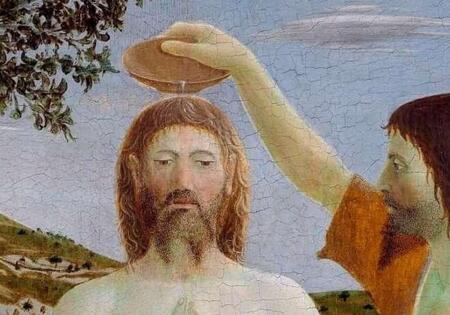
The entire scene centers on several small details: the hand of John the Baptist, the water, Christ’s head, and the dove above it. Their arrangement immediately conveys what is happening. Furthermore, the characters hardly change their poses. Piero seems to freeze the action at its most critical moment, inviting the viewer to contemplate it in a quiet setting.
Два разных состояния тела
In «Discobolus,» the body is tensed and ready to throw. Michelangelo’s David is also in a state of readiness, though his posture appears much calmer. Piero della Francesca presents a different situation: the action is already in progress, but the figures do not strive to convey its speed. These works help us understand that movement is not the only factor influencing the perception of time. Sometimes tension is created by the body’s posture, and other times—by the action stopping altogether.
Leonardo da Vinci. «The Annunciation.» c. 1472.
Leonardo depicts the Annunciation, the meeting between the Virgin Mary and the archangel Gabriel. The angel has already knelt before her, offering a lily, and Mary is responding to his greeting. The moment of encounter is significant—when one character addresses another, and the second is only beginning to react. Mary has not yet completed her movement, allowing the viewer to imagine how their dialogue will unfold.
Положение тела как реакция
In «The Annunciation,» Mary is particularly fascinating to observe. She sits at the lectern, but her attention has already shifted to the archangel. Leonardo is not depicting the conversation itself, but the moment when an ordinary activity is interrupted by an unexpected encounter. A slight change in the figure’s posture allows one to understand that something important has happened. In this instance, the sensation of time arises from the transition between two states: the calm before the encounter and the reaction to the angel’s arrival.
Gesture and direction of action
Leonardo da Vinci. «The Last Supper.» 1495–1498.
Leonardo chose the moment when Christ tells the apostles that one of them will betray him. For the characters, this is unexpected news, so each reacts differently. Some turn to a neighbor, some throw up their hands, and some seem to be trying to question what they have heard. In one painting, several reactions occurring almost simultaneously are depicted. It is especially interesting to observe how Leonardo uses gestures to convey the apostles' emotional states.
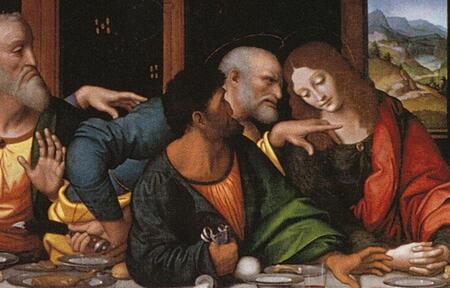
The apostles' hands are in various positions: some are directed toward their neighbors, others are open, and some are raised upward. Each gesture helps to understand a specific person’s reaction. Furthermore, these movements are interconnected. One apostle responds to Christ’s words, another attempts to address a neighbor, and a third shows disbelief. As a result, the scene is perceived as a conversation unfolding right before the viewer.
Как жест помогает рассказывать историю?
In «The Last Supper, ” gestures perform a function almost identical to dialogue in theater. Through them, one can understand who is surprised, who is asking a question, and who is addressing another person. Leonardo does not depict several sequential scenes to illustrate the development of the event. Instead, he gathers the reactions into a single moment, allowing the viewer to connect them themselves. I think this is a strong example of how an artist can convey an entire chain of actions within a single image.
Jacopo Pontormo. «Entombment» (Deposition from the Cross). Circa 1528.
In this painting, Pontormo depicts the moment of Christ’s body being carried. The figures are leaning, supporting each other, and seem to move in different directions. The composition is unusual: the characters are tightly interwoven, and the familiar sense of stability is almost absent. Christ’s body is passed from hand to hand, and it feels as if the movement could continue long after we stop looking at the painting.