Concept
In the Medieval era, the appearance of the warrior underwent a dramatic transformation: the living human face was hidden beneath a dull metal helmet, and the primary way to recognize a person became a visual sign. This study explores how, over four centuries (11th–14th centuries), knightly armor evolved from mere protection into a rigid language of symbols—essentially, one of the earliest examples of visual branding in history.
The objective of this work is to trace the evolution of how knights were identified in European art, from the era of the first Crusades to the height of the Gothic period. The analysis is grounded in the research of historians Michel Pastoureau, Jean Flori, and Johan Huizinga, who examine color, coat of arms, and armor as primary markers of status in medieval culture. Through the examination of illuminated manuscripts, cathedral and funerary sculpture, carved chests, and marginalia, the study demonstrates how the utilitarian identifier from the battlefield gradually transcended warfare, becoming a metaphor for love and faith, replacing the portrait on tomb slabs, and even transforming into an object of self-irony in manuscript margins. Ultimately, the visual code fully assumed the functions previously held by the human face.
Protogealics and the «Readable» Silhouette (11th–12th Centuries)
In the 11th–12th centuries, knightly insignia had not yet transformed into a rigid system of hereditary coats of arms, and the main reason for their emergence—the enclosed helm concealing the face—had not yet become common practice. Warriors wore open, conical helmets with narrow beards: their faces were clearly visible, so people were recognized by their appearance rather than their armor. Meanwhile, long, almond-shaped shields were already covered with large, contrasting patterns—crosses, stripes, and stylized animals. These designs still served as simple decoration and could be changed freely, but in art, they were already functioning as a striking reference point: making the warrior’s silhouette noticeable from afar and setting the rhythm of the entire battle scene [4, 5].
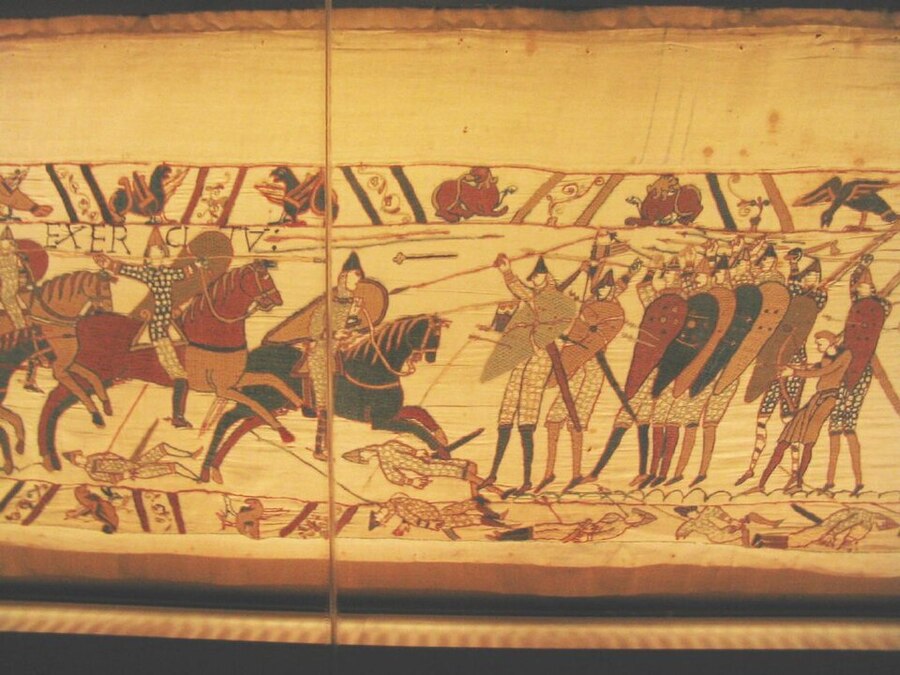
Unknown Anglo-Saxon Master. Attack of Norman Cavalry (fragment of the Bayeux Tapestry). Circa 1070–1080.
In the scene of the Battle of Hastings, long, almond-shaped shields of the Anglo-Saxon infantry form a dense, colorful wall. They are adorned with simple rows of rivets and a contrasting trim—these are not yet heraldic coats of arms, but a basic pattern that sets the rhythm for the entire scene, while the faces of the warriors remain visible beneath their conical helmets.
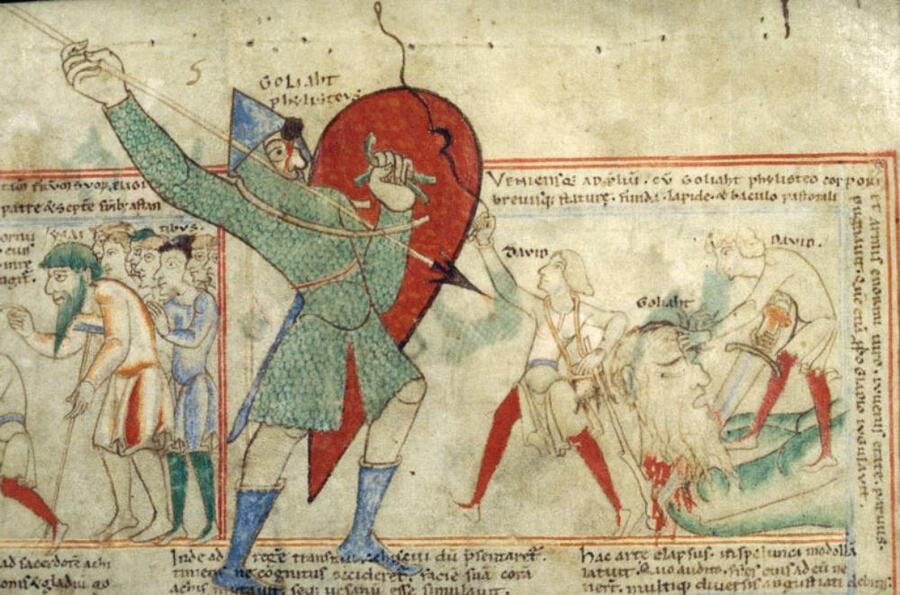
On the left: An unknown Anglo-Saxon master. William the Conqueror raises his helmet before his army (a fragment from the Bayeux Tapestry). c. 1070–1080; on the right: The Scriptorium of St. Cithian’s Abbey. David and Goliath (miniature from the Bible of Abbot Stephan Harding). c. 1109–1111.
At the turn of the 11th and 12th centuries, armor had not yet concealed the human form or substituted a name for it. On the fragment of the «Bayeaux Tapestry,» during the height of the battle, a rumor spread about the death of a commander: since personal coats of arms did not yet exist, William had to lift his helmet to reveal his face, which a comrade is pointing to with his hand. In a miniature from «Stefan Harding’s Bible,» the Old Testament Goliath is equipped in exactly the same manner—a conical helmet with a crest that leaves his face and eyes open, and his enormous red shield functions as a large color spot.
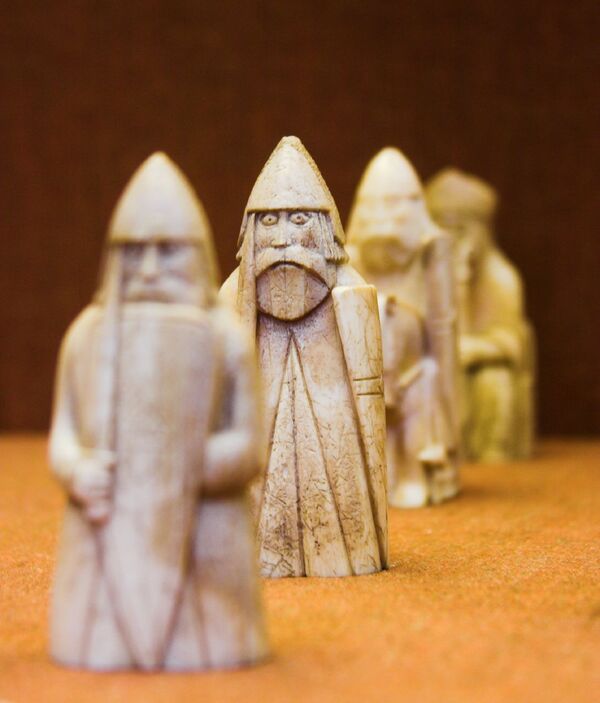
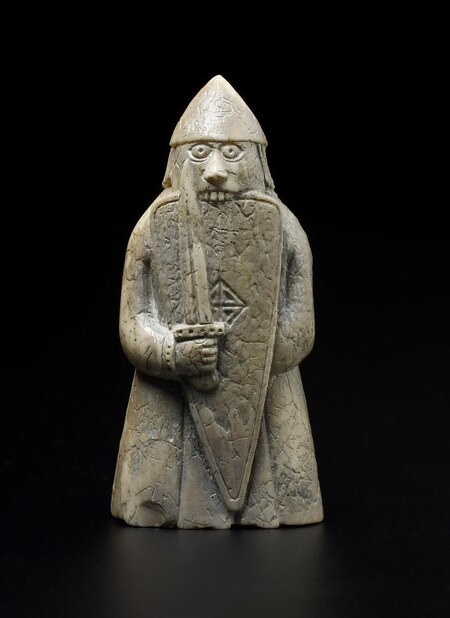
Unknown Scandinavian master. Chess pieces in the form of rook warriors from a hoard found on Lewis Island (two pieces). Circa 1150–1200.
The carved ivory figurines clearly illustrate a transitional moment in the second half of the 12th century. On one, all attention is drawn to the stern, exposed face and long beard of a warrior in a conical helmet, while his shield with simple incisions is turned aside. On the second figure, the shield is already thrust forward and decorated with a crisp carved diamond cross, but the warrior’s main emotion is still conveyed through his bulging eyes and the furious gesture of biting the edge of his shield.
Unknown Romanesque master. Crusaders' departure (fresco in the Templar Chapel at Cressac-Saint-Genis). Circa 1170–1180.
In the fresco from the Templars' chapel, the faces of the knights under round helmets are still visible, and the shields retain a decorative pattern of scrolls. However, a unified sacred symbol—a red cross—is already appearing on the chest of each knight, uniting the warriors into a cohesive unit and placing the symbol of the order above individual features.
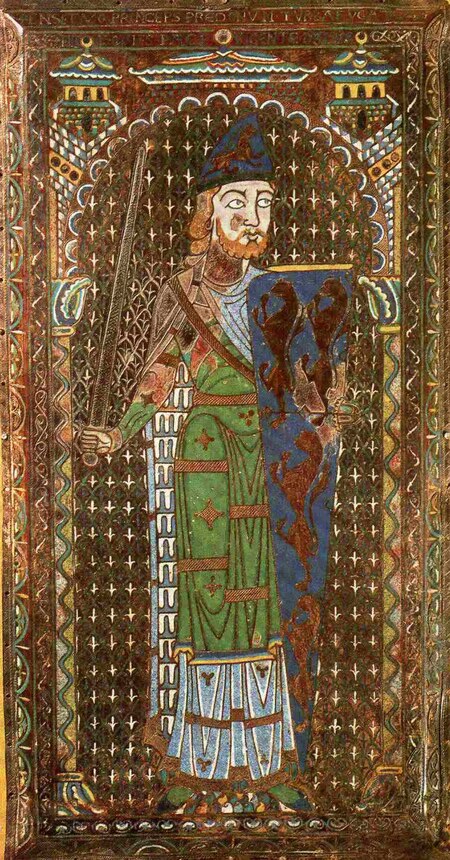
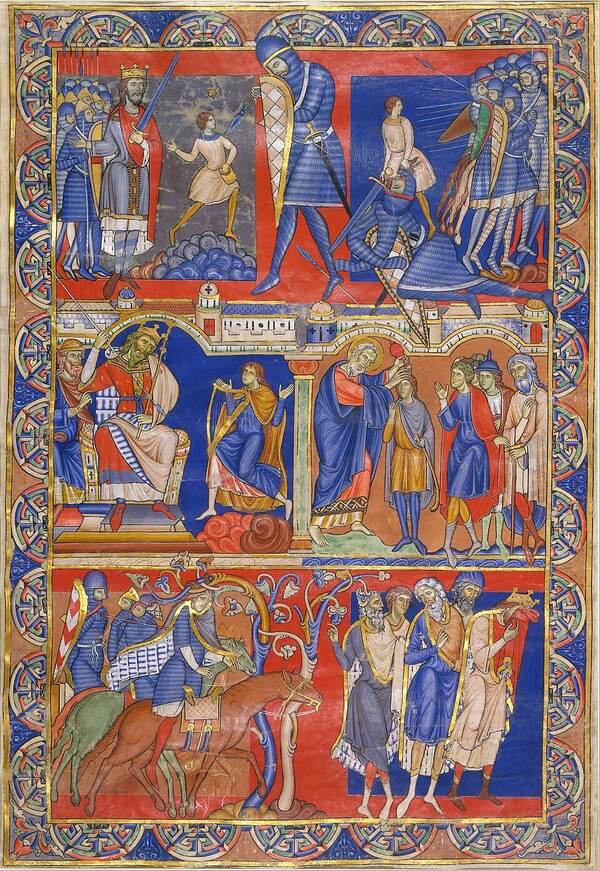
On the left: Workshop in Limoges. Funerary plaque of Geoffroi V Plantagenet, Count of Anjou. Circa 1151–1160; on the right: Morgan Leaf Master (Winchester workshop). Scenes from the life of King David (a leaf from the «Winchester Bible»). Circa 1160–1175.
By the third quarter of the 12th century, the shield gradually transforms into a canvas for vibrant familial and geometric insignia. On the funerary plaque of Geoffrey Plantagenet, one of the first permanent coats of arms appears—gold lions on a blue field—though the count himself is still depicted with an open face. In the miniature from the Winchester Bible, the warriors' shields gain saturated color and precise delineation: large rhombic lattices and contrasting red-and-white zigzags. Although the faces of the fighters beneath their crested helmets are still visible, the language of the shield is already closely approaching the true heraldry of the following century.
Closed helmet and heraldic language (13th century)
At the turn of the 12th and 13th centuries, knightly armor underwent a dramatic transformation: the open conical helmet was replaced by the solid, cylindrical topfhelm, which completely encased the head, leaving only narrow slits for the eyes [5]. The warrior’s face vanished, and living expression finally yielded to a sign [5]. To ensure the fighter could be unambiguously recognized in combat, heraldry evolved into a strict system governed by clear rules for combining colors and simple geometric shapes [4, 5]. By the 13th century, the personal insignia was no longer confined to the shield alone; it extended to the surcoat, the horse’s trappings, knightly seals, church stained glass, and cathedral sculpture, unifying the warrior’s image into a cohesive visual symbol.
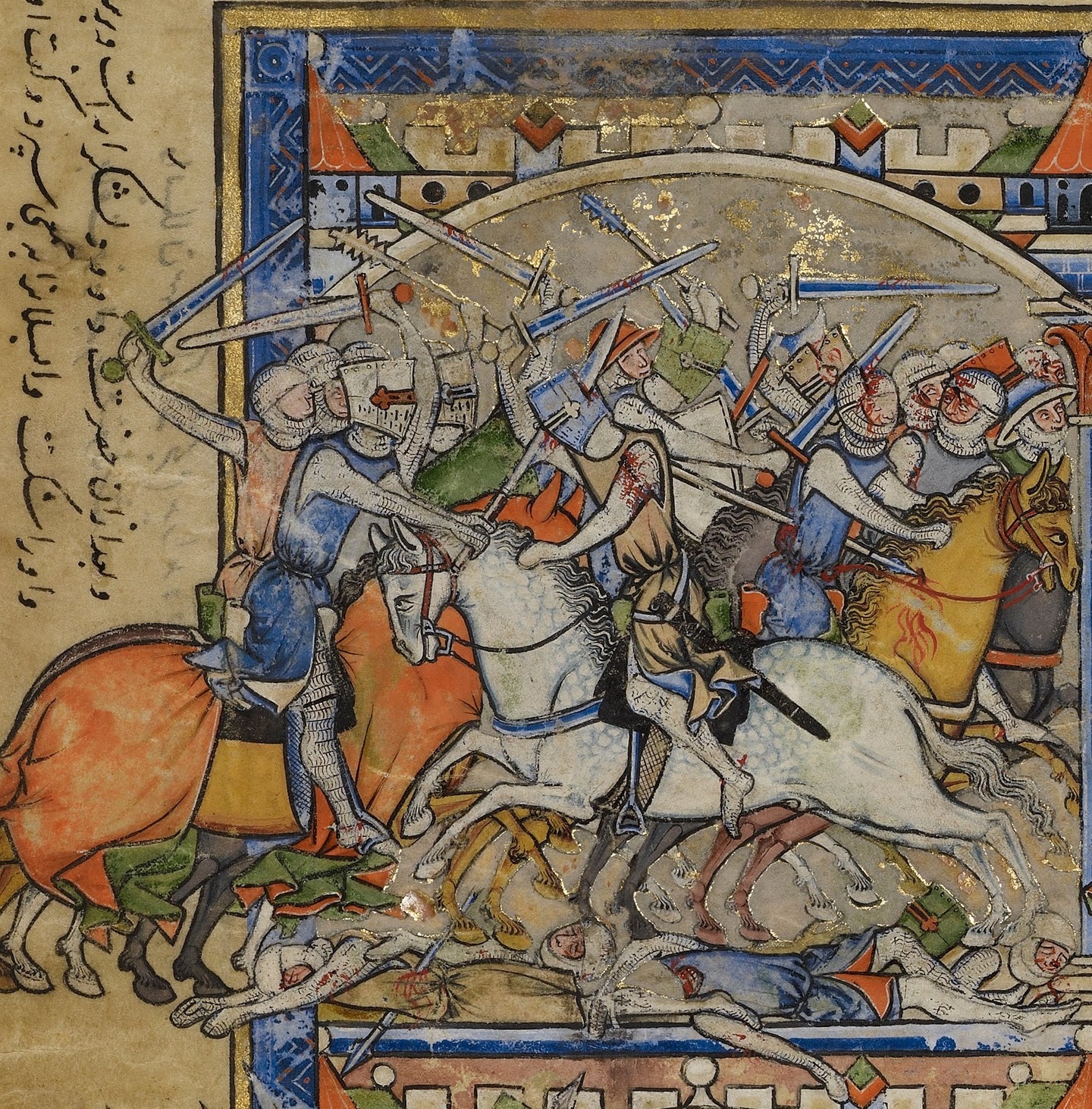
Unknown Parisian Master. The Battle of the Armies of David and Awesalom (a fragment from the «Maciejski Bible» / «Morgan Bible»). c. 1250.
This miniature vividly captures the moment of the 13th-century shift: while the common soldiers on the edges and in the background are still fighting in mail hoods and open chaperon hats with faces contorted by pain, the two central riders in the foreground are already completely concealed in cylindrical topfhelm helmets with narrow eye slits. Devoid of facial expression, they are distinguished only by the contrasting color code—blue and ochre surcoat—as well as the bright caparisons and harnesses of their horses.
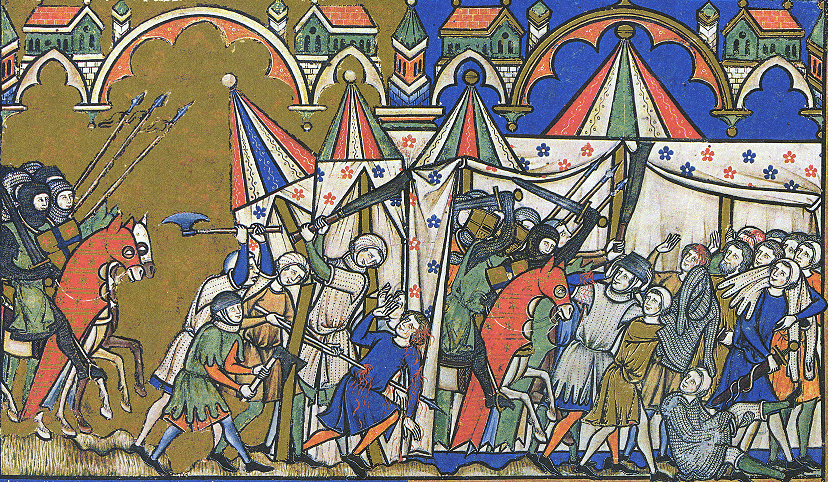
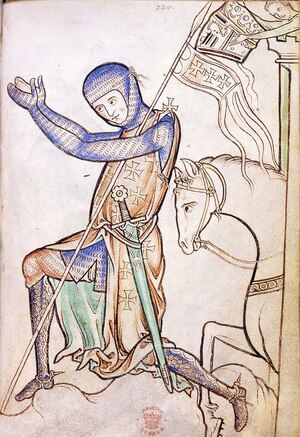
Left: Unknown Parisian master. Abraham’s nocturnal assault on the camp to save Lot (leaf 3 from the «Maciejewski Bible» / «Morgan Bible»). c. 1244–1254; right: Unknown English master. Kneeling knight (miniature from the «Westminster Psalter»). c. 1250.
Both miniatures from the mid-13th century illustrate the transition from a lifelike face to a symbol in different ways. In the leaf from the «Macieski Bible, ” knights with visible faces still ride alongside a knight in a closed Topphhelm adorned with a cross-shaped plate, who is fighting inside a tent, but the entire unit is already unified by a common color code—green surcoats, red caparisons, and a yellow shield with a blue cross in the foreground. In the „Westminster Psalter, ” the person and their symbol are divided even more clearly: the knight himself prays with an open face, but his hereditary red cross is already repeated on the surcoat and banner, and the closed Topphhelm, which replaces the face in battle, is held behind him by a squire.
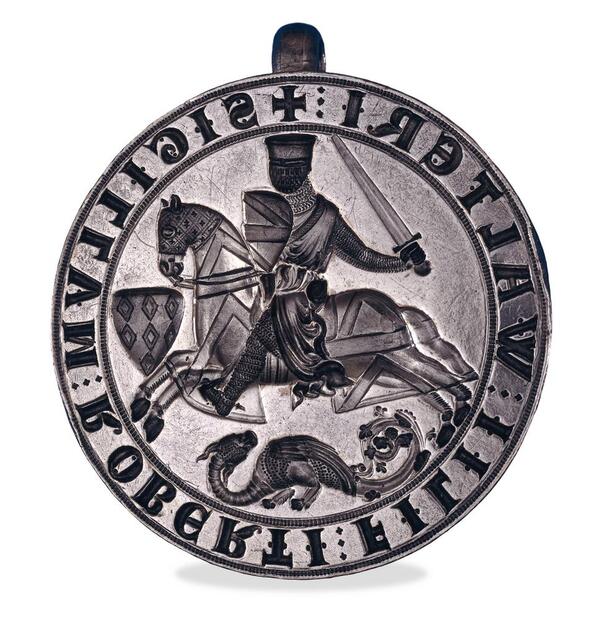
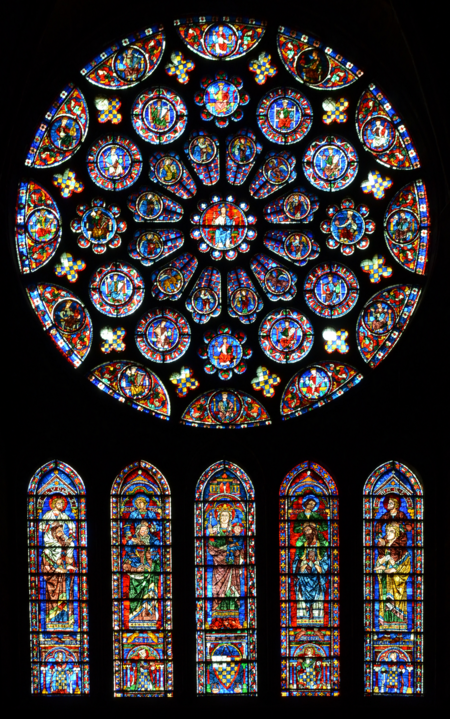
On the left: Unknown English engraver. Equestrian seal of Baron Robert Fitz-Walter. Circa 1213–1219; on the right: Unknown French master. South rose and lancet windows of the choir of Chartres Cathedral (stained glass by donor Pierre de Dreux). Circa 1221–1230.
In the 13th century, the knightly insignia extended beyond the battlefield and became established in documents and ecclesiastical architecture. On the personal seal of Baron Robert FitzWalter, the rider is depicted wearing a closed topphhelm with a grille visor; consequently, his identity and alliances are conveyed not through his face, but through his heraldry: his ancestral emblem—a sign with a belt and trusses—is placed on the shield and repeated on the horse’s caparison. In front of the steed’s chest hangs the shield of his ally, Sir Geair de Quincy, and the composition is completed at the bottom by a winged dragon. In a stained-glass window of Chartres Cathedral, the blue-and-gold checkered coat of arms of Count Pierre de Dreux is integrated into the sacred geometry of the cathedral: it is positioned next to the donor family figures in the lower windows and is repeated twelve times in the rose window itself, transforming the knight’s ancestral sign into a part of the heavenly order of Gothic architecture.
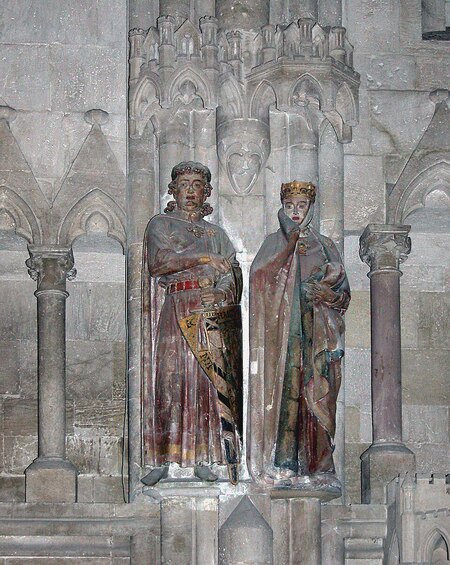
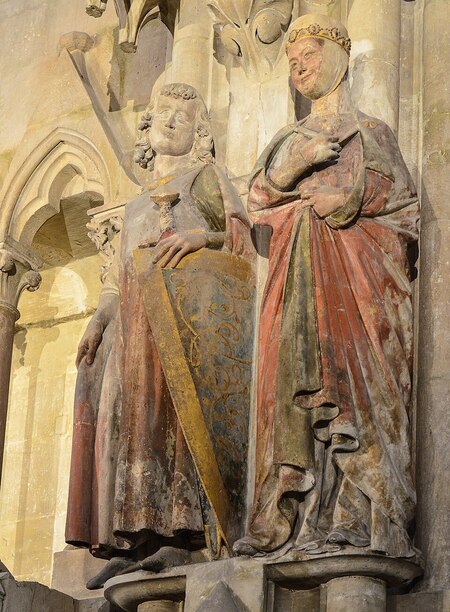
Masters of Naumburg Cathedral. Statues of Margrave Eckhard II and Uta (left), and Margrave Hermann and Reglindis (right) in the west choir of Naumburg Cathedral. Circa 1245–1255.
In the monumental sculpture of the Naumburg Cathedral, the faces of the church founders are rendered with a portrait vitality rare for Gothic art, but the most prominent symbol of their knightly and princely status remains the large triangular shield. The actual marquises lived in the 11th century, before hereditary coats of arms existed, so the 13th-century masters used the shield as a direct «signature» for the viewer: Eckhard’s shield is marked with diagonal bands, while Herman’s shield is covered with a golden floral pattern on a blue background.
Sculptural Grotesque and Totem: Fantastic Helmets (Late 13th — 14th Century)
At the turn of the 13th and 14th centuries, knightly symbolism experiences a true flourishing: the insignia finally leaves the plane of the shield and enters three-dimensional form [4, 5]. Since the knight’s head was completely covered by a massive pot-style helmet in battle and at tournaments, its upper section transformed into a base for a large, sculptural crest—a jewel [8]. These constructions were made from light boiled leather, parchment, wood, and feathers, allowing them to become enormous, sometimes taller than the knight’s head: the helmets were crowned with swan wings, bull horns, crowns, towers, fantastic beasts, and even figures of ladies [8]. In the art of the 14th century, the knight ceased to be merely a mounted warrior in armor—he transformed into a living heraldic totem, where the shield, the horse’s caparison, and the figure on the helmet merged into a single theatrical image [8].
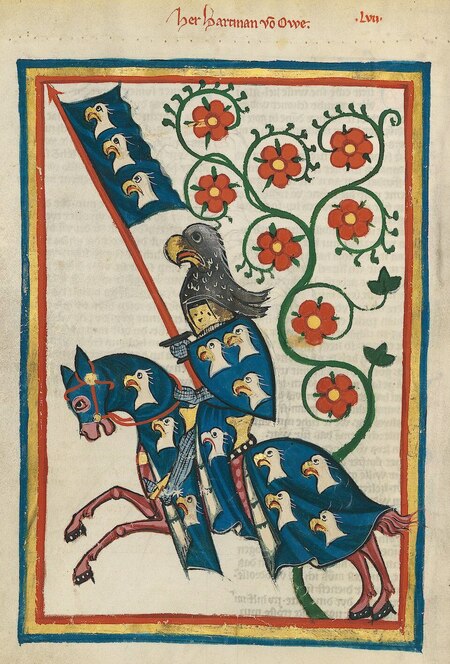
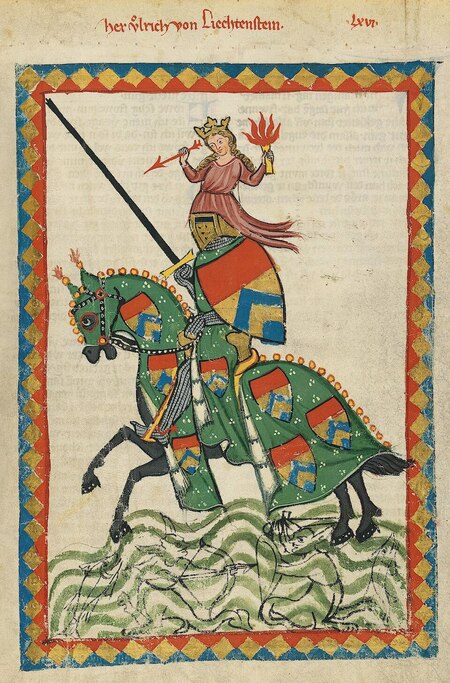
Left: Master of the main volume of the «Manesse Codex.» Minnesinger Hartmann von Auer (leaf 184 verso). Right: Minnesinger Ulrich von Lichtenstein (leaf 237). Miniatures from the «Manesse Codex» (Cod. Pal. germ. 848), circa 1300–1315.
In the miniatures of the «Manesse Codex,» the crest becomes the primary feature by which the poet-knight is instantly recognizable. In the portrait of Hartmann von Aue, the rider’s face is entirely obscured by a closed helmet, surmounted by a large sculptural head of a black eagle with a yellow beak, while white eagle heads rhythmically repeat on the blue banner, shield, and the horse’s trappings. In the scene with Ulrich von Lichtenstein, the idea is elevated to a poetic metaphor: a complete figure of a crowned goddess of love (Frau Minne)—bearing a red arrow and a flaming torch—emerges from his helmet, transforming the crest into a symbol of chivalric service to the lady.