Navigation Menu
1. Concept 2. The Lion as a Force of Nature 3. Myth and the Sacred Image 4. Defender and Symbol of Identity 5. The Lion as a Political and Cultural Symbol 6. The Animal in Art Before the 14th Century 7. Conclusion 8. Bibliography
Concept
How did the form and meaning of the lion change when transitioning from one culture to another?The lion is one of the most recognizable images in art history, occupying a special place in the history of world culture. Its image appears on the walls of ancient temples, the palaces of rulers, city gates, coins, coats of arms, religious objects, sculptures, and works of applied arts. In Ancient Egypt, it was associated with the sun, royal power, and protection. In Mesopotamia, it personified the dangerous power of nature. In India, the lion became a symbol of royal law and Buddhist teaching, while in China, it transformed into a fantastical stone guardian. In medieval Europe, it was depicted on coats of arms and in Christian art. As it transitioned from one culture to another, the lion did not disappear as a symbol of strength; rather, the understanding of it evolved. If in one culture it represents divine power, in another it becomes a sovereign, a protector of space, or a symbol of the people.
LEAF AS THE FORCE OF NATURE
For the ancient inhabitants of the Middle East, Africa, Near East, and Southern Europe, the lion was an integral part of the daily natural environment. It could attack herds, pose a danger to travelers, and threaten settlements. Therefore, its image was associated not only with beauty and majesty but also with real peril.
In art, the lion was frequently depicted as a powerful and independent creature. Even when an artist did not strive for anatomical accuracy, they invariably emphasized the animal’s key characteristics: a large head, powerful paws, teeth, claws, and a mane. Victory over such an animal was perceived as proof of a person’s bravery and ability to defend society.
Lev from Mari, Syria. c. 1782–1759 BCE
In ancient imagery, the struggle with a lion often served as a metaphor for the confrontation between order and chaos. A hero or ruler who conquered the lion symbolically demonstrated their ability to control the dangerous forces of the surrounding world.
This idea was particularly vivid in the art of Mesopotamia. There, the royal hunt for lions was not merely entertainment. A ruler who could defeat a predator symbolically showed that they could also conquer the nation’s enemies.
Royal Lion Hunt — bas-relief from the Northern Palace of Ashurbanipal. 645–635 BCE.
Naturalistic anatomy transforms the lion into a compelling adversary, and defeating it into a more significant event.
Large fragments of the muzzle, mane, paws, and tense body:
Fragments from the Hunting Cycle of Ashurbanipal. c. 645–635 BCE
Persian masters blended local artistic traditions with influences from Mesopotamia, Egypt, and other regions.
The depictions of the struggle between the lion and the bull are particularly fascinating. These can be seen in the architectural decor of Persepolis. The meaning of this motif is debated by researchers: it is linked to natural and cosmic cycles, the symbolism of power, and the representation of opposing forces.
In Persian art, the lion could serve not only as a dangerous predator but also as part of a complex system of symbols associated with the royal order and the majesty of the state.
Reliefs from Persepolis. Circa 350 BCE
MYTH AND THE SACRED IMAGE OF THE LION
In ancient cultures, animals were often linked to deities. People observed the specific behaviors of animals and projected them onto supernatural forces. The lion, owing to its strength and ferocity, became suitable for representing divine power.
In different religions, it could symbolize the sun, war, protection, royal authority, justice, and victory over evil. Sometimes the lion was depicted as a standalone sacred animal; other times, it appeared as part of a deity’s body or as its constant companion. In Mesopotamia, the lion was associated with the goddess Ishtar. In India, it became one of the important motifs in Buddhist art.
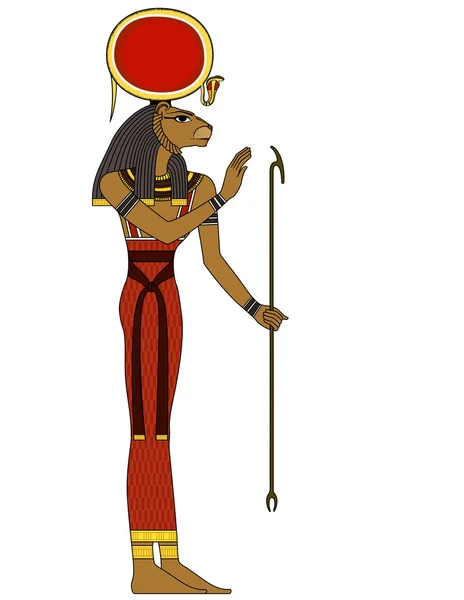
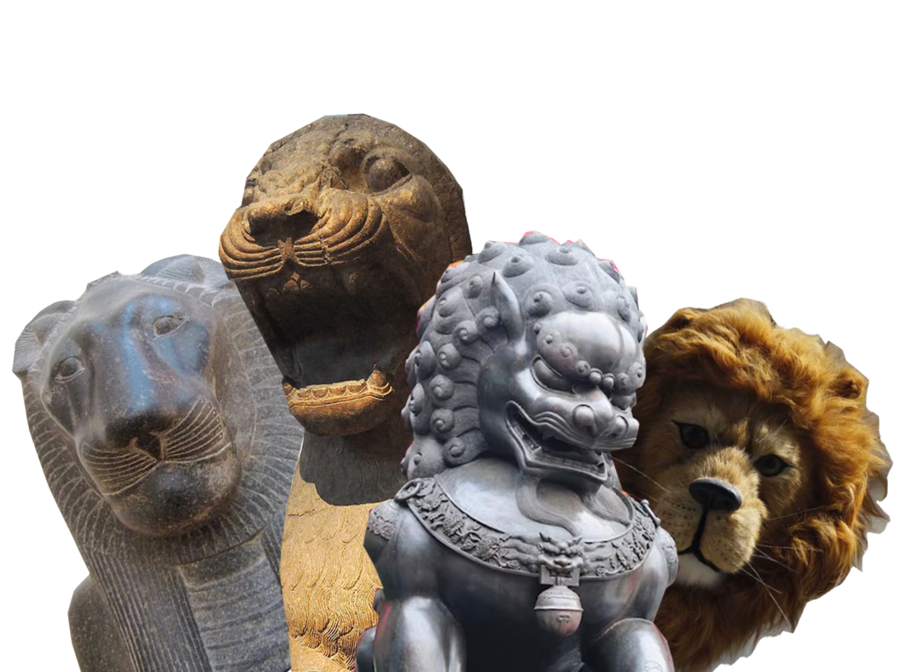
Works: Statue of Sekhmet; Babylonian lion; Ashoka Lion Capital from India.
The lion-headed goddess Sekhmet; The lion from the Babylonian palace of Nebuchadnezzar II (604–562 BCE); Ashoka’s lion capital
In Ancient Egypt, the lion held a close connection to the sun and protection. The Egyptians perceived it as an animal possessing extraordinary power and the ability to guard boundaries. Lions were often depicted lying near the entrances to temples and sanctuaries. This posture did not necessarily signify tranquility; the animal remained ready to attack and symbolically defended the sacred space. In Egyptian art, lions were also featured in royal architecture, funerary structures, and religious objects.
The Reclining Sphinx in the Egyptian temple of Abu Simbel; Maathes with the Hememet crown
The Sphinx is one of the most recognizable figures in ancient Egyptian art. It combines the body of a lion with the head of a pharaoh. The most famous example is the Great Sphinx of Giza. It guarded the necropolis grounds and was part of the sacred landscape. This image profoundly influenced subsequent cultures. In the ancient world, the Sphinx acquired new meanings, and in European art, it became associated with mystery, secrecy, and supernatural knowledge.
Images of the Egyptian Sphinx in Giza
In Egyptian mythology, there were images of lions associated with the horizon and the movement of the sun. Particularly interesting is the depiction of the deity Akher, which could be represented with two lion heads facing opposite directions.
This image symbolized the east and the west, sunrise and sunset, as well as the transition between the world of the living and the afterlife. The lions served as guardians of cosmic space, providing protection for the solar deity.
This idea demonstrates that in Egyptian art, the lion could serve not only as a protector of a temple or a king but also become a component of a complex cosmological system.
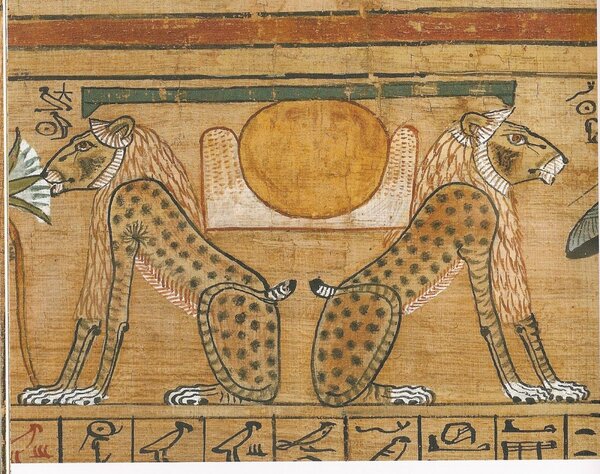
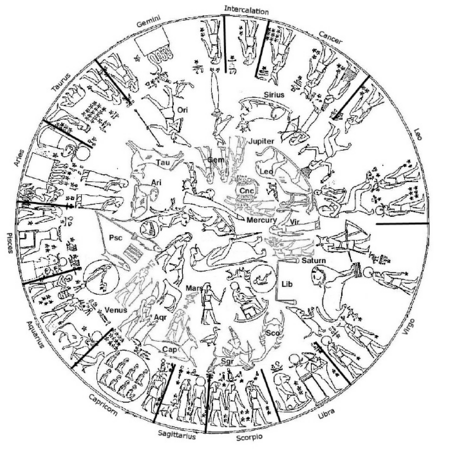
The Image of the Deity Aker; The Zodiac from the Dendera Temple
DEFENDER AND IDENTITY MARK
Stone lions were often depicted in pairs. They might be positioned on either side of a staircase, gate, or doorway. Their presence emphasized the special status of the building and symbolically separated ordinary space from sacred or royal ground.
Over time, this tradition spread to various regions. The appearance of the lions evolved according to local artistic conventions, but their fundamental function remained similar—to guard boundaries and demonstrate the power of the space’s owner.
In China, lion imagery gradually transformed into a specific type of architectural sculpture. They were placed in front of palaces, temples, administrative buildings, and wealthy residences. They were typically shown in pairs: a male and a female.
Chinese lions differ notably from real animals. They often feature large, round eyes, a decorative mane, a widely opened mouth, and stylized paws. Sometimes, a ball was depicted next to the male, and a cub next to the female. These details were associated with concepts of authority, lineage, and protection.
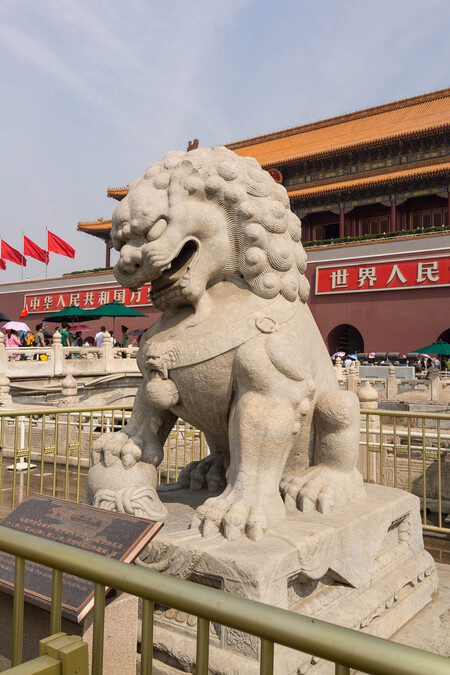
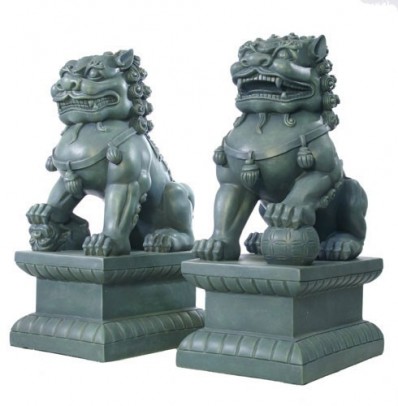
Stone lion in front of the Forbidden City in Beijing; Asian guardian lions (PARA)
The masters emphasized the expressiveness of the muzzle, the curls of the mane, and the powerful paws. The sculptures could be crafted from stone, bronze, ceramic, or wood. In some cases, the lion was depicted with its mouth open, showing its teeth, while in others, it adopted a calmer and more solemn pose. This formal variation stemmed from the shift in Chinese art—where symbolic resonance became more significant than biological accuracy. The lion needed to appear imposing and protective of the space, allowing its appearance to be exaggerated or fantastical.
Chinese Stone Lion/Guardian Statue
In Japan, Koumainu paired figures have become popular. Their bodies are covered in stylized fur, and their muzzles can have a fearsome expression. In traditional pairs, one creature is often depicted with an open mouth while the other has a closed one, though specific variations depend on time and place.
Komainu (Guardian Lion) Statues, 3rd Century BCE