Животные в средневековой миниатюре
INDEX
- Research Concept
- Iconography and Moral Semantics
- Materiality and Sheet Composition
- Conclusion
- Bibliography of Textual Sources
- Bibliography of Image Sources
Concept
I decided to dedicate my research to animal miniatures in 13th-century Western European manuscripts. The study addresses the question of how the depiction of an animal participates in the production of meaning, rather than merely illustrating the textual content. To begin, I aimed to establish the overall logic of the miniatures: moving from iconographic analysis to the material context of the folio. The second chapter focuses on the motivic structure and moral semantics, while the third examines the composition, color, and the animal’s placement within the codex’s space.
Historical Context
Medieval book miniature develops within the framework of liturgical, monastic, and courtly book culture. Manuscripts become a unique space where text, image, and the reading process harmonize. By the 13th century, with the growth of cities, universities, and mendicant orders, the system of ecclesiastical and courtly commissions grew more complex, leading to an increase in the diversity of books and workshops. Parallel to monastic scriptoriums, urban workshops arose, targeting a broader audience. Miniature began to actively interact with the architectural structure of the page. The image does not simply complement the text; it shapes the perception of it. In this aspect, the animal becomes an important motif, connecting observations of nature, traditional iconography, and moral allegory.In the 13th century, animals hold a special place in bestiaries, psalters, encyclopedic compilations, medical treatises, and moralized Bibles, their role varying depending on the type of book. In a bestiary, the animal is presented as if it were something more than just an object; it acquires allegorical meaning, rooted in the tradition of the «Physiologus.» In a psalter and in marginal illustrations, the animal can function as decoration, rhythm, and commentary, creating a semantic unity with the liturgical text.
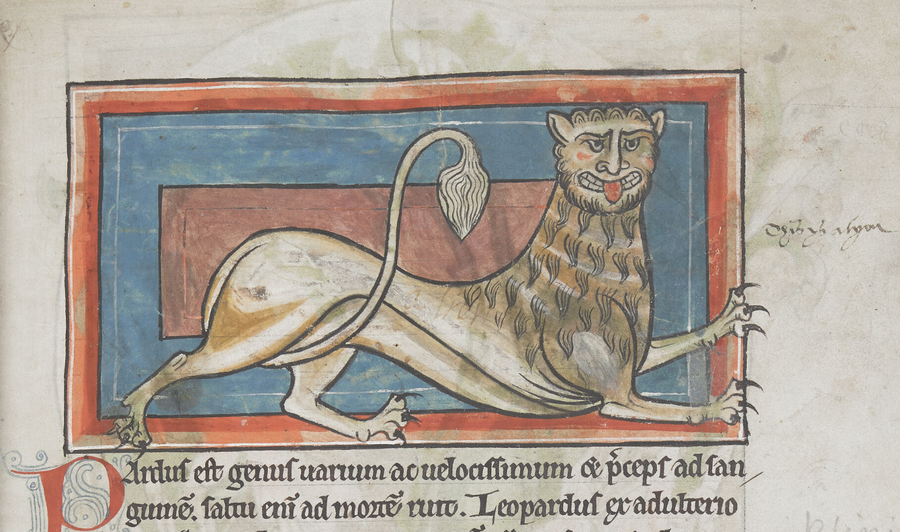
Fragment from a bestiarium with additions from Gerald of Cambrogi’s work, «Topographia Hibernica,» late 12th — early 13th century (Harley MS 4751 manuscript)
Iconography and Moral Semantics
The miniature animal from the 13th century rarely remains a biological species. It is integrated into allegorical argumentation where observation, literary tradition, and exegesis intersect. The bestiary image is formed as a statement: the posture, the direction of the gaze, and the proximity of the figures dictate the interpretation. The image is structured around recurring motifs—predator and prey, mother and offspring, etc. Furthermore, human qualities were ascribed to animals, and their behaviors served as a direct guide to the salvation of the soul or a warning against falling into sin.
Fragment from a bestiary with additions from Giraldus Cambrensis’s work, Topographia Hibernica, late 12th — early 13th century (Harley MS 4751 manuscript)
Materiality and Composition of the Sheet
The miniature exists within the space of the parchment leaf, where pigment, cinnabar, lapis lazuli, and gold are disciplined by the codex’s layout. The composition is built upon the relationship between the frame, the margin, and the textual block; an animal may occupy an initial letter, the lower margin, or the marginal space. Researchers view the marginalia as a zone of disruption to order, and this approach is productive for the 13th century, when the beast balances between illustration and invasion. Technical analysis—format, line spacing, contour density, handling of the sample—reveals how the workshop translates a verbal image into a visual formula. Materiality here is not background, but a condition of meaning: color, scale, and the frame’s boundary control the reader’s attention.
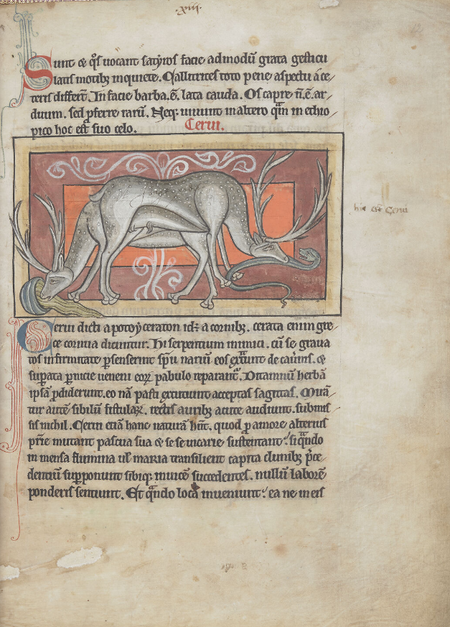
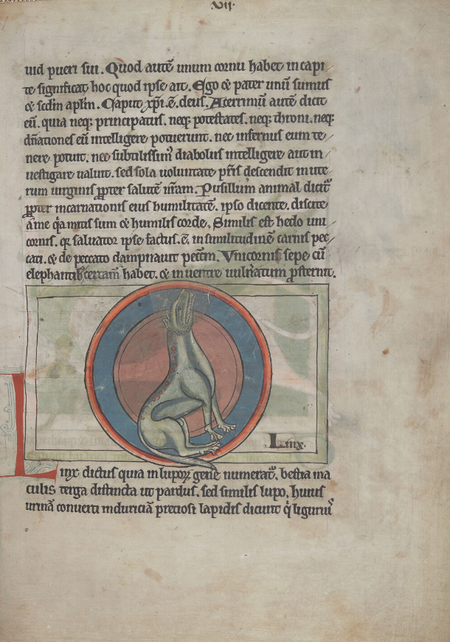
Fragments from the bestiary, supplemented with passages from Gerald of Cambro’s «Topographia Hibernica» (Topography of Ireland), late 12th–early 13th century (Harley MS 4751 manuscript)
Excerpt from the Workshop Bestiary (MS M.81).
Ingrim Wolf in the guise of a bishop—from a cycle of marginal illustrations dedicated to the funeral of the fox Renar.
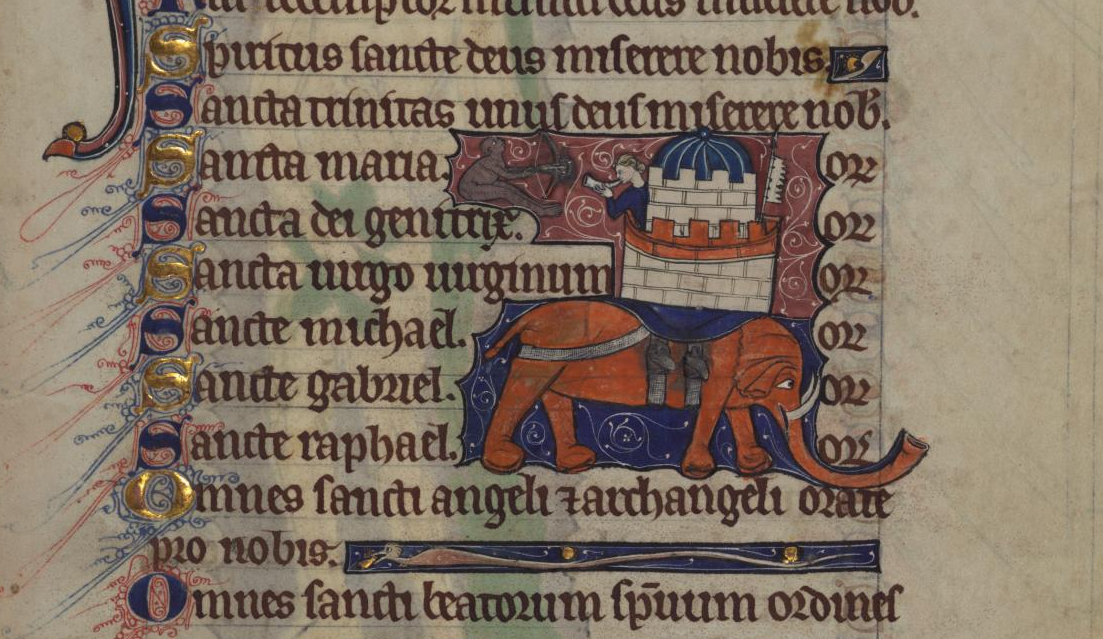
Romulus and Remus; monkey riding a bear — from «Chasovslov»
Excerpt from the «Ashmolovsky Bestiary» Design: significant miniatures. Initials.
Fragment from the «Ashmolovsky Bestiary» Design: significant miniatures. Initials.
Excerpt from the «Ashmolovsky Bestiary» Design elements: significant miniatures. Initials.
Excerpt from the «Ashmolovsky Bestiary» Decoration: significant miniatures. Initials.
Excerpt from «Ashmolovsky Bestiary» Design elements: significant miniatures. Initials.
Fragment from «Ashmolovsky Bestiary» Presentation: significant miniatures. Initials.
Excerpt from the «Ashmolovsky Bestiary» Styling: significant miniatures. Initials.
Excerpt from «Ashmolov’s Bestiary» Design: significant miniatures. Initials.
Excerpt from the «Ashmolovsky Bestiary» Layout: significant miniatures. Initials.
Excerpt from the «Ashmolov Beastarium» Design: significant miniatures. Initials.
Excerpt from the «Ashmolovsky Bestiary» Design Elements: significant miniatures. Initials.
Excerpt from the «Ashmolovsky Bestiary» Illustration: notable miniatures. Initials.
Excerpt from the «Ashmolovsky Bestiary» Layout: significant miniatures. Initials.