Concept
At the entrance of the Gothic cathedral, the same figure may appear twice. Christ stands on a pillar between the doors, and above him sits the Judge Christ. Between these images are people emerging from tombs, awaiting a verdict, or proceeding to a location designated by the court. In this work, I examine how the architecture of the entrance helps distribute these scenes and connect them. The theme grew from an interest in Gothic sculpture—which can be viewed first as part of the building and then in the scale of a single hand, face, or fold of fabric.
How does the reading of the Last Judgment change if the scenes of resurrection, weighing of souls, and separation of people occupy different places on the portal? My hypothesis is that the overall axis between the doors and the figure of Christ the Judge immediately establishes the compositional center, while the placement of subsequent narrative episodes dictates where the viewer’s gaze will travel from that center. The distinction should be particularly clear in the position of the scales. Next to the processions, they help delineate the boundary between the two groups. Among the opened tombs, they link the judgment’s resolution with the moment of resurrection.
The study included the central portal of the south transept of Chartres Cathedral, as well as the central western portals of the cathedrals of Paris and Amiens. Their sculptural programs developed in the first half of the 13th century. In all three cases, the «Last Judgment» is located above the main entrance, Christ occupies the upper section of the relief, and two groups of people extend to the sides. This proximity allows for a comparison of identical motifs and an observation of differences in their placement. In Chartres, the depth of the south porch is significant. In Paris and Amiens, the portal’s position within a row of three western façade entrances is important.
For each monument, I am using a general view; a frontal shot of the relief and photographs of individual scenes are sufficient. A general plan is needed to understand the positioning of the sculptures above the doors. In close-up, one can observe where the heads and torsos are turned, where the line of figures breaks, and what is at its edge. In all comparisons, left and right are counted from the viewer’s perspective. The scale of the photographs is adjusted for detail comparison, so I judge the physical size of the figures only within the confines of a single portal.
The visual sequence begins with an approach to the doors. Next, I compare the standing and seated figures of Christ on the central axis. The following sections are dedicated to the tiers, the weights, and the two processions. In each of these, Chartres, Paris, and Amiens follow in the same order, which makes it easier to notice the change in placement of the same motif. Close-ups show the gestures at the edges of the processions and their continuation on the archivolts—that is, on the arches surrounding the tympanum. Finally, I return to the Parisian portal and compare the modern appearance with the 18th-century drawing. This helps to understand which relationships between the opening and the relief are dependent on restoration.
I verify the placement of the scenes and their dating using the scholarly catalog «Theophyl» from the Centre André Chastel and by consulting cathedral materials. Jacqueline Young’s article on the movement of figures suggested paying attention to the direction of the heads, legs, and gestures of the attendants. In my comparison, these details correlate with the boundaries of the tiers and the placement of the weights. I cross-reference the history of the Parisian entrance’s renovation with materials from the Cloister of Cluny and the museum catalog of Charles Persse’s drawings. The photographs in the longread show both the modern and archival condition of the portals. Where the dating of a specific detail differs from the dating of the ensemble, it is indicated separately.
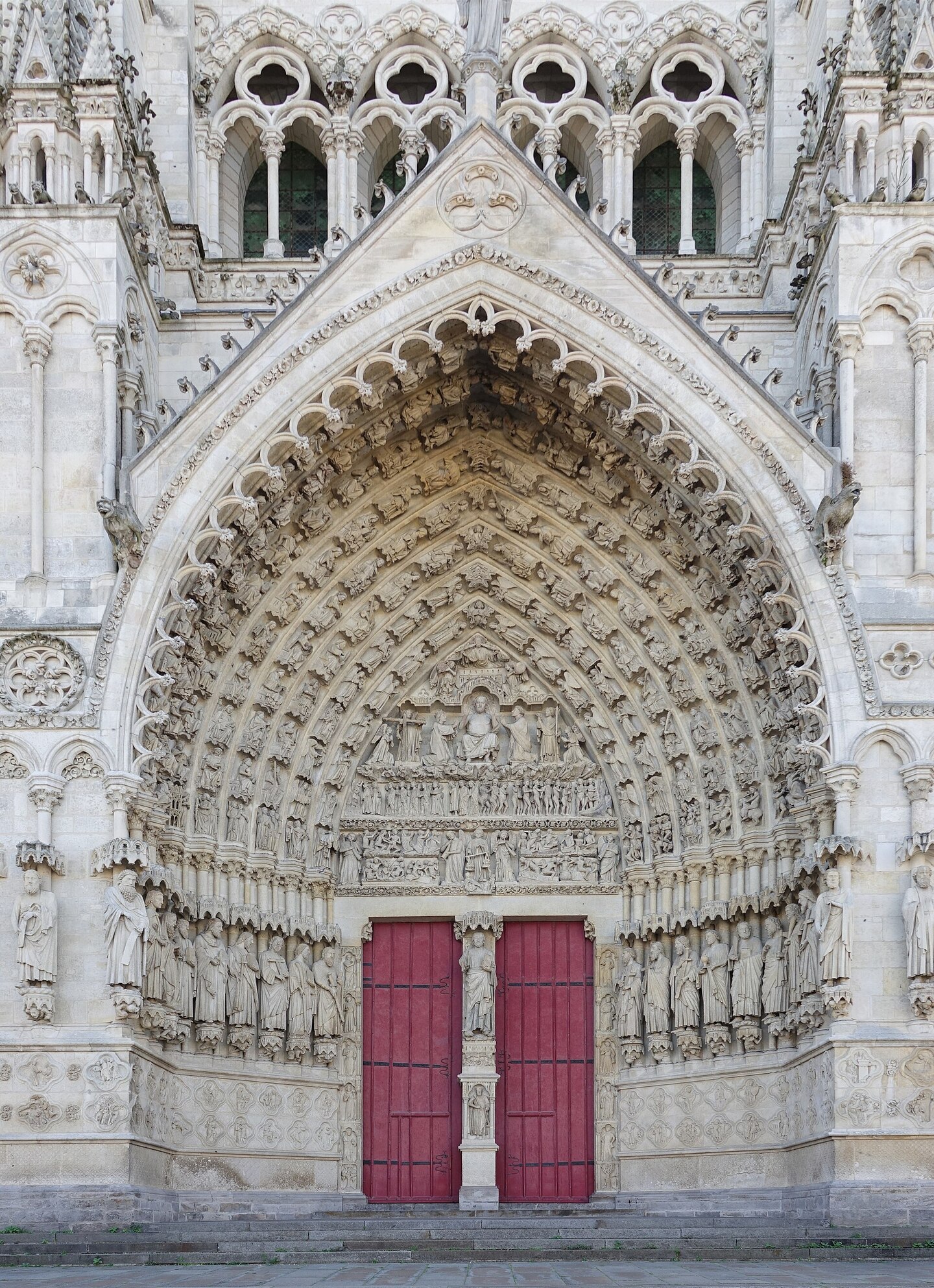
It is easiest to distinguish the doorway and the large pointed arch. Scenes inside the arch become visible as you get closer. The shift in scale for the three portals begins at different points on the facade.
Chartres Cathedral. Southern Portico. XIII Century Portico. Unknown Architects. Photo Txllxt TxllxT, 2011.
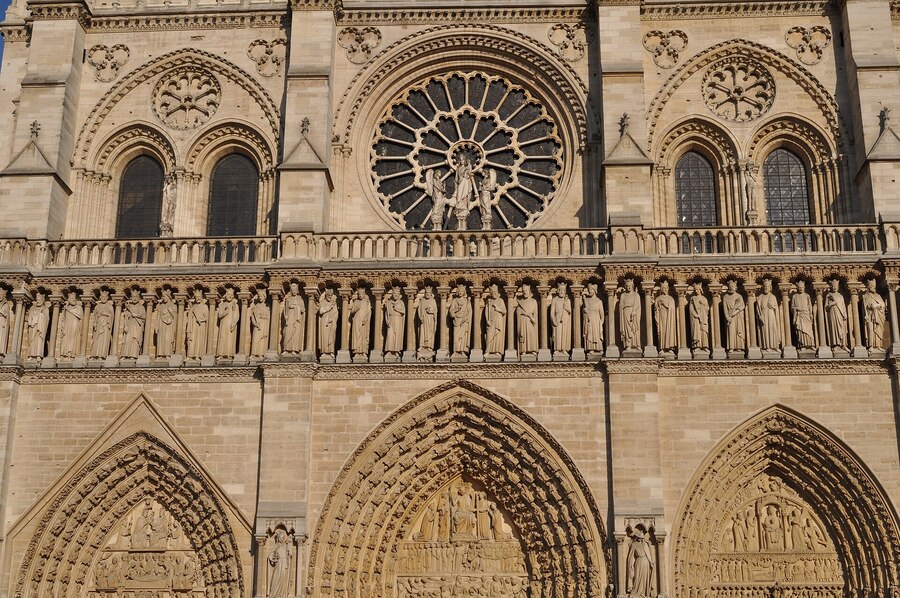
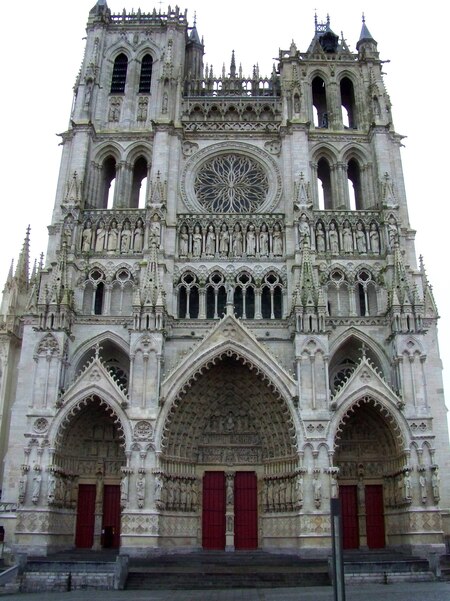
On the left, Notre-Dame de Paris. West facade. Unknown 13th-century masters. 19th-century restoration. Photo by Starbuck melo, 2011. On the right, Amiens Cathedral. West facade. Gothic ensemble of the 13th–15th centuries. Authors unknown. Photo by Florestan, 2008.
At Chartres, a wide staircase leads to the entrance. A deep portico conceals part of the relief from a visitor approaching from the side. The cathedral’s website dates this sculpture to the early 13th century. In Paris, the central portal is positioned under the axis of the rose window. Its placement within a row of three arches is noticeable even from the plaza. In Amiens, the central arch is wider than the flanking ones. Red doors highlight the actual openings, allowing for a comparison of their widths.
Notre Dame Cathedral. Central West Portal. Unknown Masters of the 13th Century. 19th-Century Restoration. Photo by Jean-Pol Grandmont, 2011.
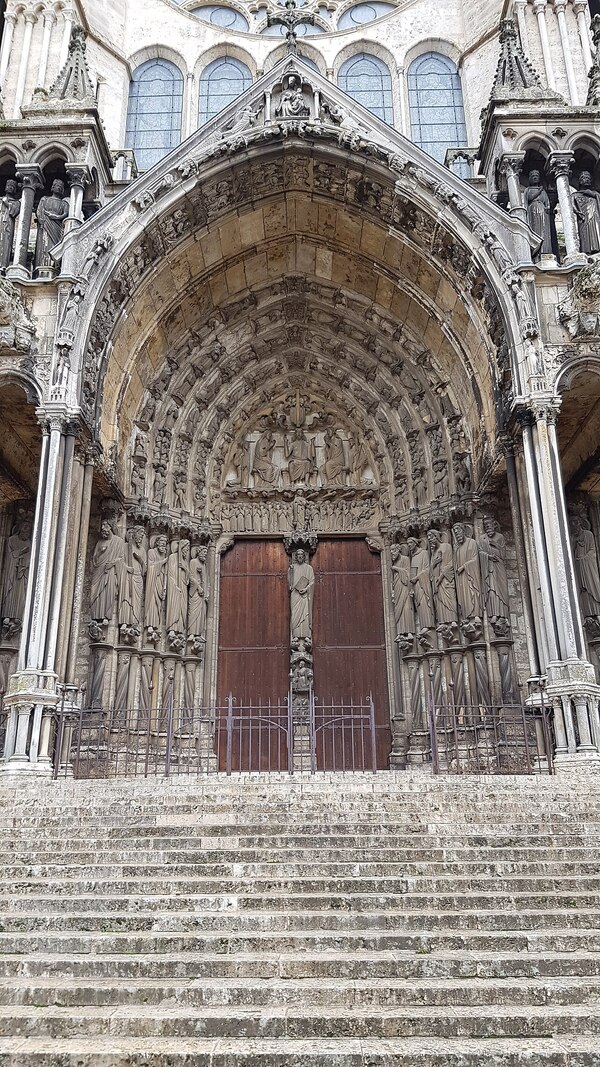
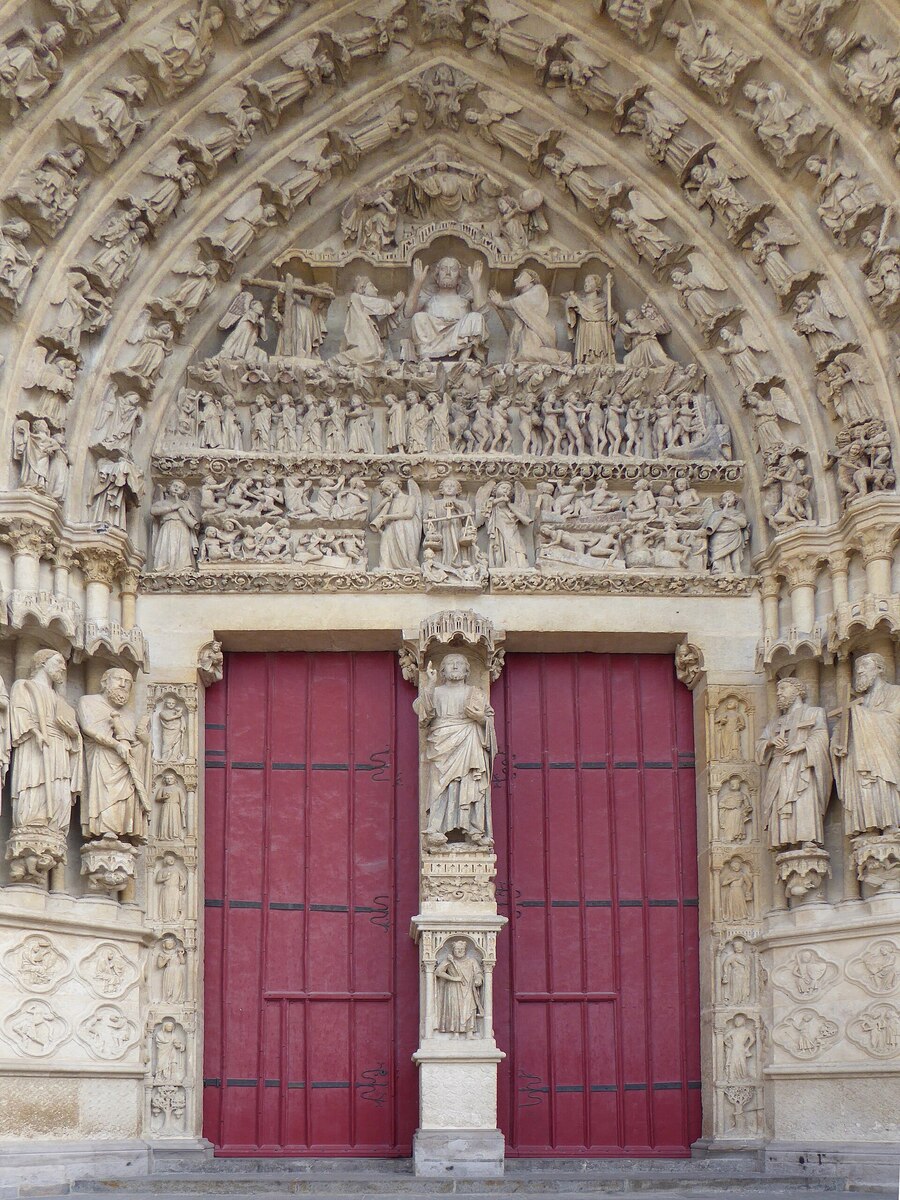
Chartres Cathedral on the left. The central portal of the south porch. Unknown masters of the early 13th century. Photo by Seudo, 2016. Amiens Cathedral. The central west portal. Unknown masters of the first half of the 13th century. Photo by Pierre André, 2017.
In the axial shot, the steps lead directly to a column situated between the two doors. The tympanum is visible in the distance, behind several rows of sculpture. Side lighting emphasizes the depth of the arches. With this type of illumination, the overall contour of the arch is visible before the figures in the shadow beneath it. Both doors and the high relief can be seen in a single frame. From the threshold to the apex of the composition, the gaze rises along the central column.
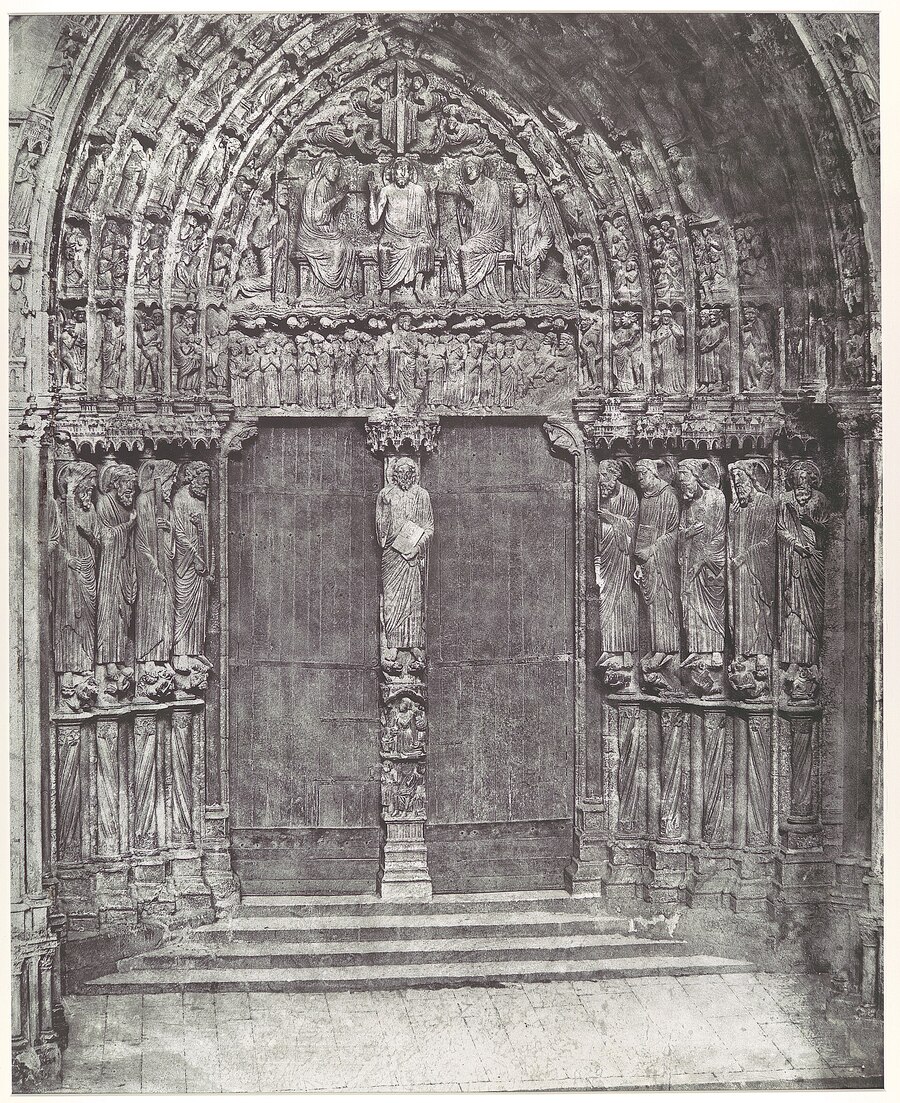
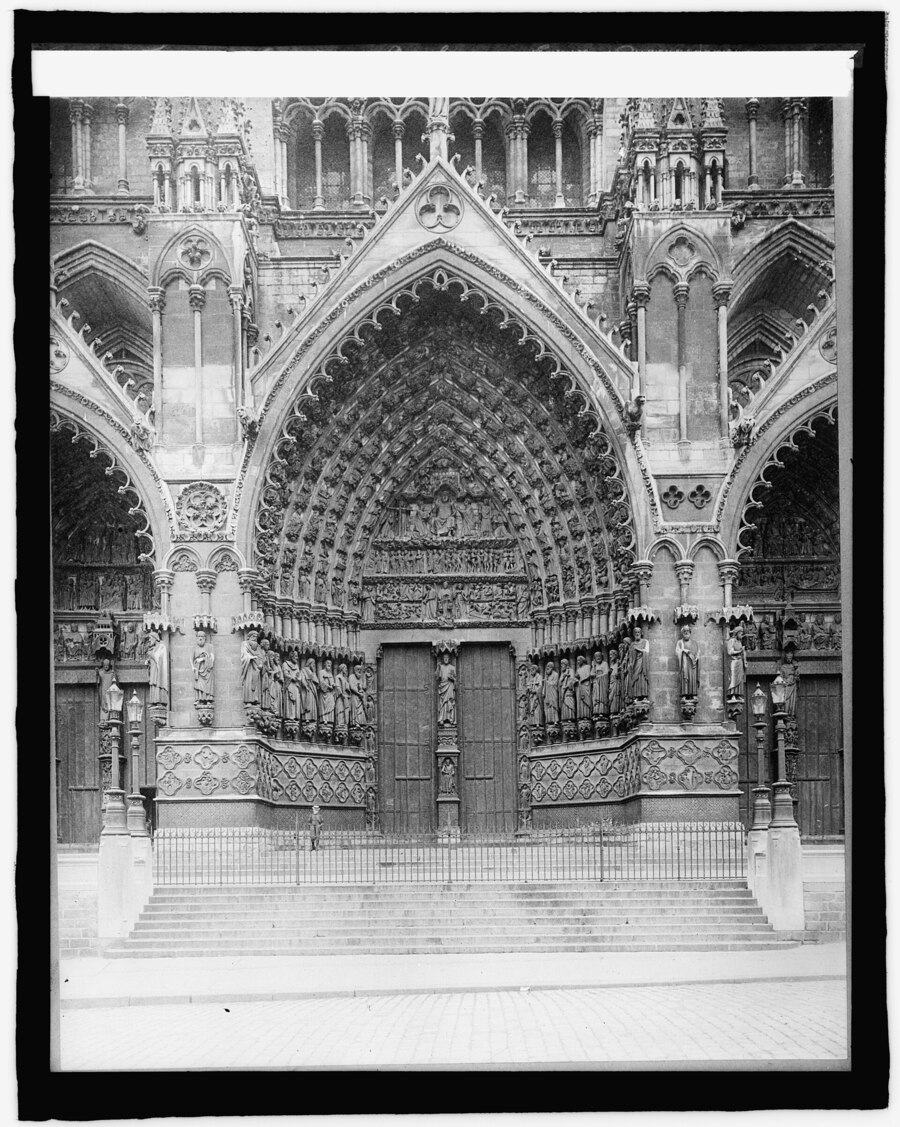
Left: Charles Negre. Central portal of the south transept of Chartres Cathedral. Photogravure from a 1855 photograph, printed in 1857. Right: Central portal of Amiens Cathedral. Archive photograph. Glass negative, 1916–1917.
In the mid-19th-century photograph engraving, almost the entire entrance is visible. The dark doors emphasize the standing figure, while rows of fine details above it converge toward the arch’s apex. In the archival photo, the height of the sculptural field relative to the doors is clearly discernible. This distance makes the overall structure more noticeable than the individual scenes.
The tympanum is the space between two doorways. It depicts a standing Christ. In the tympanum—the sculptural field within the arch above the doors—Christ is already seated on a throne.
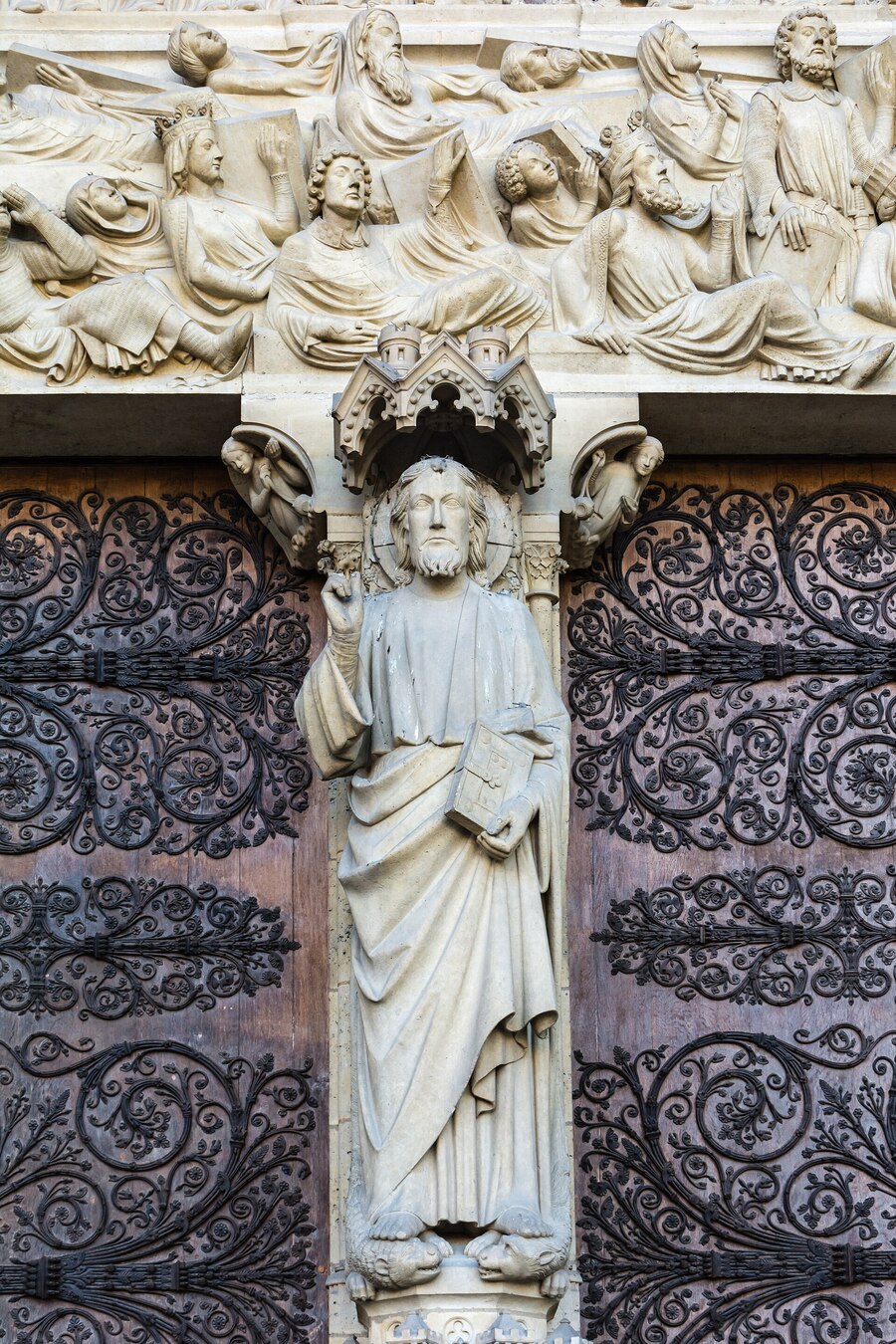
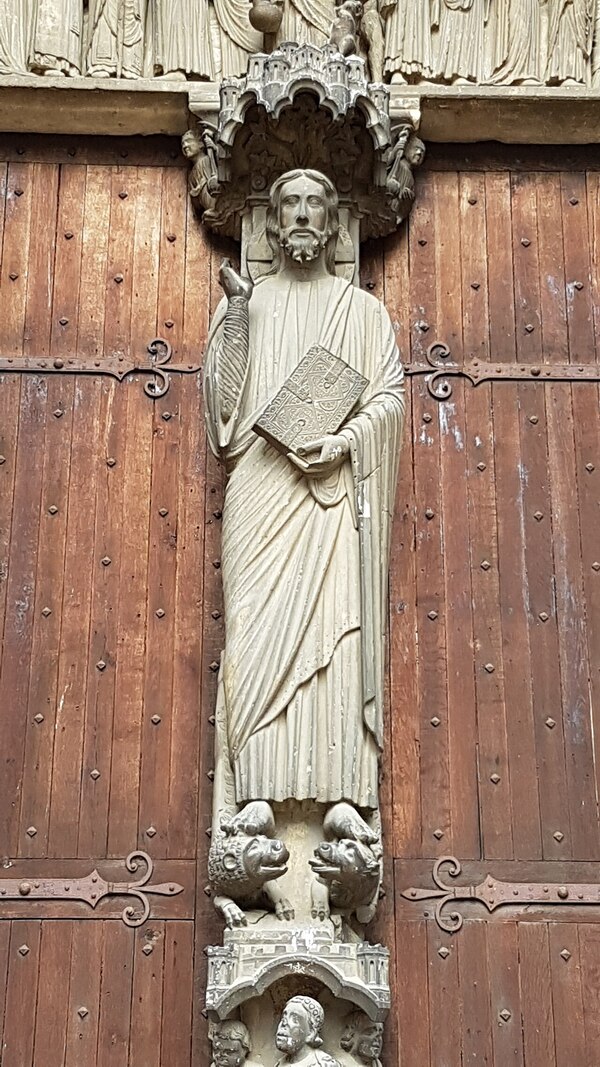
Left: Chartres. Christ on a tympanum. Unknown masters of the early 13th century. Photo Seudo, 2016. Right: Paris. Christ on a tympanum. Adolph Victor Geoffroy-Deshouaux, 1847–1864. Photo Uoaei1, 2015.
Chartres Christ holds a book and faces the person approaching the entrance. The figure’s vertical line aligns with the line dividing the doors. In Paris, the standing figure is beneath the stripe of the risen Christ. The statue was created by Adolf Victor Geoffroy-Desanges in the 19th century. The raised arm and book allow one to identify Christ at the entrance. The folds of the garment cross the body’s vertical axis, and the edges of the doors continue it upward.
Charter. Christ Judge, Theotokos, and John. Unknown masters of the early 13th century. Photo by Fab5669, 2017
Paris. Christ the Judge, the Virgin, John, and angels. Unknown masters of the 13th century. 19th-century restoration. Photo Uoaei1, 2015 (fragment).
Amiens. Christ in Majesty under a Baldachin. Unknown masters of the first half of the 13th century. Photo by Daniel Gaudry, 2011.
Christ faces the viewer directly. Two flanking figures turn toward him, their gestures directing attention to the center. The angels stand closer to Christ, while the Virgin Mary and John occupy the edges of the group. The narrow upper field of the arch emphasizes the height difference between the standing and kneeling figures. The carved canopy repeats the arch’s form on a smaller scale. Its central section marks the seated Christ, and the side projections encompass the nearest figures.
Chartres. Angels with a cross over Christ. Unknown masters of the early 13th century. Photo by Fab5669, 2017 (fragment).
Paris. Spear and cross next to Christ. Unknown masters of the 13th century. 19th-century restoration. Photo Uoaei1, 2015 (fragment).
Amiens. The Raised Arms of Christ. Unknown Masters of the First Half of the 13th Century. Photo by Eusebius, 2008 (fragment).
In Chartres, the cross is above Christ’s head. Its vertical line continues into the figure’s posture on the throne. The Parisian instruments of Passion flank Christ. A bright section of the exposed chest remains between the two verticals. The palms are raised to the sides of the face. Through this gesture, the upper composition links the image of the Judge with the crucifixion. Near him, angels hold the instruments of Passion.
The comparison begins with the scene of the resurrection. In Chartres, it must be sought on the arches around the central relief. In Paris, the scene occupies the lower transom. In Amiens, the weighing of souls is included in the same tier.
Chartres. The Last Judgment and Archivolts. Unknown Masters from the Early 13th Century. Photo by Eusebius, 2009.