Contents
1. Research Concept 2. Research Goals and Methods 3. The Judgment in Chartres 4. The Judgment in Bourges 5. War and Death in Maciejewski’s Bible 6. The Suffering Body: Crucifixus Dolorosus 7. The Martyrdom of Saint Bartholomew 8. Blood and Color 9. Between the Beautiful and the Horrific 10. Conclusion 11. Sources
Concept
Medieval art is often associated with religious harmony, sublime beauty, and faith. However, alongside depictions of saints, the Virgin Mary, and the celestial world, there are also works dedicated to suffering, death, physical vulnerability, and fear. This theme is particularly vividly explored in Western European art of the thirteenth and fourteenth centuries. During this period, artists increasingly focused on the physical suffering of Christ and the saints. Tension-filled poses, expressive faces, scenes of torment, and images of the Last Judgment appear in sculpture, illuminated manuscripts, and church reliefs. This raises a question: why does art tied to the idea of salvation and eternal life so frequently address death and physical suffering? Why can a frightening image be perceived not only as horrific but also as aesthetically expressive? In this study, death is examined as a distinct visual language. Through the depiction of the suffering body, artists conveyed ideas of sacrifice, faith, redemption, and the inevitability of human death. The concept of «aesthetics of death» unites the artistic techniques by which terrifying and painful subjects are transformed into expressive works of art. The term «body horror» is used here only as a modern analogy, as medieval masters did not conceive of the contemporary horror genre. The central idea of this research is that in medieval art, physical horror and spiritual beauty are not mutually exclusive. The depiction of physical suffering can, conversely, intensify the perception of holiness, sacrifice, and salvation.
Why did medieval artists turn to frightening depictions of death and suffering, and how did physical pain and bodily vulnerability become a means of expressing spiritual beauty?
The more expressively artists depicted human vulnerability and physical suffering, the more they could emphasize spiritual fortitude, sanctity, and the idea of redemption.The research is based on a visual analysis of artworks. I am examining not only the subject matter and how it is rendered—the positioning of figures, gestures, composition, color, clothing, and symbolic details. Five works from the 13th and 14th centuries were selected for analysis. They present different facets of the theme of death.
The research is fundamentally based on a visual analysis of artworks. I examine not only the subject matter and how it is portrayed—the positioning of figures, gestures, composition, color, attire, and symbolic details. For this analysis, five works from the 13th and 14th centuries were selected. They illustrate different facets of the theme of death.
South Portal of Chartres Cathedral. The Last Judgment
Chartres, France
c. 1210–1230
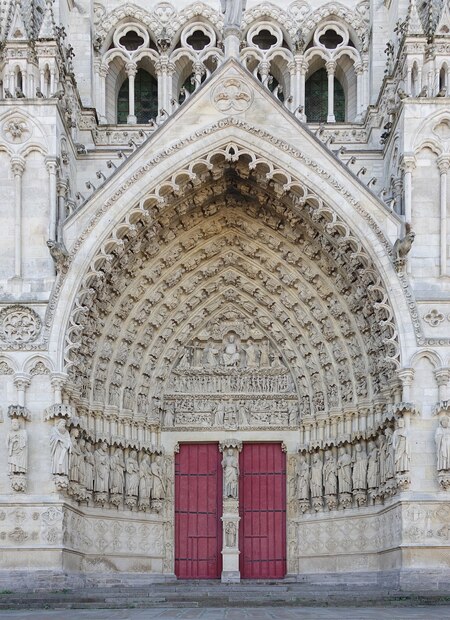
A significant example of the depiction of death is found on the central portal of the south transept of Chartres Cathedral. Its sculptural program is dedicated to the Last Judgment. Christ is presented at the center of the composition. Beside him are angels carrying the instruments of the Passion—objects that recall his earthly suffering and sacrifice. The marks of the crucifixion are emphasized on Christ’s body, allowing the image of the judge to simultaneously retain the features of the suffering Savior.This convergence is particularly vital to the research theme. Christ is not presented as a typical, authoritative judge, but as one who has personally endured human pain and death. His suffering becomes the foundation for the salvation of others. To his sides, the Virgin Mary and St. John the Theologian are depicted in postures of prayer, forming the Western Deesis and interceding for humanity. Below are scenes of archangel Michael weighing souls; he holds the scales of justice, dividing the deceased into the righteous and the sinners—to Christ’s left, angels guide the righteous through the gates of heaven, while on the right, demons lead the sinners into the maw of Leviathan, symbolizing hell.The composition illustrates a movement from death to judgment and eternity. Unlike the triumphant depictions of Christ, where physical suffering can be almost imperceptible, the wounds here become an essential part of the image. They remind the viewer of Christ’s sacrifice and the possibility of salvation. The Chartres portal demonstrates that in Gothic art, physical vulnerability could be perceived as a testament to sacrifice and spiritual strength.
Last Judgment
Sculpture by Bourgeois, France, adorns the tympanum of the central portal on the west facade of the Cathedral of Saint-Étienne
Circa 1240s
In medieval Christian art, death was perceived not only as the end of earthly life but also as the beginning of post-mortem existence. One of the central themes revealing this idea is the Last Judgment. On the central portal of the west façade of the Cathedral of Bourges, the moment of humanity being divided into the righteous and the sinners is depicted. The composition includes people rising from their graves, the archangel Michael weighing souls, and figures associated with the image of Hell.Particular attention is drawn to the depiction of the resurrection of the dead. Human figures ascend from their tombs, returning to life after a long wait. The sculptors portrayed nude figures in various poses, conveying their awakening and turmoil before the impending judgment. They become part of a grand composition where the fate of an individual person connects with the fate of humanity as a whole.In the scene of the weighing of souls, Archangel Michael acts as the judge, determining a person’s afterlife destiny. The image of the scales symbolizes divine justice. Nearby are demonic figures associated with the punishment of sinners. The image of Leviathan is also present in the composition, whose jaws serve as the entrance to Hell.Here, death is presented as part of a religious system of worldviews. The human body regains meaning after death: it is resurrected and stands before the highest court. The frightening elements of the depiction serve a didactic function. They were meant to remind believers of the responsibility for their own actions and the possibility of afterlife punishment.Thus, the aesthetic of death in Bourges is built on the confluence of fear and order. Even the depiction of Hell is subservient to the overall composition, in which every figure participates in revealing the religious meaning. While Chartres particularly emphasizes the connection between Christ’s suffering and the salvation of people, Bourges places greater focus on the resurrection, the judgment, and the individual’s ultimate fate.
Morgan Picture Bible
Paris, circa 1244–1254. Miniatures on vellum. Morgan Library & Museum, MS M.638
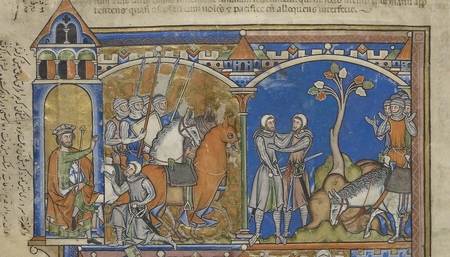
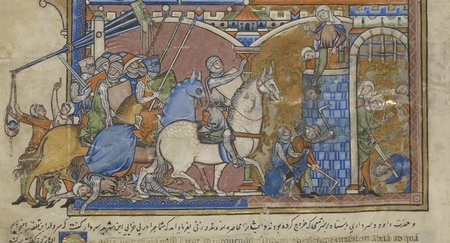
If death in depictions of the Last Judgment is tied to a religious concept, in scenes of war it takes on a more mass-driven and everyday character. This is particularly evident in the Masicius Bible, also known as the Morgan Picture Bible or Crusader Bible.
The manuscript was created in Paris around 1244–1254, presumably commissioned by King Louis IX of France just before his Seventh Crusade. It contains numerous miniatures depicting Old Testament narratives. The unique aspect of this manuscript is that the biblical events are rendered in the visual style of the 13th century: the characters wear clothing, armor, and weaponry characteristic of the manuscript’s creation period.
The battle scenes feature dynamic compositions. The figures of warriors are arranged in complex groupings—their bodies are inclined, their arms are raised, and their movements intersect. The artist’s attention is focused not only on the protagonists but also on the action unfolding around them.
Unlike depictions of saints, where suffering is often linked to the idea of a spiritual trial, the war scenes present death as a consequence of human conflict. Unlike the more stylized Romanesque or Early Gothic depictions, the artists of the Masicius Bible do not temper the brutality of the battles. The miniatures are replete with severed limbs and heads, helmets split open, piercing wounds from spears and arrows, and scenes of dispatching the wounded with daggers to the face. Beyond mass skirmishes, the manuscript meticulously records executions, murders, betrayals, and the demise of biblical figures. Death is shown as an inherent, physically palpable part of the earthly journey and divine retribution. The expressiveness of the scenes of violence is heightened by the luxurious artistic form: bloody clashes unfold against a shimmering gold background. For the medieval viewer, this contrast emphasized that even the most terrible death and bloodshed were interwoven into a higher providential design. There is no mandatory juxtaposition of tormentor and saint here. The artist demonstrates a collision of people where physical strength and violence become part of the historical narrative. Nevertheless, the miniatures should not be perceived as documentary renderings of specific historical battles; rather, they illustrate biblical events using the visual language of contemporary military culture.
Crucifixus Dolorosus (The Suffering Christ’s Crucifixion)
Cologne, St. Mary’s Church on the Capitole
c. 1300–1304
Polychrome wooden sculpture
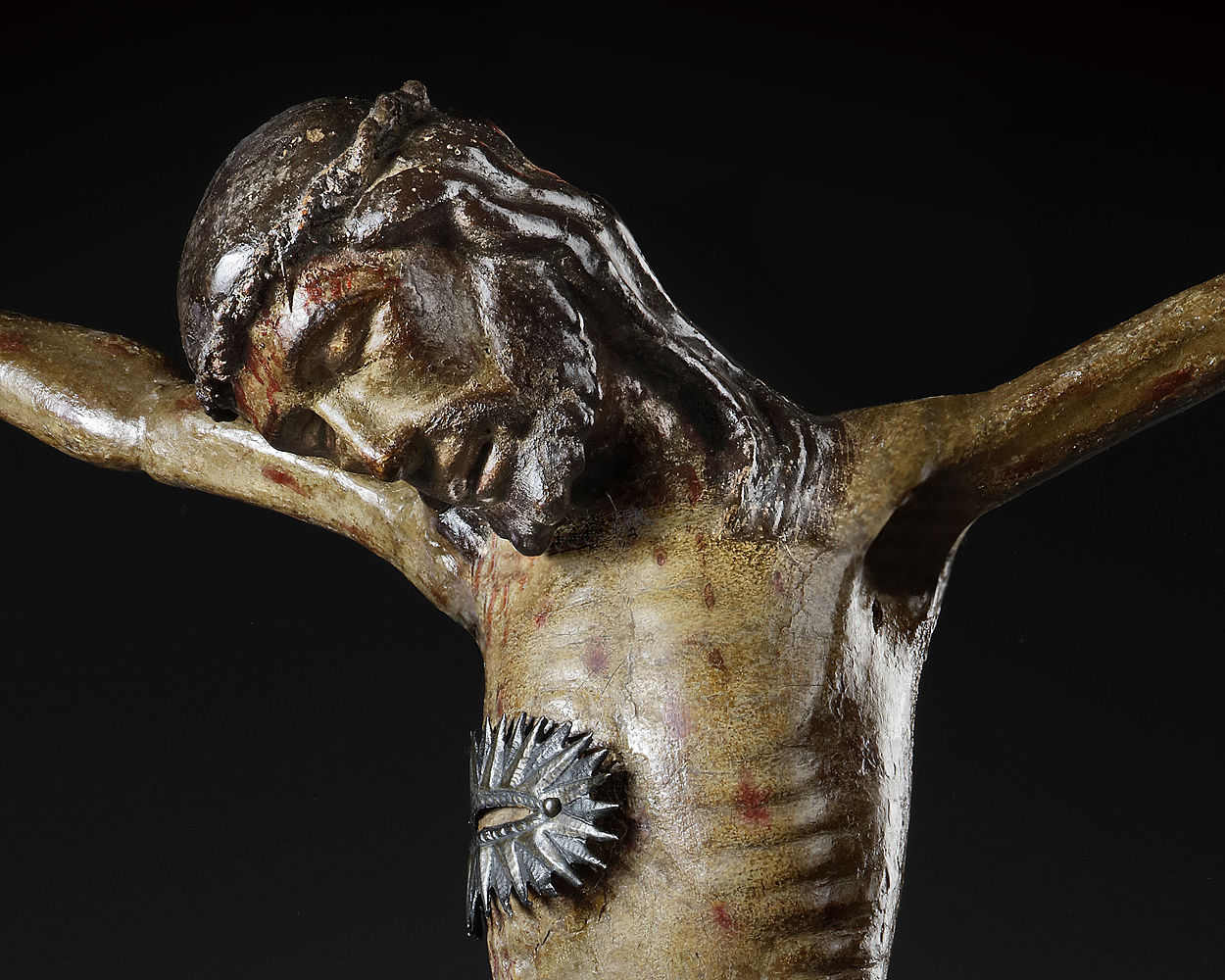
One of the most expressive examples of depicting physical suffering in medieval art is the Crucifixus Dolorosus from St. Mary’s Church on the Capitoline Hill in Cologne. The title translates to «Crucifixion of the Suffering Christ.» It belongs to a specific type of crucifix where the focus is not only on the religious significance of Christ’s sacrifice but also on the physical dimension of his suffering.
The figure of Christ differs from earlier, more solemn depictions of the crucifixion. His body is rendered as human, vulnerable, and exhausted. The pose emphasizes the weight of the body, and the lowered head and taut lines of the figure intensify the sensation of pain. The sculptor does not aim to create an image of a calm, majestic conqueror of death. Instead, the viewer confronts the image of a person enduring suffering.
Polychromy—the painting of the wooden sculpture—plays a particular role. Color helps render the figure more visceral and convincing. Because of this, the crucifixion is perceived not just as a symbolic sign of Christian faith but also as the image of the human body. However, the meaning of the work is not reducible to the demonstration of physical pain. In Christian tradition, Christ’s death is a sacrifice for the salvation of humanity. Therefore, the physical suffering here acquires a spiritual dimension. The more human and vulnerable Christ is depicted, the more strongly the significance of his sacrifice is underscored.
It is important to note that the traditional dating of the crucifixion to around 1304 is associated with an inscription mentioned by the 17th-century author Egidius Helenius. The inscription itself has not survived, so the date cannot be considered absolutely accurate. Nevertheless, the work is generally attributed to the turn of the 13th–14th centuries.
In this work, one of the main principles of the aesthetics of death is evident: physical suffering does not annihilate the spiritual beauty of the image; rather, it becomes a means of expressing it.
Pacino di Buonguida. The Martyrdom of Saint Bartholomew
From the Laudario di Sant’Agnese Manuscript
c. 1340
Tempera and gold on parchment
Two main scenes are positioned side-by-side: on the left, the skin of the saint is being flayed; on the right, he is being beheaded. In the first panel, he is chained to a ring on a light tower with one raised arm; in the second, he kneels in prayer, wearing his own removed skin like a cloak. The severed head retains a golden halo.
The color organization of the leaf is almost festive. A deep blue background is surrounded by a coral border dotted with white diamonds. Pink, blue, and green scrolls unfold across the margins, interspersed with golden circles. Against this backdrop, the reddish areas of the freshly exposed hands and feet stand out particularly sharply. The saint’s pale torso is elongated in a soft S-curve; long strips of removed skin continue the movement of his limbs. Blood drips down in thin verticals, collecting in small spots near his feet.
The presumed contrast between the grotesque executioners and the idealized victim here requires further examination. Pacino’s tormentors are not transformed into fantastic monsters. They are people dressed in pink, orange, and green, possessing severe features and focused movements. One works standing, another kneels, and a third reaches for the raised arm. Their professionalism makes the scene particularly unsettling—the violence appears as organized labor. Bartholomew’s face is sorrowful and concentrated, but his mouth is not open in a scream. His distinction is expressed primarily through the halo, the openness of his figure, and his gesture of prayer.
In the second scene, the saint’s physical and spiritual fate diverge directly within the image. The head is already falling, yet the hands continue to fold in prayer. Above, angels receive the small figure of the soul. The artist simultaneously depicts the disintegration of the human organism and the preservation of personality in another state of existence. The metamorphosis of the skin is especially potent: the body’s natural boundary becomes clothing. What should have ensured human integrity now hangs freely around him.
Beneath the scenes are red lines of musical staff, square black notes, and the hymn’s text. The leaf was intended for performing a hymn on St. Bartholomew’s day. This significantly alters its perception: the dreadful image existed within a musical and prayerful action. Within our analysis, the rhythm of the blood streams can be compared to the measured quality of the musical notation, although such a correspondence cannot be taken as proven intent by the artist.
Blood and Color
At the turn of the 13th and 14th centuries, interest in the body as mutable matter increased. Death acquired temporal depth: an artist could depict the moment of impact or the still figure of the deceased, as well as the gradual erosion of human form. Meanwhile, physical specificity continued to carry symbolic weight. The depiction of decay allowed viewers to contemplate time, social status, and their own fate.In medieval art, color did more than simply convey the appearance of objects; it held symbolic meaning. Red was particularly crucial to the theme of death, often associating with blood, sacrifice, suffering, and martyrdom. In religious imagery, red frequently signified the blood of Christ and the saints. However, its meaning was not limited solely to suffering. Red could also symbolize love, spiritual strength, solemnity, and divine power. Therefore, it must be interpreted in light of the narrative and the specific context of the artwork.Medieval masters employed various materials to create red hues, including cinnabar, artificial vermilion, orpiment, red earth pigments, and organic dyes. Their use depended on the time period, region, workshop, and the cost of the materials.Franciscans and Dominicans urged believers to empathize with Christ’s earthly, human suffering. Realistic blood helped the viewer experience deep emotional shock and compassion. Thus, color became the link between the material and the symbolic. A splash of red could remind the viewer of physical pain while simultaneously pointing to the idea of sacrifice and redemption. This was especially pronounced in depictions of the Crucifixion and martyrdom. The artist created visual «bloody» accents that directed the viewer’s attention to the most significant parts of the composition.It is important to note that medieval art did not transition instantaneously from convention to realism. Symbolic and more realistic imagery coexisted. Artists could emphasize bodily details while simultaneously maintaining conventional composition, gold backgrounds, and a religious system of signs.
Between beautiful and terrible
The works examined show that medieval aesthetics of death were not monolithic. They integrated several modes of representing human suffering. In the portals of Chartres and Bourges, death is linked to religious concepts of the Last Judgment, resurrection, and afterlife. In Maciejewski’s Bible, it is revealed through military conflict and human violence. In the Crucifixus Dolorosus, Christ’s body becomes the primary vehicle for emotional impact. In the miniature depicting the martyrdom of Bartholomew, physical suffering is contrasted with the saint’s spiritual fortitude. Despite these differences, these works are united by an effort to depict death as an phenomenon imbued with a specific religious or moral meaning. The representation of the body proves particularly significant. It could be weak, suffering, and vulnerable, yet simultaneously retain spiritual significance. This is why physical imperfection was not necessarily perceived as the antithesis of beauty. Medieval artists employed frightening and even shockingly explicit details to evoke compassion, fear, awe, or contemplation of one’s own life in the viewer. Visual horror became a means of conveying an idea rather than an end in itself.
Conclusion
The research conducted indicates that death and bodily suffering held a significant place in Western European art during the 13th and 14th centuries. They were depicted across various genres and forms: in sculptural crucifixes, illuminated manuscripts, martyrdom scenes, military episodes, and the architectural compositions of the Last Judgment. The analyzed works suggest that medieval aesthetics of death were constructed upon the interaction of two opposing forces. On one hand, artists engaged with human physicality, portraying suffering, vulnerability, and fear. On the other hand, these images were embedded within the religious framework of sacrifice, salvation, resurrection, and eternal life.Thus, the study’s hypothesis is confirmed: medieval artists utilized the depiction of physical suffering not only for emotional impact on the viewer but also to elucidate spiritual and moral concepts. Corporeal terror became part of an artistic language through which art spoke about faith, human nature, and the finitude of life. The main paradox of medieval aesthetics of death lies in the fact that beauty could emerge where bodily destruction was depicted. This was not an admiration of pain itself. Rather, through the portrayal of suffering, artists sought to convey what could ultimately triumph over death: faith, sacrifice, and the hope of salvation.
How medieval Christians perceived death, burial, the memory of the dead, and the Last Judgment. Goldiner S. Art and Death in the Middle Ages // The Metropolitan Museum of Art. — 2001. — URL:https://www.metmuseum.org/essays/art-and-death-in-the-middle-ages (Accessed: November 15, 2026).
An article on how imagery could affect the feelings of believers. In the Mirror of Christ’s Passion // Princeton University Art Museum. — URL:https://artmuseum.princeton.edu/art/stories-perspectives/collection-publications-mirror-christs-passion (Accessed: November 15, 2026).
Examining Christ the Judge, the Instruments of Passion, the Archangel Michael, martyrs, and the division of people into the saved and the condemned. The South Portal // Chartres Sanctuaire du Monde. — URL: https://www.chartres-csm.org/en/the-cathedral/the-sculptures-on-the-transept-portals/the-south-portal/ (Accessed: November 15, 2026).
Official historical material about the cathedral of Bourges. Bourges Cathedral // Centre des monuments nationaux. — URL:https://www.bourges-cathedrale.fr/en/discover/bourges-cathedral (Accessed: November 15, 2026).
Material from the Leuven Catholic University library regarding the transition from the solemn image of Christ to the image of the suffering human being. The Iconography of the Stations of the Cross in Late Medieval and Early Modern Works // KU Leuven Libraries. — URL: https://bib.kuleuven.be/english/msb/special-collections/14emotions (Accessed: November 15, 2026).
The Morgan Library catalog with the history, dating, provenance, and content description of the Masciewski Bible. Old Testament Miniatures (MS M.638) // The Morgan Library & Museum. — URL: https://www.themorgan.org/manuscript/158530 (Accessed: November 15, 2026).
Colour and Meaning // Fitzwilliam Museum, University of Cambridge. — URL: https://colour-illuminated.fitzmuseum.cam.ac.uk/explore/colour-and-meaning (Accessed: November 15, 2026).