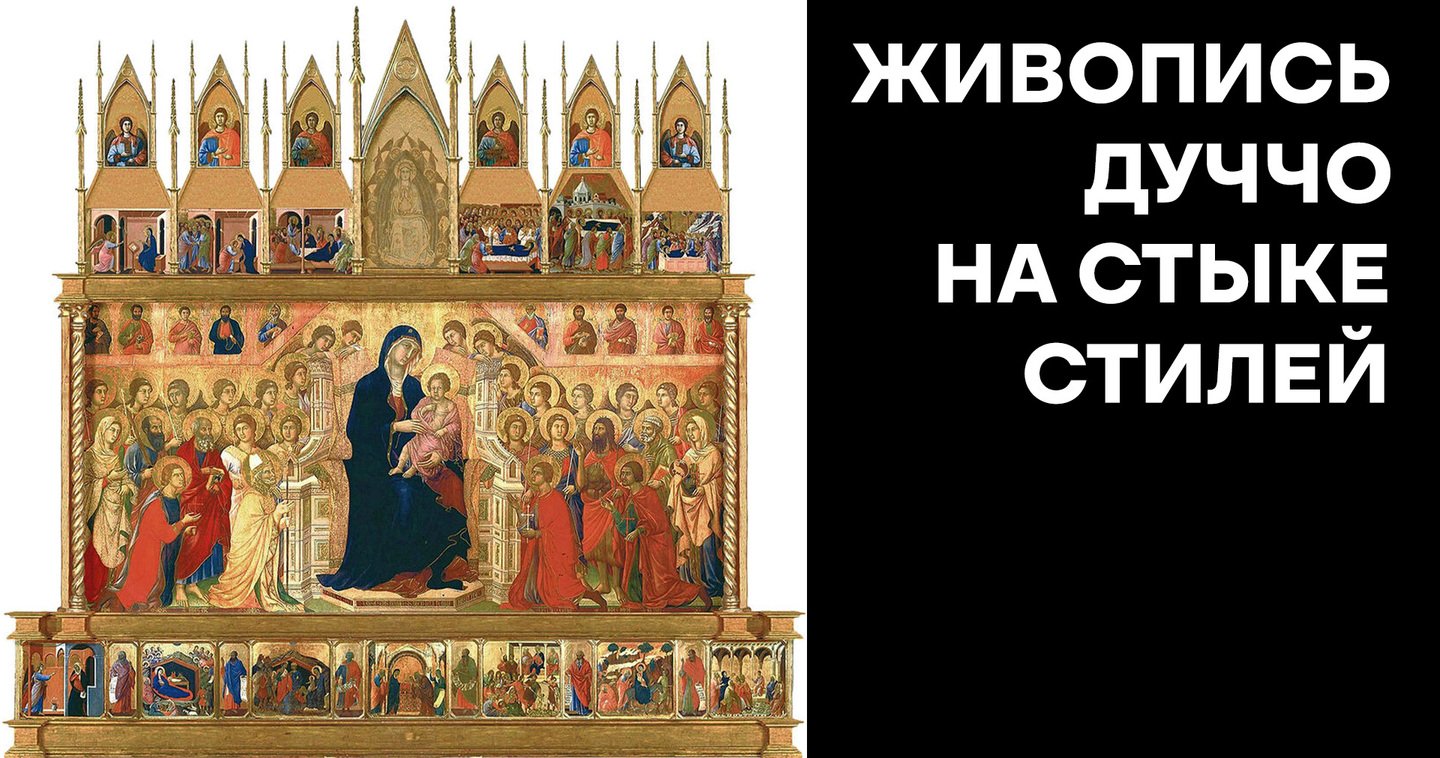
CATEGORIZATION
1. Concept
2. Byzantium
3. Gothic
4. Florence and Personal Style
5. Conclusion
CONCEPT
The end of the 13th and beginning of the 14th centuries marked a transitional period in the history of European art. During this time, the principles of proto-Renaissance began to form, which would later lay the foundation for the entire Renaissance era. Trends that foreshadowed humanism were expressed in art through an increased focus on human experience. Artists strove to lend their work a sense of naturalism and volume. Siena became one of the main centers of this transformation, developing its own artistic tradition. Duccio di Buoninsegna is considered one of the most significant figures in Sienese art, regarded as the founder of the Sienese painting school. His works profoundly influenced subsequent generations of Sienese masters and defined the unique artistic style of the region.
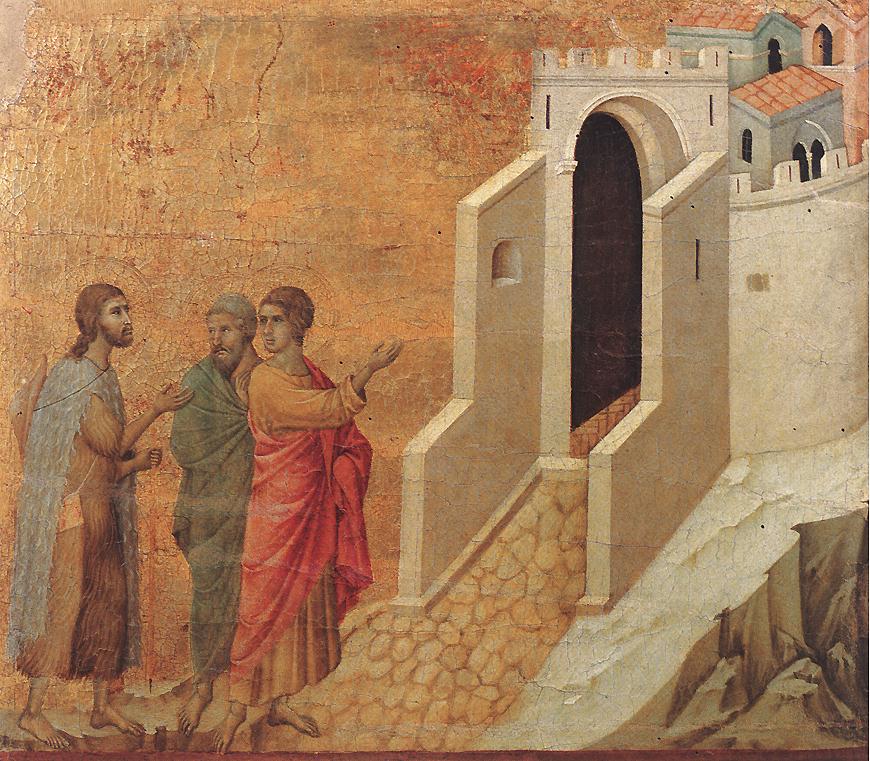
Maestro (excerpt from «The Road to Emmaus»), Duccio di Buoninsegna, 1308–1311
Duchccio, immersed in the creative environment, was inevitably influenced by existing traditions and other artists. I believe that his mastery in combining completely different styles contributed to the creation of masterpieces. After all, it was the combination of Byzantine solemnity and rigor with Gothic grace and a certain Sienese lyricism that became one of Duccio’s defining characteristics, establishing his uniqueness.
In this research, I aim to trace which artistic styles influenced Duccio, how they manifest in his works, how he achieved aesthetic balance, and what constitutes his unique artistic voice—his signature style.
The research hypothesis is that Duccio’s unique style emerges from a synthesis of Byzantine, Gothic, and Florentine painting principles, particularly the style of Cimabue, whom Duccio was inspired by.
BYZANTINE INFLUENCE
By the end of the 13th century, the Byzantine painting tradition had forged a unique visual language and firmly established itself throughout the Eastern Roman Empire. Its defining feature—a highly refined iconographic canon—dictated the rigor and solemnity of the Byzantine style. Icons featured a gold background, symbolizing divine light. The themes and composition of the icons were predetermined; figures were depicted frontally, with the emphasis placed not on emotional expression but on restraint and majesty. Surrounding objects and space were conventional, employing reverse perspective.
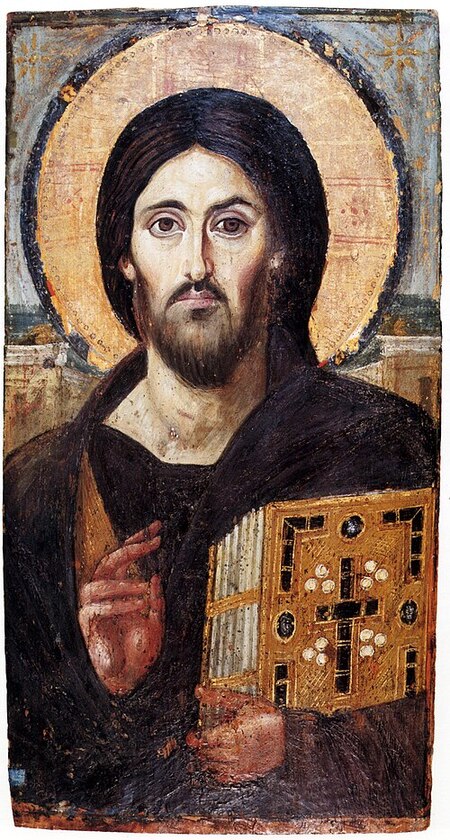
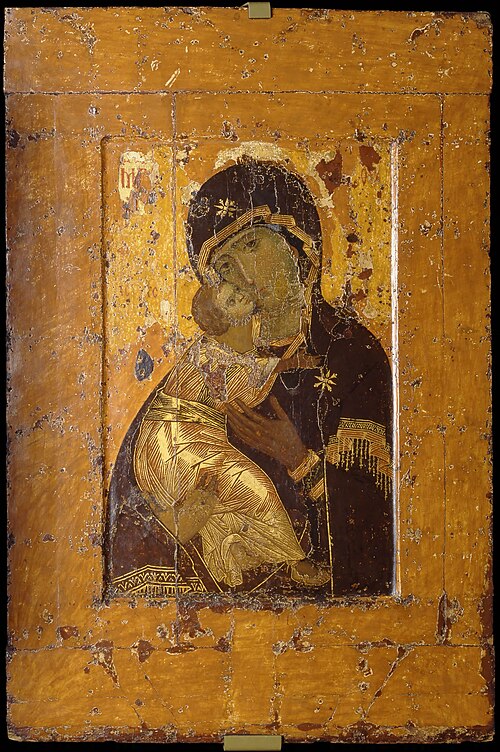
Christ Pantocrator from Sinai Monastery, 6th Century | Vladimir Icon of the Mother of God, 12th Century
This style was directly influenced by Italian art because it was widespread in Italy during the 13th century, thanks to the migration of Byzantine masters, trade connections, and monuments brought from the sacked Constantinople. The combination of Byzantine elements with the Romanesque style gave rise to what was called the «Greek manner» in Italy.
Duccio was no exception, and the influence of Byzantine painting principles is clearly visible in his works. However, the artist did not limit himself to a banal continuation of a long-standing tradition. In his works, he referenced established Byzantine artistic techniques while emphasizing his own vision. In his early works, the influence of the Greek style is particularly noticeable. The artist paints on a gold background and uses traditional composition. Building on this foundation, he began to experiment, transforming the style toward increasingly original solutions.
Madonna Stroganova, Duccio di Buoninsegna, 1300
Madonna Stroganova exemplifies the ambiguity in assessing Duccio’s artistic borrowings. The emotional interaction between the infant and the Mother of God appears to be a Duccio innovation, yet it could easily reference Byzantine art. The Eastern iconographic type, «Eleousa, ” suggests the depiction of the intimacy between Mary and the infant Christ. The Vladimir Icon of the Mother of God, for instance, belongs to this type.
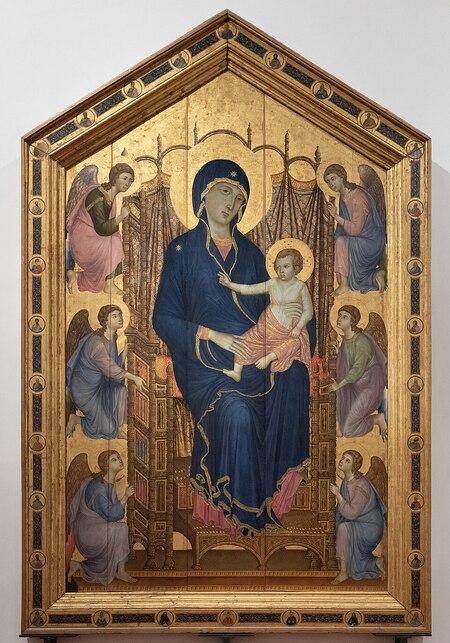
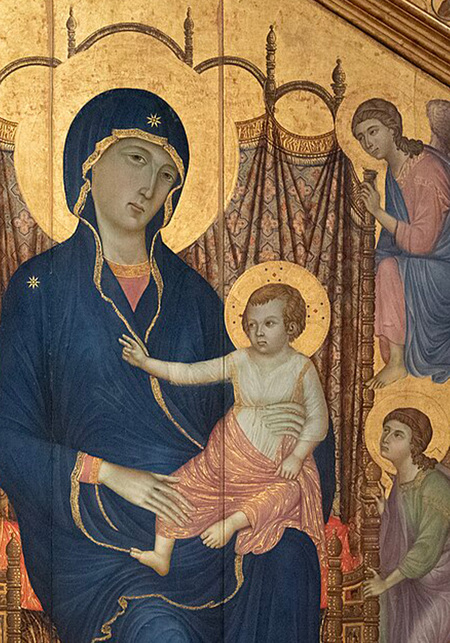
Madonna of Ruccellai, Duccio di Buoninsegna, 1285
Madonna of Ruccellai—a clear example of the preservation of Byzantine traditions in sacred painting. The gold background creates a sense of timelessness, symbolizing the divine radiance emanating from the saints. The Virgin Mary is the compositional focal point. Her figure faces the viewer, while the angels flanking her are symmetrically arranged, reinforcing the visual hierarchy.
However, even here, one can note a softness in the drapery and a sense of spatial depth not typical of Byzantium, evident in the depiction of the throne. The angels' faces carry a hint of emotion. Each one holds the throne differently. This also attests to the complexity and thoroughness of the imagery.
Stained Glass of the Apse at Siena Cathedral, Duccio di Buoninsegna, circa 1288
Assumption. Fragment of the apse stained glass from the Siena Cathedral, Duccio di Buoninsegna, c. 1288
Fresco of the Dormition of the Theotokos. Sopochany Monastery, c. 1265
In Duccio’s stained-glass depiction of the Dormition of the Theotokos in the apse of the Siena Cathedral, he references the traditional Byzantine iconographic scheme (Dormitio Virginis). At the center of the composition is Christ, holding Mary’s soul in the form of an infant, while the Theotokos lies on a bier before him, surrounded by the Apostles. The artist preserves the traditional hierarchy of the figures but slightly deviates from strict symmetry. The Apostles are more clustered together—another step away from the canon toward naturalism.
Researcher Rosa D’Amico also notes the resemblance between the image of Christ and the Assumption fresco at the Sopochany Monastery—a distinguished monument of Byzantine painting—especially in the facial features, which Duccio softens through the play of light and shadow. The stained glass beautifully demonstrates how the artist reinterprets conventional patterns.
Maestà (Fragment), Duccio di Buoninsegna, 1308–1311
In the «Maestà,» Byzantine influence is also evident in the use of chryso-graphy—delicate golden lines applied over the painted layer to delineate folds and highlights on the garments. This technique was widely used in Byzantine iconography and imparted a luminous quality to the image. Even in later works, such as the Maestà, Duccio includes elements of the Greek style. The gold lines are particularly noticeable on the Virgin Mary’s clothing, where they define the fabric’s folds, emphasizing Byzantine decorative richness.
The works examined demonstrate the significant influence of Byzantine heritage on Duccio’s creativity. This influence is evident in the iconography of the Virgin and Child, the use of gold backgrounds and traditional composition, the engagement with canonical religious narratives, and technical methods such as chryso-graphy. Furthermore, the Byzantine elements do not restrict Duccio’s artistic language; rather, they form the foundation for his subsequent artistic decisions. By preserving traditional imagery and techniques, the artist gradually enriches them with emotional expressiveness, plasticity, and attention to human feeling.
GOTHIC AND WESTERN EUROPEAN MOTIFS
In addition to the Byzantine tradition, the Gothic style of Western Europe also exerted a strong influence on the development of Italian culture in the 13th century. Gothic art is characterized by a freer depiction of human experience, stemming from the necessity of engaging the viewer emotionally in the narrative. Elegant lines and elongated forms are associated with the noble purity of the characters. The abundance of patterns, ornaments, detailed backgrounds, attention to nature, and the depiction of Gothic architecture all suggest that earthly beauty is not considered sinful. On the contrary, it is a manifestation of divine beauty. The Gothic perspectives are close to Duccio. He widely employs the aforementioned techniques, which, combined with Byzantine elements, open up an entirely new vision.
Reverse side of Maestà (excerpt — «The Temptation of Christ on the Mount»), Duccio di Buoninsegna, 1308–1311