Архитектура как палимпсест: наслоение культур, стилей и смыслов
This project is a student assignment from the School of Design or a research project by a faculty member of the School of Design. This project is not commercial and serves educational purposes.
Concept
This visual study focuses on architectural structures that have endured shifts in religion, political power, or cultural context. The buildings have undergone physical transformations, and new societies have redefined their meaning. The same architectural volume could transform from a sanctuary of one faith to a monument of a former power, a museum, or an element of a new ensemble.
Main Question
What happens to architecture when culture, religion, or power changes? Which elements are preserved, which are destroyed, which are borrowed, and which take on new meaning?
Architectural transformation is rarely a complete erasure of the past. Even when a building’s purpose changes, its former structure, materials, or layout can continue to influence its new appearance. Architecture becomes a material testament to multiple historical epochs.
Palimpsest as a Metaphor
Palimpsest is a manuscript where new text was applied over older script. In architecture, this term helps describe a building where historical layers do not entirely erase one another. Old walls, columns, mosaics, and floor plans can remain within a new space—sometimes openly, sometimes concealed.
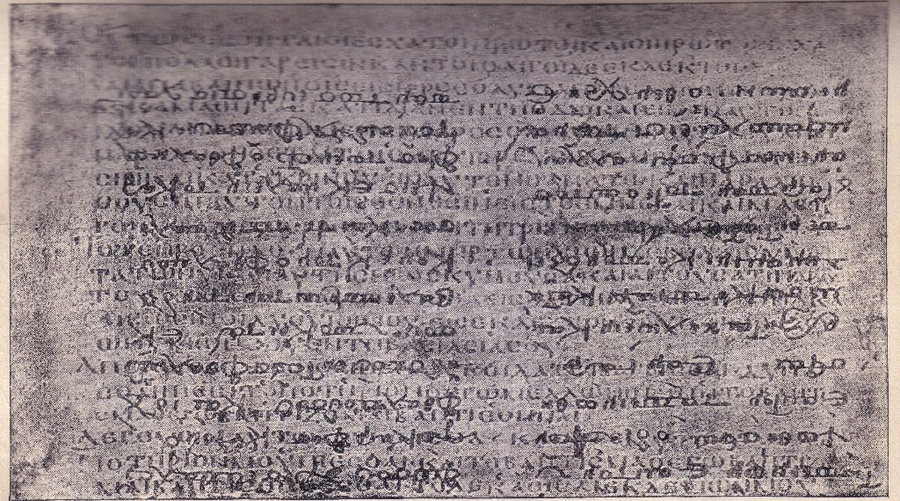
Fragment from the «Efremov Codex» with the Gospel of Matthew, 20:16–23. Bibliothèque nationale de France
Constantine’s Arch in Rome was constructed between 312 and 315. Its decoration incorporates reliefs and sculptural elements from earlier imperial monuments. This reuse connected Constantine’s image with the authority of previous rulers, transforming ancient art into an instrument of political memory.
The Arch of Constantine in Rome was constructed between 312 and 315 AD. Its decoration incorporates bas-reliefs and sculptural elements from earlier imperial monuments. This reuse linked Constantine’s image to the authority of his predecessors and transformed ancient art into a tool of political memory.
Functional transformation—a change in purpose. Symbolic—a change in signs and imagery. Constructive—reusing elements or technologies. Stylistic—a synthesis of various artistic traditions. Memorial—transforming an active space into a monument, museum, or restoration object.
In each section, four levels are compared: the general outline and building plan; structural elements; decoration and symbols; and contemporary usage. This comparison allows us to see exactly what has changed and what remains part of the architectural memory.
Lascaux Cave Paintings. Dordogne, France.
The prehistoric space reminds us that architecture begins not just with building walls. Caves were used as sites for image-making, ritual, and collective memory. The Lascaux cave complex dates to the Upper Paleolithic period. Its paintings are connected to a specific geological environment—the walls, passages, and depth of the cave. After the original was closed to the public, replicas and museum displays were created. Here, what changes is not the building’s religious nature, but its access protocol and the way the space is perceived.
Interior of the Lasco Cave. France, Dordogne Department.
The transition from a ritualistic or unknown purpose to a museum display alters the viewer’s relationship with the space. The cave becomes an object of preservation, scientific study, and controlled visitation. The replica retains the viewing experience but is not identical to the original site.
Historical engraving based on a drawing by George Wheeler, 1676.
In antiquity, the temple was not merely a shell for cult worship. Its proportions, orientation, portico, and placement within the city shaped the image of order and social identity. Later societies could preserve this architectural language even as its original religious function faded.
Pierre Peitie. Greece, Athens, 1828–1836. Watercolor.
The Parthenon was constructed in the 5th century BCE as a temple to Athena on the Acropolis. In Late Antiquity, it was converted into a Christian church. This transformation involved adapting the interior space for Christian worship. It is important to compare not only the symbols but also how the orientation and organization of the sacred space changed.
Contemporary photography, view from the Pnyx hill.
During the Ottoman period, the Parthenon served as a mosque. In 1687, during the Venetian siege, an explosion in the gunpowder magazine inside the structure caused severe damage. The modern monument is not a «pure» ancient form, but rather the result of a layered history, destruction, and restoration. A change in function does not always require the complete dismantling of the architectural body, but it can alter its internal organization and visual interpretation.
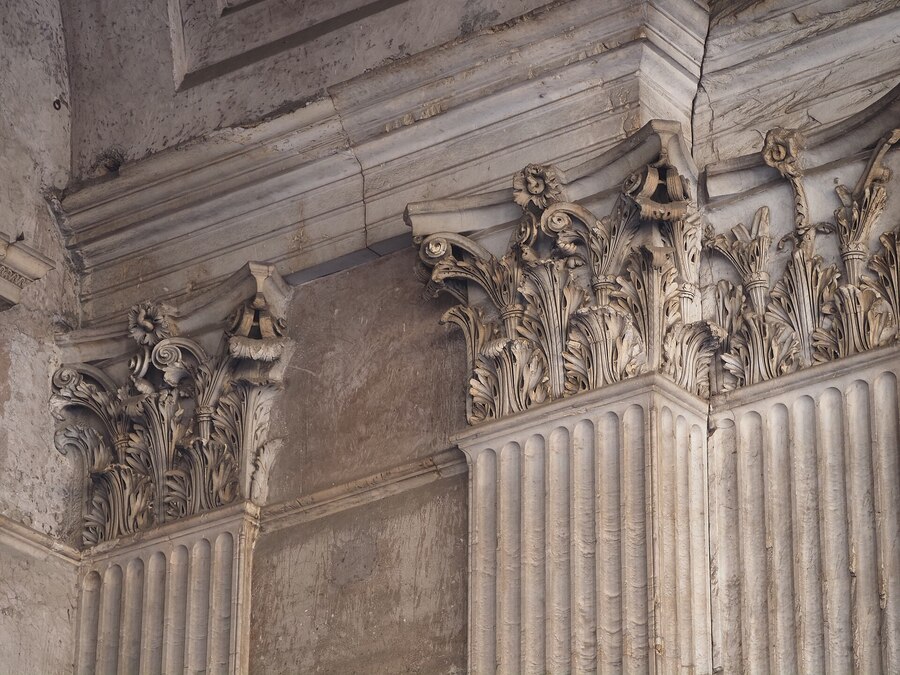
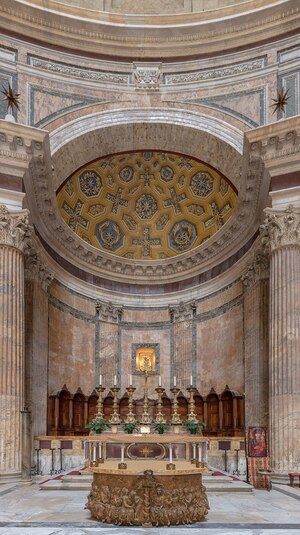
Architectural interior decoration of the Pantheon. 118–128 AD; The main altar of the Pantheon, which was converted into a Christian church in 609.
The modern Pantheon in Rome was constructed under Hadrian, approximately between 118 and 125 CE. In 609, it was dedicated to the Christian Church of Santa Maria ad Martyres. Italy’s Ministry of Culture attributes the monument’s preservation precisely to its conversion into a church.
The dome of the Pantheon, featuring a coffered ceiling and a central opening—the oculus. 118–128 AD.
The main volume of the rotunda, portico, and dome remained the core of the building. Christian use altered the interior liturgical design and the meaning of the space, but it did not destroy the engineering system. Unlike the Parthenon, the Pantheon preserved the integrity of its domed interior.
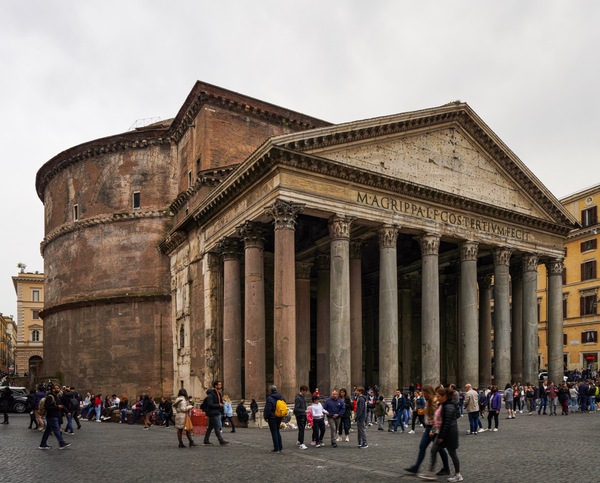
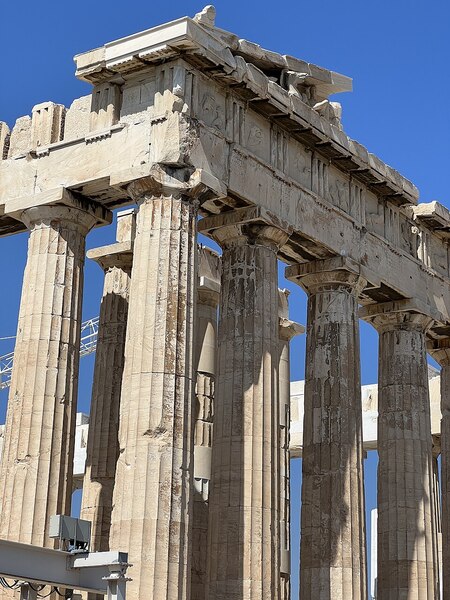
Pantheon, view of the main facade, 118–128 AD; Fragment of the colonnade and entablature of the Parthenon, 447–432 BC.
The Parthenon and the Pantheon present two different scenarios. In Athens, the shift in religion was accompanied by significant changes and destruction. In Rome, the new function helped preserve the ancient structure. Therefore, religious adaptation could have been both a mechanism for preservation and a cause for reconstruction.