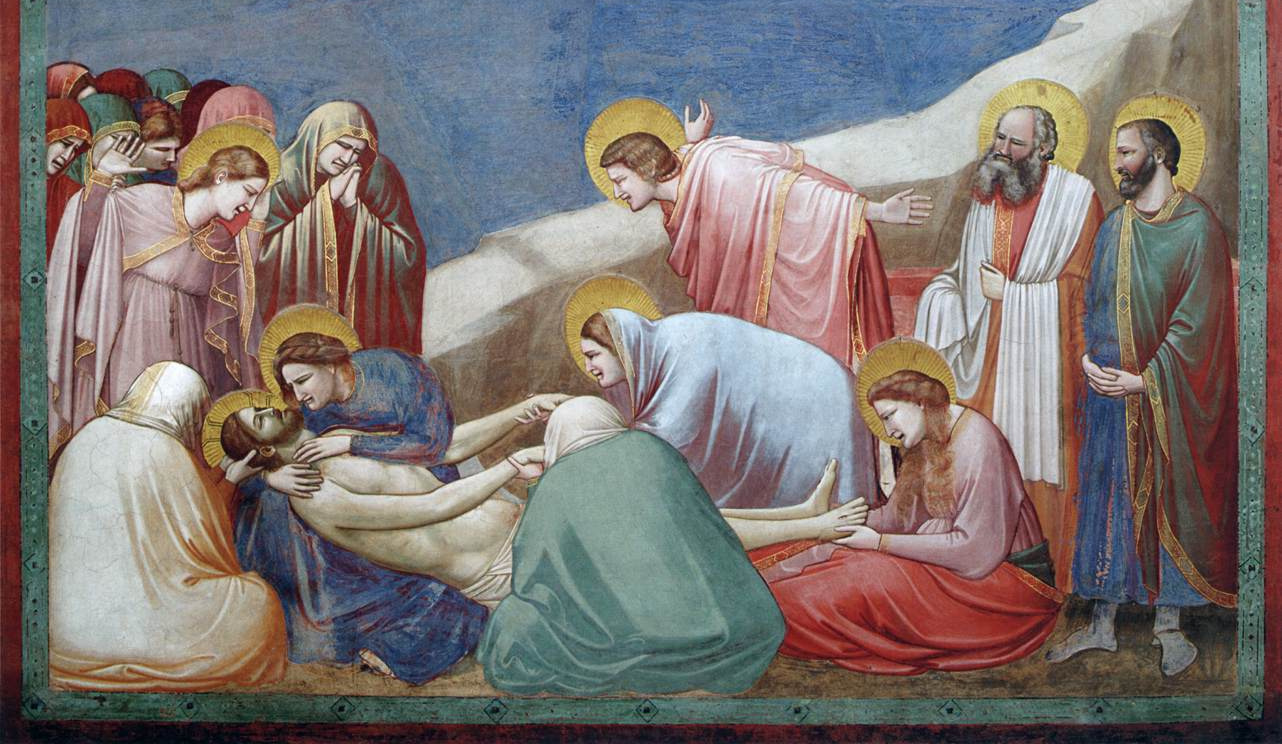
Жесты рук во фресках Джотто
Капелла Скровеньи, около 1305 года
Research Question
How do touch, hand gestures, and distance between figures help to distinguish the characters' actions in the twelve frescoes of the Scrovegni Chapel?
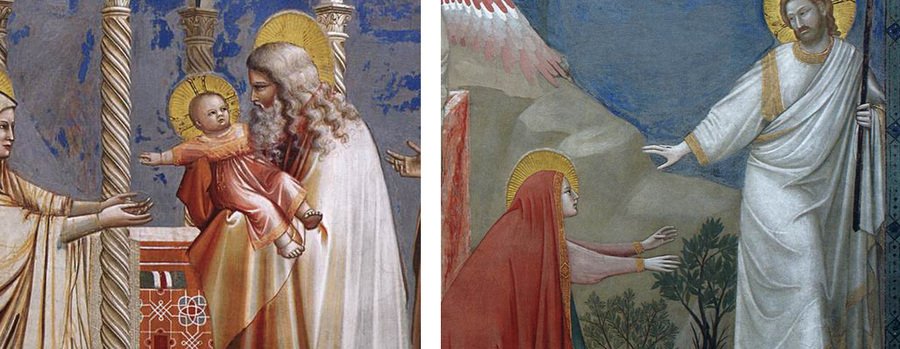
Left: Giotto di Bondone. «The Meeting.» c. 1305. Fragment. Right: Giotto di Bondone. «The Resurrection. Do Not Touch Me.» c. 1305. Fragment.
Concept In the frescoes of the Scrovegni Chapel, gestures help us understand what is happening between the characters. Mary reaches out to the child, Christ addresses Lazarus through the crowd, Judas embraces Christ, and Magdalene reaches toward him. In some scenes, the hands connect the figures, while in others, there is a gap between them. These episodes are taken from a single cycle painted by Giotto in Padua around 1305. Therefore, we can compare gestures within the same ensemble. [1; 2] Let us assume that the meaning of a gesture can be understood by the person’s posture and the reaction of the person they are addressing. Mary’s outstretched hands in the «Meeting» are directed toward the child held by Simeon. In the scene with Magdalene, the hands are also outstretched, but the figures never touch. To differentiate these actions, we can look at the direction of the hand, the tilt of the torso, and the distance remaining between the figures. A familiar narrative can be easily retold, yet we might miss how Giotto depicts the action. In the «Meeting,» we can name all the participants, but their names will not clarify how the artist connected the figures on either side of the altar. By tracing who is holding the child and whom the child is reaching for, we can see how Giotto conveys movement in a static scene.
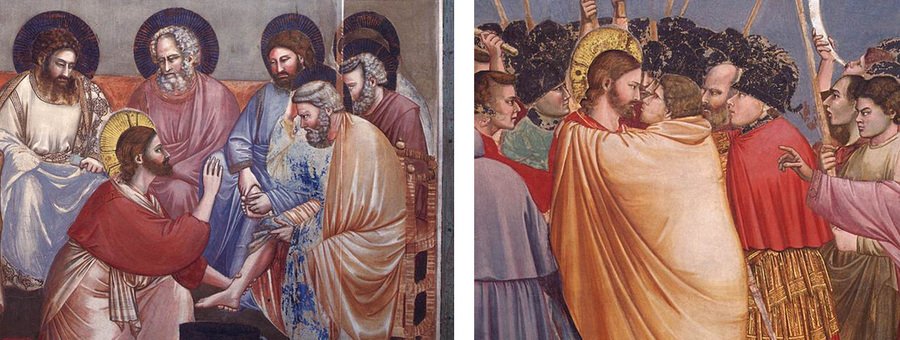
Left: Giotto di Bondone. «The Washing of the Feet.» c. 1305. Fragment. Right: Giotto di Bondone. «The Kiss of Judas.» c. 1305. Fragment.
Material and StructureTwelve scenes from the Gospel cycle have been selected for comparison. In the first chapter, we will examine how hands support or receive a body. In the second, we will trace how characters address one another from a distance. The third chapter analyzes how grasp, swing, and pointing converge within a single group. Finally, the last chapter compares scenes where characters hold the body of Christ, reach toward him, or watch him go. A list of scenes by chapter is provided in the «Analysis Order» section.We will begin the analysis of each scene with an overview, followed by a detailed fragment. The overview shows where the person is located and whom they are addressing. The fragment allows for a clearer view of finger positioning, elbows, or points of contact. In paired images, we will compare similar gestures under different circumstances. For example, in «The Nativity» and «The Meeting, ” Mary reaches out to the infant, but her posture and distance from the child differ.Method and SourcesDuring the analysis, we will ask: who is making the gesture, who is the hand directed toward, is there contact, and how does the second character respond? Head turns and torso inclination are also important. In „The Meeting, ” for instance, the child looks at Simeon while reaching out to Mary with his hand. If one only looks at the palm, one might miss that the child is addressing two people simultaneously.The titles, dating, and reproductions are sourced from the Web Gallery of Art catalog. Smarthistory materials help correlate „The Nativity“ and „The Lamentation“ to understand how the scenes are arranged in the chapel. A fragment from Andrew Ladis’s book was used to refine the dating of the frescoes. [1–4]Familiarity with the narrative helps identify the characters and understand which event is depicted. For example, in the fresco „The Wedding at Cana, ” one can distinguish Christ’s raised palm and the hands of people holding vessels. To understand what miracle is occurring, one must know the story itself. The conclusions of this work pertain only to the selected scenes from the chapel.
Order of Analysis
Touch: «Nativity, ” „The Visitation, ” „Washing of the Feet.“
Gesture at a Distance: „Marriage at Cana, ” „Resurrection of Lazarus, ” „Expulsion of the Money Changers from the Temple.“
Confrontation: „The Kiss of Judas, ” „Christ before Caiaphas.“
Loss and Separation: „Crucifixion, ” „Lamentation, ” „Do Not Touch Me, ” „Ascension.“
All works are executed in fresco in the Scrovegni Chapel, Padua. WGA indicates the years 1304–1306; the work adopts a generalized date of „circa 1305.“ [1; 4]
Chapter 1. Touch
Giotto di Bondone. «The Meeting.» c. 1305. Fragment.
The positioning of the figures differs: Mary lies next to the child, Simeon holds him before him, and Christ bends down toward Peter’s feet.
Giotto di Bondone. «Nativity of Christ.» c. 1305.
At the nursery, all attention is focused on the infant. Mary turns on the couch and accepts the baby from the woman on the left. Joseph sits slightly lower, supporting his head with his hand. His posture clearly indicates where the group dedicated to the child ends. [1]
Giotto di Bondone. «The Nativity of Christ.» c. 1305. Fragment.
The fragment shows a woman on the left supporting the infant, while Mary extends her arms toward him. The heads of both women are inclined toward the child. Their gazes and hands converge in one section of the fresco.
Giotto di Bondone. «The Meeting.» c. 1305.
Simeon holds the child over the altar edge. Mary stands opposite him, reaching out her hands toward him. There remains a space between the adults; the infant’s body and their opposing gestures connect the two sides of the composition.
Giotto di Bondone. «The Encounter.» Circa 1305. Fragment.
Simeon still holds the child. The child looks at Simeon and then reaches for Maria. She opens her palms to meet him. If you only follow the child’s gaze, you might miss this movement. [1]
Giotto di Bondone. «The Washing of the Feet.» c. 1305.
Christ has lowered himself before the seated Peter. The basin is placed below them, and the other apostles surround this pair. The posture of Christ and Peter sets the act of washing apart from the group of figures gathered around.
Giotto di Bondone. «The Washing of the Feet.» c. 1305. Fragment.
With one hand, Christ supports Peter’s foot above the basin. With the other, he raises his palm toward the apostle, prompting him to turn his head. One hand is occupied with the washing, while the second accompanies the address to Peter.
Left: Giotto di Bondone. «The Nativity.» c. 1305. Fragment. Right: Giotto di Bondone. «The Meeting.» c. 1305. Fragment.
In «Christmas, ” Maria receives the child while lying down, turning her entire body toward him. In „Encounter, ” she stands on the opposite side of the altar. She must reach toward the child—this is best seen in her extended forearms.
Left: Giotto di Bondone. «The Washing of the Feet.» Circa 1305. Fragment. Right: Giotto di Bondone. «The Lamentation of Christ.» Circa 1305. Fragment.
In «The Washing of the Feet, ” Christ leans toward Peter and holds his foot. In „The Lamentation, ” the other figures are already bent over Christ himself. In both scenes, hands support the body in the lower part of the image.
Left: Giotto di Bondone. «The Meeting.» c. 1305. Fragment. Right: Giotto di Bondone. «Foot Washing.» c. 1305. Fragment.
What Touch Implies
Touch allows for the distinction of participants' roles. In «The Encounter, ” Simeon holds the child while Maria extends her palms toward him. In „Washing of the Feet, ” Christ supports Peter’s foot from underneath. The support is placed on the hands, and the curvature of the torso demonstrates how a figure adapts to another body.
Chapter 2. The Distant Gesture
Giotto di Bondone. «The Raising of Lazarus.» Circa 1305. Fragment.
In the following scenes, Christ does not touch the person to whom he is speaking. The direction of the hand must be correlated with the position of the other participants.
Giotto di Bondone. «The Marriage in Cana.» Circa 1305.
At the table, everyone is engaged in their task: some are talking, others are holding vessels. Amidst all these movements, it is easy to overlook Christ’s raised hand in the left section of the fresco.
Giotto di Bondone. «The Marriage at Cana.» Circa 1305. Fragment.
On the right, a servant tips a vessel over a jug while the man seated nearby raises a cup to his mouth. Their hands are occupied with objects. Christ, in the left section of the fresco, has an open, raised hand.
Giotto di Bondone. «The Raising of Lazarus.» c. 1305.
Christ stands on the left, extending a hand toward Lazarus on the right edge. Witnesses are positioned between them. The hand stands out against the blue background above the inclined figures, ensuring the gesture’s direction is not lost in the crowd.
Giotto di Bondone. «The Resurrection of Lazarus.» c. 1305. Fragment.
In the fragment, one of the witnesses stands next to Lazarus, covering his face. Others are turning their heads or raising their hands. Their movements are focused around Lazarus, whom Christ addresses from the opposite side of the fresco.
Giotto di Bondone. «Expulsion of the Merchants from the Temple.» c. 1305.
Christ’s raised hand is pulled back; the torso is turned, and the feet are spread apart. The person opposite leans in and raises a palm. The swing and the defensive gesture form a counterpoint at the center of the fresco.