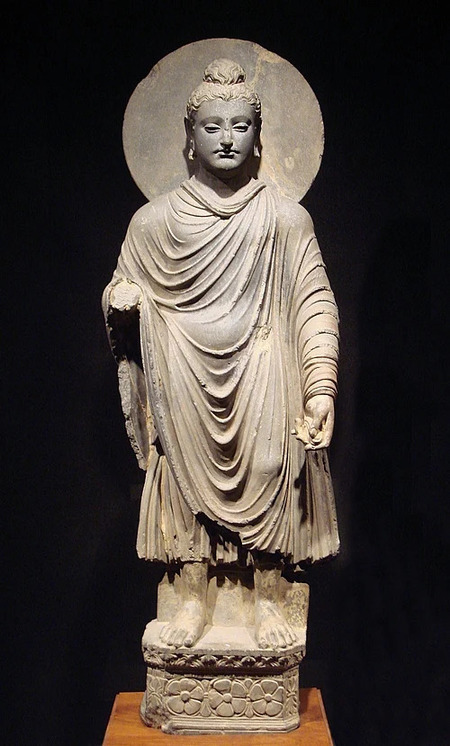
Concept
Buddhism originated in India around the 5th century BCE and subsequently spread across much of Asia. Along with it, religious themes and imagery traveled, but in different countries, these elements gradually evolved. Consequently, Buddhist art—for instance, in China, Tibet, and Sri Lanka—differs markedly: the Buddha and other sacred figures are depicted differently, and their poses, gestures, colors, composition, and details vary.
I am interested in understanding why this happened and how one religion has taken on so many different visual forms.
I chose this topic because I am interested in how religious ideas are reflected in art and what happens to them when they are introduced to a different cultural environment.The spread of Buddhism can be traced through the changes in sculpture, painting, relief work, and architecture. It is also important to understand which features are related to religious concepts and which emerged under the influence of local traditions and historical circumstances.
I suggest that the differences between artistic traditions are not solely explained by religious doctrines. Local artistic practices, materials and techniques, patronage from rulers and monasteries, as well as cultural exchanges also influenced them. Buddhist imagery gradually adapted to the new environments, migrating from one country to another.
To find similarities and differences between works from various disciplines, and to understand the reasons behind them, I decided to focus on how Buddhas and Bodhisattvas are depicted, what symbols and attributes artists employ, how the composition and space are structured, and what colors and techniques are used. Therefore, the objects selected for this study could be compared based on theme, function, or date of creation.
The core research question is: how did the visual language of Buddhist art evolve as Buddhism spread from India to other regions of Asia, and what influenced these changes?
In this study, I aim to trace the evolution of Buddhist art from early Indian forms to regional traditions, illustrating how universal religious iconography merged with local artistic characteristics. This comparison will help illuminate why the visual language of Buddhism became so diverse.
The research will span from the 2nd century BCE, beginning with early Indian Buddhist art and symbolic depictions of the Buddha, through the emergence of his anthropomorphic form, and concluding with major regional traditions that persist today: Theravada in Sri Lanka and Southeast Asia, and Mahayana in China.
Early Art and the Transition to the Human Form of Buddha
The first surviving monuments of Buddhist art appeared long before the Buddha began to be depicted in human form. In early works, his presence was often conveyed through symbols and objects related to his life and teachings. This approach can be seen in the reliefs of stupas—Buddhist structures that served as places of veneration and relic storage.
Northern Gate of the Great Stupa No. 1 in Sanchi, India. 1st Century BCE. Stone. Photo: Wikimedia Commons.
Sanchi in central India became one of the important centers of early Buddhist art. A complex of stupas, temples, and monasteries has been preserved here, with construction beginning as early as the 3rd century BCE. Later, in the 1st century BCE, the main stupa was adorned with stone gates featuring numerous reliefs. These reliefs depict scenes from the life of the Buddha, stories of his past lives, and images of people, animals, and mythological creatures.
It is particularly interesting that in some scenes, the Buddha himself is not depicted in human form. Instead, artists used objects and symbols that indicated his presence. For instance, the Wheel of Dharma symbolized the Buddha’s teachings, the Bodhi tree recalled his enlightenment, and the empty throne denoted the place where he resided.
A fine example of this type of depiction is the bas-relief of the stupa enclosure in Bhartrhota. On it, you can see a royal couple paying homage to a flower-adorned throne. Above it is a wheel, festooned with garlands. There is no figure of the Buddha here, but the combination of the throne and the wheel allows one to understand exactly whom the characters are worshipping.
Unknown Master. «Worshiping the Buddha, from the railing of the Bharhut Stupa.» Early 2nd century BCE. Stone. Freer Gallery of Art, Smithsonian National Museum of Asian Art, Washington.
Here, it is important to pay attention to how the composition itself is structured. The throne is at the center, and the figures bowing to it are arranged on either side. The wheel and garlands highlight the main part of the scene, so the eye is immediately drawn to it. Even without a depiction of the Buddha, the artist creates a sense of his presence.
In early Buddhist art, symbols were used to narrate the life of the Buddha and convey the ideas of his teachings. In academic literature, this method of depiction is often called aniconism. However, this should not be interpreted as evidence of a strict prohibition against depicting the Buddha in human form. Scholars continue to debate why early artists used this specific system of imagery and how it should be understood.
The Emergence of the Human Buddha Figure
Around the first centuries AD, the situation began to gradually change: the Buddha started to be depicted as a human figure. This process was particularly active during the reign of the Kushan dynasty, when Mathura in northern India and Gandhara in its northwest became important artistic centers. Today, the territory of ancient Gandhara belongs primarily to Pakistan and eastern Afghanistan.
It is interesting that each of these two centers developed its own methods of depicting the Buddha. In Mathura, artists drew upon local Indian sculptural traditions, while Gandhara showed a noticeable influence from Greek and Roman art. However, it is impossible to say exactly which of the two centers first created the human image of the Buddha—this question remains a subject of scholarly debate.
Unknown Master. «Seated Buddha with Two Attendants.» Circa 131 CE. Red sandstone. Mathura, India. Kimball Art Museum, Fort Worth.
In this sculpture, it is particularly noticeable that the artist pays great attention to the Buddha’s figure. His form occupies the central position and stands out in size compared to the accompanying characters. The rounded body, open shoulder, and serene posture convey a sense of stability and inner strength. Simultaneously, the image retains a connection to earlier Indian sculptural traditions.
In Gandhara, during the same period, a different artistic language was taking shape. The region lay at the crossroads of trade and cultural routes, so local masters were familiar with Mediterranean art, including Greek and Roman artistic traditions. This significantly influenced how they depicted the human body, face, and clothing. However, Gandharan art was not simply a copy of Western models; it fused local Indian sensibilities with borrowed artistic techniques.
Unknown master. «Seated Buddha.» I—early 2nd century CE. Bronze with traces of gilding. Gandhara, modern-day Pakistan. Metropolitan Museum of Art, New York, Inv. No. 2003.593.1.
Unlike Mathura sculpture, the Buddha here is depicted in a more delicate and detailed manner. His robes cover both shoulders, and the folds of the fabric are meticulously rendered, creating the impression of soft, naturally draping material. The face, hairstyle, and drapery treatments recall Greco-Roman sculptural techniques.The halo behind the Buddha’s head is particularly unusual: its edges are shaped like sharp rays. Traces of gilding remain on the bronze surface, suggesting the sculpture was originally much more vibrant. The Metropolitan Museum of Art notes a possible connection between this unusual halo and depictions of Roman rulers, who sometimes portrayed themselves as solar deities. This is a fascinating example of how artistic motifs from different cultures could converge in a single work.
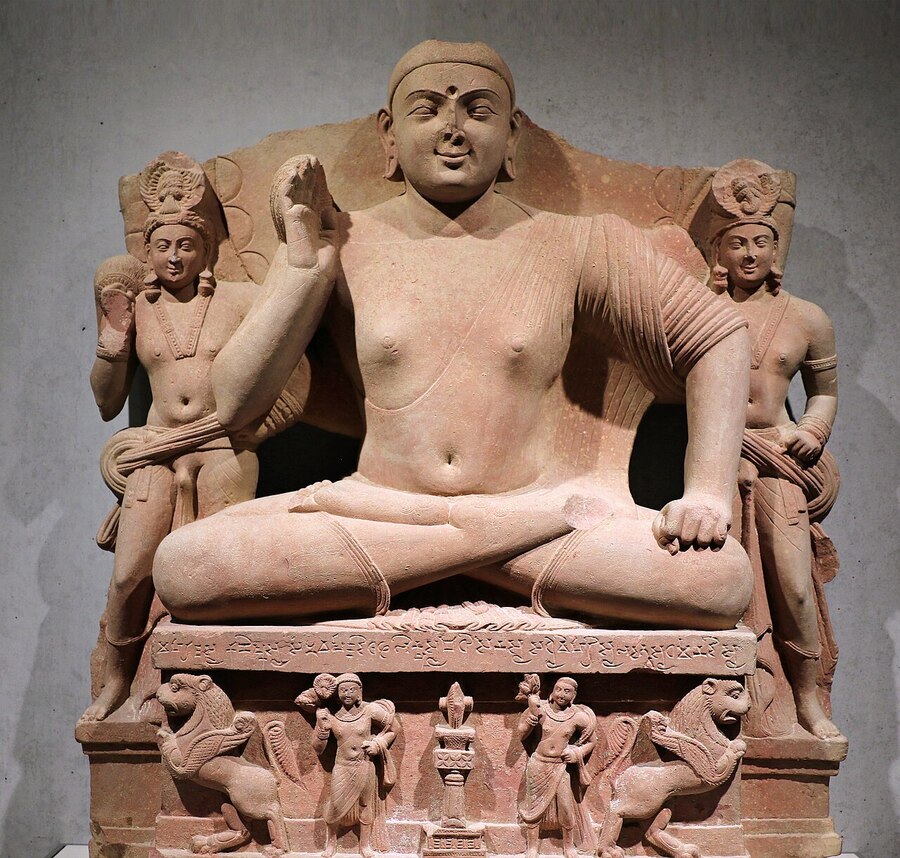
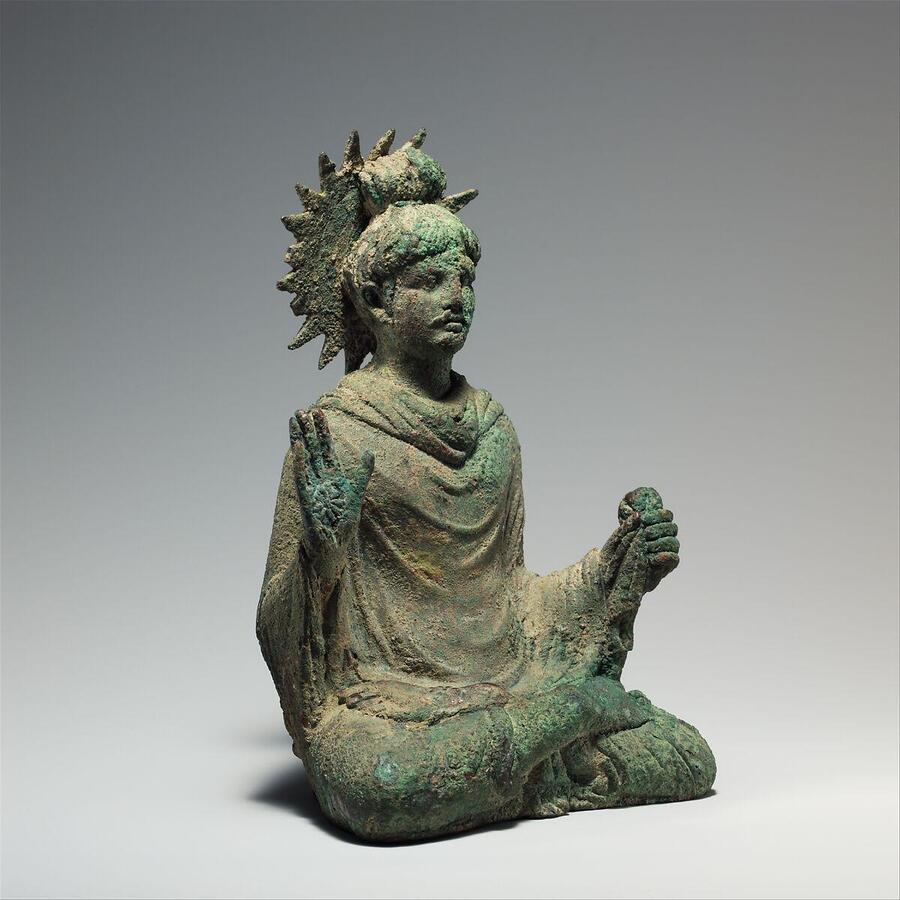
Comparing these two works reveals how distinctly masters from different regions interpreted the same image. In Mathura, the focus is primarily on the Buddha’s body—it appears massive, stable, and almost monumental. In Gandhara, the drapery folds, hairstyle, and facial details are more pronounced. The materials also differ: red sandstone in one case and bronze with traces of gilding in the other.
Thus, the appearance of the human figure did not result in the creation of a single canon that would look uniform across all regions. On the contrary, different ways of depicting the Buddha emerged even in the early centers of Buddhist art. Mathura developed a local Indian sculptural tradition, while Gandhara fused it with artistic techniques that arrived through cultural exchange.
(2) Theravada: The Image of the Buddha in Sri Lanka and Southeast Asia
Spreading from India, Buddhism gradually took root in Sri Lanka and Southeast Asian countries. Alongside the religious teachings came artistic imagery: depictions of the Buddha, reliefs illustrating episodes from his life, temple sculpture, and painting. Over time, local artisans developed their own ways of portraying the Buddha, utilizing the materials, techniques, and artistic methods familiar to their regions.
Sri Lanka became one of the most significant centers of early Buddhist art outside of India. Buddhism arrived on the island in the 3rd century BCE, and its ancient capital, Anuradhapura, remained a major religious and cultural hub for centuries. It was here that the tradition of Buddhist sculpture took shape, with images of the Buddha himself holding a particularly important place.