Contents
Introduction
- The Self-Sustaining Body: «Hellenistic Prince» and «Boxer at Rest»
- Support in the Arms: «Drunken Old Woman»
- The Final Support: «Dying Gall»
- Support That Becomes a Trap: «Laocoön and His Sons»
- Released Support: «Gallic Man Killing Himself and His Wife» Comparative Conclusion Conclusion Bibliography Image Source List
Introduction
Statues are usually seen as static, but Hellenistic sculptors often choose a moment for them where stillness itself becomes an event—the battle is over, strength is fading, or balance is about to be lost. In such moments, the body no longer depicts the action—it carries the consequences of it. Fatigue, age, pain, and tension are conveyed not through a specific grimace, but in the figure’s posture: how the torso is inclined, where the head is turned, and how the weight is distributed.
This study investigates a simple notion: the emotion of Hellenistic sculpture can be read through support. The less capable a figure is of sustaining itself, the more critical the support becomes—be it stone, a vessel, a shield, or other bodies. Six works were selected for this analysis: the statue known as the «Hellenistic Prince, ” „Boxer at Rest, ” „Drunken Old Woman, ” „Dying Gaul, ” the group „Laocoön and His Sons, ” and the group „Gaius Killing His Wife.“ These are examined in an order designed to track step-by-step how the figure loses its verticality—from a standing body to a seated one, then to a falling figure, and finally to bodies that hold and restrain one another. The sequence concludes with a figure that stands erect once more, but now supports another person instead of itself.
The Self-Supporting Body: «Hellenistic Prince» and «Boxer at Rest»
«Hellenistic Prince» is the starting point for all comparison: it is the only figure among the five that requires no external support. The man stands in full height. Weight is distributed unevenly, and this prevents the silhouette from freezing into a column, yet the image remains composed. The powerful torso and calm posture give the impression of a strength that requires no proof. Who is depicted and what his status was are unknown [1]; for analysis, this is even convenient—one must look at the body itself, not at the biography.
Figure 1. «Hellenistic Prince, ” detail: head and shoulders. Bronze, early 2nd century BCE; Palazzo Massimo, Rome.
Figure 1 shows only a fragment of the statue, yet even this piece communicates a great deal. The head is turned to the side, the gaze drifts past the viewer, while the neck and shoulders remain straight. There is movement, but it does not compromise stability—rather, it demonstrates it: the figure can turn without taking any risks.
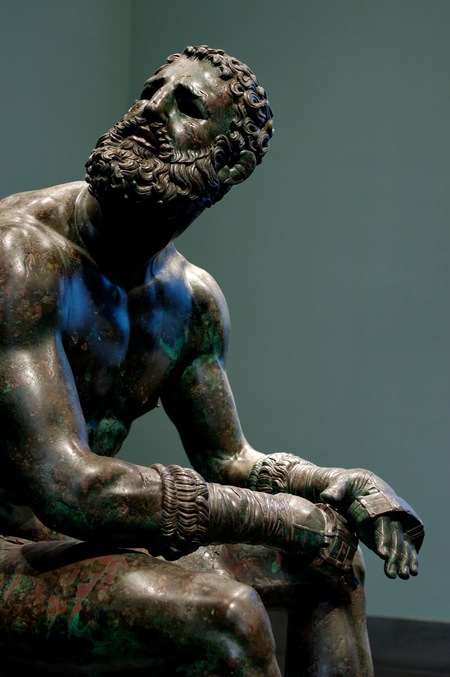
«Boxer at Rest.» Bronze, Late Hellenistic sculpture; Palazzo Massimo, Rome.
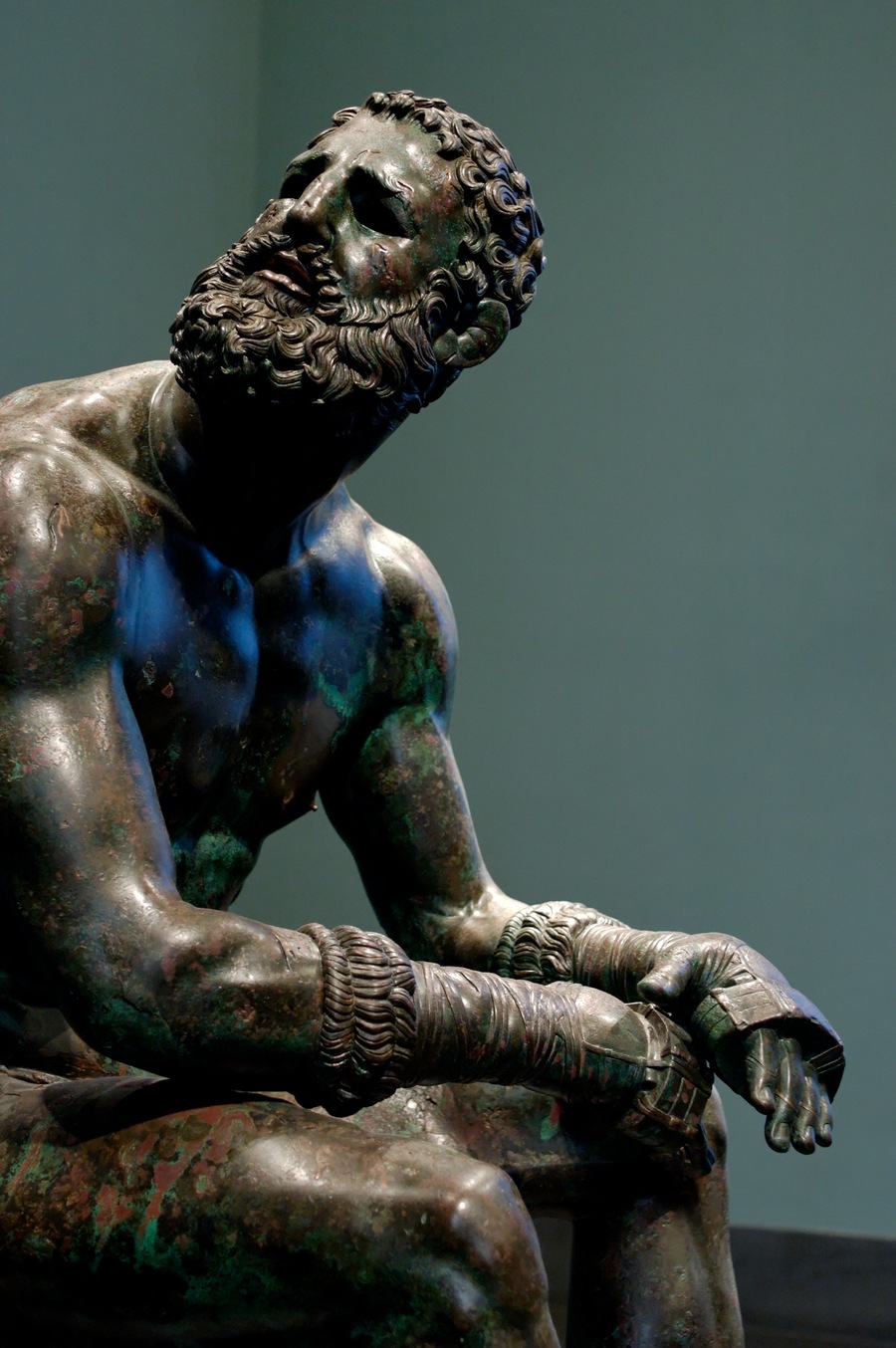
«Boxer at Rest» is made from the same material but conveys the opposite kind of strength. He sits on a stone, his torso leaning forward, his forearms resting on his knees. The body is no longer supporting itself—it has transferred some of its weight to the support. The face and torso are marked with the signs of blows, and the reddish-copper inlays indicating injuries stand out against the dark bronze [1]. The sculptor does not show the fight itself; we are presented with a pause after it, and all attention shifts to the weight of the body.
The most expressive element of this figure is the discord between its parts. The lower half is at rest: arms are lowered, and the torso sinks. The upper half is alert: the head is raised and sharply turned over the shoulder, as if someone has called out to a boxer. The rest is incomplete, and it is from this mismatch that tension is born.
«Boxer at Rest.» Bronze, Late Hellenistic sculpture; Palazzo Massimo, Rome.
Placed side-by-side, the two bronzes illustrate that strength can be both a state of being and a cost. In the prince, it is expressed through composure and a unified silhouette; in the boxer, it is seen in a body that withstood pressure and is now in recovery. Though the material is the same, the difference is created not by technique, but by posture and surface: one presents a whole form, while the other bears the marks of struggle.
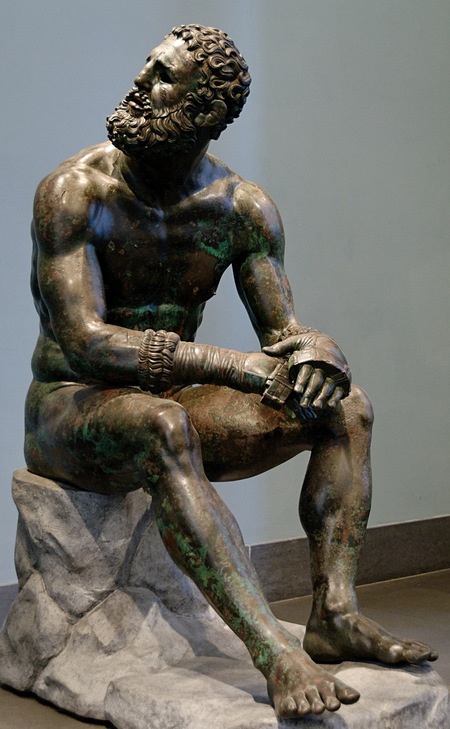
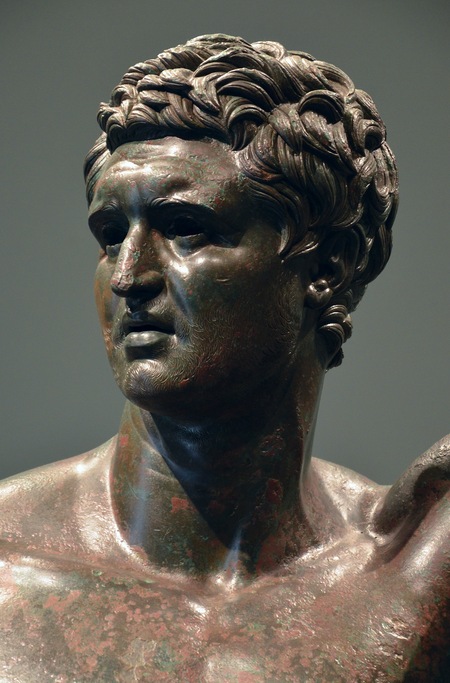
«Boxer at Rest.» Bronze, Late Hellenistic sculpture; Palazzo Massimo, Rome. «Hellenistic Prince,» detail: head and shoulders. Bronze, early 2nd century BCE; Palazzo Massimo, Rome.
Support in Hands: «Drunken Old Woman»
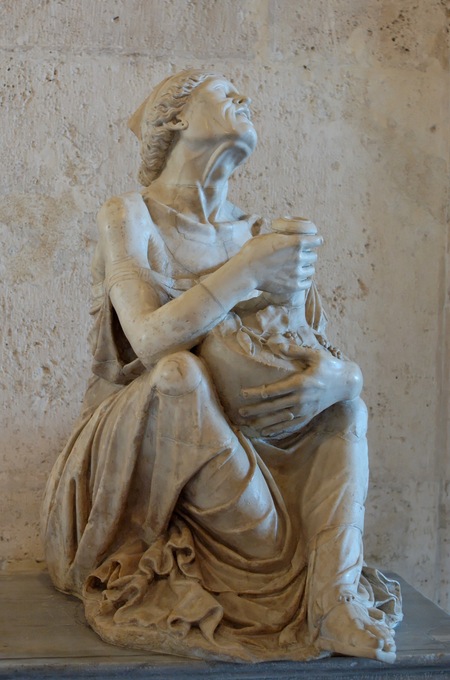
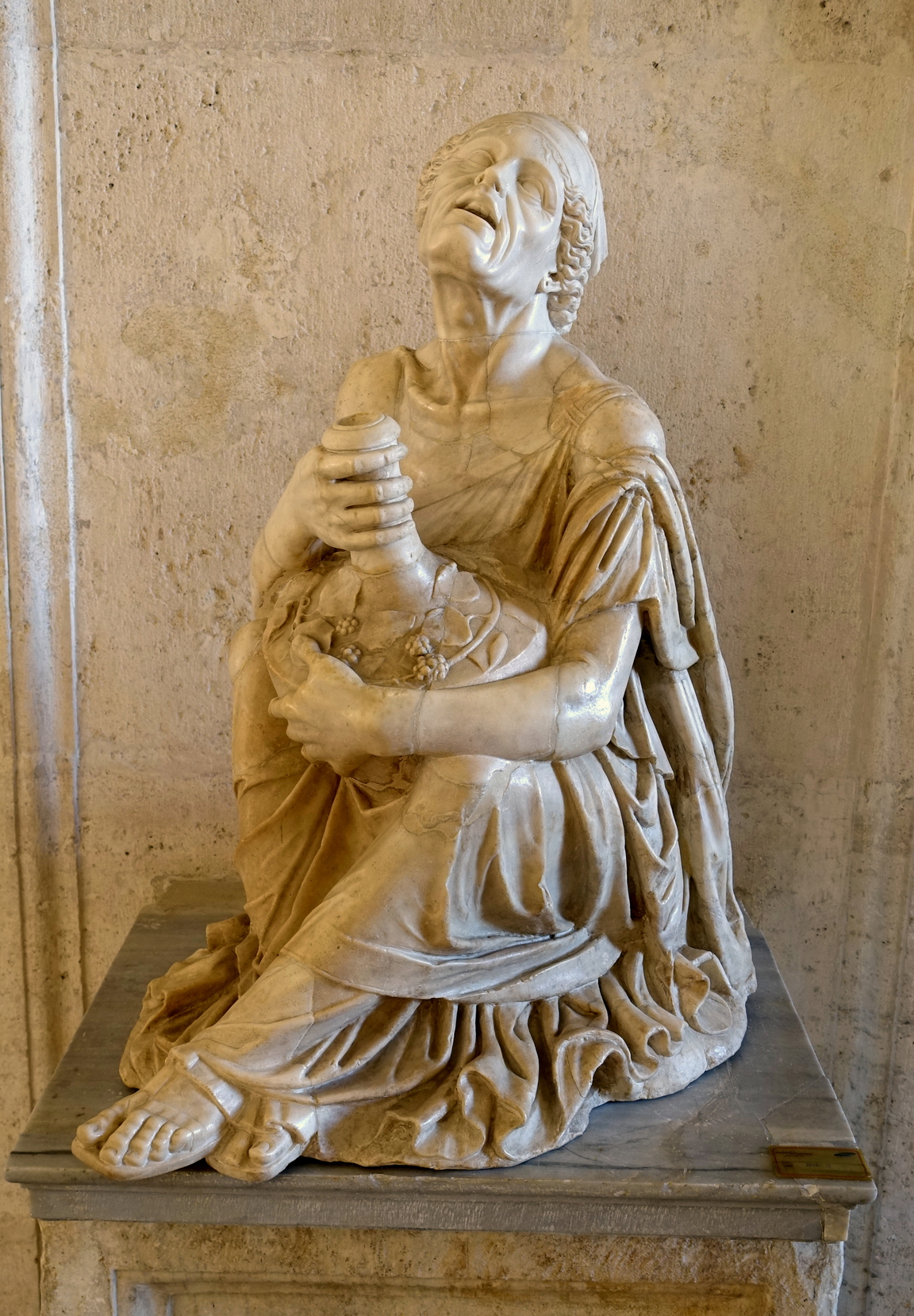
In «The Drunken Old Woman,» the support is literally in her hands. The woman is seated, pressing a vessel against herself with both hands. It becomes the center of the composition: her arms enclose the space around it, and her hunched back echoes its rounded volume. However, her head is tilted back, her face turned upward. The lower part of her figure is closed around the vessel, while the upper part is open—and this fissure makes the old woman appear vulnerable and unstable.
«Drunken Old Woman.» Roman marble copy of an Hellenistic original; Capitoline Museums, Rome.
Here, there’s a parallel with the boxer that is easily missed. Both figures are seated, both their bodies are sinking, and their heads are lifting. But if the boxer’s raised head suggests he is still alert, the same gesture in the old woman is read differently—as detachment. A similar movement yields a different meaning depending on the body that performs it.
«Boxer at Rest.» Bronze, Late Hellenistic sculpture; Palazzo Massimo, Rome. «Drunken Old Woman.» Roman marble copy of an Hellenistic original; Capitoline Museums, Rome.
The old woman’s body does not exhibit idealized strength nor participate in a heroic action. Even exhausted, the boxer remains an athlete; in the old woman, strength has entirely left the image. This fact is even more telling, as this state has become the subject of sculpture: this work significantly broadens the scope of what was considered worthy of depiction.
«Drunken Old Woman.» Roman marble copy of an Hellenistic original; Capitoline Museums, Rome.
Age is presented without attempt to soften it. Wrinkles, thinness, tense hands—these are not adornments, but elements that construct the character of the subject. Meanwhile, the sculpture does not devolve into a mundane sketch or mockery; the gaze is held by the precise plasticity of the face and hands, and the contrast between the heavy vessel and the fragile figure. We learn nothing about this woman’s life—her condition is evident in her posture and in how she holds the object. The preserved statue is a Roman marble copy of a work from the Hellenistic period [2].
The Last Pillar: «Dying Gall»
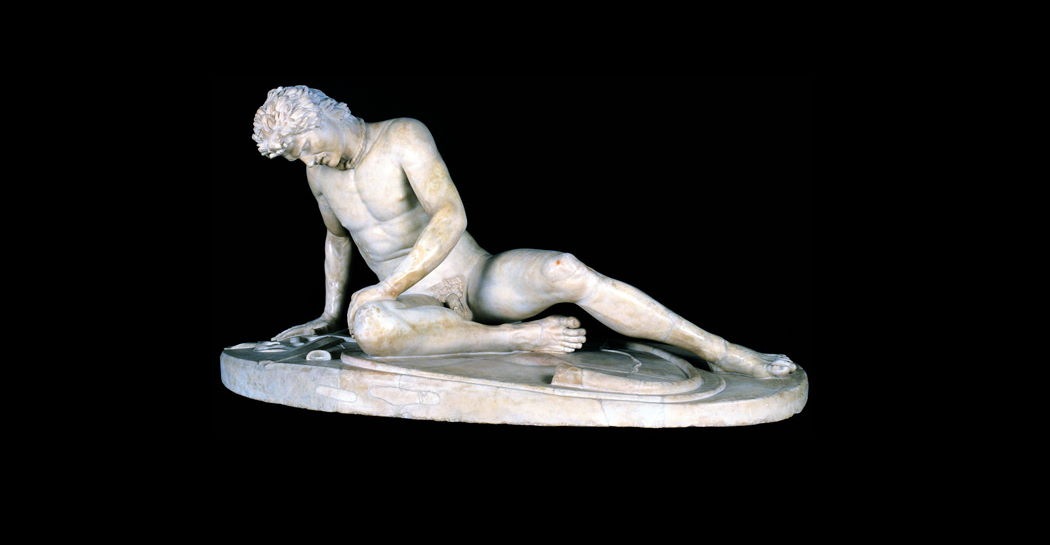
«Dying Gall» rests on the plinth; one arm digs into the earth, bearing the body’s weight, the head bowed. This is the first of the figures under consideration to slump downward. The diagonal of the shoulders and the tilt of the torso draw the viewer’s gaze toward the point of support—the single arm still holding the body up. The sculpture illustrates not so much the wound as the gradual change in posture: the body yields to gravity, but not immediately.
«Dying Gall» (Capitoline Gall). Roman marble copy; Capitoline Museums, Rome.
If the boxer and the old woman hold their heads up, the Gaul’s head is bowed—and this sequence reveals how resistance fades. However, the character does not become a faceless sign of defeat. The arm is still holding the torso; the muscles remain tense. The viewer’s gaze travels from the support, across the bent back, to the head and face, composing an image of a single movement—from exertion to weakening. The sculpture is known from the Roman marble copy of the Greek bronze group; the Gaul in the character allows one to recognize the torso and hairstyle [3].
«Boxer at Rest.» Bronze, Late Hellenistic sculpture; Palazzo Massimo, Rome. «Drunken Old Woman.» Roman marble copy of an Hellenistic original; Capitoline Museums, Rome. «Dying Gaul» (Capitoline Gaul). Roman marble copy; Capitoline Museums, Rome.
Two photographs of the same statue function as two different distances. The overall impression is of a loss of balance, while the close-up reveals the individual features of the face and the meticulously rendered hair. The fall and dignity do not contradict each other; the sculpture portrays both what happens to the body and the fact that we are looking at a specific human being.
«Dying Gall» (Capitoline Gall). Roman marble copy; Capitoline Museums, Rome.