NAVIGATION
- Concept
- Light as a means of organizing stage space: «A Midsummer Night’s Dream»
- Light as a tool for spatio-temporal dramaturgy: «Mahabharata» (1985)
- Light as a means of controlling audience perception: «The Storm» (1990)
- Conclusion
CONCEPT
A lighting score in scenography is a clear, fixed plan for the lighting design of a stage space, evolving over time. Analogous to other musical scores, stage lighting is examined through rhythm, intensity, color, direction, contrast, and sequence. This definition allows light to be studied as an independent expressive medium in theatrical design. Consequently, new functions for light emerge, allowing it to be viewed not merely as a technical tool enabling the audience to literally see what is happening on stage, but as a complete element that shapes space, defines the action’s timeframe, and manages the viewer’s perception.
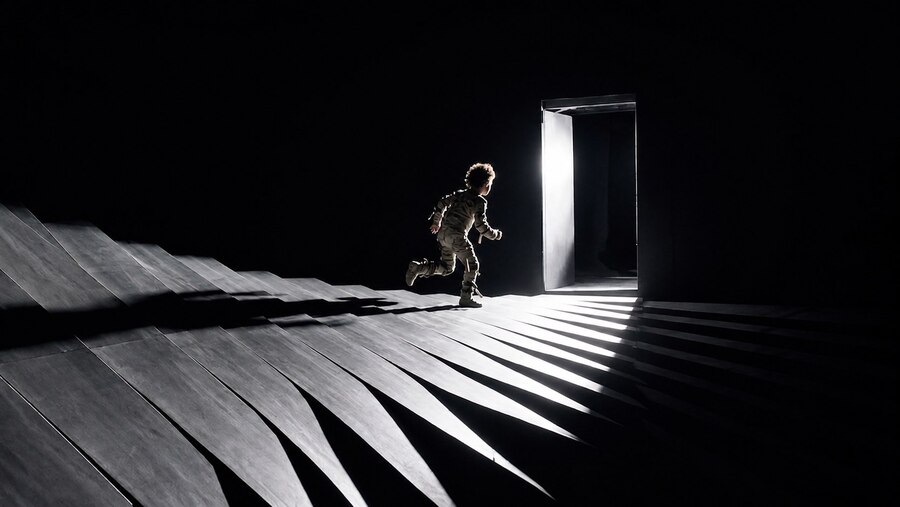
The focus of this study is the work of British director Peter Brook. His concept of «empty space, ” articulated in his 1968 book of the same name, points to the necessity of transforming the traditional foundations of theatrical art and abandoning excessive scenic illustration.Discussing the central issue in contemporary productions—the typification of set design—Peter Brook posits that space arises from the interaction between the actor, the audience, and the stage’s expressive elements. In this sense, light acquires special significance: it allows for the modification of the stage environment’s character without its physical alteration.The research is built upon a comparative analysis of three of Peter Brook’s productions: A Midsummer Night’s Dream (1970), The Mahabharata (1985), and Storm (1990). Each work reveals a distinct aspect of the interaction between light and stage space. A Midsummer Night’s Dream examines the role of uniform lighting in creating a neutral, conventional stage environment. In The Mahabharata, the focus is on light’s ability to denote various spaces, organize temporal transitions, and highlight dramatically significant episodes. The analysis of Storm aims to investigate the interaction between illumination and material scenography and its potential role in shaping visual accents and audience focus.
Theater not only reveals the invisible but also creates the conditions for its perception.
The visual material is primarily composed of archival photographs of productions, scenographic documents, and testimonials from participants in the creative process. This documentation is supplemented by the author’s analytical diagrams, which record the distribution of lighting zones, tonal relationships, compositional accents, and changes in illumination over time.
The research aims to identify the principles through which light functions as a tool for organizing the stage space in the theater of Peter Brook. The working hypothesis posits that the expressiveness of the lighting in his productions is determined not by the sheer quantity or technical complexity of the light effects, but by their interaction with the space, the movement of the actors, and the play’s dramaturgy.
Therefore, this study focuses on understanding stage lighting as a distinct language of visual communication—one in which illumination does more than merely make events visible; it actively participates in creating the theatrical image. Examining Peter Brook’s productions from the perspective of design history allows for the identification of how minimalist scenographic choices alter the relationship between the material environment, light, and audience perception.
Light as a means of organizing stage space — A Midsummer Night’s Dream