Concept
My visual research focuses on the depiction of women in 1930s American animation. I am interested in examining how women were portrayed in cartoons of that era, what ideals of femininity were reflected in these images, and why certain heroines differed so significantly from others. Animation was a significant part of mass culture—cartoons were watched by a wide audience, and the characters became recognizable and popular beyond the screen. Therefore, I find it compelling to consider female protagonists as a reflection of their time’s culture. Through their appearance, behavior, and interactions with others, we can see what qualities of women were considered attractive or, conversely, became targets of satire. It is particularly interesting that animation allowed artists to deliberately exaggerate specific character traits—to alter body proportions, emphasize facial features, and make movements and emotions more expressive. Because of this, a heroine’s character could often be inferred simply from her appearance.
For this study, I selected five popular and recognizable heroines from American animation of that era: Betty Boop, Olive Oyl, Minnie Mouse, and Snow White from Fleischer Studios and Disney.
All of these characters achieved widespread fame and became recognizable icons of 1930s popular culture. Furthermore, they are quite distinct from one another. I found it interesting to focus specifically on these heroines because each one is vibrant in her own way and possesses a distinctive character and appearance. Through them, I want to explore the means by which these images were created, what they have in common, and what their differences were.
Key research question: What perceptions of femininity existed in American animation during the 1930s, and how were they conveyed through visual means?
Research hypothesis: I hypothesize that several distinct models of female representation existed in American animation of the 1930s. These differences were evident not only in the characters' appearances but also in their facial expressions, physicality, personality, and social behavior. Moreover, I suspect that a heroine’s appearance did not always determine her character or her role in the plot. Behind a certain image could be qualities that seemed completely unexpected at first glance. Therefore, I am interested in examining not only how the heroines looked but also the extent to which their behavior aligned with the initial impression given by their appearance—to see how differently the same character can be interpreted.
Research structure: The study is built upon analyzing and dissecting female characters to identify their specific traits. First, I examine Betty Boop, considering the image of an attractive, sensual, and liberated young woman. Next, I move to Olive Oyl, whose look and movements are based on comedic exaggeration. Then comes Minnie Mouse—a heroine who embodies romance, softness, and flirtatiousness. Finally, I analyze two interpretations of Snow White: one from Disney and one from Fleischer Studios. In each section, I focus on the character’s appearance, the specifics of their facial expressions and movements, as well as their behavior and interactions with other characters.
Betty Boop
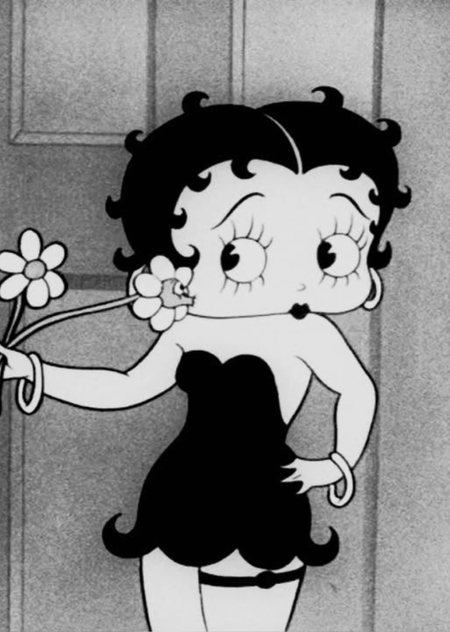
Betty Boop is perhaps one of the most recognizable figures of an attractive woman in 1930s American animation. Large eyes, a short dress, a slender waist, a coquettish smile, and playful demeanor make her a true beauty. At first glance, she may seem like just a pretty girl created to attract male attention and please those around her. But is Betty really that simple? Is her image limited to that of an attractive and slightly frivolous girl, or is there something more beneath the surface? To understand this, one must first look at the history of the character’s creation. Betty’s image was largely shaped by the influence of popular popular culture of the late 1920s and early 1930s. One of the inspirations for her creation was the American singer Helen Kane, who was known for her baby voice performance style—a high, deliberately childlike voice.
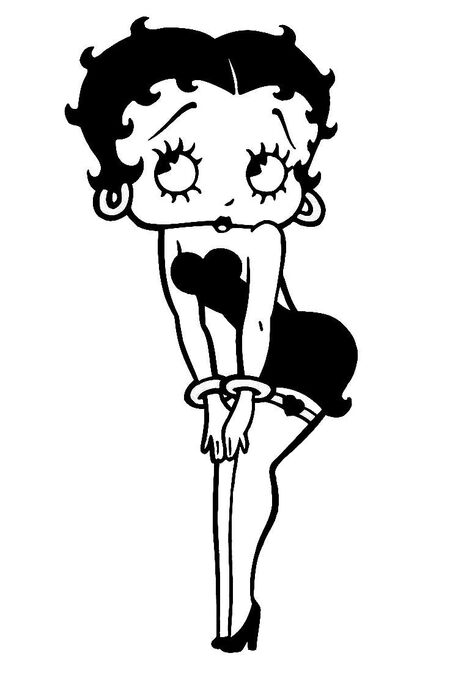
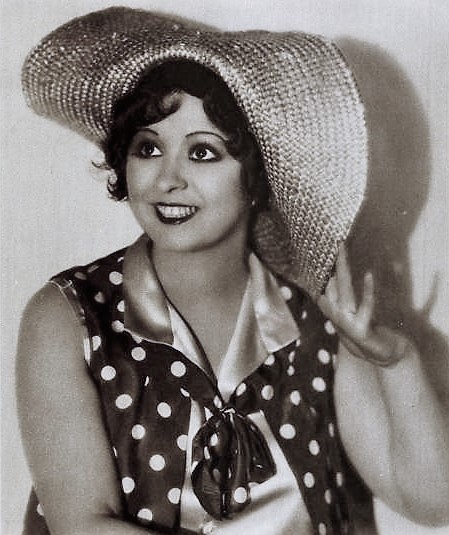
Betty Boop and Helen Kane
Betty first appeared in the cartoon Dizzy Dishes (1930) as a singer performing on a restaurant stage. Initially, however, the character featured canine traits: long, droopy ears resembling a dog’s and a distinctive black nose.
Dizzy Dishes (1930)
Gradually, her appearance began to take on more human features, and by 1932, Betty became an independent heroine and received her own series of cartoons.
Timeline of Betty Boop’s Evolution
In Betty’s persona, there is an intriguing combination of innocence and sensuality. On one hand, she appears sweet and even somewhat naive; on the other, her image is clearly designed to draw attention. That is the essence of Betty: she is simultaneously like a charming girl and a genuine flirt.
The Dancing Fool (1932)
Betty’s flirtatiousness is particularly evident in her dancing. She is constantly performing for the audience—sometimes swaying smoothly to the music, sometimes abruptly changing her pose, and other times adding a expressive gesture or a deliberate arch to her torso. Her movements possess a great deal of theatricality; they are intentionally exaggerated.
Betty Boop Boop-Oop-A-Doop (1932)
Betty Boop for President (1932)
The use of rotoscoping in Bamboo Isle deserves particular attention. This technique allowed real human movements to be transferred into animation, lending Betty’s dance movements greater fluidity and naturalness while retaining their expressiveness.
Bamboo Isle (1932)
Betty’s facial expressions also play an important role in her character. She frequently smiles, winks, makes exaggerated faces, and looks at those around her with large, expressive eyes.
This is particularly noticeable in scenes with male characters. For instance, in the cartoon Betty Boop’s Big Boss, she comes to apply for a job and almost immediately begins flirting with her employer. During the conversation, Betty climbs onto his lap, sits on the desk, dances, and sings. She behaves quite unrestrainedly—she takes the initiative herself and clearly benefits from the fact that the boss likes her.
Betty Boop’s Big Boss (1933)
But beneath her playfulness lies a rather willful personality. This is clearly evident in the cartoon Minnie the Moocher. After an argument with her parents, who scold her for refusing dinner, Betty decides to leave home. She packs her belongings, leaves a farewell note, and slips out the window. This episode demonstrates the heroine’s defiance—she is resolute and unwilling to adhere to others' rules.
Minnie the Moocher (1932)
Betty is not afraid of public attention; in fact, she seems to derive pleasure from it. In many cartoons, she finds herself at the center of the action—performing for audiences, singing, dancing, and effortlessly capturing attention. Furthermore, Betty has a keen understanding of the impression she makes on others, and she knows how to leverage it. In Betty Boop for President, she runs for president and participates in the election campaign. Naturally, she doesn’t shy away from her familiar charm: Betty uses her attractiveness to win over voters. However, there’s a cleverness to this—she understands that her looks and popularity can help her achieve what she wants, and she isn’t hesitant to take advantage of it.
Betty Boop for President (1932)
Thus, Betty embodies a new image of womanhood—a free-spirited, self-assured young woman who freely expresses her desires, is unafraid to break the rules, and decides for herself how to proceed. Her attractiveness becomes not merely an external quality, but a means to achieve her goals.
Olive Oil