RESEARCH CONCEPT
Rationale for Topic Selection
This research grew from the question: what happens when pop song lyrics stop being «words set to music» and become a trajectory for embodied experience in real space?
Jennie Kim, in the lead track of the album Fallen Angel (2026), tells a story that appears on the surface to be a search for love, but in the music video, it unfolds as a journey toward the inner child. A girl with white wings leads the protagonist through water, fire, and thorns to a final home, where both—Jennie and the child—are clad in identical red robes. Critics have described the video as a «dark fairy tale» about «reuniting with a more authentic version of oneself.»
What interested me wasn’t what was shown in the clip, but how this experience could be translated into a physical space without turning it into mere «decoration.» The song lyrics—“I’m searching, ” «Without you, these wings are of no use, ” „Wherever we land is where we turn into a home, ” „Don’t leave a fallen angel out here on her own”—are not just lyrical content. They represent a sequence of states: searching, trusting, transitioning, accepting. This very sequence became the core of the concept: the lyrics become a journey, a route viewers follow from the entrance to the stage.
Why Jennie and not another artist? Because in her solo work of recent years, the visual language, text, and authorship strategy form a unified statement about the multiplicity of the «self"—the alter ego Jennie Ruby Jane, the polyphony of Ruby, and the introspection of Fallen Angel. This is not about «pretty music videos»; it is a system that can be translated into a spatial narrative.
Why the greenhouse at the Seoul Botanic Garden? Because it is constructed geometry—a dome composed of 3180 triangular panels, a skywalk, and a waterfall—which already constitutes a static scenario awaiting activation. The ritual confronts this geometry rather than dissolving into it.
The study is divided into three parts, corresponding to three questions. The first part—"Who is speaking?"—analyzes Jenny as the author of a system of multiple selves: the alter ego (created in childhood in New Zealand), Ruby’s authorship (co-producer of all 15 tracks), Fallen Angel’s introspection, visual oppositions (water/fire, red/white, fall/flight), and the four lines as four stages of a journey. The second part—"Where is it heard?"—explores the greenhouse at the Seoul Botanic Garden as a space where human geometry (dome, triangular glass, skywalk) already constitutes a fixed scenario. This also includes the site’s history, architecture, acoustics, and evening light. The third part—"How can this happen?"—proposes the concept of the «Garden of the Inner Child"—an evening immersive ritual where the song lyrics become a route, and the viewer journeys from blindness to sight, accompanied by child guides. This also incorporates the concert’s visual materials.
Sources are divided into three categories. Primary sources—text and materials about Fallen Angel (ELLE, Telegraph India, LOS40), and interviews with Jenny (Apple Music, Billboard, Variety)—are used to analyze the visual language and artistic stance. Analytical sources—materials on the greenhouse architecture (POSCO Newsroom, Designboom, Outdoor Design) and on immersive theater (Punchdrunk, studies of «blindfold performance»)—are used to understand how space and tactile experience function within the performance.
Key question: Can the lyrics of the song «Fallen Angel,» when translated into a spatial rite of passage that organizes audience movement within the Seoul Botanic Park Greenhouse, serve this purpose? Hypothesis: Yes, provided the ritual becomes an experience of trust where the song’s text is felt by the body rather than read by the eyes.
JENNIE: THE ARTIST AS A SYSTEM OF MULTIPLE «SELFS»
When I began this research, the question before me was: how to choose an artist whose visual practice is not limited to «beautiful clips» but forms a system that can be translated into a spatial narrative? Jennie Kim drew me in not because of the size of her fandom or her commercial success, but because in her recent solo career, the visual language, text, and authorship strategy form a unified statement about the multiplicity of the «self.»
Jenny was born on January 16, 1996, in the Cheondam-dong neighborhood of Seoul. At the age of 9–10, she moved to New Zealand to study, spending about five years there before returning to Korea in 2010 to enroll in the YG Entertainment trainee academy. This early experience—living in a foreign linguistic and cultural environment—became, as I will show, the source of her central artistic method: creating alter egos as a means of survival and self-understanding.
1.2. Alter Ego as the First Artistic Gesture
In academic literature concerning identity in pop music, alter egos are often treated as a marketing tactic or a «mask» for a stage persona. Jennie’s case is more complex. In an interview with Apple Music, she explains: «When I was around 11 years old, I knew I wanted to create this identity for myself because 'Jennie' wasn’t giving me enough. And I thought, 'I want a longer name.'» Thus, Jennie Ruby Jane was born—a name she later used as a stage pseudonym in her acting career.
For my research, what matters is not «how many» personalities she has, but that she conceives of herself as a system rather than as a singular point. The alter ego is the first graphic gesture: it separates «Jennie» (the public figure) from «Ruby Jane» (the private self) and creates a gap where authorship becomes possible. Without this gap, there would be no Ruby or Fallen Angel—albums in which the multiplicity of the «self» becomes not a biographical detail, but a structural principle.
Still from the official music video for «Fallen Angel» by JENNIE August 9, 2026 — [1]
1.3. From «SOLO» to Ruby: The Path to Authorship
Jennie’s career as a solo artist launched in November 2018 with the single «Solo,» which topped the South Korean Gaon digital chart and the American Billboard World Digital Song Sales. However, as I note following critics, «Solo» was still «heavily influenced by the BLACKPINK visual system of the YG era"—it was more of a «group member’s solo debut» than the expression of an independent artist.
The turning point came in 2023 when Jennie did not renew her contract with YG Entertainment for solo activities and founded her own label, Odd Atelier. In an interview with Variety, she explained this decision as a desire «to free herself creatively—to make music without limits.» This institutional shift—creating her own infrastructure—made possible what happened next: the album Ruby (2025), in which Jennie served as co-producer for all 15 tracks and a lyric co-writer.
On Ruby, she collaborated with Mike WiLL Made-It, Diplo, El Guincho, FKJ, and featured artists—Dua Lipa, Childish Gambino, Doechii, Dominic Fike, Kali Uchis. Each featured voice is another «facet,» another layer of the polyphony of «self.» The album is not a monologue; it is constructed as a space where different versions of Jennie engage in a dialogue. Inspired by Shakespeare’s play As You Like It, Ruby explores themes of «birth, love, faith, and zenith"—but, as I interpret it, «zenith» here does not mean fame, but a point where all versions of the self can coexist.
Promo still for a music video clip. YG Entertainment 2025.
1.4. Fallen Angel: Text as a Return Scenario
If Ruby was a «declaration of independence, ” then Fallen Angel (2026) is an introspection. This three-track EP, composed of the title track, „Heaven, ” and „Less Than a Lover, ” is described by Jenny herself as a work born „from a very personal place, from the most authentic self-expression.“ Unlike Ruby, where she „proved“ her validity as a solo artist, Fallen Angel is a „lighter personal statement“ in which she „no longer needs to prove anything.“
Critics have described the music video for the lead track as a «dark fairytale, ” comparable to the works of Tim Burton: „a balancing act between light and darkness, between campfires and colors, butterflies and nightmares.“ The visuals include a fall into the water, black swans, roses and thorns, a winged girl guiding the heroine, and a final scene within a house engulfed in flames.
For the concept of the «Garden of the Inner Child,» the figure of the winged girl is key. Analytical materials offer the interpretation that she represents Jenny’s «inner child"—a figure that «acts as a guide in her personal quest.» This is not an «official» reading, but it is supported by the clip’s overall structure: the story unfolds as an initiatory journey in which the heroine moves through various stages to «reunite with a more authentic version of herself.»
Still from the official music video for «Fallen Angel» by JENNIE, August 9, 2026 — [1]
Frame from the official music video for «Fallen Angel» by JENNIE, August 9, 2026 — [1]
1.5. Song Lyrics as a Route
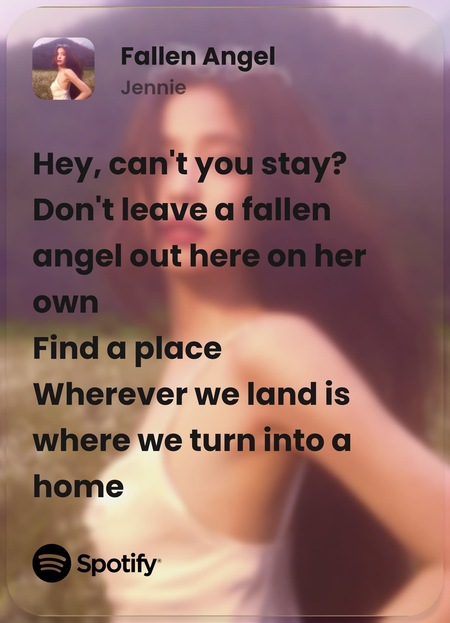
For my research, it is critically important that the lines from «Fallen Angel» form a sequence, not merely a collection of «beautiful phrases.» I have identified four lines that constitute the four stages of a journey:
Line Stage State «I’m searching, I’m searching, I’m searching / For a love.» Seeking Impotence, blindness.
«Without you, these wings are of no use.» Trust Reliance on another.
«Wherever we land is where we turn into a home.» Transition Home as a state.
«Don’t leave a fallen angel out here on her own.» Acceptance Vision, connection.
This structure, embedded within the text—the song moves from the repetitive «I’m searching» to the final «Don’t leave a fallen angel out here on her own,» which functions as a plea directed toward another. Within the context of the music video, this «other» turns out to be a child with wings—meaning the protagonist herself in her childhood. The journey, therefore, is a path toward the self, not toward «someone else.»
Still from the official music video for «Fallen Angel» by JENNIE — August 9, 2026 — [1]
1.6. Visual Language: Color, Water, and Fire as Operators