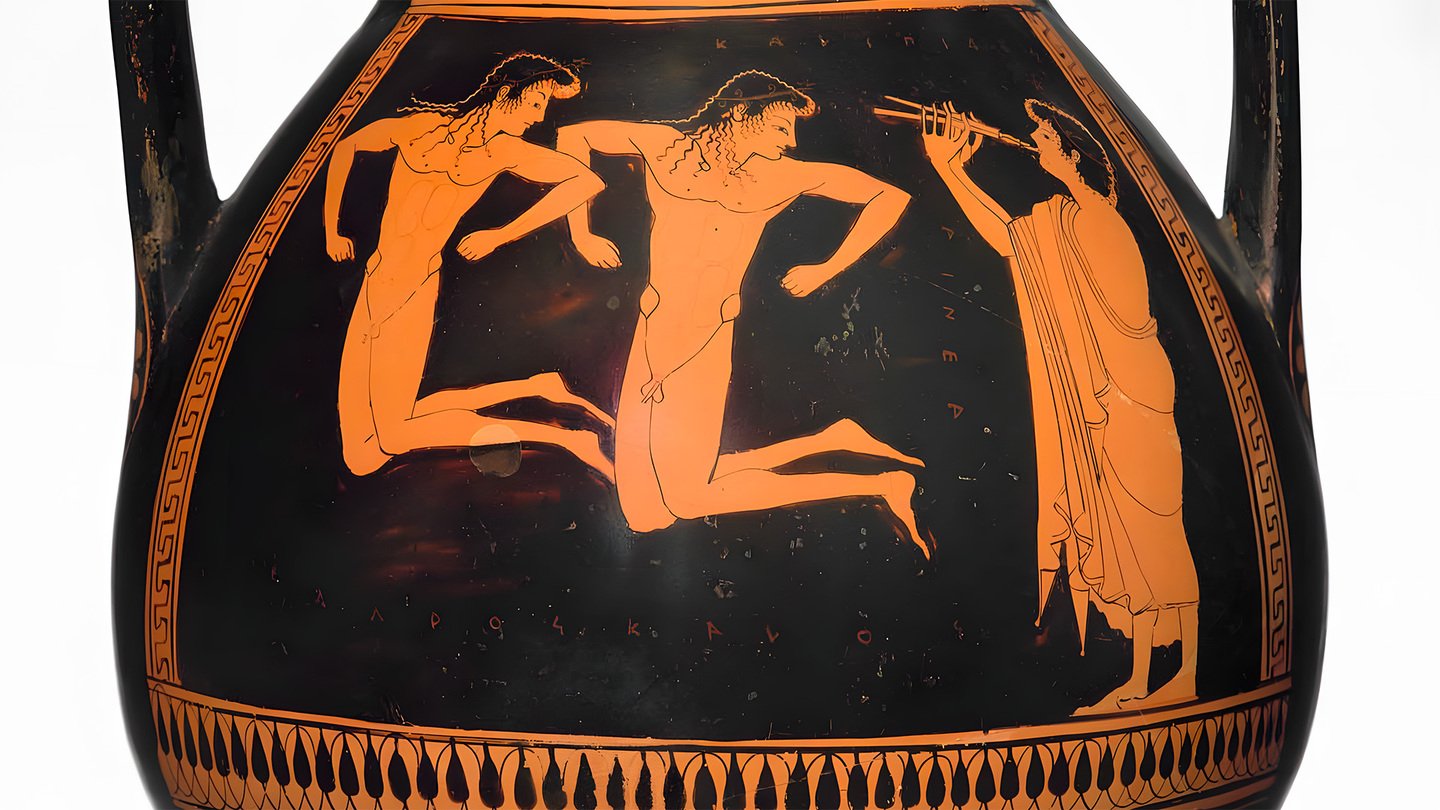
Concept
If you look at a map of Ancient Greece, you can be surprised by how fragmented and dispersed the Greek oikoumene was. Numerous islands scattered across the sea, the diversity of city-states spread across the mainland, each with its own system. Despite all of this, the Greeks managed to form a worldview that amazes me with its natural harmony and integrity. The modern world appears to me as a space teeming with visual signals, where the brain almost constantly receives streams of new information. Ancient Greek art, conversely, proclaims kalokagathia as its primary principle—one manifestation of which is the unity of form and content. For me, it has become a space for freedom, contemplative contemplation, and reflection on what is most important.
Vase painting as a space for freedom, thoughtful contemplation, and reflection on what matters most.
This is precisely why ceramic paintings were created thousands of years ago. Guests would discuss the subjects depicted on the vessels during feasts, needing to demonstrate significant erudition. A feast was an event designed to lift people away from the mundane, channeling their entire intellectual energy toward conversations about the sublime—and ceramic painting was an indispensable part of that. While studying Greek vase painting, I discovered an increasing number of techniques that I could apply to my own artistic practice. Ancient masters not only overcame the challenges of working with the material but also imbued their works with an elusive yet comprehensive beauty that is truly captivating. The resonant grace of the form and the vividness of the variations—that is what drew me to the art of Greek vase painting. In this visual exploration, I aimed to find and examine in detail the artistic solutions that make the compositions of vessel imagery so harmonious.
The objectives of this research are to analyze the compositional solutions in ancient Greek vases from the Classical period, identify the primary ones, and examine them in greater detail to understand the principles underlying harmony.
Greek vase painting boasts a long developmental history. Throughout various historical and cultural periods, changes occurred in the composition and style of the decoration on the vessels. During the Early Classical period, this art had not yet achieved such technical perfection or systematic coherence; consequently, the compositions appear charming, though occasionally naive. Greek vase painting reached its zenith during the High Classical period, so for this analysis, I chose vessels from precisely that era. Their main strength lies in the fact that the artisans achieved compositional perfection while simultaneously preserving the clarity of the image. The compositions of the Late Classical period, conversely, are masterfully staged, but they are often overloaded, losing the pure, harmonious structure found earlier. Nevertheless, to more clearly trace the compositional features of High Classical vase painting, I will occasionally refer to vases from other periods.
After analyzing the development of Greek vase painting and comparing compositions from different eras, I identified several compositional properties that make them exceptionally coherent and artistically rich. Based on these, I constructed a visual study:
Navigation Menu
1. Tectonics
2. Placement of Main Masses
3. Internal Rhythms of Form
The movement of thought in visual research follows the principle of «from macro to micro.» First, we will examine the global principle of organizing decoration on Greek vases; next, we will move to the arrangement of figures; and finally, we will focus on the elements within the larger parts—the internal rhythms and lines that exist within the overall composition structure.
Tectonics
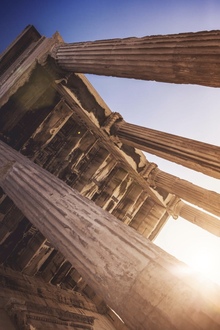
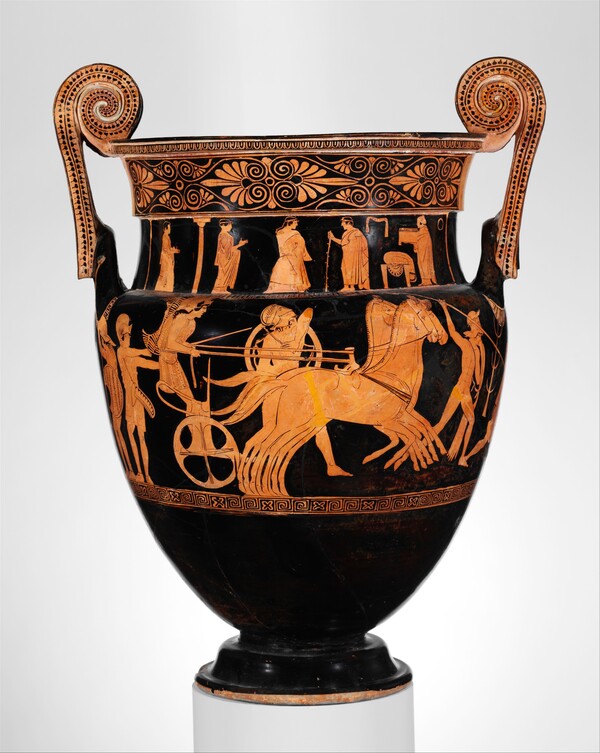
Tectonics is one of the key characteristics of ancient Greek art. It expresses the visual demonstration of the interplay between gravity and elasticity. In temples, for example, there are stone elements that visually mimic wooden roofing (triglyphs), joining elements (gutters), and the wooden post-and-lintel structure (entablature). The tectonics of a Greek vase lies in how the decorations help the viewer visualize the vase’s structure.
The process of throwing a vase on the potter’s wheel
Most Greek vessels were crafted on the potter’s wheel. The method of arranging the image around the circumference of the vessel in stacked bands references the structure created on the wheel: when the piece was not yet finished, continuous bands were clearly visible on its surface.
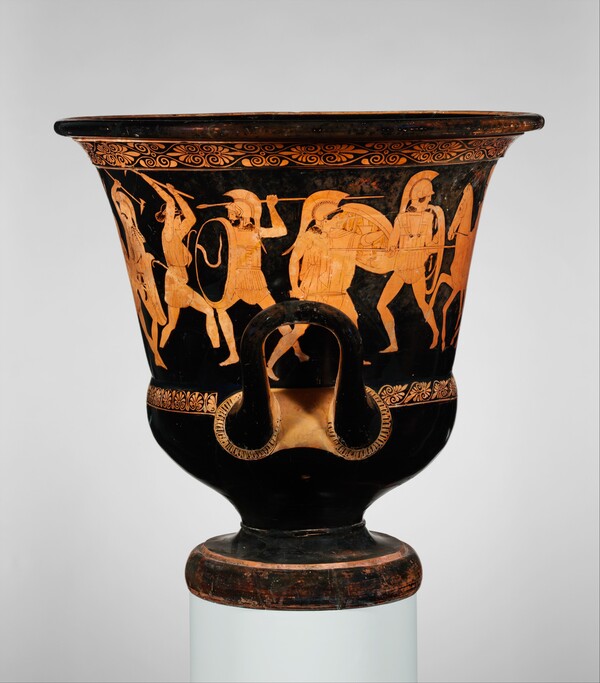
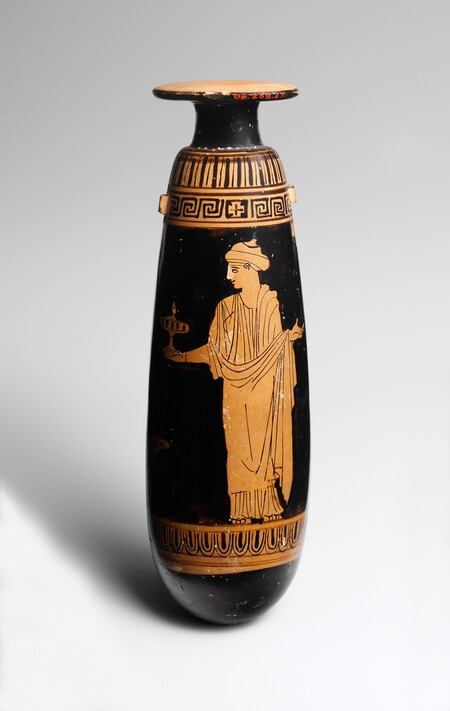
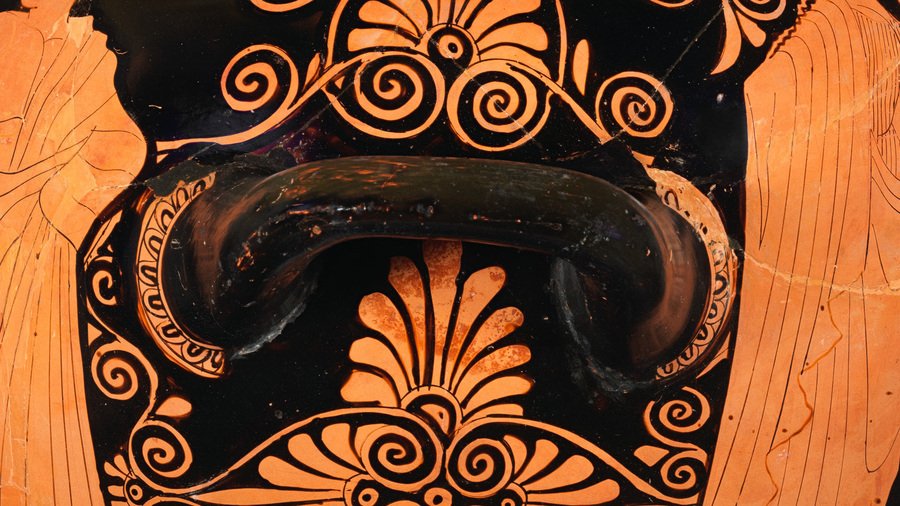
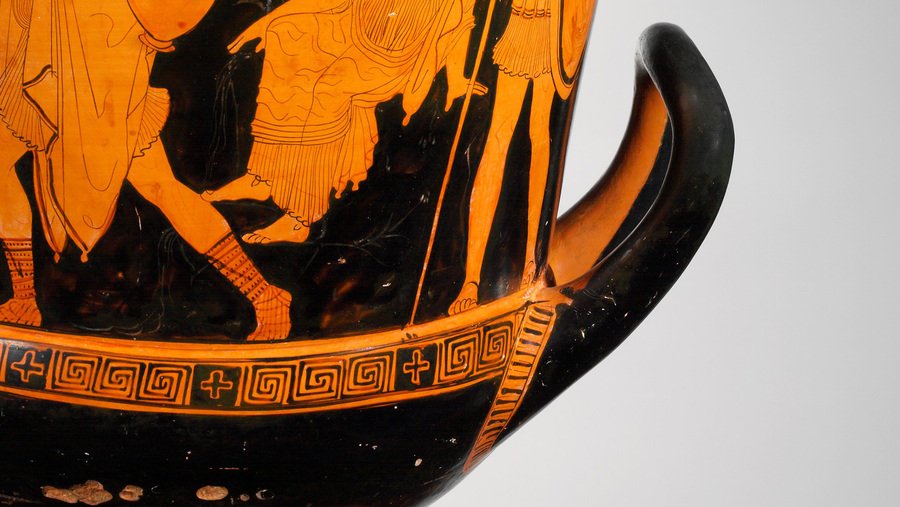
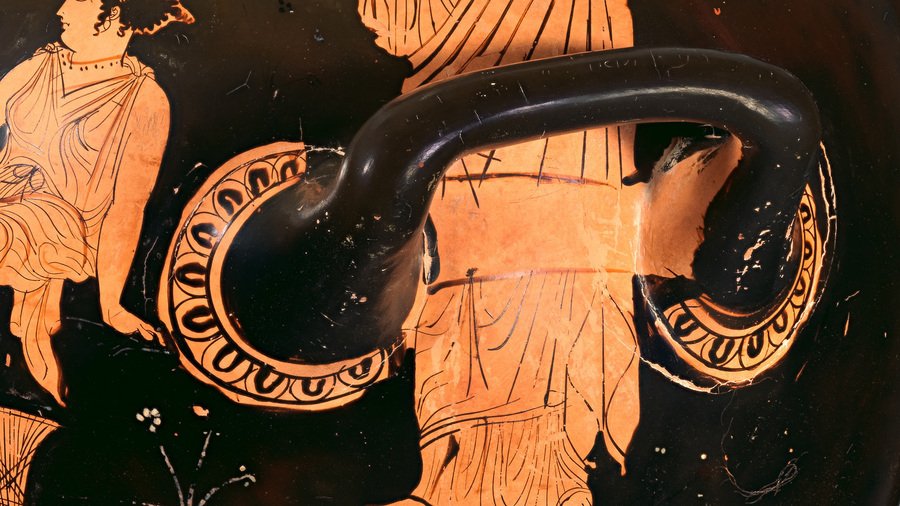
The handles were attached to the vessel after the primary form was established. The pattern placed on the side of the handles emphasizes their thickness and durability.
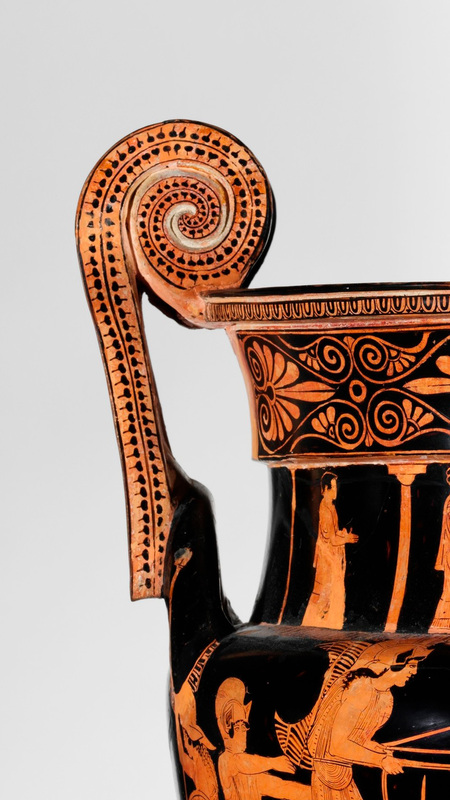
The pattern could also be applied around the point where the handle was attached to the vase.
Source
Source
Source
Source