Медуза Горгона. Между чудовищным и прекрасным
Визуальные образы в древнегреческой вазописи и архитектурном декоре VII–IV веков до н. э.
Concept
In ancient Greek art, the Gorgon Medusa was depicted in diverse ways: ranging from a grotesque monster to a figure with natural human features. This research investigates the interplay between the human and the monstrous in her image and how her interpretation was influenced by the mythological narrative, artistic form, material, and function of the work.
The primary corpus comprises eleven artifacts from the 7th–4th centuries BCE: four vase paintings, four metalworks, and three terracotta anthephixes. The analysis takes into account the place of manufacture, discovery, and current preservation of each object.
The study relies on museum catalogs, archaeological publications, and academic works concerning the history and interpretation of the Medusa image. Documented facts are strictly separated from scientific hypotheses and original interpretations.
The central hypothesis of this research is that the Medusa image did not evolve linearly from monstrous to beautiful; rather, different artistic types could coexist. Anthropomorphism is not equivalent to idealization, and the softening of her appearance is manifested through the abatement of the grotesque and the harmonization of her features.
Primary Method
Comparative visual analysis of monuments, taking into account their iconography, artistic form, and function. The analysis considers composition, head positioning and rotation, gaze direction, facial expression, proportions, body plasticity, supernatural attributes, and material specifics. The context of the image is also addressed separately: whether it is a mythological scene, the function of a metal object, or the protective purpose of architectural ornamentation. The analysis is based on museum catalogs, archaeological publications, and scientific research. Documented information, scientific hypotheses, and original visual observations are clearly delineated.
The main research question
How did the interplay of human and monstrous traits shape the various artistic representations of Medusa the Gorgon in ancient Greek art from the 7th to the 4th centuries BCE, and what role did the mythological narrative, artistic form, material, and function of the artwork play in this process? The working hypothesis is that the image of Medusa did not evolve linearly from monstrous to beautiful: different modes of depiction could coexist, determined by artistic and functional objectives. Furthermore, anthropomorphism did not necessarily imply idealization; rather, the softening of her appearance manifested through the lessening of grotesque elements and the harmonization of features.
Chapter I. The Medusa in Mythological Action
From the Gorgons Group to Medusa’s Downfall
On the amphora by the Nessian artist (c. 620–600 BCE), the three Gorgons are presented in a unified scene of motion. Their bodies are oriented to the right, while their faces face the viewer. This combination of directional movement and frontal facial presentation creates a tension between the figures' dynamism and the direct visual contact. The rhythm established by the repeated poses is disrupted by the decapitated Gorgon, traditionally identified as Medusa. Furthermore, Perseus is not depicted on the body of the vessel: what we see is not a scene of pursuit, but an image of the Gorgons as a collective group, in which the demise of one of the sisters has already become a settled event. This interpretation aligns with mythological tradition but should not supplant a direct description of the image [1].
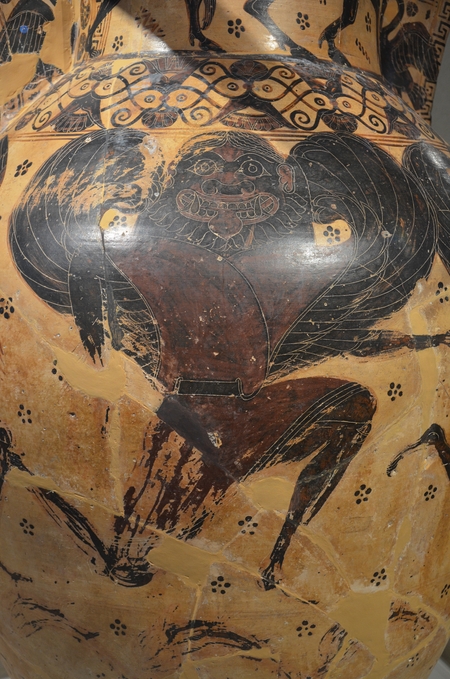
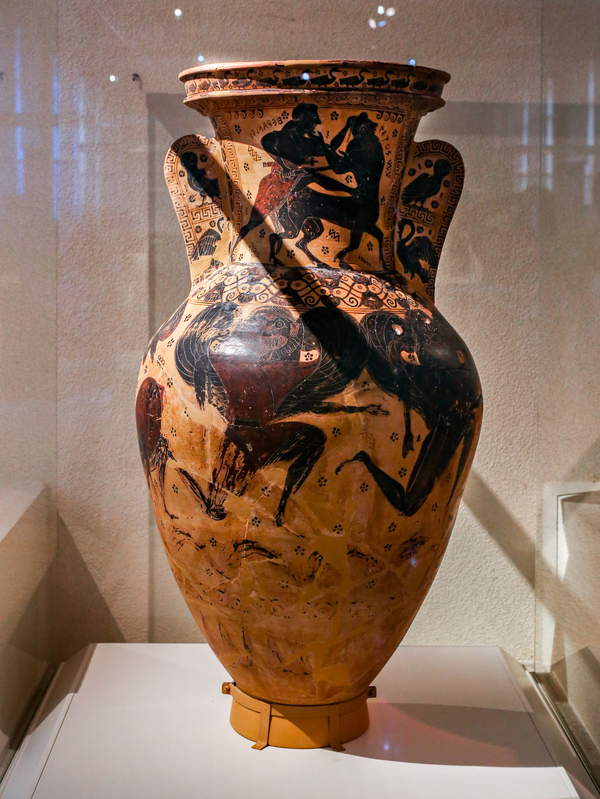
Amphora by Nessosian artist, c. 620–600 BCE
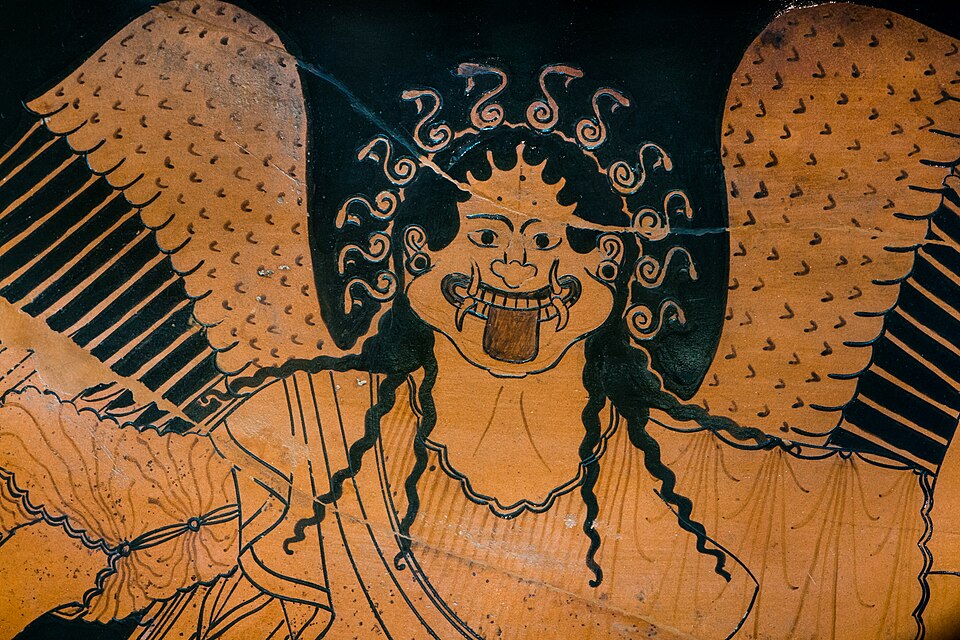
The myth is also depicted on the kylix of the artist Amasis (circa 550–530 BCE). This shows the beheading of Medusa: Perseus thrusts his sword into her neck, looking away, while Hermes observes the event. The central placement of the Gorgon and her frontal face draw the viewer’s gaze directly to the action’s victim. The four wings, the snakes emerging from her hair, and the serpents coiling around the belt of her garment, along with the protruding tongue and three streams of blood, underscore the supernatural and terrifying nature of the character. Furthermore, the composition is not built solely around Medusa’s figure; Perseus’s averted gaze and Hermes’s presence suggest different modes of participation in the unfolding drama. The inscription «Amasis made me» is the potter’s signature, not an attribution to the painter [2].
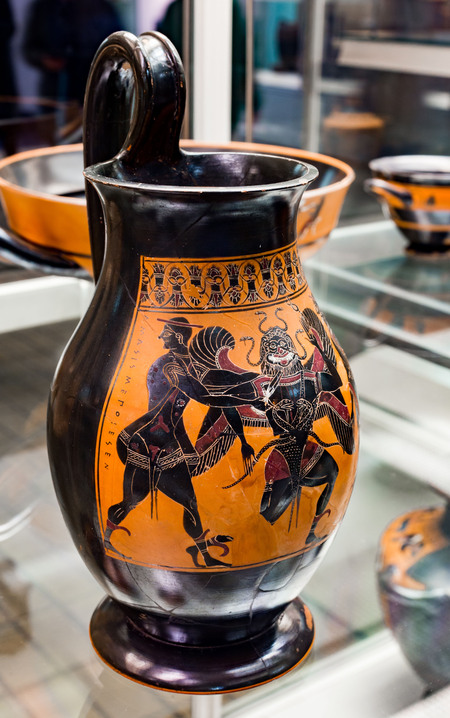
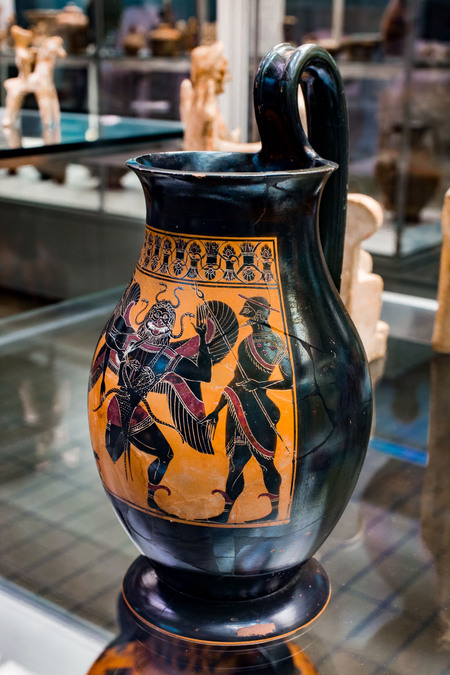
Olpa of the artist Amasis, c. 550–530 BCE.
Sleeping Medusa
On the Attic red-figure bell-shaped krater by the artist from Villa Giulia (c. 460–450 BCE) is depicted the moment preceding decapitation. Medusa is shown asleep, and Perseus approaches her; Hermes and Athena are nearby. The closed eyes eliminate direct contact with the viewer and deprive the scene of the tension characteristic of the Gorgon’s frontal gaze. However, this does not mean the complete disappearance of monstrous features: the wings retain an indication of her supernatural nature, and certain facial details continue to link the image to traditional Gorgon iconography. As a result, Medusa’s figure exists between two iconographic registers—the sleeping, vulnerable woman and the mythological creature whose nature remains recognizable.
Bell-shaped crater by the artist from Villa Giulia. Perseus prepares to decapitate sleeping Medusa, c. 460–450 BCE.
On the Pelike attributed to Polygnotus (c. 450–440 BCE), Medusa is also depicted asleep, yet her appearance differs notably from the traditional monstrous type. Her face is rendered in a three-quarter profile, her eyes are closed, and her head rests on her crossed arms; natural proportions and meticulously arranged curled hair form the image of a young woman. Her wings retain the character’s connection to the supernatural realm but no longer feature the customary set of sharply pronounced grotesque traits. Percy’s position is particularly significant: the hero looks not at Medusa, but at Athena, addressing the goddess as his patroness. The Metropolitan Museum directly characterizes the Gorgon on this Pelike as a beautiful young woman—one of the earliest examples of such an depiction in Attic vase painting [7].
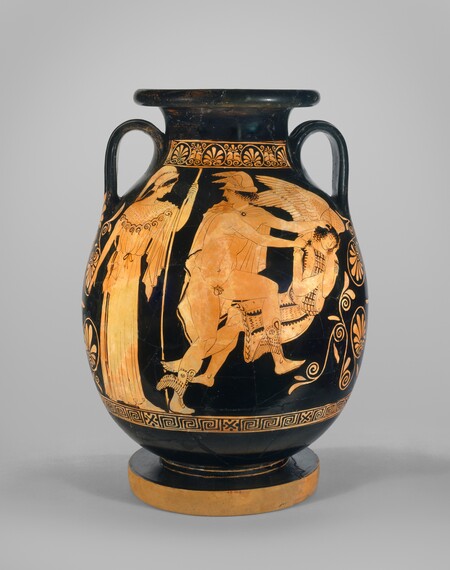
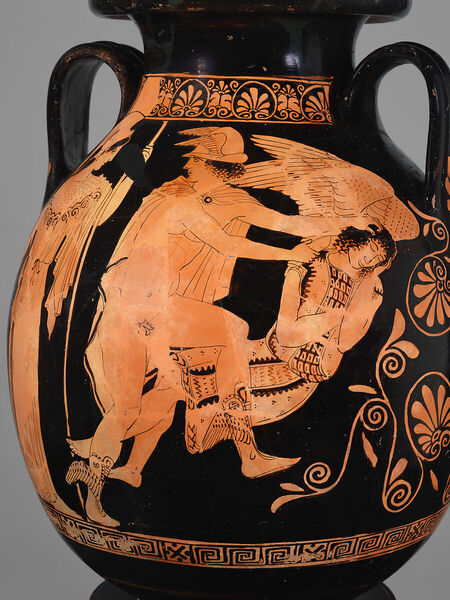
Pelecid, attributed to Polygnotus. Perseus beheads the sleeping Medusa, c. 450–440 BCE.
Chapter I Conclusion
The examined artifacts suggest that Medusa’s depiction in mythological scenes is defined not only by her appearance but also by her role in the narrative. She is presented as part of the moving group of Gorgons, the central figure in the beheading scene, or the sleeping victim whom Perseus approaches. The nature of her interaction with the viewer also changes: a frontal face creates direct visual contact, whereas closed eyes and a turned head eliminate that contact.
Moreover, the degree of monstrousness is not determined solely by chronology. The differences between the artifacts are also related to the specific moment of the myth chosen and the artistic objective of the depiction. As Catherine Topper’s research shows, the emergence of a beautiful Medusa should not be viewed as an inevitable outcome of the gradual abandonment of the archaic monstrous type, but rather in the context of a specific scene and its semantic emphasis [6].
Chapter II. The Medusa Face: Between the Monstrous and the Human
In Greek art, the image of Medusa was not confined to a single portrayal. Her depiction could retain overtly monstrous features or gradually adopt a calmer, more harmonious interpretation. This evolution is particularly evident in works of metal art: bronze mirrors and plaques, gold ornaments, and elements of military gear. The function of the object influenced the character of the image—in one instance, the Gorgon’s face was intended to intimidate, while in another, it became part of a decorative composition.
The first artifact is a bronze mirror featuring the head of Medusa, originating from Southern Italy and dated to 500–480 BCE (Getty Museum, 96.AC.109). The face faces the viewer directly: wide-open eyes, a massive mouth with a protruding tongue, serpentine locks, and a prominent beard create a deliberately grotesque appearance. The frontality intensifies the directness of the gaze—the image does not invite the viewer to observe a mythological scene, but rather seems to engage with them in direct interaction. The placement of the head on the reverse of the mirror is also significant. Medusa functioned not only as an adornment for the object but also as an apotropaic image intended to ward off evil glances. Here, her monstrous quality is not a flaw of the artistic form, but its principal expressive element.
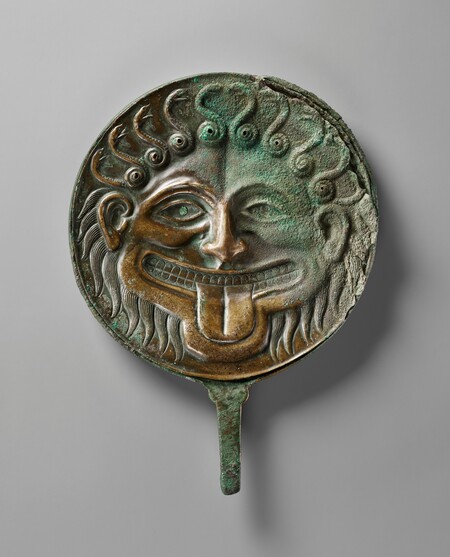
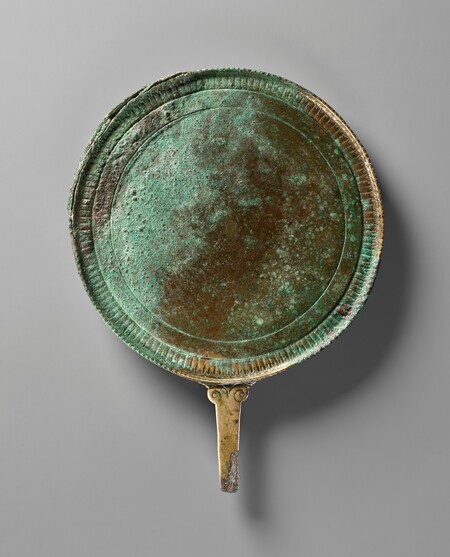
Bronze mirror depicting the head of Medusa, circa 500–480 BCE.
The depiction takes on a different character in the gold pendant shaped like a Gorgoneion from Cyprus, created around 450 BCE (Metro Museum, 74.51.3397b). The small size of the ornament and the use of precious material alter the perception of the image: the face becomes part of a carefully organized decorative surface. The details of the hair and teeth are rendered through granulation; the eyes and earrings were originally meant to contain enamel. Even so, the monstrous attributes do not entirely disappear: the teeth and serpentine hair retain a connection to the traditional image of the Gorgon. The primary shift is in the manner of artistic presentation—the terrifying face is incorporated into a jewelry composition and acquires a greater decorative order. This is not yet the transformation of Medusa into a beautiful woman, but it represents a different balance between frightening content and the object’s aesthetics.
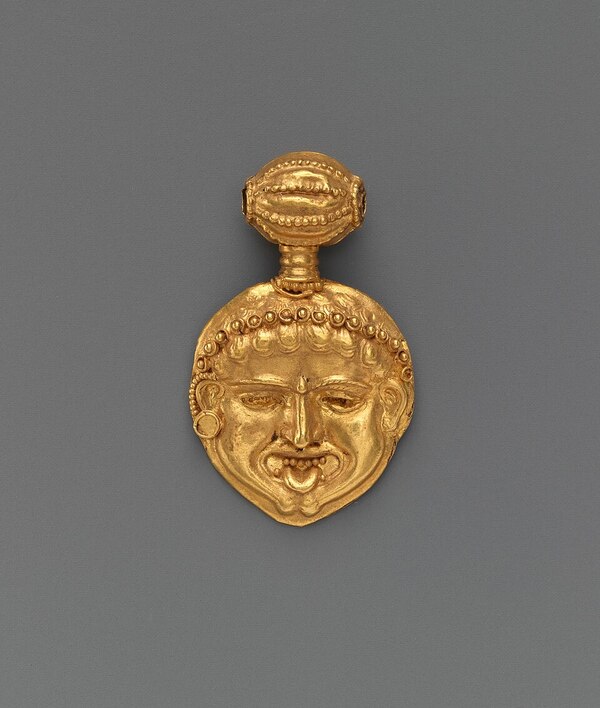
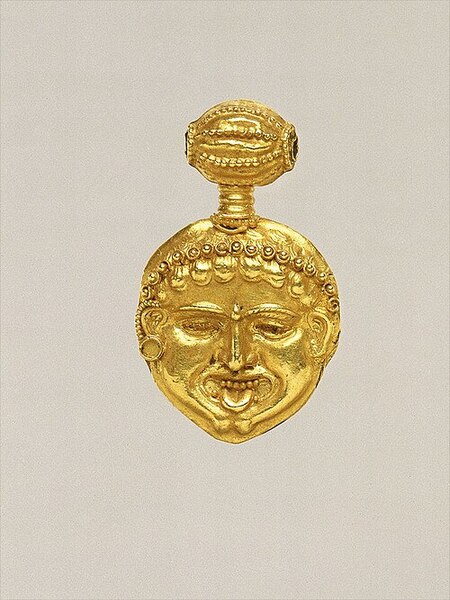
Gold pendant in the shape of a Gorgonion, circa 450 BCE.
The next artifact is a bronze appliqué figure of the Gorgon from Athens, discovered on the Acropolis in 1836 (Bibliothèque nationale de France, bronze.706). It depicts her in a swift run: her arms are outstretched, her legs are bent in motion, four large wings are positioned behind her, and two smaller ones are on her heels. In contrast, her face remains directed straight toward the viewer. A significant difference from previous depictions is that the figure is revealed not only through a singular face but through the plasticity of the entire body. A short tunic, heavy braids, and a dynamic posture merge the human form with fantastic attributes. The Gorgon retains her strangeness, yet her image becomes more cohesive and plastically organized. The monstrous quality does not disappear here; rather, it is integrated into the expressive form of the moving human body.
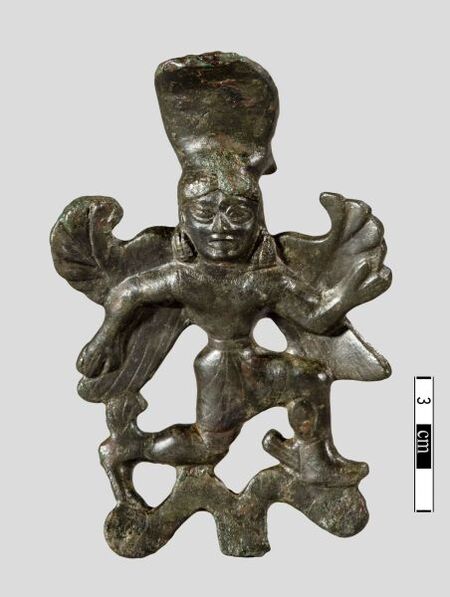
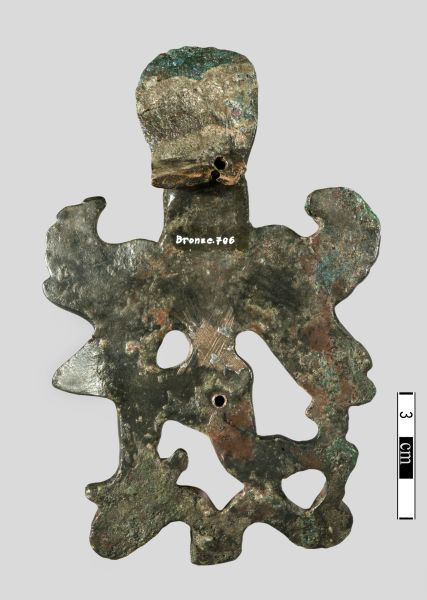
Bronze plaque figurine of the Gorgon, discovered on the Athenian Acropolis in 1836.
The most noticeable softening of features is displayed in a bronze fibula from Southern Italy, dating to the 4th century BCE (Metropolitan Museum of Art, 1991.171.45). A Gorgon head is depicted on the fibula’s upper section. Compared to earlier Southern Italian fibulae, its face appears significantly less repellent—the grotesque expressiveness gives way to a calmer, more harmonious rendering. Nevertheless, the image retains its function. The Gorgoneion is placed on a protective element of the armor covering the knee, and its circular shape and intimidating mythological nature suit the object’s purpose. Thus, the softening of appearance does not imply a rejection of the protective meaning of the image. The Medusa becomes less monstrous yet continues to retain the power of her image.
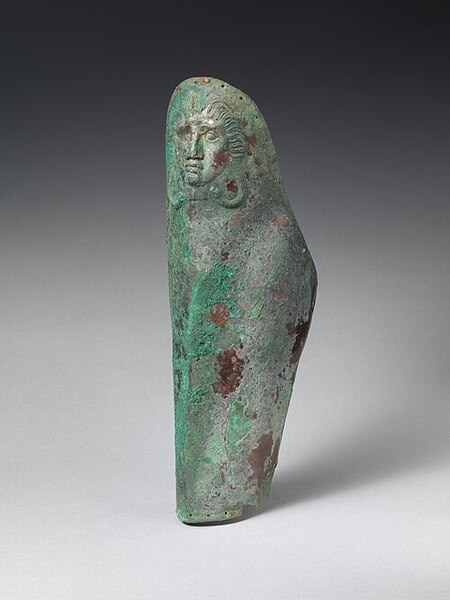
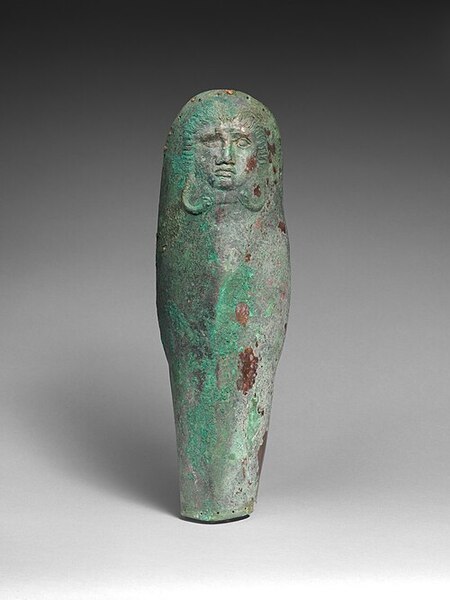
Bronze appliqué depicting a gorgoneion, 4th century BCE.