Concept
The starting point for my research was my fascination with Ernst Haeckel’s illustrations. Beyond the unusual natural forms, I am interested in how they are presented: the arrangement of figures on the page, the correspondence between the overall appearance and the details, the repetition of elements, and the combination of illustration and explanation. This fascination led to a question about fantastical representation: what allows an imagined creature to be presented not merely as an expressive image, but as an organism that one as if already observed and studied?For the course History of Fiction and Futurism, I examine this problem through the methods of depicting invented nature. The focus is on the transition from depicting a single unusual body to integrating it into a body of knowledge—its structure, the differences between organisms, behavior, and conditions of existence. The connection to futurism is revealed by comparing images of hypothetical future fauna with other variations of imagined nature.
Area of Study: Visual techniques that create the effect of a familiar fictional organism. By this effect, I mean an organization of the image where the creature is presented as amenable to sequential description, comparison, and explanation. I distinguish this effect from the realistic rendering of volume and texture, and also from proof of biological viability. The work does not involve experimental measurement of viewer trust—the conclusions will pertain to the structure of the images and the nature of the information presented within them.
The research is structured thematically, not biographically. The first part examines how perspectives and details render the body available for observation. The second part addresses how external form connects to the presumed internal structure. The third section is dedicated to comparative arrays and distinguishing constant from variable characteristics. The fourth investigates the organism’s relationship with action and environment. The fifth compares the explanatory image with the presentation that merely creates the anticipation of explanation. This sequence allows for a transition from the individual body to a system of organisms and subsequently tests the boundaries of the chosen methods of representation.
Primary Method: comparative visual analysis. Images are grouped by a shared characteristic, and then the variations in how that characteristic is used are examined. The analysis of the entire sheet is supplemented by close-ups of significant fragments and custom comparison diagrams, which are labeled as the author’s analytical treatment. Every commentary must specify which observed feature supports the thesis, how it relates to a neighboring image, and what this comparison does not allow to be established. Micro-conclusions connect individual comparisons to the central question of the work.
Textual Sources are selected based on their connection to specific images and the research problem. Priority is given to captions for original publications, available authorial texts and commentaries, and information from museum and publisher catalogs. Research literature is utilized for historical context and definition refinement. Authorial explanations are aligned with what is actually depicted in the image, rather than substituting for visual analysis. Publisher descriptions are not considered a substitute for the book read; the extent of reference to each source is specified precisely. Borrowed statements and quotations are accompanied by citations.
Key Question of the research: How do techniques of scientific illustration present a fictional creature as an object of observation and knowledge? The working hypothesis is that this effect is created by two related, yet distinct mechanisms. The first is the consistency of information: perspectives correspond to each other, details relate to the whole, and the construction aligns with the depicted action. The second is the use of a recognizable format of a scientific document: comparative tables, numbering, and explanatory captions. The comparison should demonstrate when these mechanisms support each other, and when the documentary formatting exists without explaining the creature’s structure.
The result will be a typology of techniques, detailing their capabilities and limitations. This typology will help answer how an image translates a fantastical form from the realm of a singular marvel into the domain of imagined knowledge. The possibility of applying these findings in art design is seen as a consequence of the research, but creating one’s own entity does not replace the analysis of selected works.
I. Make the organism visible
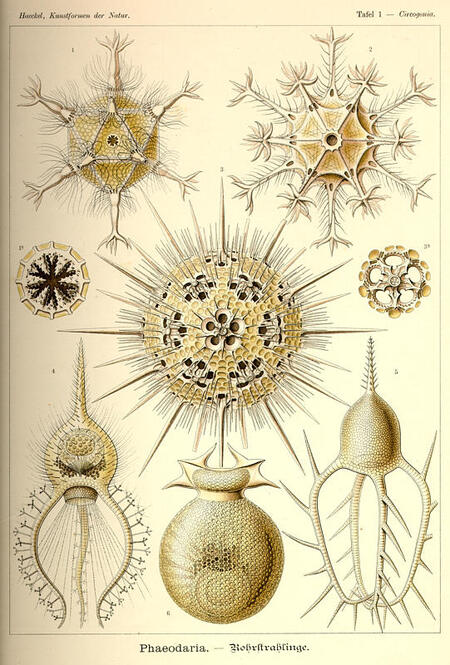

Ernst Haeckel; lithograph by Adolf Gilch. Phaeodaria. Plate 1 from «Beauty of Forms in Nature.» 1899–1904
In Heckel’s first table, the central radial form is surrounded by multifaceted, rounded, and elongated structures. While their appearance varies, the diversity is organized by the repetition of a small number of elements: perforations, bridges, rays, and branching points. This allows for a comparison of specific methods of shell construction rather than a generalized «strangeness.» A large central figure is emphasized by its scale but is not isolated from the others. It becomes one variant of the overarching problem—the connection between the surface and its projections. This principle is precisely what is essential for fantastical design: complexity ceases to be a random accumulation of ornamentation when one can trace the rules governing its organization. Thus, pattern is created not by the quantity of details, but by the ability to perceive recurring relationships between them.
Ernst Haeckel; lithograph by Adolphe Gilcher. Discomedusae. Plate 28 from «Beauty of Forms in Nature.» 1899–1904 (series publication period).
The scientific drawing compiles data inaccessible from a single vantage point; its conventionality serves as the explanation. The perspectives function as a system, where each reveals what the others do not.In plate 28, a large convex form at the top neighbors a circular image below and small supplementary figures at the edges. The sheet cannot be interpreted as a single moment of underwater observation: the images are placed within a shared field, but they do not form a unified perspective space.It is precisely this conventionality that makes the plate useful. The overhead view allows one to read the height and silhouette; the large lower form reveals the distribution of elements around the center. The peripheral figures offer a different level of scrutiny. However, one cannot automatically assume that all images are views of a single specimen without a legend: the overall sheet may combine different objects and details.The upper image is read through a profile: the convex umbrella is separated from the drooping branches. In the circular image, the distance from the center, the repetition of segments, and the ratio of internal to external zones are more important. One representation does not replace another because they disclose different spatial relationships.
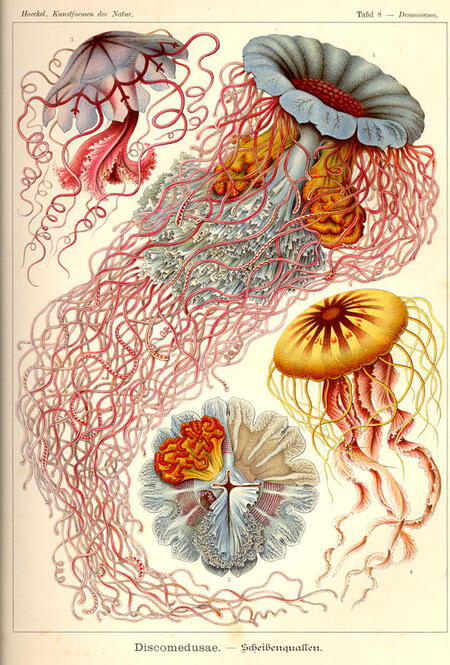

Ernst Haeckel; lithograph by Adolf Gilcher. Discomedusae. Table 8 from «The Beauty of Forms in Nature.» 1899–1904 (period of series publication)
In Table 8, the bodies of the jellyfish and their numerous filaments are not confined to strict, separate cells. The tentacles intersect, pass through the overall composition, and form long, colorful trajectories. The semi-translucent areas allow the internal structures to be read, but the dense overlap simultaneously complicates the separation of one form from another.
The plate demonstrates a compromise between analytical clarity and plastic expressiveness. A unified rhythm connects the forms and conveys their length, while the numbering and color variations help maintain the individual objects. Therefore, scientific illustration does not necessarily equate to the maximum isolation of every element—sometimes it showcases complexity precisely through superposition.
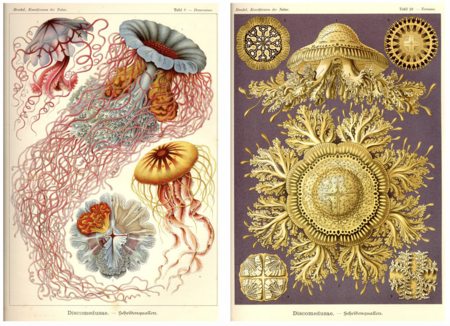
Both tables focus on jellyfish but present different trajectories of attention. In Table 8, the gaze follows long filaments and intersections; in Table 28, it returns to large central forms and discrete peripheral details. The former emphasizes continuity and motion, while the latter suggests the fragmentation of representation.This comparison is significant because it dismantles the notion of a singular «scientific style.» One author manipulates density, contrast, and the degree of figure isolation depending on the representational goal. To borrow a scientific presentation into fantasy is to choose a mode of explanation, rather than mechanically applying the same background and grid.Thus, the scientific language of imagery consists of decisions, not a single, unchanging aesthetic.
Portrait and model are not the same thing
Terrell Witlatch. Gungans. «Principles of Creature Design, ” pp. 156–157. 2015.
Several projections restrict arbitrary design: a part invisible from one viewpoint must align with what is seen from another.The left side of a Whittaker spread is dedicated to close-up head studies, while the right shows the figure in full and in linear profile views. These sections serve different purposes. Portraits emphasize facial features, surfaces, and expression; comparative figures make general proportions and limb placement accessible.The image simultaneously serves to design a character and to describe a creature. A psychologically expressive head does not substitute for information about the body’s structure. Conversely, a set of consistent projections does not yet convey individual character. The spread does not eliminate this distinction—it delegates tasks among its various components.In the linear sequence, the viewpoint changes, but the relationships between the neck, torso, arms, and legs must remain consistent. The absence of saturated color facilitates contour comparison; attention relies less on texture and localized color spots.This sequence introduces a verifiable constraint. A form that is expressive from the front must have a defined continuation from the side and the back. However, this is not a technical drawing—one cannot claim millimeter-perfect proportional alignment without precise grids and measurements. Here, visual consistency of the design solution is paramount, not the presence of an engineering calculation.

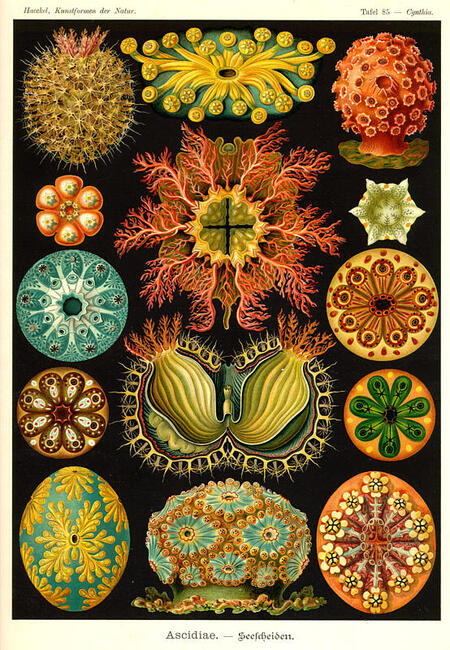
Ernst Haeckel; lithograph by Adolf Gilch. Ascidiae. Plate 85 from «The Beauty of Forms in Nature.» 1899–1904 (period of series publication)
The scientific presentation begins with the specificity of the subject: exactly what is shown and how it relates to neighboring figures.In the ascidia table, rounded external forms, rosette-like clusters, and open structures coexist. Without explanation, it is not always clear where a complete body is depicted, where it is a part of one, and where it is an aggregation of repeating elements. The decorative coherence of the leaf does not alleviate this uncertainty.Here, the independent function of the caption becomes visible. It defines the status of the image. The symmetry of the composition helps maintain diversity, but the order of the page cannot be automatically assumed to be a property of the entire nature. Artistic arrangement and biological organization are different levels that the investigation must separate.
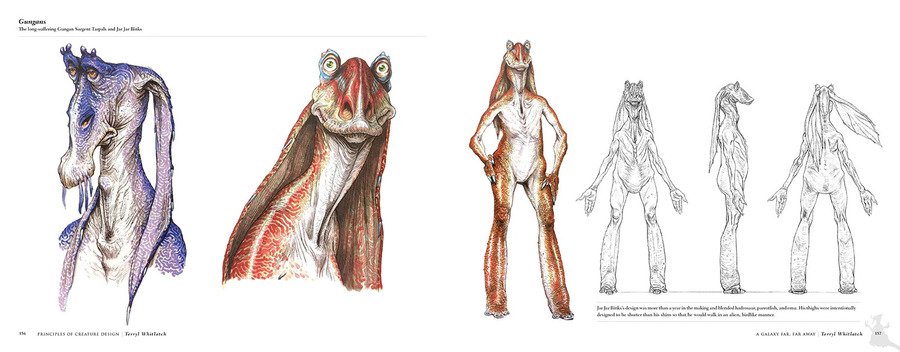
The similarity between these sheets is not in the form of the organisms or in the style. Both distribute the material in such a way that individual images can refine one another. The difference lies in the types of relationship: Hekkel requires distinguishing between objects and the levels of their presentation, whereas Whitlatch requires correlating an expressive image with a stable structure.
Thus, the initial stage of the effect of familiarity arises not from detail itself. The image provides several points of access to the subject and establishes relationships between them. If these relationships are not defined, the sheet remains merely an assembly of beautiful figures, even if it includes numbering and resembles an atlas.
The first mechanism of persuasiveness is the mutual consistency of images: the detail, the angle, and the overall view must correspond, not merely exist side-by-side.
II. Explain the body
Terrell Witlath. Billyphant and Satyr. «The Science of Creature Design, ” pp. 66–67. 2015.
On the spread, the quadruped Billyphant stands alongside the biped Satyr. Their silhouettes, proportions, and temperaments differ, yet both concepts are revealed through several layers of presentation. Instead of a single finished drawing, a system of transitions is shown: the generalized structure, the skeleton, the musculature, and the external form.
This organization allows the artist’s work to be partially subjected to critical examination. One can assess whether the limb lengths are maintained, how the body volume relates to the supporting structure, and how the head’s positioning continues the neck line. The sheet does not prove the existence of these animals; it demonstrates that the imagination is constrained by an accepted framework rather than being completely reassembled in every image.
It is particularly significant that the viewer is provided not just with the result of the hybridization, but with the method of its coherence. The proboscis-like extension of the head is read in relation to the elongated skull; the mass of the body is read in relation to the supports. A peculiar detail requires a resolution with the surrounding parts. This is what distinguishes a constructed organism from a mere montage of recognizable fragments.
Productive hybridization alters the relationships within the entire body, not merely its external set of features.
The two bottom images of Billyphant compare the developed musculature with the colored exterior appearance. In the colored drawing, the anatomical lines disappear, but the masses they indicate must be retained. The coverings do not cancel out the structure; they merely make it less immediately visible.
This introduces a criterion suitable for comparing fantastic imagery. Detailed texture is not proof of deep development if it cannot be correlated with the volume and movement of the body. Conversely, a smooth or conditionally rendered surface can belong to a consistently constructed form. The degree of rendering hair, folds, and spots should not be confused with the coherence of the organism.
Terrell Whitlatch. Nature Sketches and JakkoBeast. «Principles of Creature Design, ” pp. 170–171. 2015.
The spread is built upon a stark contrast in scale. On the left, there are numerous small animal sketches; on the right, there is one large creature. Observations of heads, limbs, torsos, and poses are juxtaposed against the assembled form, which must be maintained as a cohesive whole.The left page is not an instruction set—it is not telling the viewer, «put the head here and the tail there.» Instead, it presents broader comparative material: differences in support, weight distribution, back plasticity, and the degree of limb mobility. The right page offers an answer to how these observations can coexist within a single body. The believability of the hybrid is not tested by the number of recognizable animals, but by the coherence of the final figure.The fantastical creature particularly features a heavy torso, relatively short supports, and a massive head. The striped surface, fangs, and other noticeable traits might appear as separate borrowings. However, the overall arch of the back and the low position of the body unify them into a single plastic problem.Furthermore, the pose does not reveal everything. It allows for a discussion of visible mass distribution and the nature of contact with the ground, but it does not fully disclose the articulation of the joints or the internal structure. This image is more structurally defined than a random collage, yet it remains an artistic project. The transition from sketches to a complete being should not be mistaken for experimental proof of its viability.