Concept
The ancient Roman sculptural portrait holds a unique place in the history of classical art. Unlike the Greek tradition, which focused on creating a generalized ideal, Roman masters developed a fundamentally different approach: the portrait became less of an aesthetic object and more of a tool for social and political communication. It was in Rome that a developed system of portrait genres first emerged in European art history—from austere Republican busts to stately Imperial statues. Studying this evolution allows us to understand how artistic form submits to the demands of ideology and how the visual language of power shifts alongside changes in political structure.
Material Selection Principle
Selected sculptures from the period spanning the 1st century BCE to the 3rd century CE, housed in the collections of leading global museums—including the Vatican Museums, Capitoline Museums, The Metropolitan Museum of Art, the Uffizi, and the State Hermitage Museum—were chosen for analysis. The selection criteria were based on chronological and typological principles, encompassing both official imperial portraits and private busts.
Rubrication Principle
The material is organized into five sections, each covering thematic aspects of Roman portraiture corresponding to key evolutionary stages: Republican verism; the transitional period of Julius Caesar; Augustan classicism; the Julio-Claudian and Flavian dynasties; and the Antonine and Severan eras. Within these sections, the visual narrative is structured around contrast—juxtaposing veristic and idealized examples—which effectively demonstrates the shift in artistic objectives.
Key Question
How did the political structure of Rome influence the artistic techniques of sculptors and the visual language of portraiture?
Hypothesis
The shift from Republican Verism to Imperial Idealism was not an evolution of aesthetic taste, but a change in political objectives: the portrait transformed from a tool of intra-aristocratic competition into an instrument of state propaganda and the sacralization of imperial power. Stylistic fluctuations between Verism and Classicism during the imperial era reflected not so much artistic preferences as the needs of each dynasty to legitimize its rule.
Republican Period: The Cult of Ancestors and the Triumph of Verism
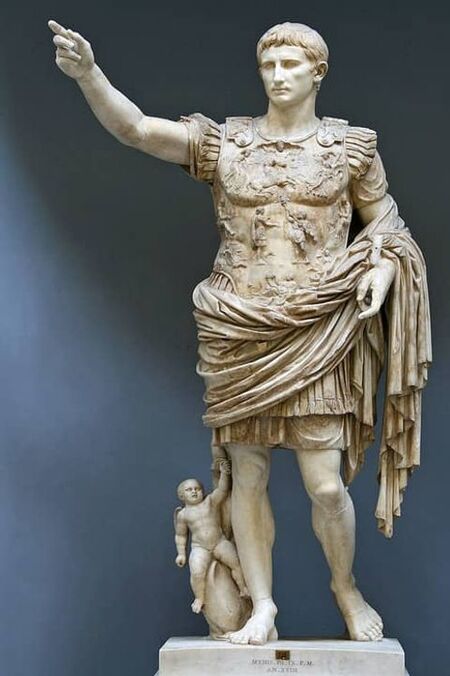
Статуя римлянина с портретами предков
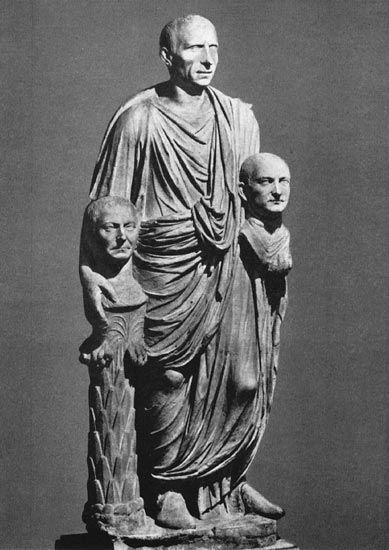
Бюст Юния Брута
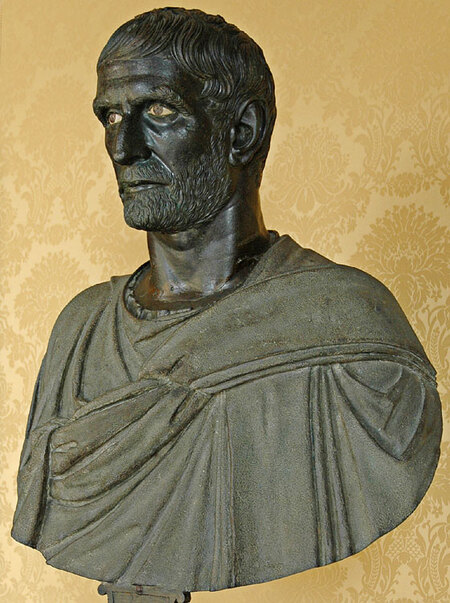
Portrait of Emperor Pompey the Great
Republican portraiture was shaped by the cult of ancestors: wax masks of the deceased were kept in the atrium and used in funeral processions. Sculptors meticulously reproduced every detail—wrinkles, scars, bald spots—because old age and wisdom gained through experience were regarded as virtues of a true Roman citizen. Verism was not naturalism in the modern sense; rather, it was a social marker: the portrait demonstrated an individual’s right to hold public office, their military achievements, and their commitment to republican values. A characteristic example is the «Portrait of a Patrician, ” where the emphasized sagging skin and deep wrinkles create the image of a person whose life was dedicated to serving the Republic.
Tombstone stele of a Roman married couple
Portrait of Patricia
Transitional Period: Julius Caesar and the Birth of Cult of Personality
The Tuscan Portrait of Caesar
Portraits of Caesar—a bifurcation point in the history of Roman portraiture. On one hand, veristic traits are preserved (baldness, wrinkles, leanness); on the other, the first attempts at monumentalizing and idealizing the ruler’s image while he was still alive emerge. Caesar was the first of the Roman politicians to systematically use his portrait as a tool of propaganda: his images on coins and in public spaces shaped the image of a charismatic leader standing above the republican institutions.
Portrait of Caesar on a Coin
Bust of Caesar from Naples
The August Era: Augustan Classicism and Imperial Propaganda
Август в образе Великого Понтифика
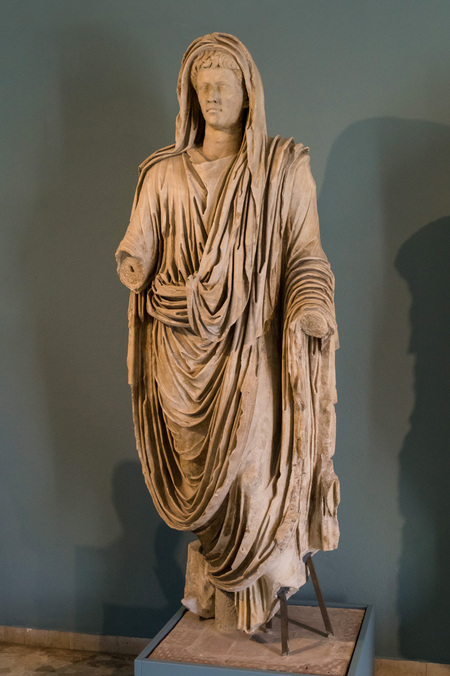
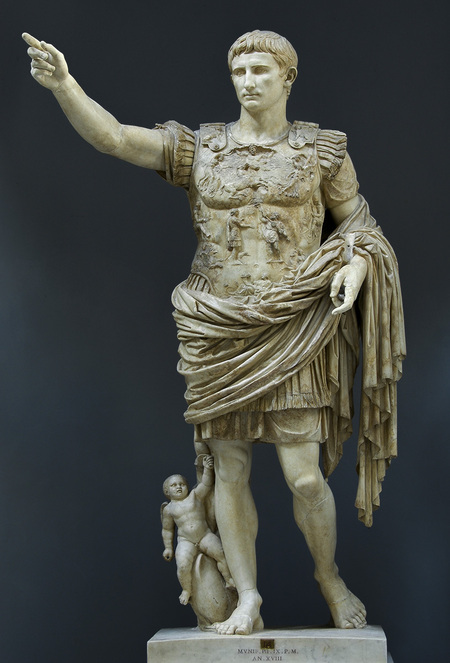
Август из Прима Порта
Portrait of Livy
With the advent of Augustus, there is a radical break from Verism. The official portrait of the emperor is created as an idealized image: a smooth face without wrinkles, eternal youth, and classical proportions borrowed from Greek sculpture (Polykleitos). Augustan classicism was a conscious political strategy: the emperor sought to distance himself from the «republican» visual tradition and create the image of a ruler whose authority was sanctified by the gods. The Augustus of Prima Porta statue is a programmatically rich work: it features an idealized face, a heroic body, a relief on the cuirass detailing his victory over the Parthians, and a Cupid figure at his feet, signifying his divine parentage (descended from Venus).
The Dynasties of the Julio-Claudians and Flavian Emperors: A Return to Realism and Experimentation
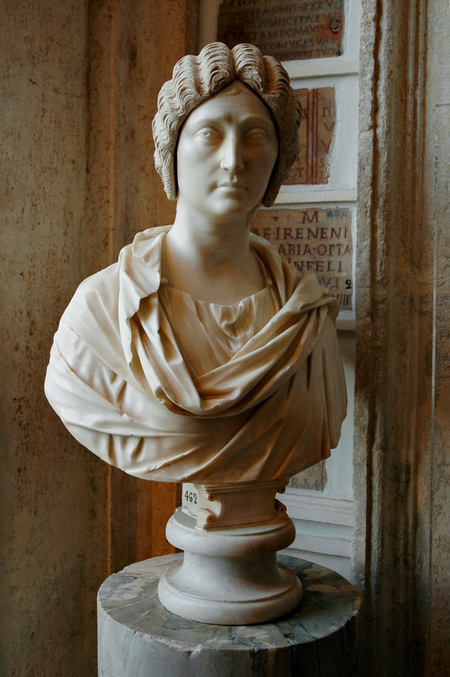
Женский портрет флавиевского времени
Портрет Веспасиана
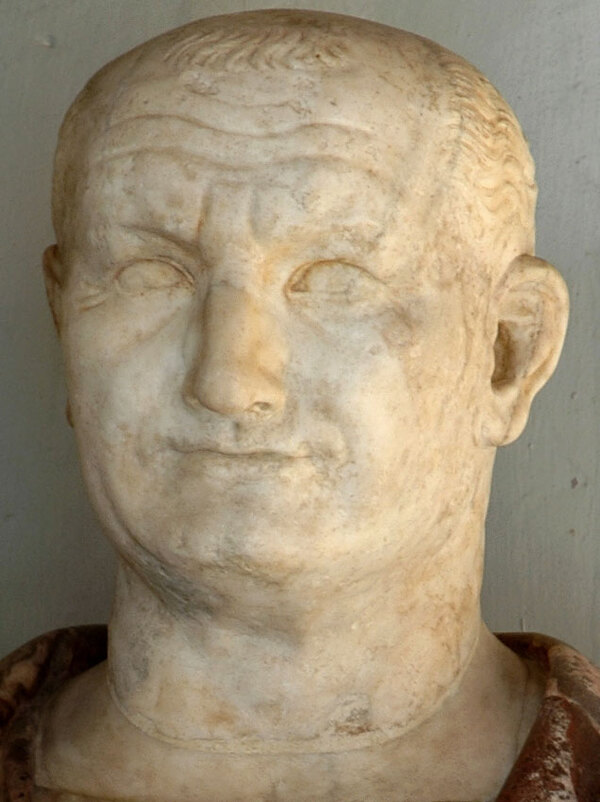
Imperial idealism was not monolithic. Under Claudius, there is a discernible turn toward republican standards: the portraits of the emperor reflect age and individual features. After the Civil War, the Flavian dynasty consciously embraces verism: Vespasian is depicted as a popular emperor, a seasoned commander marked by experience, without idealization. This stylistic pendulum demonstrates that each dynasty utilized portraiture to legitimize its authority, appealing either to republican tradition or to the classical ideal.
Portrait of Claudius
The Antonine and Severan Era: Psychological Depth and Eastern Influence