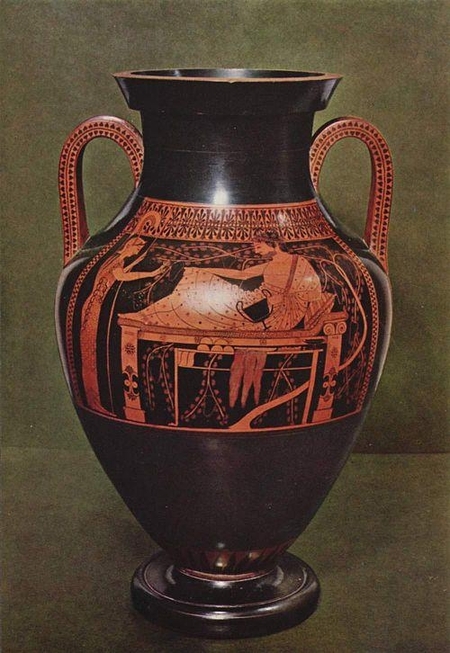
From Silhouette to Line
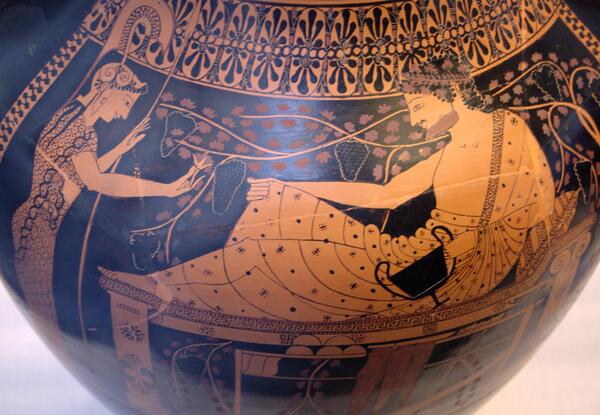
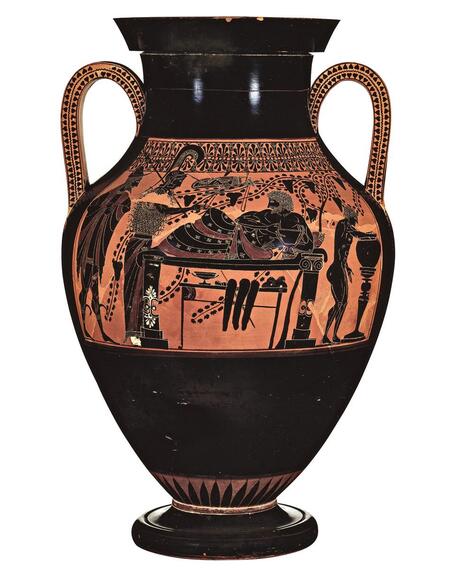
Bilingual amphora from the Andokidas workshop. Circa 520–510 BCE. State Antiquities Collection, Munich.
Around 530 BCE, Athenian masters began mastering a new technique for decorating pottery. Unlike black-figure vase painting, where figures' details were incised into a dark silhouette, the red-figure technique allowed internal lines to be applied with a brush, preserving the natural color of the clay.
Research Concept
In the latter half of the 6th century BCE, Attic vase painting achieved a high degree of mastery in the black-figure technique. Around 530 BCE, Athenian masters began to master a new painting style—the red-figure technique—which fundamentally altered the principle of image construction.
Instead of incising internal details onto a dark silhouette, artists gained the ability to apply lines directly onto the surface of the figures with a brush. This expanded the possibilities for conveying the human body, movement, and the finest details.
The coexistence of these two techniques on a single vessel allows for a clear tracing of the evolution of vase painting’s artistic language and helps to determine which new expressive means emerged among the masters.
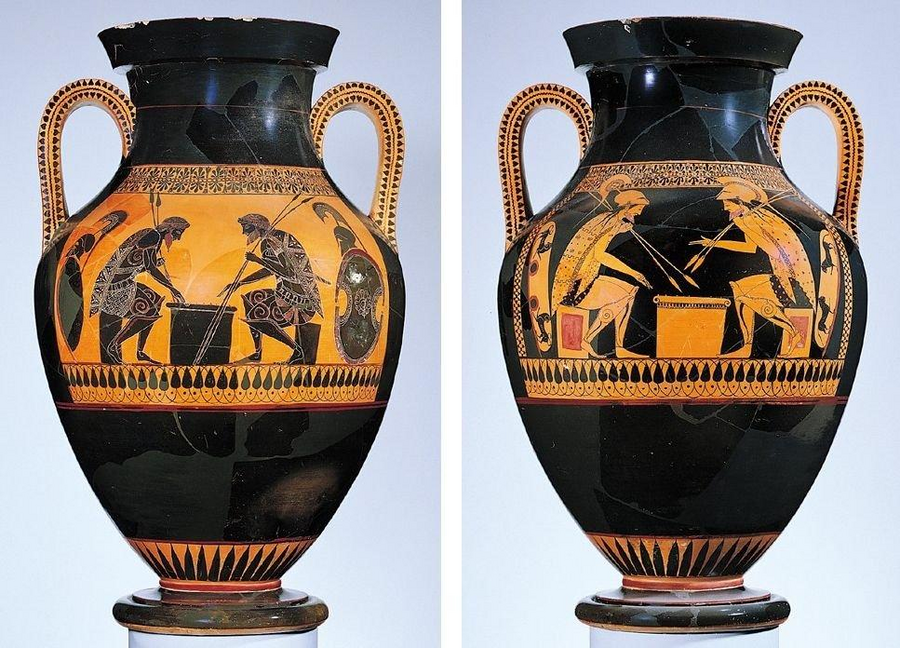
Bilingual amphora depicting Achilles and Ajax. Circa 525–520 BCE. Museum of Fine Arts, Boston.
For this study, works from Attic vase painting of the late 6th century BCE have been selected, representing three stages of artistic technique development: — Mature black-figure vase painting; — Transitional pieces combining both techniques; — Early red-figure vase painting.
Primary attention is given to works that allow for a comparison of the methods used to depict the human body, movement, and decorative elements.
Principle of Categorization
The first part of the study is divided into four directions, each exploring distinct evolutions in the artistic language of Attic vase painting.
Technique and Line — methods of application, characteristics of outlines and internal lines, and the differences between incision and brushwork.
Anatomy and Volume — the depiction of proportions, musculature, and the plasticity of the human body.
Movement and Composition — the portrayal of gestures, complex poses, perspectives, and figure interaction.
Transitional Period — experimental vase painting that incorporates red-figure techniques into black-figure works.
Detailing and Ornamentation — methods for depicting clothing, folds, hair, and decorative elements.
The second part of the study examines classical period red-figure vase painting and is also divided into sections.
Angle and Perspective — altering the turn of figures and depicting objects in reduction.
Shading and Color — techniques for creating shadow using cross-hatching.
Key Question
What is the fundamental difference in the graphic language of the two techniques, and how did the change in the character of the line influence the composition of the image?
Kylix, red-figure vase painting depicting Olympian gods, circa 500–515 BCE.
Technique and Visual Language
In the red-figure vase painting, lines of varying characteristics were employed. Thick black slip formed relief strokes that visibly projected above the vessel’s surface. These were used to delineate figures and highlight individual elements.
Diluted slip left a more translucent brownish trace, resembling a wash. This was used to depict hair, animal fur, and muscular definition. The combination of these techniques allowed for variation in the drawing’s expressiveness—ranging from sharp contours to soft tonal transitions.
Plaque signed by the potter Gorgos. Circa 510–500 BCE. Inner medallion: a youth with a rabbit. Museum of the Ancient Agora, Athens.
Before the final painting was applied, the artist could delineate the composition with shallow grooves on the surface of the dried clay. These grooves fixed the placement of the figures, their basic outlines, and individual details.
These traces are especially noticeable on sections that retained the clay’s natural color. Sometimes the grooves intersected the future black background: in such cases, the sheen of the coating inside the depressions allowed one to determine that the drawing was applied before it appeared.
The level of refinement in the preliminary sketch varied. It might be limited to the arrangement of the main figures or include details that ultimately did not make it into the finished composition.
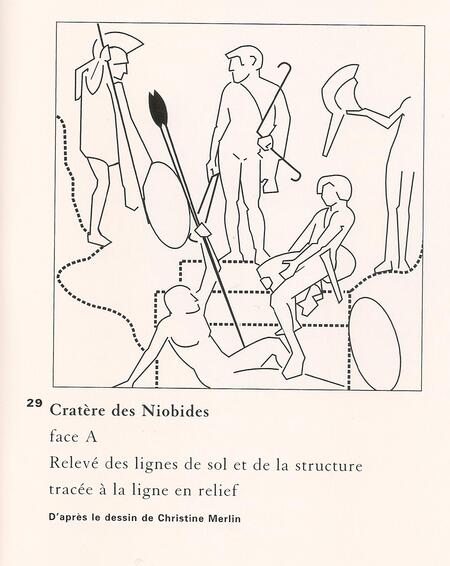
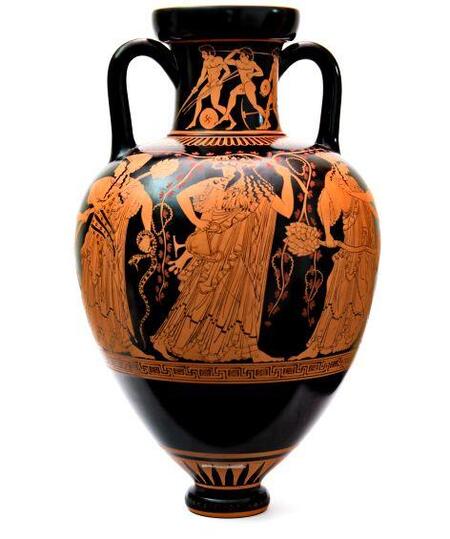
Cleofractian painter. Echiniform amphora, circa 500–490 BCE. On the left—a published graphic record of the preliminary drawing; on the right—a photograph of the completed painting.
Anatomy and Volume
Euphronios. Crater depicting the death of Sarpedon. Circa 515 BCE.
In Evfronia’s composition, Sarpedon’s body occupies the central position. Winged deities of Death and Sleep lift the fallen hero, exposing his torso to the viewer.
Particular attention is paid to the anatomy of the body: the ribcage, abdominal muscles, and limbs are clearly defined. Contours and internal lines delineate individual muscle groups, conveying their spatial relationship.
Meanwhile, Sarpedon’s face is rendered in a strict profile view, bearing a tranquil expression. The contrast between the dead body and the idealized appearance of the hero intensifies the tragic quality of the scene.
The polychrome technique allowed artists to more subtly delineate anatomical forms and convey their interconnectedness. The human body began to be perceived not only as a silhouette with defined details but also as a complex sculptural construct.
Movement and Composition
Euphemia. «Three Feasting Figures.» Circa 510 BCE. State Antik Collection, Munich.
In this composition, three symposium participants are depicted dancing in various poses. Their postures differ in torso direction, limb placement, and orientation relative to the viewer. The central figure is particularly interesting: her body is unfurled in a complex turn, with individual parts captured from different angles. The figures are not constrained by strict profile or full-frontal depictions—the artist employs three-quarter views and perspective foreshortening. Consequently, movement becomes the primary organizing principle of the composition. The figures are perceived as participants in a continuous action rather than as static silhouettes placed side by side.
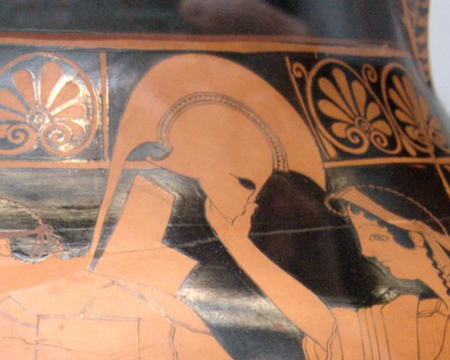
The interaction between the figures and the image boundaries also changes. On the amphora, the high crest of the helmet crosses the upper decorative band. The figure element seems to extend beyond its allotted space.These boundary transgressions intensify the feeling of movement and connect the image to the vessel’s ornamental design.
The masters' experiments with body rotations, perspectives, and angles made the compositions more dynamic. Space began to be perceived not only through the placement of characters but also through the direction of their movements and their interaction with the image borders.
Detailing and Ornamentation
In black-figure vase painting, clothing ornamentation could become an independent element of the narrative. On an amphora by Exekias, the cloaks of Achilles and Ajax are covered with stars, rosettes, swastika-like, and other geometric motifs.
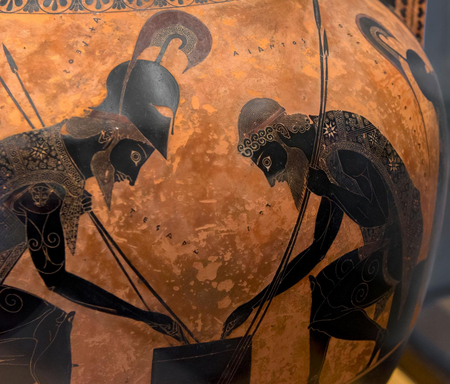
Decorative patterns do more than simply fill the surface of clothing; they construct a complex visual structure and accentuate the exceptional nature of the depicted figures. In Anthony Manzieri’s (2024) research, these ornaments are proposed to be viewed as significant iconographic elements connected to epic traditions, cosmological perceptions, and the symbolism of luxury goods.