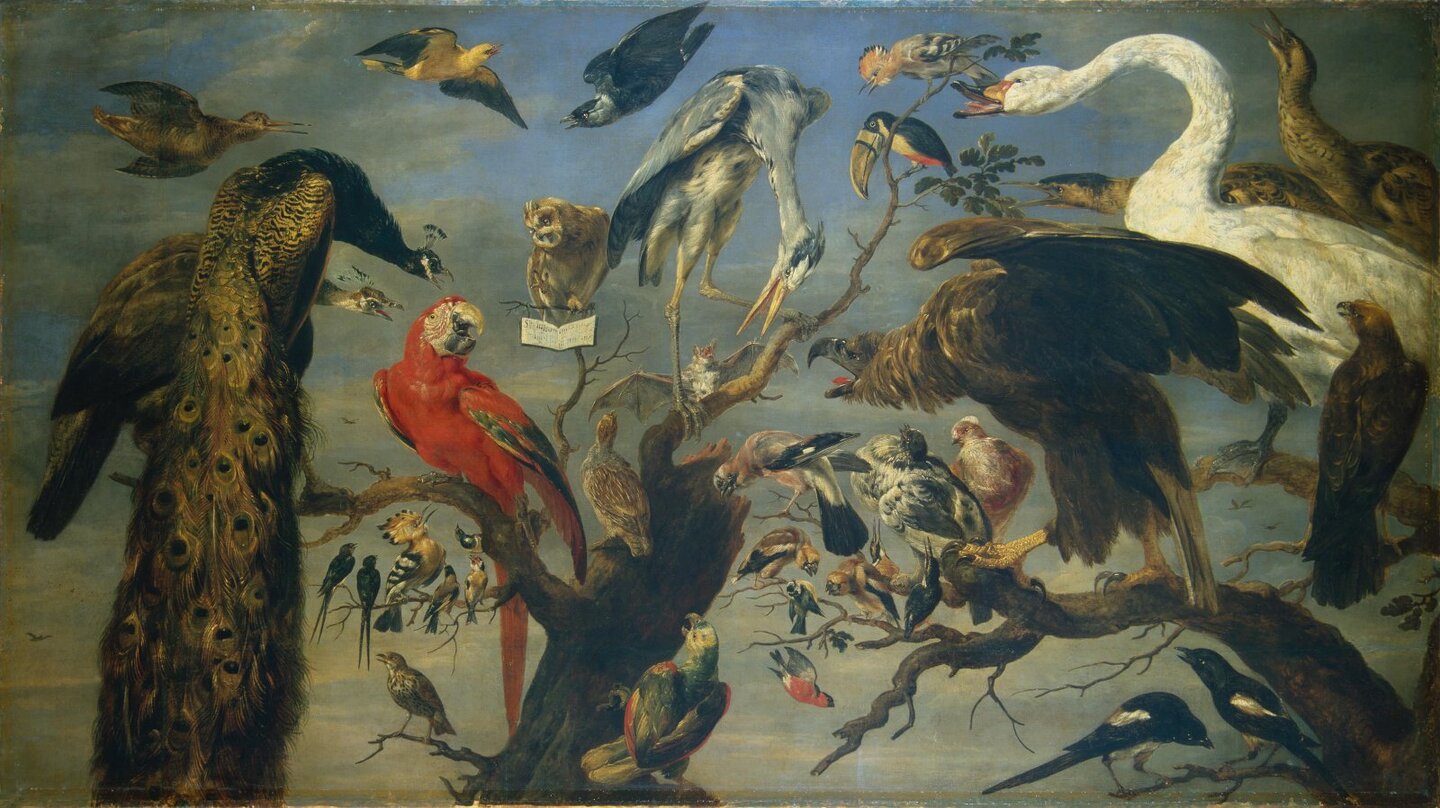
«Look at the birds of the air: they neither sow nor reap nor gather into barns; and your Heavenly Father feeds them.» [1]
Birds have always held a special place in the human imagination. During the Middle Ages, they were often perceived as a symbol of the connection between heaven and earth. Due to their ability to fly, birds were associated with freedom, spirituality, and the yearning for the Divine. In medieval Christian painting, the depiction of a bird was rarely limited to a simple reproduction of nature. Beneath its appearance could lie biblical narratives and a complex system of symbols.
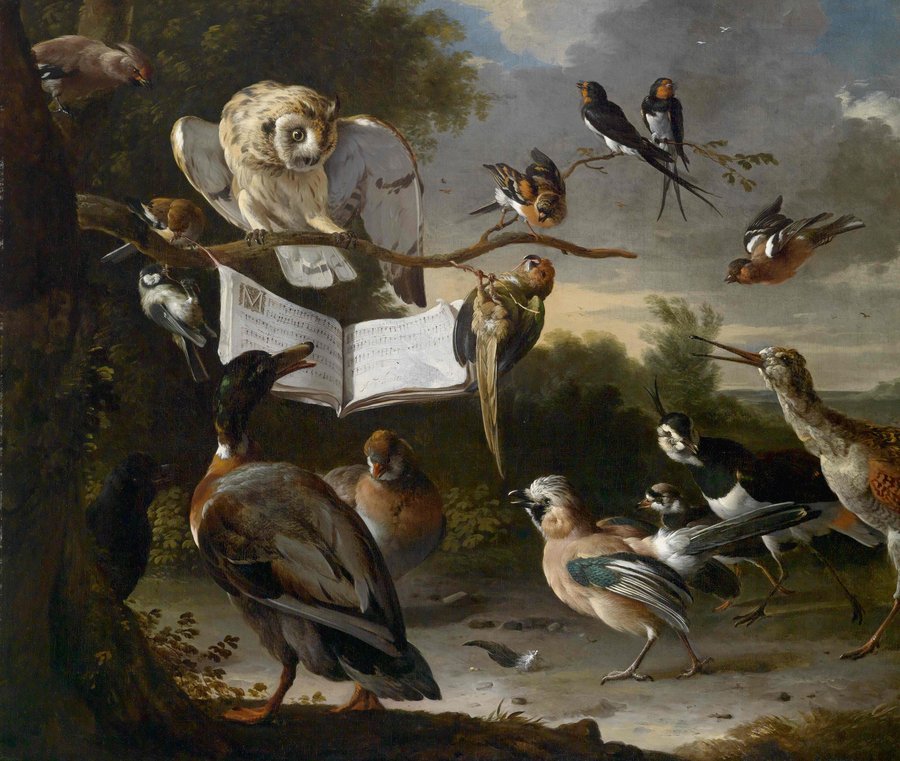
Bird Concert. Melchior de Hondecooter. 1670
Concept
The motivation for this study stemmed from my interest in the role of birds in medieval Christian painting—specifically, why the same species of birds might appear in different narratives and what symbolic meanings were embedded within them. For the research, I selected works of medieval Christian art that feature birds. Particular attention is given to pieces depicting doves, pelicans, roosters, finches, and peacocks. The study is divided into several thematic sections. In each section, specific birds and their associated symbolic meanings will be examined. The textual sources utilized include the Bible, scholarly research on the history of medieval Christian art, and materials on Christian symbolism regarding animals and birds. The central hypothesis of this research is that birds in medieval Christian painting were not merely decorative elements, but significant symbols used to convey religious ideas, perceptions of the spiritual world, and faith.
Dove
European culture was largely shaped by the influence of the Bible. The dove is one of the most frequently appearing birds in biblical narratives. The image of the dove in medieval Christian art is interpreted in various ways. Traditionally, the dove is perceived as a symbol of purity and innocence. We recall the words of Jesus Christ from the Gospel of Matthew: «Be wise as serpents and innocent as doves» [2]. This phrase emphasizes the dove’s connection to qualities such as meekness, purity, and sincerity. Most often, the dove symbolizes the Holy Spirit. As the evangelists recount, during Christ’s baptism, the Holy Spirit descended upon Him in the form of a dove [3]. From that moment on, the dove became one of the principal symbols of the Holy Spirit in Christian tradition.
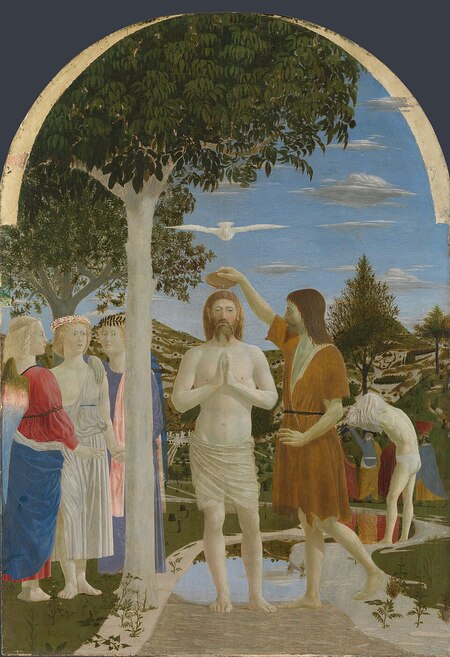
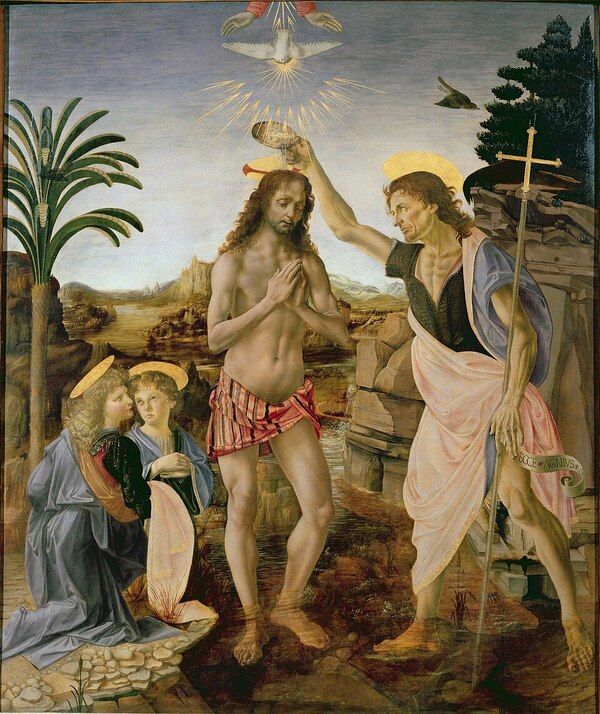
The Baptism of Christ. Piero della Francesca. 1448–1450 The Baptism of Christ. Andrea Verrocchio, Leonardo da Vinci. 1472–1475
The image of the dove has even more ancient roots. In the Old Testament, doves and turtledoves are mentioned as sacrificial birds. They could be offered by people who could not afford to sacrifice a larger animal. This tradition was preserved in the Gospel narratives. For example, in the scene of the Presentation of the Lord, Mary and Joseph bring two young doves or two turtledoves to the Jerusalem Temple as a sacrifice, following the decree of Mosaic Law [4].
Finding. Giotto di Bondone. 1304–1306
In the Bible, the dove also appears in the story of Noah’s Ark. After the Great Flood, Noah released a bird several times to check if the water had receded from the earth. At first, the dove returned without finding a place to rest. But after some time, it returned with an olive leaf in its beak. This signified that the water was beginning to pull back and life was returning to the earth [5]. Since then, the dove with the olive branch has become a symbol of peace, hope, and renewal.
Pelican
In Christian symbolism, the pelican embodies sacrifice, love, and self-sacrifice. Medieval tradition held a belief that the pelican fed its young with its own blood by piercing its chest. This image became a symbol of the sacrifice of Jesus Christ, who gave his life for the salvation of humanity. Therefore, the pelican was often perceived as a reminder of Christ’s love and his redemptive sacrifice.
The image of the pelican is also found in Medieval literature. Dante Alighieri, in The Divine Comedy [6], refers to Jesus Christ as «our Pelican.» This comparison demonstrates how firmly the image of the bird was established in Christian culture and how closely it was connected to the idea of sacrificial love.
Crucifixion (Fragment). Lorenzo and Jacopo Salimbeni. 1416
Rooster
The image of the rooster in Christian symbolism also carries several meanings. One of the main meanings of the rooster in Christian symbolism is connected to the story of Saint Peter’s denial. Upon hearing the cock crow, Peter remembered Christ’s prophecy and realized that he had denied him three times [7]. This moment became a symbol of repentance and the recognition of his own weakness. Therefore, in Christian painting, the rooster can serve as a reminder of human error, sincere regret, and the return to faith.
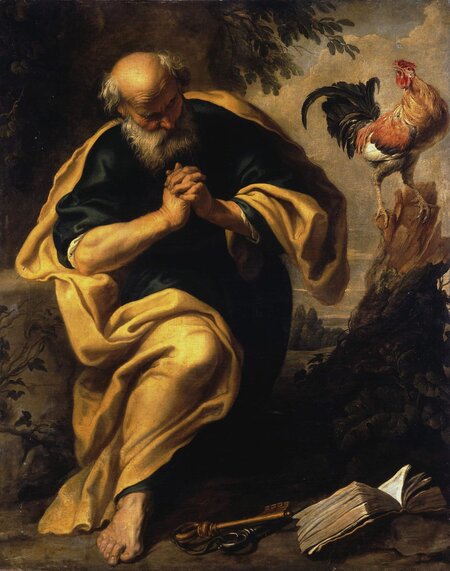
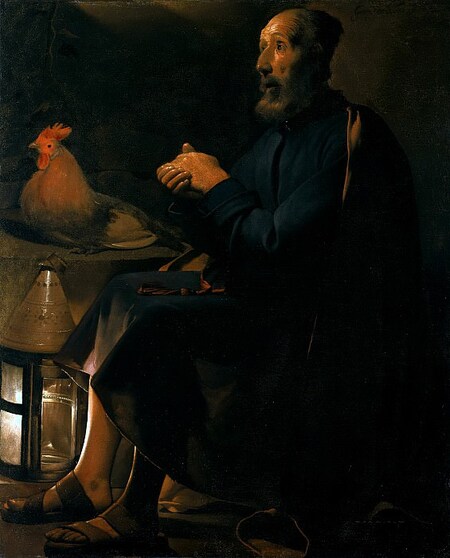
The Repentance of Saint Peter. Gerard Segers. 1625–1629 The Repentance of Saint Peter. Georges de Latour. 1645
Another association of the rooster is with the Resurrection of Christ. Because of its morning crow, the bird heralds the arrival of a new day. In Christian symbolism, dawn was associated with the triumph of light over darkness, as well as the triumph of life over death. Therefore, the rooster could be perceived as a symbol of spiritual awakening, hope, and Resurrection.
The Nightingale
In Christian symbolism, the goldfinch is connected to the Passion of Christ. According to medieval legend, the goldfinch tried to alleviate Jesus Christ’s suffering by pulling a thorn from his crown of thorns. During this act, a drop of Christ’s blood fell onto the bird’s head, leaving a characteristic red spot. Thus, the goldfinch became a symbol of compassion, mercy, and sacrificial love, as well as a reminder of the Passion of Christ. This is why medieval artists often depicted the infant Christ holding a goldfinch. This image carried a special meaning: the bird served as a reminder of Christ’s future suffering and sacrifice. In this way, even in scenes depicting Jesus’s childhood, artists could foreshadow his destiny—to come into the world to redeem the sins of humanity.
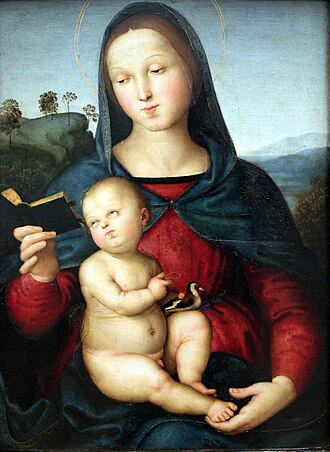
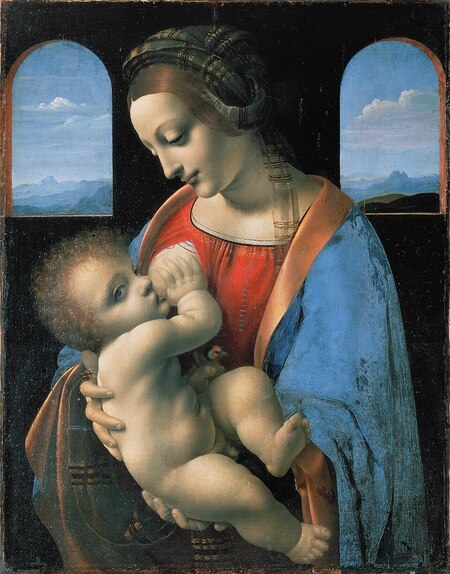
Madonna Solly. Raphael Santi. 1500–1504 Madonna Litta. Leonardo da Vinci. 1490–1491
The apocryphal «Gospel of the Childhood of Thomas» tells the story of how a young Jesus sculpted twelve sparrows from clay and brought them to life with his word. While this narrative is not included in the canonical Gospels, it gained traction in medieval culture and found expression in painting. In this story, the birds become a symbol of revival and new life. The miracle performed by the young Jesus can also be connected to the idea of the Resurrection—the triumph of life over death. Thus, the image of the birds underscores Christ’s divine power, capable of granting life.
Peacock
In Christian symbolism, the peacock was associated with Paradise and the beauty of the heavenly realm. Its vibrant plumage was perceived as a reflection of the perfection and splendor of God’s creation. In some Christian compositions, the peacock was depicted alongside a chalice or a vine. In such a setting, its image could acquire Eucharistic significance. The peacock symbolized immortality and eternal life, while the Eucharist reminded believers of Christ’s sacrifice and the promise of salvation. This is how the image of the peacock is revealed in Domenico Ghirlandaio’s fresco, «The Last Supper.» The bird is depicted near a window among other elements of the natural landscape. Within the context of the Last Supper—which is tied to the institution of the Eucharist—its image can also be viewed as a reminder of salvation and the hope of attaining eternal life in Paradise.
The Last Supper. Domenico Ghirlandaio. 1480
In European Christian painting, the peacock was also associated with wisdom and spiritual perfection. Specifically, in Antonello da Messina’s painting, «Saint Jerome in his Cell, ” this bird can be perceived not merely as an ornament, but as a symbol of scholarship. This interpretation is particularly interesting in the context of Jerome’s own persona—one of the greatest theologians and scholars of the early Christian Church who dedicated his life to studying and translating the Holy Scriptures.
2
4
3