Как средневековые художники изображали повадки животных в английских бестиариях XII–XIII веков
Section Headings
1. Concept 2. Animal and its offspring 3. Encounter between animal and human 4. Collision between two animals 5. Conclusion 6. Bibliography 7. Image sources
Concept
For this visual research, I selected 12th–13th century English bestiaries because their miniatures allow one to trace how the artist transforms the animal behavior described in the text into a brief narrative. On a single page, the artist must present the actors, connect them, and select a moment from which the viewer can reconstruct the entire episode. It is particularly interesting to compare illustrations of the same scene across different manuscripts. For instance, in a scene featuring a unicorn, the viewer’s attention might focus on the proximity of the beast and the maiden or shift to the hunters—whose gestures and weaponry alter the nature of the event. The core of this study will consist of miniatures from the Worcester Bestiary and the Ashmolean Bestiary. I am selecting images with established dating, known folio numbers, and clear enough reproductions to observe the poses, gestures, and relationships between the figures. For direct comparison, I am taking miniatures depicting the same episode, which can be identified through the manuscript text or catalogue description. The same animal might appear in several narratives, so character matches alone are insufficient for comparison. The research will be divided into three parts, categorized by the type of interaction between the characters. In the first part, I will examine scenes featuring an animal and its offspring, using lions and the pelican as examples; the second part will cover the encounter between an animal and a human, using the unicorn; and the third part will focus on the clash between two animals, exemplified by the crocodile and the hydrus.
Animal and its offspring
Уорксопский бестиарий
Бестиарий Эшмола
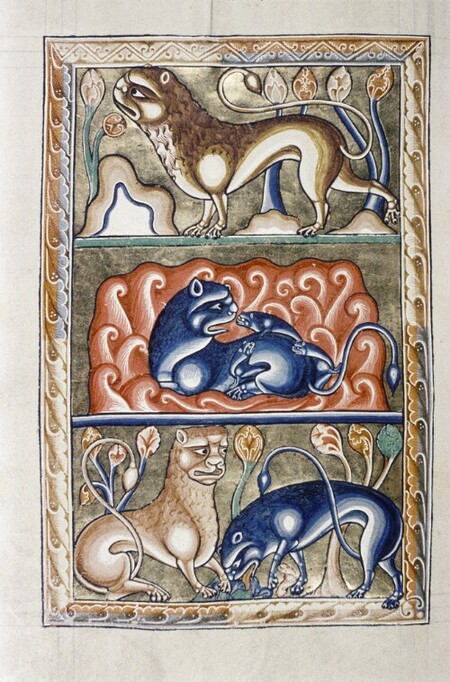
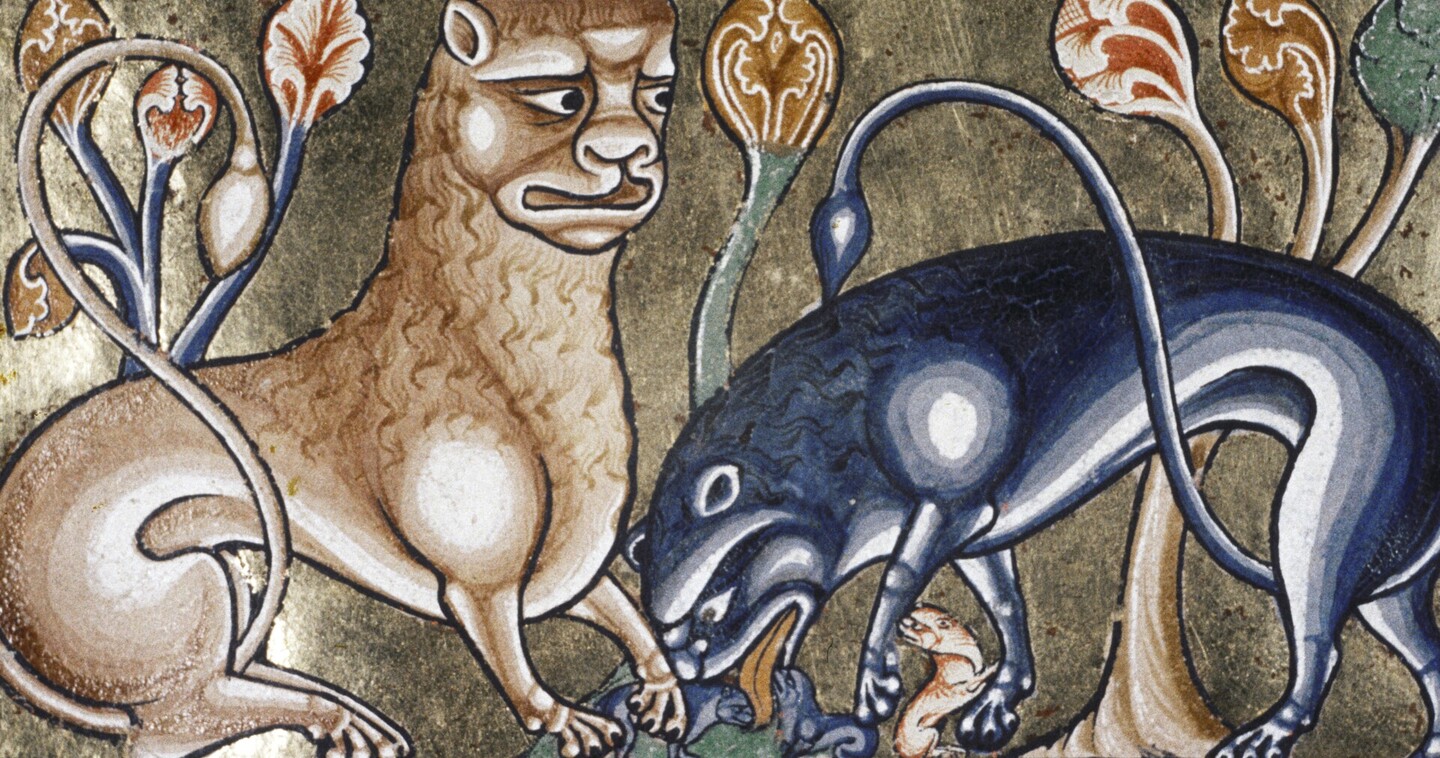
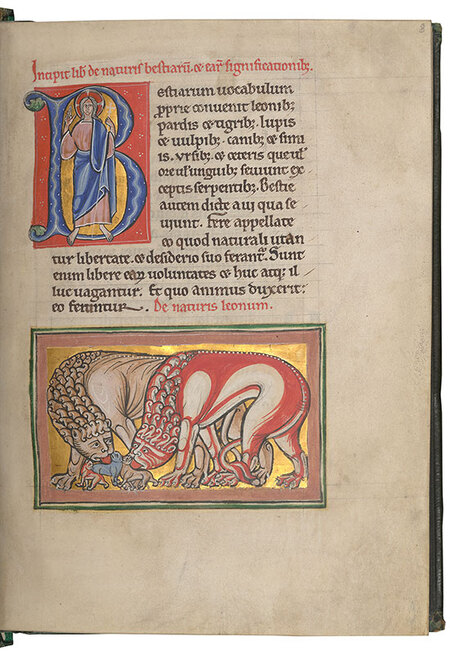
On the workshop sheet, two large figures form arcs over the lion cubs. The mouths of each adult lion are directed toward the cubs, and red tongues emphasize the contact. In the lower band of Ashmole’s Bestiary, a blue lion is leaning, while a light-colored one sits upright. In both versions, the gaze reaches the lion cubs through the posture of the adult animal, although the number of leaning figures differs. The workshop sheet places the scene beneath the initial featuring Christ. This proximity helps link the legend of the lion cubs’ resurrection with Christ’s resurrection.
Уорксопский бестиарий
Абердинский бестиарий
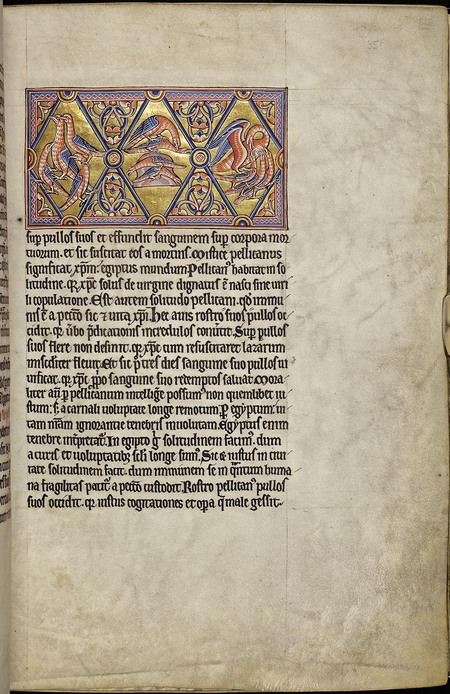
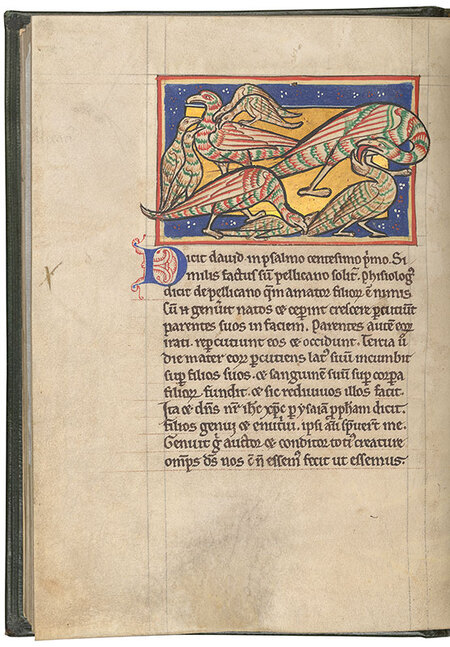
The workshop artist repeats the adult bird three times within a single frame. Chicks attack it, then one lies at the bird’s feet, and the last group depicts its revival. The wings of adjacent birds almost touch, so the sequence must be inferred from their postures. On the Aberdeen sheet, the ornament spreads these same events across three sections. In that piece, the viewer’s gaze can move from left to right. Both miniatures employ figural repetition, but the Aberdeen one also uses the frame itself to indicate where one episode ends and the next begins.
Абердинский бестиарий
Уорксопский бестиарий
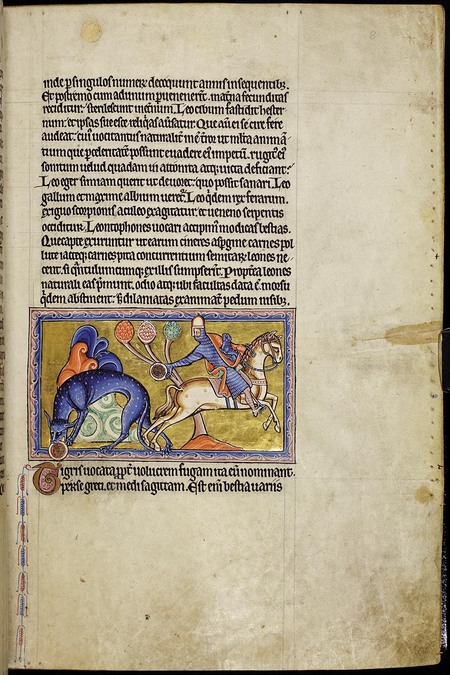
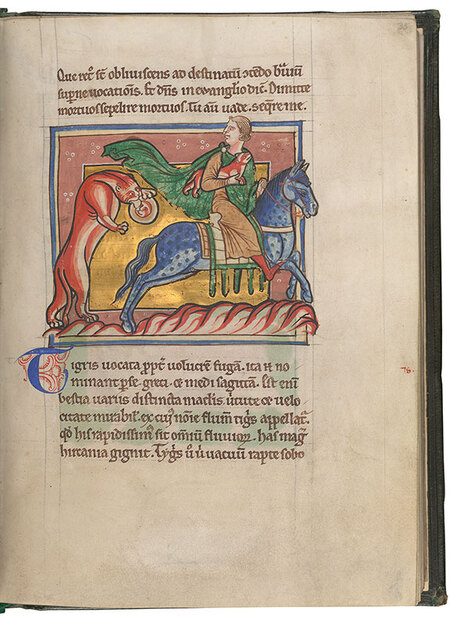
In the Workshop Bestiary, a rider carries a tiger cub while looking back, and a tigress presses against a round mirror. In the Aberdeen Bestiary, the animal also pauses by a round object as the rider departs. In both versions, the miniature simultaneously depicts a real cub with the captor and a false cub to the tigress. The round object changes the animal’s direction of gaze and explains the halt in the chase. According to the text, the tigress mistakes her own reflection for the cub. This detail transforms the scene of the chase into a narrative about deception.
Уорксопский бестиарий
Абердинский бестиарий
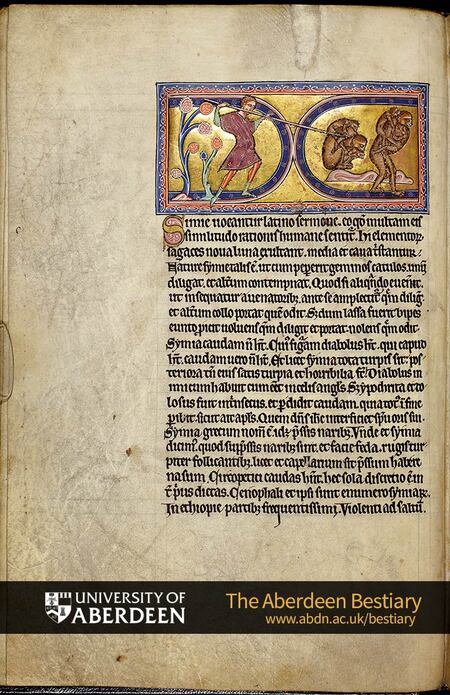
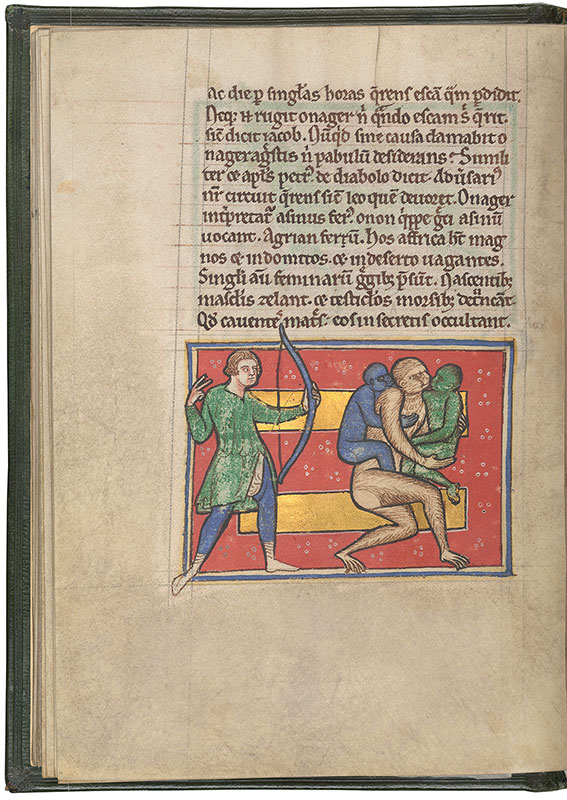
On the workshop sheet, the archer on the left aims the bow toward the fleeing monkey. One infant is pressed to her chest, and another clings to her back. On the Aberdeen sheet, the composition is divided into sections, but the different positions of the infants are still discernible. For the narrative, it is crucial who is holding whom. In the legend, the mother releases the one she was carrying in her arms at the end of the chase, while the second remains on her back. The arrangement of the figures helps the viewer perceive the difference between the infants even before the text explains its consequences.
Абердинский бестиарий
Абердинский бестиарий
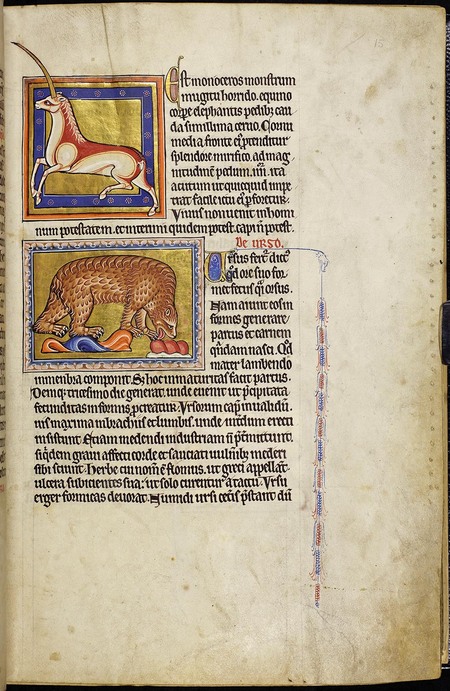
In the bottom miniature, a large bear mother bows her head over a small figure. The distance between her muzzle and the cub almost vanishes, and the curve of her back unites both figures within a single plane. Medieval texts attribute the ability to give newborns shape with its tongue to the bear mother. The image depicts close contact, but the tongue movement itself could easily be interpreted as washing or nurturing. On this page, text is needed to distinguish a specific action from other similarly outward gestures.
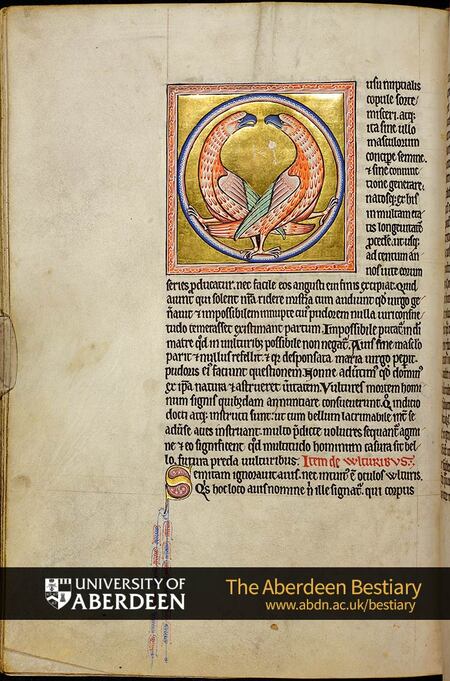
Two griffs face each other within a circular frame. Their necks and beaks form opposing lines, and the outlines of their bodies converge at the bottom of the circle. Meanwhile, the text on the leaf discusses the legend of offspring birth without the involvement of a male and compares it to the birth of Christ. The image contains neither a nest nor chicks. This instance demonstrates that the miniature can represent the animals while leaving the actual narrative of procreation to the text. The symmetry helps identify that a pair of birds is depicted on the leaf, but it does not indicate the described method of reproduction.
Aberdeen Bestiary
One ostrich lifts its head toward a star positioned outside the frame, while the other bends down to its eggs. These two contrasting gestures reveal different aspects of a single narrative. According to the text, the appearance of the Pleiades signals to the bird when to lay its eggs, after which it covers them with sand. The miniature places both actions side-by-side. The viewer sees where one bird is looking and what the other is doing, and the sequence and connection between these gestures are revealed by reading the story.
The Encounter Between Animal and Human
Уорксопский бестиарий
Бестиарий Эшмола
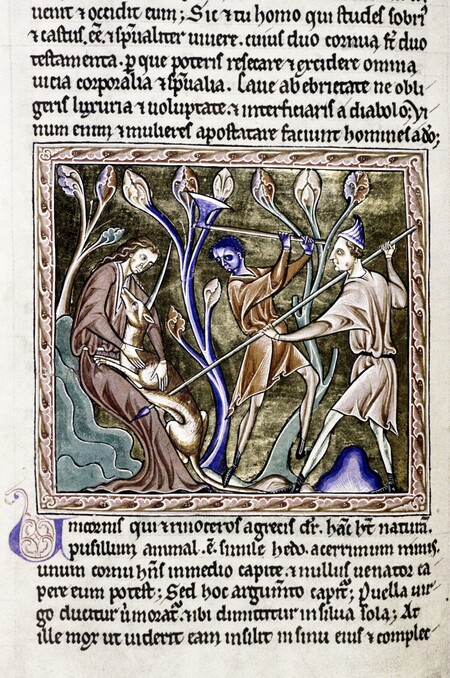
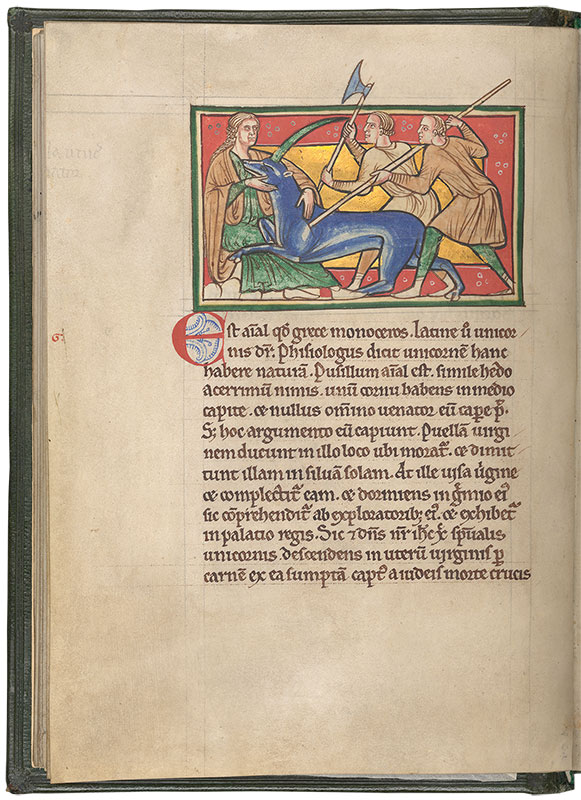
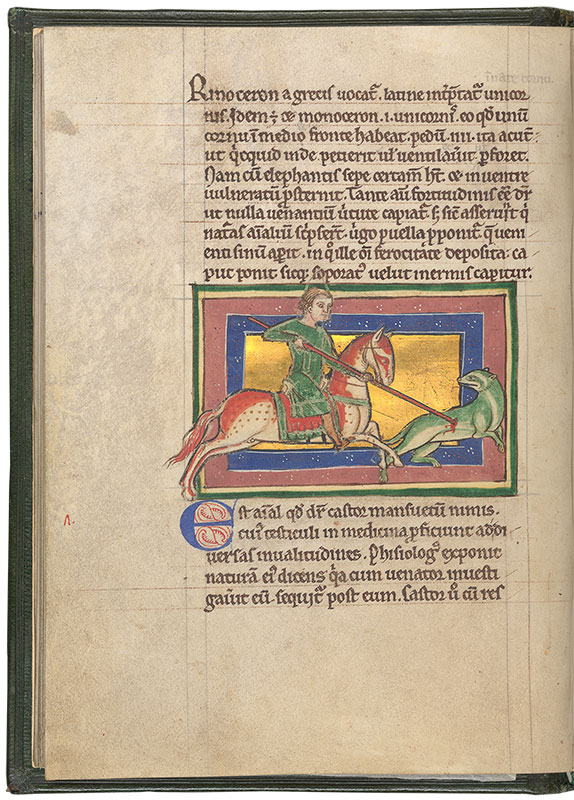
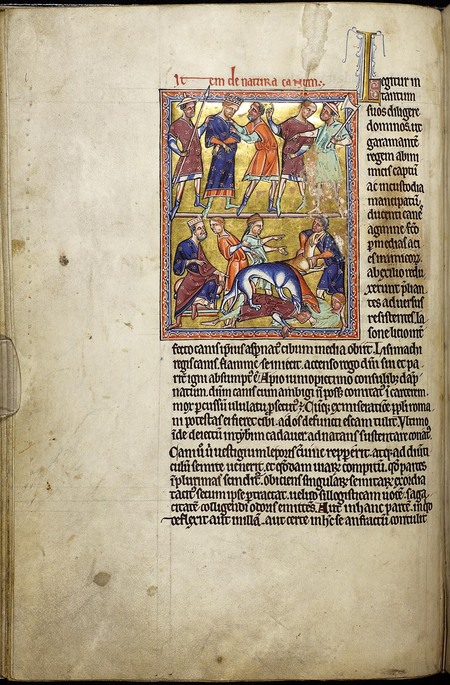
In the Workshop Bestiary, a long, blue silhouette of a unicorn connects the girl on the left with the hunters on the right. The beast presses against the girl, and a spear enters the space of this tight group. In Ashmole’s Bestiary, a tree with blue branches more noticeably divides the participants. The spear crosses this boundary, connecting the hunter’s arm to the beast’s body. In both manuscripts, the unicorn’s closeness to the girl suggests why the hunters might approach. The compositional difference determines whether the viewer first notices the general silhouette of the beast or the distance between the two groups.
Уорксопский бестиарий
Абердинский бестиарий
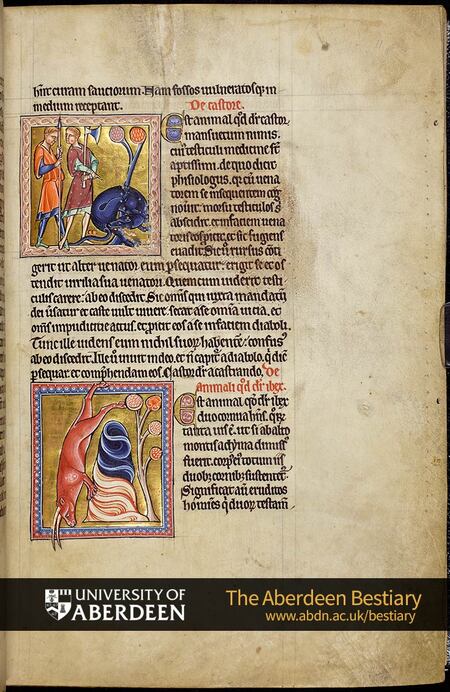
In the workshop miniature, the spear of the rider dictates the pursuit, while the beaver turns its head backward. In the Aberdin upper miniature, the actions of the beast and the hunter are also confined to a tight scene, but it must be distinguished from the depiction of the ibex below. The text states that the hunters are pursuing the beaver for a body part attributed with medicinal properties. When the animal sheds it, the pursuit loses its meaning. While the direction of the figures shows a chase, the reason for the hunt and the animal’s strategy only become clear after reading the text.
The Eschmol Bestiary
Aberdeen Bestiaries
In the Bestiary of Ashmole, the bonnacone is turned to the right, with the hunter standing behind it on the left. A tree rises between them, and the hunter holds his shield toward himself. On the Aberdeen leaf, the beast is also turned away from the human, and the direction of the action is particularly clear from the position of the raised shield. According to the bestiary, the bonnacone defends itself from the pursuer by throwing scalding dung. In these scenes, the direction of the beast’s head does not indicate who its action threatens. The hunter’s defensive gesture allows the relationship between the figures to be reconstructed.
Абердинский бестиарий
Абердинский бестиарий
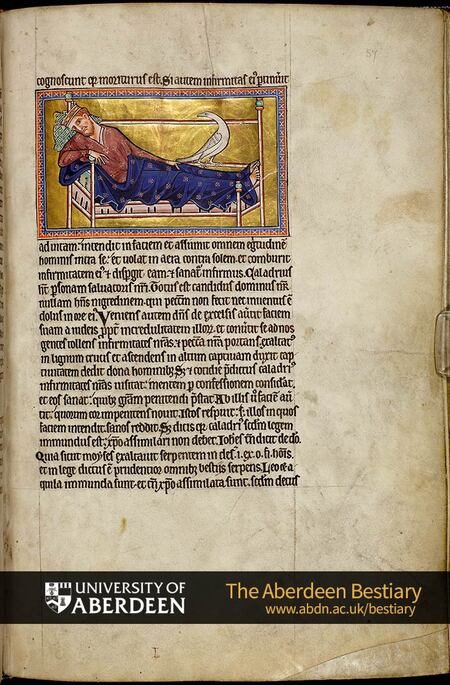
On a golden background, a bird is positioned by the sick person’s bedside. Its head is turned toward the human, and the small distance between them becomes the focal point of the scene. In bestiaries, the direction of the bird’s gaze carries significance: if the caladrius looks at the sick person, they will recover. This image depicts exactly that scenario. In the scene with the unicorn, the connection between the human and the animal is conveyed through an embrace and a spear. Here, it is established by a mere turn of the head, and the text explains why this gesture equates to a prophecy.