The Visual System of Monsters in Romanesque Art of Burgundy and Central France (1100–1150)
Concept
Romanesque churches from the 11th–12th centuries feature numerous depictions of various fantastical monsters. My research focuses specifically on the visual construction of the monster: how it is assembled from its parts, how it is organized within the composition, and how it relates to the architecture. The relevance of this work stems from the need to examine, in greater detail, the visual methods used to depict monsters in Romanesque monumental sculpture. While these figures are often studied within the context of religious symbolism, it is equally important to explore them directly as artistic images. The material is limited by chronological and geographical parameters. The chronological scope covers 1100–1150, a period of active development for Romanesque monumental sculpture and the proliferation of complex compositions featuring fantastic creatures. The geographical scope encompasses Burgundy and Central France, as these regions were vital centers of Romanesque architecture and sculpture, boasting a significant number of surviving monuments.
The primary principle of categorization in this study is typological. Images are distributed according to types of subjects, which allows the research to focus directly on the methods of their embodiment. This approach enables the classification of images and the tracing of visual characteristics specific to each type. The main material analyzed in my research consists of images of Romanesque monumental sculpture. Comparative analysis holds particular significance, where images of the same type are juxtaposed across different monuments, and different types are analyzed within a single monument. This reveals the modes of depiction and sculptural solutions. Textual sources are utilized as supplementary material to establish the medieval context and to correlate verbal descriptions with their visual realization.
Key Research Question
What visual elements were used to create the imagery of monsters in Romanesque monumental sculpture of Burgundy and Central France during the 1100–1150s, and what are the distinctive features of the depiction characteristic of various types of fantastic creatures?
Hypothesis
Creatures are formed through established visual conventions: the combination of various anatomical elements, alterations in proportions, and the organization of figures within architectural space. Different creature types are characterized by specific approaches to plastic and compositional construction, and comparing these artifacts reveals both general principles and individual peculiarities.
The structure of the work follows a typological categorization: the first chapter is dedicated to hybrid creatures, the second chapter to sirens, and the third chapter to anthropomorphic and demonic beings.
structure of the paper
1. Introduction
2. Hybrid Beings
3. Sirens: A Stable and Iconographic Type of Fantastic Being
4. Anthropomorphic and Demonic Creatures
5. Conclusion
6. Bibliography
Allegory of Luxuria. Saint-Madeleine Basilica, Vezelay. 12th century. Unknown artist.
Chapter 1. Hybrid Beings
1.1. The Hybrid as a Specific Image Type
One of the characteristic features of Romanesque sculpture from the first half of the 12th century is the diversity of fantastic creatures whose bodies do not correspond to the natural anatomy of animals or humans. These depictions can combine traits from several species: the wings of a bird, the torso of a quadruped mammal, the tail of a lion, or the claws of a bird of prey. Such beings are typically referred to as hybrid figures.Researcher Kirk Ambrose views the monsters in Romanesque sculpture as a complex category of imagery that cannot be reduced solely to negative symbolism or a representation of evil [1]. It is critically important that such figures be examined within the context of a specific monument, rather than being interpreted according to a predetermined schema.
1.2. Integration of Human and Animal Elements
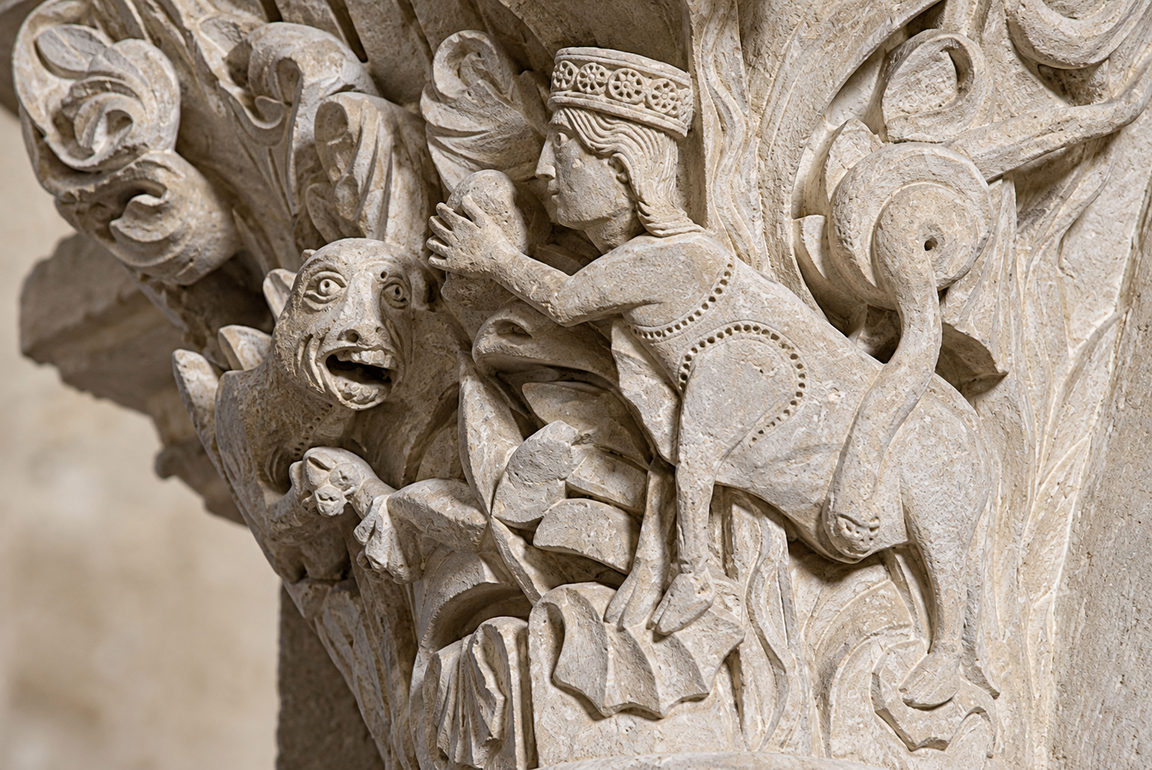
Ephop, riding a hybrid creature. Capital of Saint-Lazare’s Cathedral, Oton, Burgundy. First half of the 12th century. Unknown artist.
One of the most striking examples of hybrid imagery is the capital of St. Lazare’s Cathedral in Autun, which depicts a rider mounted on a fantastic beast. Its anatomical composition combines the torso, covered in fur, with the wings and claws of a bird. While individual features allow one to recognize various animal forms within the creature, they are all unified within a single body. This very combination makes the image an example of a hybrid construction. Furthermore, the creature’s fantastic nature is not achieved by completely abandoning recognizable anatomy. On the contrary, the sculptor utilizes clearly discernible elements from familiar animals but combines them into a configuration impossible by the laws of nature. As a result, the viewer can recognize individual body parts but cannot attribute the entire creature to one real species. Particular attention should be paid to the placement of the capital within the architectural space. It was located in the portal zone, and its depiction was designed to be perceived in relation to the architectural surface. The sculptural figure is not a standalone statue because its form is subordinate to the boundaries of the stone block. This influences the body’s posture, the direction of movement, and the overall silhouette.
1.3. Anatomical Assembly: How Fantastic Bodies Are Created
The principle of anatomical assemblage involves joining elements from different animals within a single form. In Odone’s image, «Hybrid Animal with Rider, ” several visual components can be identified: the animal’s torso—the primary mass of the figure; the wings—an element that alters the familiar silhouette of a quadruped; the lion’s tail—an additional trait connecting the figure to the image of a large predator; the hooves and bird talons—details that unify features from different species; and the human rider—a separate figure interacting with the hybrid animal. These elements are not merely added to the body as decorative details. They fundamentally alter the perception of the animal, rendering its species affiliation ambiguous, and imbue the body with a fantastic quality. The description of the monument allows for the possibility that what we are viewing could be a hippogriff [2]. Two levels of form combination can be distinguished here. The first is internal, where different anatomical traits are unified within a single creature. The second is compositional, where the human figure connects with the animal through interaction. The result is a complex image in which the boundary between human, animal, and fantastic creature becomes visually ambiguous. This example demonstrates that hybridity can be created not only by merging individual body parts but also by combining multiple figures to form a unified compositional structure. This approach aligns with Kirk Ambrose’s observations that Romanesque masters may not only have reproduced existing types of monsters but also created new fantastic forms by combining familiar elements [1].
1.4 Various Ways to Construct a Fictional Creature
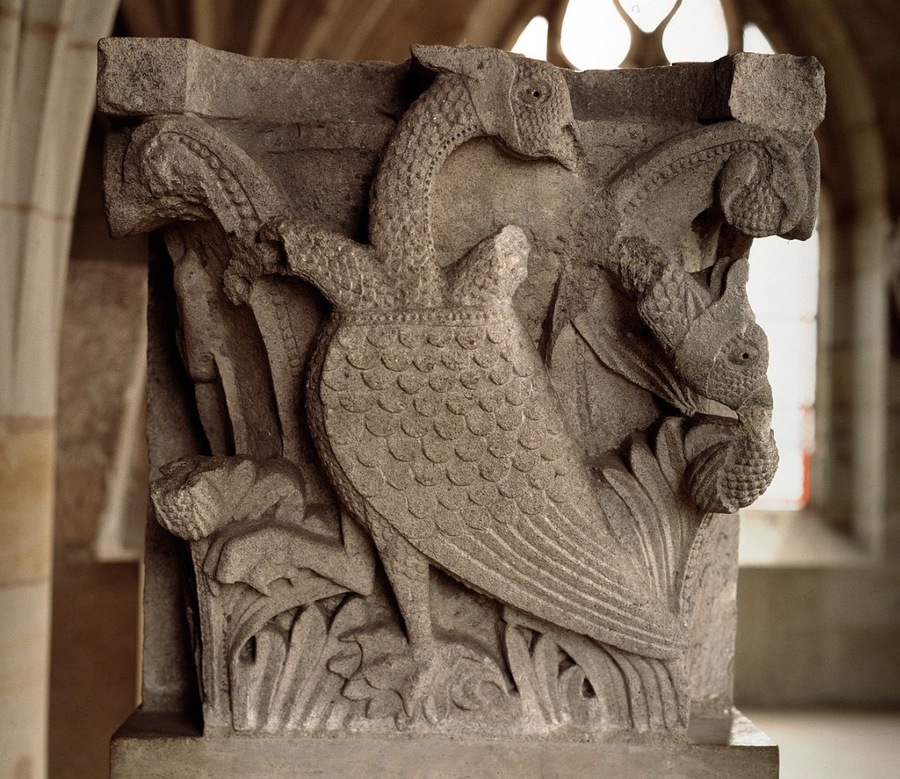
Unknown Master. Capital with a three-headed bird. 1130–1135. St. Lazarus Cathedral, Autun, Burgundy. Unknown Master. Capital «Fantastic Struggle.» First half of the 12th century. Saint-Madeleine Basilica, Vézelay, Burgundy.