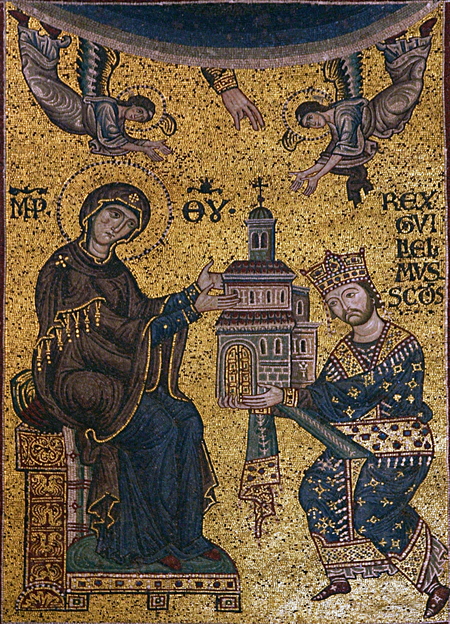
The Monreale Cathedral is located on Sicily, near Palermo. It was built by order of King William II, and its mosaic decoration was primarily created in the 1180s.
The mosaics of this cathedral form an expansive cycle of images depicting Biblical narratives. Among them, scenes from the life of Christ—which illustrate miracles and healings—hold a special place. These compositions are interesting not only for their religious content but also for the manner in which the artists conveyed actions and relationships between the figures portrayed.
In medieval mosaics, a gesture often substitutes for a detailed depiction of an action. By observing the position of the hands, one can understand that a character is addressing another person, asking for help, or responding to a request. The lean of the torso, the turn of the head, and the direction of movement help determine who is in the active position and who is receiving the address. Even slight variations in the figures' postures can alter the nature of the interaction within the scene.
This study examines the mosaics of the Montreal Cathedral depicting the miracles and healings of Christ. The main interest lies not in the history of each event in isolation, but in the plastic resolution of the compositions: how the figures are arranged, what gestures they employ, and how these elements relate to one another.
Research Question
How do the gestures and poses of the characters in the Montreal mosaics depict humanity’s approach to Christ? Why is a mere hand movement sufficient in some scenes, while the inclination of the entire body or a touch is important in others?
Research Objective
To determine the role that hand positions, body inclines and turns, gazes, and character movement play in conveying their relationships and the sequence of depicted events.
Principles of Rubrication
The material is divided thematically and comparatively. Initially, the general context of the mosaic cycle is examined. Then, each of the five mosaics is analyzed separately—from the overall composition to the gestures, poses, and gazes of the characters. Following this, the scenes are compared based on common features: Christ’s gestures, the postures of the healed individuals, the direction of gazes, and the interaction between figures. The concluding section synthesizes the research findings and formulates conclusions about the role of gestures in narrative conveyance.
Healing a person with a desiccated hand
Healing of a Person with a Withered Hand. Mosaic of the Montreal Cathedral, late 12th century.
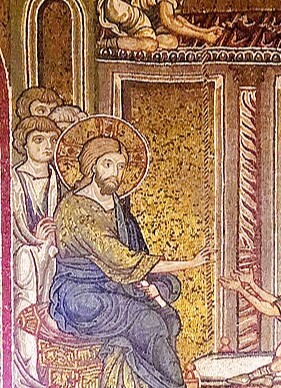
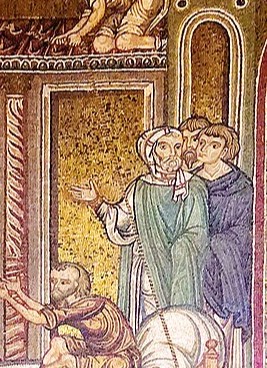
The scene is divided into two parts. A sick person stands on the left, and Christ sits on the right. A golden strip remains between them, and the appeal passes through it. The apostles crowd behind Christ, and on the left edge, another bearded man in a white headdress is visible. This is likely the scene’s witness. The entire action unfolds against a backdrop of buildings with arches.
Healing a person with a withered hand. Montreal Cathedral, late 12th century.
The patient leans slightly forward. With his healthy hand, he supports his injured wrist. The damaged arm hangs freely downward, its fingers bent. This posture suggests that the person cannot move it normally. He seems to be showing Christ what has happened to him. At the same time, the patient’s head is turned toward him.
Healing of a Man with a Withered Hand. Montreal Cathedral, late 12th century.
Christ sits on a throne; his posture is steady, and his head is turned toward the ailing figure. His right arm is extended forward, fingers open. In his left, he holds a scroll. The gesture is aimed directly at the afflicted hand, seemingly responding to what the person is indicating. This creates a straight line between the two figures, even though they do not touch.
Healing of a Man with a Withered Hand. Montreal Cathedral, late 12th century.
In the center of the mosaic, there is almost nothing—just a golden background between the columns. But this emptiness is not superfluous. It separates the two figures while simultaneously connecting them: Christ’s gesture and the sick man’s gaze cross it. If the figures stood close together, the interaction would be read differently. The distance makes it more noticeable.
In the book «Art and Eloquence in Byzantium,» Henry Maguire examines this posture of the hand as a sign of granting healing. He also notes that this gesture is repeated in other miracle scenes in Montreal. Therefore, this is not a random movement but a consistent visual motif that links the individual episodes of the cycle.
Healing a relaxed state
Healing the Relaxed. Mosaic of the Cathedral of Monreale, late 12th century.
The composition features three groups: Christ on the left, a sick person in bed at the center, and scribes with Pharisees on the right. Above them, people are lowering the bed through an opening in the roof. The mosaic encapsulates several moments of a single story.
Healing the Relaxed. Montreal Cathedral, late 12th century.
Two men lean over an opening and lower the bier. Their hands are occupied holding the sick person, and their torsos are directed downward. The posture of the figures indicates that they are in motion and performing a specific action. The upper section of the mosaic explains how the sick person came before Christ.
Healing the Relaxed. Montreal Cathedral, late 12th century.
He sits on the bed, leaning forward, reaching both arms toward Christ. It looks like a movement toward him. But the lower body remains on the mattress, and in one figure, the desire to reach meets the inability to stand.
Healing the Relaxed. Montreal Cathedral, late 12th century.
Christ sits upright, calmly, his right hand directed toward the sick person. The straight figure and the inclined body create a contrast, and the axis of the entire scene runs between them: the sick person reaches out to Christ, and Christ responds with a hand.
Healing the Relaxed. Mosaic of the Cathedral of Monreale, late 12th century.