Navigation:
1. Concept
2. Armor
3. Exoskeleton
4. Augmentics
5. Combat Vehicle
6. Conclusion
Concept
Science fiction constantly attempts to imagine what humanity will become under the influence of technological progress. One of the most illustrative examples is the image of the soldier of the future—a fighter whose physical capabilities, perception, and effectiveness are expanded through science and engineering. The concept of the enhanced warrior originated in literature: in Robert Heinlein’s Starship Troopers (1959), the combat spacesuit becomes a key element of service, and Joe Haldeman’s The Forever War (1974) reveals the cost of such augmentation. These texts establish the ideological context, but the material for analysis comes from the visual imagery of film and video games.
Fiction offers not one, but several fundamentally different answers to the question of how to transform a human into a perfect weapon. Therefore, in this work, the image of the future soldier is examined through a typology: fighter classes are distinguished based on the degree of technological intervention in the human body. These include the armored fighter, the exoskeleton fighter, the augmented fighter, and the fighter fully transformed into a combat machine. The classes are arranged from least to most intervention, allowing us to see how the boundary between human and weapon gradually dissolves.
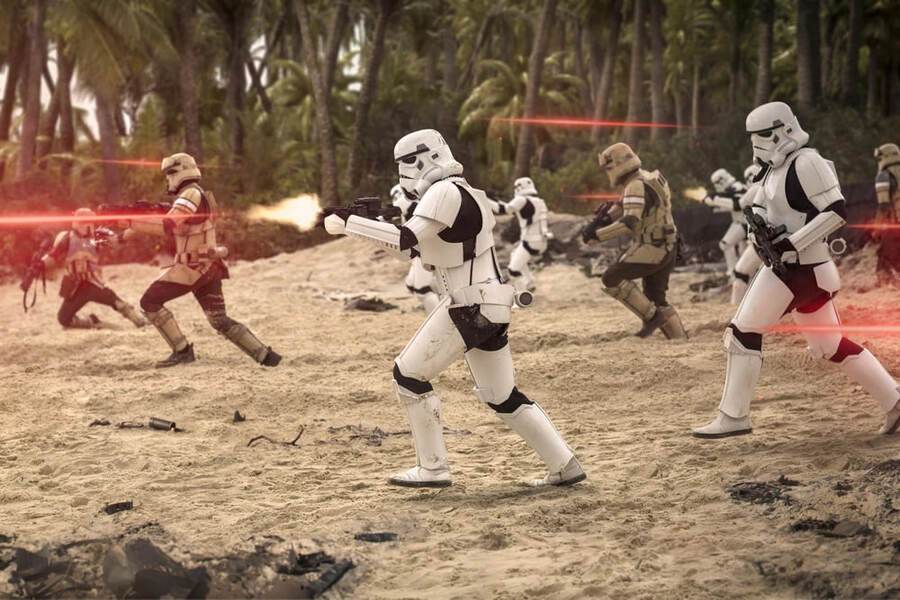
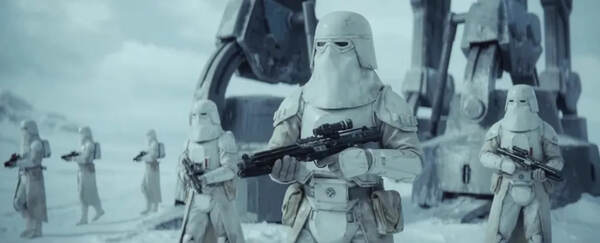
Imperial Stormtroopers. Star Wars: Rogue One (2016)
The object of this study is the image of the soldier of the future in science fiction. The subject encompasses the visual and structural characteristics of each class—silhouettes, materials, proportions, armor design, helmet and weapon configuration, as well as conceptions regarding the boundary between human and machine. The goal is to identify the primary classes of future soldiers and illustrate how their visual language reflects notions of technological perfection. The source material includes Star Wars, Robocop, Warhammer 40,000, Fallout, Halo, Crysis, Edge of Tomorrow, Doom (including Doom Eternal), and Cyberpunk 2077.
Particular attention is given to the engineering logic of these fantastic constructs. Armor, helmets, exoskeletons, and weaponry are examined as components of a unified system designed to solve specific problems; their form reveals the biological limitations the creators seek to overcome. As technological intervention increases, the question of the boundary between human and machine arises: advancement implies not only new capabilities but also the potential loss of autonomy, individuality, and control over one’s own body. Therefore, each class expresses both the aspiration toward technological perfection and the anxiety surrounding its consequences.
The methodological foundation is typological analysis, supplemented by comparative visual and iconographic approaches: images are matched based on silhouette, level of bodily and facial coverage, and the balance between the organic and the technological. This research poses the question of the cost of perfection: will humanity retain its essence in the pursuit of efficiency?
Armor
The first class of future soldiers is characterized by the least degree of technological integration into the body. Here, technology remains an external layer: the person dons armor rather than becoming part of it. The armor can be removed, revealing a normal human body underneath, which is why this class is most often perceived as a logical extension of real military gear. However, even with such a «minimal» transformation, science fiction endows the armor with its own visual language, within which concepts of the soldier’s role, individuality, and relationship to war are established.
Assault Squad aboard the Death Star
Stormtroopers from Star Wars (since 1977) are built upon the idea of anonymity. The white armor, closed helmet with narrow black lenses, and uniform silhouette transform an individual fighter into an element of the army. The face is completely concealed, and distinctions between the soldiers are minimized—the viewer perceives not a person, but a function. The name itself traces back to German assault units of World War I, and the strict symmetry and uniformity are often associated with the aesthetic of totalitarian armies. The white color enhances the contrast with the surroundings and the heroes, making the stormtrooper a visual adversary.
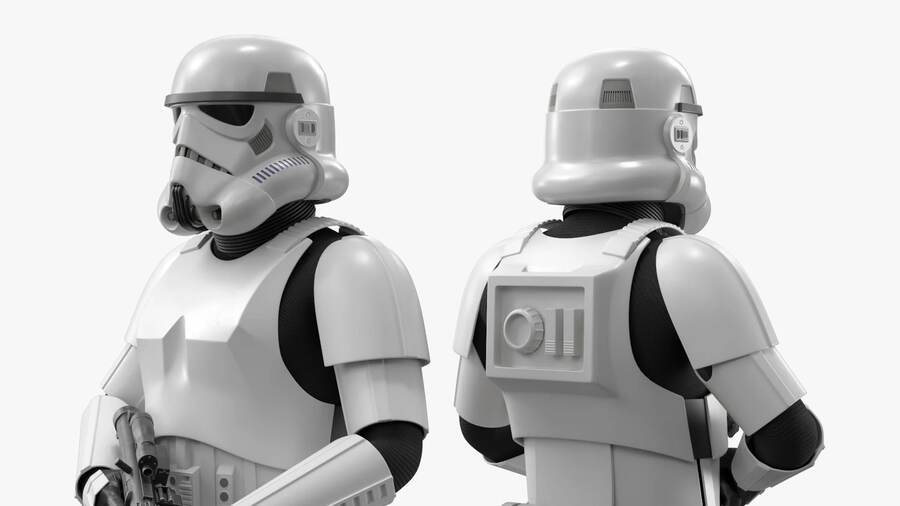
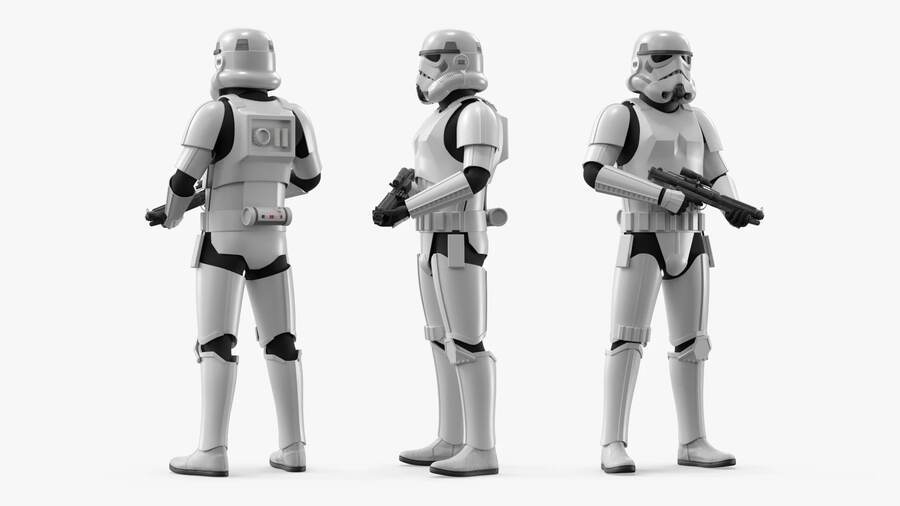
Imperial Stormtrooper Armor. It protects the wearer from environmental exposure, as well as thrown and contact weapons, but it remains vulnerable to blaster fire.

Among the variations of trooper armor, one should highlight the modification for extremely low temperatures (on the left) and the equipment of a scout trooper (on the right).
The armor of the predecessors to imperial stormtroopers is noteworthy. Clone soldiers wear armor with a similar logic, but individualization is allowed—coloring and markings enable differentiation between units and individual fighters. Thus, within one class, the science fiction genre demonstrates two approaches: armor that erases the human, and armor that preserves its traces.
In Doom, the armor is tied not to an army, but to a single hero. The Praetor Suit in Doom (2016) and Doom Eternal (2020) is built upon an aggressive and instantly recognizable form: a heavy helmet with a visor, sharp angles, and a decidedly massive torso. In contrast to the troopers of Star Wars, there is no concept of faceless masses here—the armor functions as an extension of the hero’s personality, expressing his physical power and unwavering resolve.
It is notable that the engineering logic of the costume is barely revealed visually: the design is calibrated for an immediate emotional impact rather than structural plausibility. The differences between the 2016 and 2020 versions—noticeable in the increasing complexity of the silhouette and details—demonstrate how the look becomes more technologically advanced over time while retaining its symbolic role as a symbol of power.
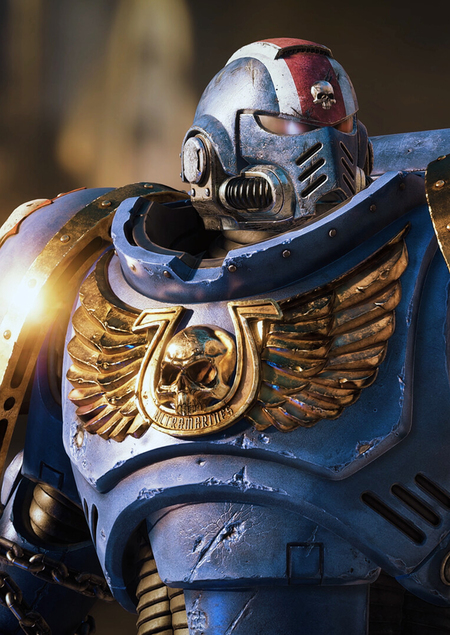
In Warhammer 40,000 (since 1987), the power armor of a Space Marine is constructed on different principles. Its massive silhouette, exaggerated shoulder pauldrons, Gothic details, heraldic insignia, and ornamentation transform it into something between armor, temple architecture, and a war machine. Here, the armor is not merely protection; it is a vessel of the order’s identity—its color and symbolism communicate the unit’s affiliation and history. The blend of medieval and technological motifs expresses a view of warfare as a sacred, almost religious activity where technology is subservient to ritual.
This archetype sits on the boundary of classification. Power armor not only protects but also augments the wearer’s capabilities, and the Space Marine itself is a genetically modified warrior featuring various augmentations, so the bodily modification is already evident. Visually, the identity remains centered on the armor, but functionally, it borders on an exoskeleton—that is, the next classification level.
Exoskeleton
Technology ceases to be merely a protective layer and begins to amplify the body’s own movement: the soldier’s strength, speed, payload capacity, and endurance are determined by the suit’s mechanics. The human transforms into an operator inside a machine, and the armor becomes a working tool. The boundary between human and technology is blurred here, but not eliminated—the suit can still be removed; however, without it, the combatant loses their advantage. Four archetypes have been selected for analysis: «Edge of the Future, ” Crysis, Fallout, and Halo.
In the film «Edge of Tomorrow» (2014), exoskeletons are presented as heavy industrial machinery. The angular frame, attached weaponry, exposed mechanical components, and rough, unornamented form create the impression not of heroic armor, but of a utilitarian machine designed for mass deployment. The fighter’s face remains discernible, preserving their individuality and emphasizing that a person is inside the suit.
It is notable that the suit does not render the wearer invincible: it is cumbersome, requires management skills, and does not guarantee success on its own. Here, the exoskeleton appears as an extension of real military gear, pushed to its logical extreme. This image distinguishes itself from most other examples in the class, where technology is depicted as almost magical.
Power armor in Fallout and Halo serves a singular function: augmenting and protecting the human body, yet aesthetically and conceptually, these two portrayals are diametrically opposed.
In Fallout (since 1997), power armor embodies retrofuturism. Its massive, riveted construction, complete with visible hinges, tubing, and weld seams, resembles an industrial apparatus more than a graceful suit of armor. The technology is presented as crude, mechanical, and «readable"—the viewer can clearly discern how it functions. In the world of a post-nuclear wasteland, this armor becomes a relic of a lost civilization, its aesthetic carrying an irony toward pre-war militarism and the faith in technology’s unquestionable benefits.
In Halo (since 2001), the Mjolnir armor represents futurism; it is an image of the future without looking back. Smooth, streamlined surfaces, concealed mechanics, a seamless helmet with an opaque visor, and an energy shield create the impression of a technology that has evolved to the point of becoming non-visible. The face is completely concealed, and the hero’s anonymity enhances his role as a universal warrior with whom the player can identify.
In Crysis (2007), the Nanosuit becomes the central element of the character’s image. Unlike the heavy armor in «Future’s Edge,» it conforms to the body, and its capabilities are determined not only by mechanics but also by switchable modes: enhanced armor, increased strength, speed, and camouflage. The suit transforms into a system that the soldier controls by selecting the appropriate function for the specific situation.
Here, the exoskeleton ceases to be an external construct in the conventional sense; it functions as an interface between the human and the technology.
Augmetics
The technology finally departs the outer layer and moves inside the body. Implants, prosthetics, and organ modifications become part of the organism, meaning they cannot simply be removed like armor or an exoskeleton. A person doesn’t put on an advantage; they gain it at the cost of their own body, thereby acquiring a dependence on the technology. This is precisely where the question of the boundary between human and machine ceases to be a question of equipment.
In Deus Ex: Human Revolution (2011), augmentations are shown as a noticeable, almost showy part of the body. Mechanical arms and legs, built-in blades, and glowing lines on the chassis stand out against the hero’s ordinary clothing, while the characteristic black-and-gold palette lends the technology a strict, almost Renaissance aesthetic. The implant here is not concealed beneath armor; it reads as a sign distinguishing the augmented human from others.
It is important to note that these enhancements are not free. The user must regularly take a drug to prevent implant rejection; therefore, the technology creates a physical dependency. Furthermore, augmentations in the game world cause societal conflict, dividing people into the «enhanced» and the «unenhanced.» Thus, the image of the augmented warrior here is linked not only to military effectiveness but also to the question of who has the right to control one’s body.
In Cyberpunk 2077 (2020), implants have been transformed into consumer products. Blades integrated into forearms, augmented limbs, reaction acceleration systems, and many other modifications can be purchased and installed, and their appearance often becomes a stylistic element: metal, neon, and exposed mechanisms combine with corporate iconography. The body becomes a platform that the owner expands according to their capabilities and finances.
The cost of such augmentation is also included in the concept. An excessive number of implants leads to the loss of human qualities—in the game’s world, this condition is described as cyberpsychosis. Thus, Cyberpunk 2077 portrays augmentation as a constant choice between efficiency and maintaining one’s identity, where the boundary of humanity is defined not by the construction of a suit, but by the number of modifications installed.