Древнегреческий меандр в античности: из Греции в Рим.
Concept
The art of ancient Greece holds a significant place in world culture. In fact, it is the ancestor of many fields in architecture, literature, sculpture, and painting. Even contemporary artists still reference the established canons of antiquity, albeit often subconsciously.
The Romans who conquered Greece also developed a profound respect for its magnificent cultural heritage. They adopted many characteristic features of Greek life. One such borrowing was the ornament known as the meander.
This study attempts to delineate the clear similarities in the representational style of the meander in ancient Greek and Roman art, while also pointing out differences in the interpretation of the ornament. It examines, using specific examples, how the same broken line changes its meaning as it transitions from Greek symbolism to Roman daily life, appearing under the scepter of different eras. The research material includes Greek and Roman monuments where the meander functions as a standalone or framing ornament: geometric and red-figure amphorae, painted and carved friezes of Greek temples, Roman floor mosaics from Pompeii, Herculaneum, and the Chedworth Villa in Britain, and the ornamental reliefs of the Altar of Peace of Augustus. The comparison is structured around three criteria: the form of the line, the context of application, and symbolism.
Key Question
To what extent and in what specific aspects (form, material, context of use, symbolism) did the Greek meander influence Roman culture? What transformations did this winding motif undergo in Roman society?
Relevance of the Study
The conducted research is timely, as analyzing the transformation of the meander allows the reader to understand the influence of different eras on the variability of decorative elements.
Hypothesis
The reinterpretation of the Greek meander in Roman culture was not a simple copying or simplification of form; it represented a profound spatial reinterpretation. It evolved from a simple border motif to complex double and «swastika» variants, moving from ceramics to monumental mosaics and architectural friezes.
Research Objectives
1) Analyze the Greek meander and identify its characteristic plastic features.
2) Conduct a visual comparison of ornament interpretations and categorize them.
3) Determine the specific aspects in which the similarities and differences of a single ornament are expressed across different time periods.
The visual study is based on works from the history of ancient art and ornamental theory, as well as archaeological descriptions of Roman interiors and mosaics. Direct and indirect visual parallels between artworks from both eras have been selected for analysis. The chronological period encompasses both Archaic Greece and the Roman Empire.
Table of Contents: Introduction Analysis: 1 The Origin of the Meander 2 The Variety of Spirals 3 From Plane to Volume Conclusion Bibliography Image Sources
Origin
The river’s course becomes so winding that all curves are called meanders.
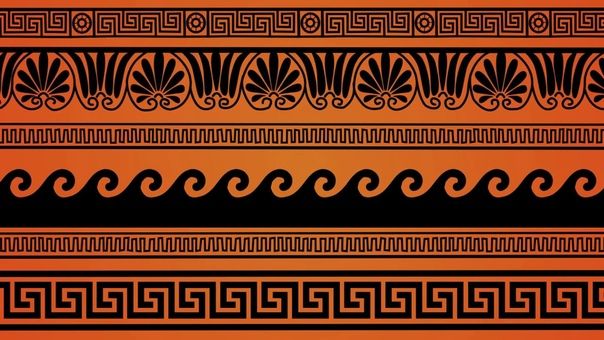
The origins of the meander are lost in the depths of centuries—it is believed the motif originated as far back as the Paleolithic era. According to one theory, it stems from a schematic depiction of a trap or a hunting snare, while at the same time, the pattern could represent the symbol of a wave, making it one of the oldest symbols of the elements.
Later, the ornament will receive its name precisely because of the continuous forward and backward motion, reminiscent of the winding course of the Meander River in Asia Minor, on the territory of modern-day Turkey.
Among the most famous examples of the ancient Greek meander are the so-called Dipylon amphorae, which received their name from the Dipylon («Double») Gate in Athens, located in the Kerameikos area—outside the city walls, where the ancient necropolis was situated. Archaeologists discovered these amphorae near these gates. They are classified as belonging to the Geometric style, dating to the 8th century BCE, and some reach nearly two meters in height. The amphorae were most often used as grave markers, and they were decorated with geometric ornamentation—zigzags and triangles. In addition to natural patterns, the facial sides of these vessels also feature a spiral sequence familiar to us.
stylized drawings of Geometric period amphorae
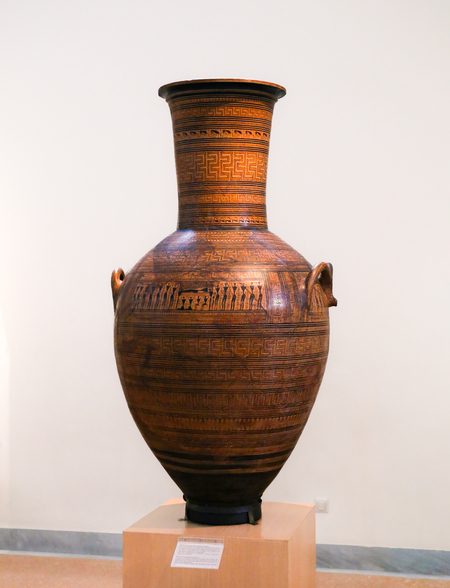
Дипилонская амфора позднего геометрического стиля, расписанная Дипилонским вазописцем.
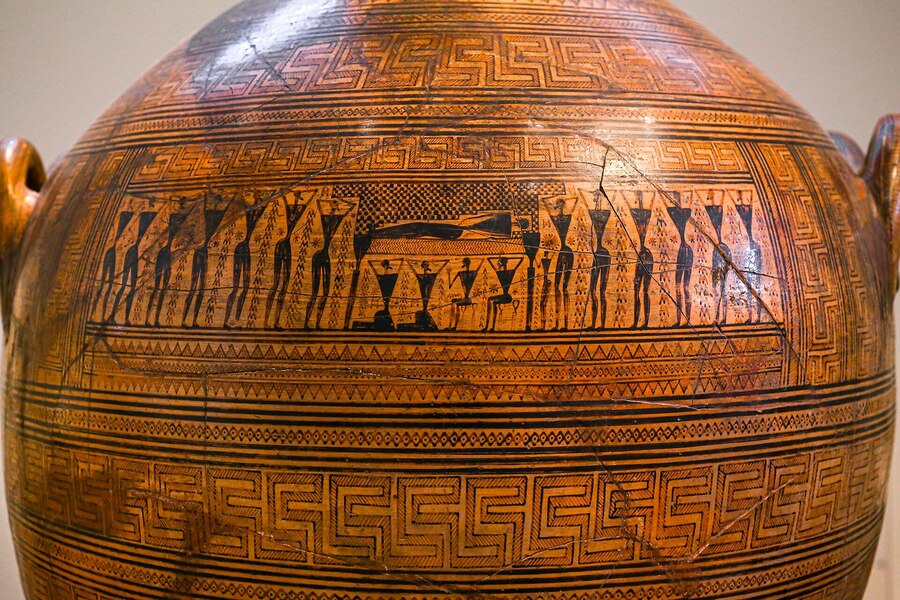
фрагмент амфоры, Афинский национальный археологический музей, 755-750 г. д. н.э
In addition to decorating the walls of vessels, the ancient Greeks framed the architraves of their temples with meander patterns, emphasizing the sacred significance of the location.
Architectural frieze with meander pattern in the Parthenon, Athens
Such a diverse spiral
In the second century BCE, the Romans conquer Greece. However, instead of destroying the culture of the conquered people, they begin to actively borrow both mythology and characteristic Greek elements in visual arts. The meander is no exception.
In Rome, the meander retained its Greek meaning of the endless line, but it evolved from a symbol of measure and eternity into foremost a spatial frame of luxury and established interior design. The Greek significance was not canceled. The discerning viewer could still read the continuous straight angle as infinity, repetition, and a resemblance to a labyrinth.
The River Meander, as a source of the name, recedes in importance. For Roman artists, the etymology is less significant than the motif itself—a design recognizable as Greek. The new emphasis is placed on the motif’s placement. In Greece, it framed vessels and temples, functioning as an object of contemplation. In Rome, however, there was no hesitation in placing it on floors or incorporating it into illusionistic wall paintings. The line gains thickness, shadow, and color.
Meander Types in Roman Art
The Romans did not leave a motif known to us unchanged. While preserving its characteristic features, they reworked the appearance of the ornament. A total of three main types of meander are identified. One of the more complex variations of the Roman meander is the double meander. It consists of two parallel lines that create a denser rhythm.