Демоническое в живописи Иеронима Босха: визуальные образы искушения, греха и адского наказания
«The difference between this artist’s work and that of other painters is that others try to depict people as they appear on the outside, while he had the courage to portray them as they are on the inside.» — José de Segúenza, 17th Century.
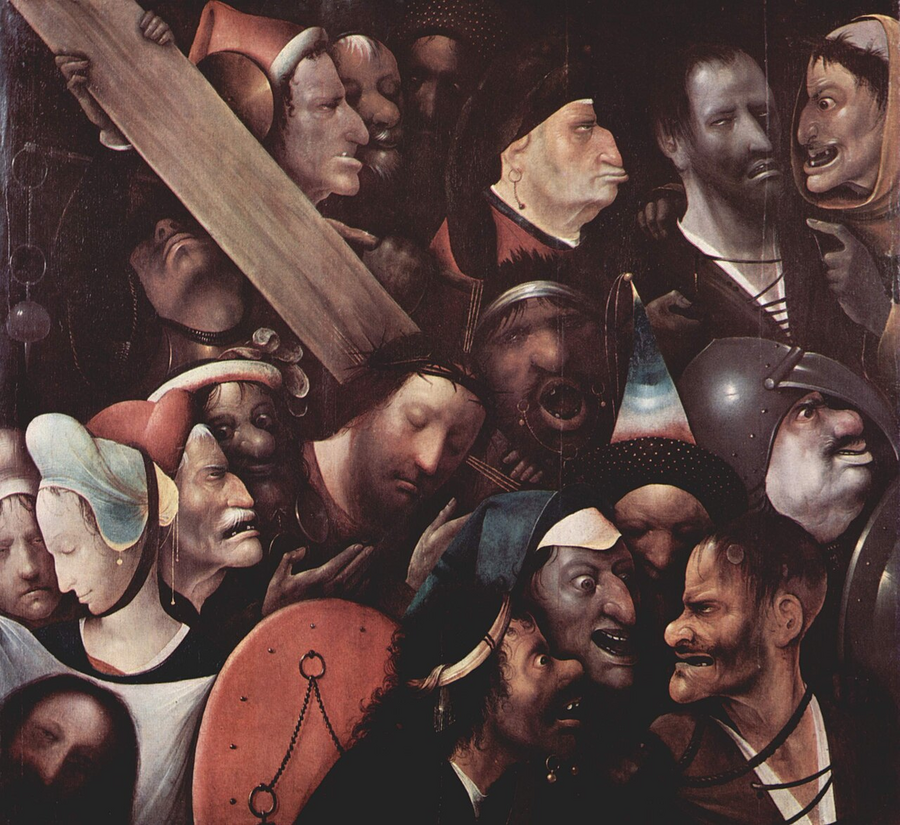
Hieronymus Bosch, «The Carrying of the Cross,» c. 1510–1535.
Concept
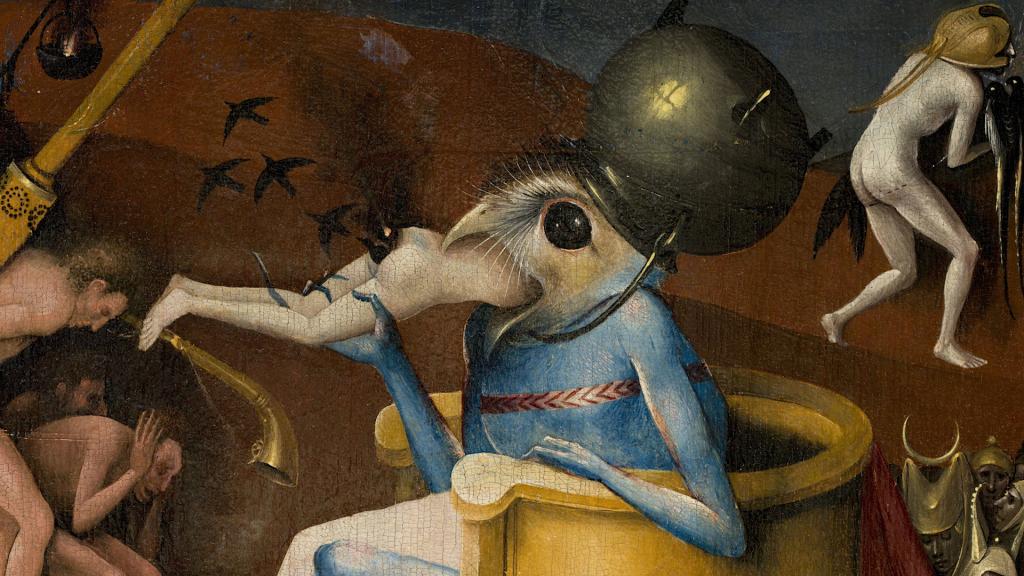
Hieronymus Bosch created one of the most unconventional figurative worlds in the history of European painting. His canvases are filled with demons, hybrid creatures, fantastical animals, and strange objects that transform familiar religious narratives into terrifying visions. Underlying this outward fantasy, however, is profound Christian subject matter: sin, temptation, spiritual decay, the Last Judgment, and eternal punishment.
Bosch’s demons are unlike the traditional characters of religious art; they rarely possess recognizable human forms, often appearing grotesque and even comical. Yet, it is precisely this quality that makes them so unsettling. Their bodies seem assembled from parts that should never coexist. Humans take on animal traits, animals morph into humanoid shapes, and ordinary objects become integrated into monstrosities. Bosch illustrates how the demonic permeates everyday human life, taking the form of attractive objects, animals, and even human figures.
The objective of my visual research is to trace how Hieronymus Bosch depicts demons and uses Christian symbolism to explore themes of temptation, sin, and spiritual punishment.
Demons as Embodiment of Christian Evil
One of the defining characteristics of Bosch’s paintings is his unconventional depiction of demonic beings. The artist hardly confines himself to specific external forms. His demons may possess avian heads, fish tails, human faces, animal paws, or elements of inanimate objects. This anatomy does not appear arbitrary. In Christian tradition, God creates the world in an ordered manner, and evil is associated with the violation of that established order. Bosch literally transfers this idea onto human bodies. His demons lack natural proportions, and their appearance is a combination of incompatible elements. It is particularly interesting that many of them do not appear majestic or powerful. On the contrary, their bodies are often disproportionate, their movements unnatural, and their facial expressions resemble grotesque masks. This is a crucial artistic technique: in Bosch’s work, evil possesses no inherent beauty or harmony; it exists as a distortion of an already created world.
Hieronymus Bosch, «The Last Judgment,» 1504, fragment
«Last Judgment»
Hieronymus Bosch, «The Last Judgment,» 1504.
On the left panel of the triptych is depicted the Garden of Eden, where the creation of man and the Fall occur. However, in the upper part of the composition unfolds another narrative—the fall of rebellious angels. Bosch portrays not only the act of falling but also the transformation of their appearance. The angels lose their accustomed form and turn into creatures with dark wings and animalistic features. Thus, the artist connects physical transformation with spiritual descent.
Bosch places the origin of evil even before the Fall of Man. The human story becomes part of a larger confrontation between the divine order and the forces that turned away from it. The artist adheres to Christian doctrine and does not depict demons as an independent race of beings that always existed separately from God. Their origins are tied to the fall: initially, they belonged to the celestial world, but they changed due to their own choice.
In Bosch, the demonic begins with the violation of the divine order, and the monstrous appearance becomes a reflection of this transgression.
Hieronymus Bosch, «The Last Judgment, ” 1504, fragment
«The Temptation of Saint Anthony»
Hieronymus Bosch, «The Temptation of Saint Anthony, ” c. 1505–1506, fragment
«The Temptation of Saint Anthony» is a work where the demonic world becomes the central theme of the composition. Unlike paintings where fantastic creatures appear amidst numerous human characters, here almost the entire space is dedicated to the narrative of the confrontation between the saint and the demons. Saint Anthony the Great was a Christian hermit who lived in Egypt during the 3rd–4th centuries. According to the saint’s life, while in solitude, he endured numerous trials that took the form of demonic attacks and sensual visions. In Bosch’s painting, this story transforms into a complex narrative where temptation manifests simultaneously as physical violence, deception, and allure.
Hieronymus Bosch, «The Temptation of Saint Anthony,» c. 1505–1506, fragment
The central section of the triptych is the most iconographically complex. Around the ruined structure gather fantastic creatures that appear to be participating in a strange religious ritual.
The woman holding a chalice near the other figures is particularly interesting. Her posture and the object in her hands recall the sacrament of communion. However, the surrounding creatures have demonic appearances, and the entire scene resembles a distorted church rite.
The scene is often interpreted as a parody of Mass or a black mass. Nevertheless, one cannot state with absolute certainty that the artist is depicting a specific ritual. More significant is the compositional juxtaposition: objects resembling ecclesiastical attributes are integrated into a demonic space.
Despite the multitude of demons, Saint Anthony does not appear defeated. He maintains his connection with Christ and continues to resist temptation.
This constitutes the triptych’s strongest visual contrast: a genuine nightmare unfolds around the saint, yet the image of salvation remains preserved within the ruined chapel.
The demonic space is outwardly all-encompassing, but it is incapable of destroying the presence of Christ.
«Garden of Earthly Delights»
Hieronymus Bosch, «The Garden of Earthly Delights, ” c. 1490–1500, fragment
In «Garden of Earthly Delights, ” the demonic world manifests differently. While the artist depicts a direct confrontation between humanity and demons in „The Temptation of Saint Anthony, ” here the focus is on the consequences of human fallenness. On the exterior of the triptych panels, a terrestrial sphere is depicted on the third day of creation. When open, it reveals three realms: paradise, the world of earthly pleasures, and hell.
Hieronymus Bosch, «The Garden of Earthly Delights,» c. 1490–1500, exterior of the panels
The exterior shutters establish the initial point of the narrative: the world was created by God and was initially subject to a certain order. After opening the shutters, the viewer sees this order gradually breaking down.
Hieronymus Bosch, «The Garden of Earthly Delights,» circa 1490–1500, fragment
The left panel is dedicated to the Garden of Eden. In the center, God presents Adam and Eve, surrounded by animals and fantastical plants.
At first glance, the space appears harmonious; however, Bosch introduces unusual details here that disrupt the feeling of an ideal paradise. In the lower part of the composition, predatory animals devour other creatures. One can see hybrid animals that could not exist in the real world, as well as fantastical birds and a three-headed amphibian.
The motif of the toad is particularly important. In medieval symbolism, this animal was associated with impurity, danger, and the powers of the devil. In other of Bosch’s works, toads appear next to nude figures and in compositions related to hell. In this case, their presence suggests that danger exists even before the human fall from grace. The world already contains traces of a future disruption of order.
Hieronymus Bosch, «The Garden of Earthly Delights, ” circa 1490–1500, fragment
Another important motif is the owl positioned within the Fountain of Life. It is a striking black spot, strongly contrasting with the painting’s light and delicate color palette. Bosch frequently uses owls as a symbol of sin, heresy, and evil.In «The Garden of Earthly Delights, ” Hieronymus Bosch uses the owl to suggest that even in paradise, at the dawn of creation, there is a trace of evil—that darkness and vice have always been inherent to the universe, which aligns with previous conclusions about the painting.
Hieronymus Bosch, «The Garden of Earthly Delights, ” circa 1490–1500, fragment
The central panel of the triptych is filled with nude figures who bathe, play with animals, eat fruit, and interact with one another. The primary motif becomes sensual pleasure, which gradually takes over the entire space of the painting.It is particularly interesting that the demonic figures are virtually absent here. Evil is not presented overtly—it manifests in the actions of the people themselves. People gather huge berries and fruits, interact with animals, and immerse themselves in an endless sequence of pleasures.Here emerges one of the most powerful ideas of the entire triptych: humanity fails to notice its own spiritual decline because it is completely absorbed by pleasure.
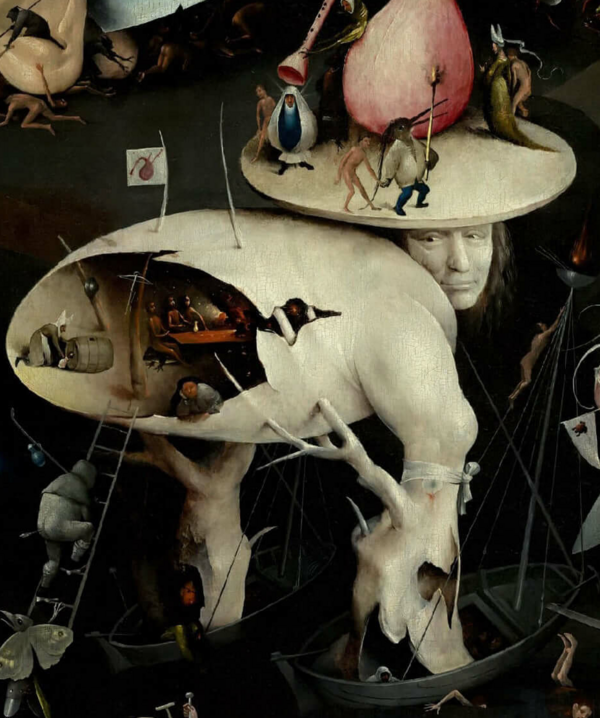
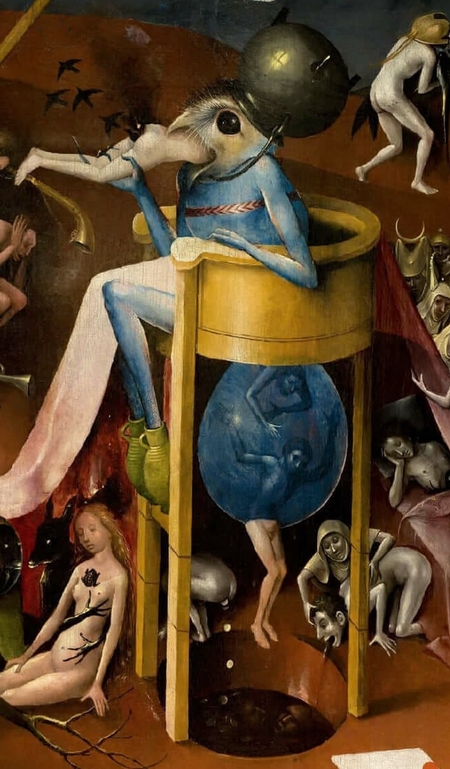
Hieronymus Bosch, «The Garden of Earthly Delights, ” c. 1490–1500, fragments