Navigation
Introduction[1] The Uncanny Valley: Why «Almost Human» Is Frightening [2] From Makeup to Pixels: The Retouching of Age [3] The Digital Head: Successes and Failures [4] Resurrection: Actors Who Don’t Exist [5] Without Markers: A Young Face, an Aging Body [6] Neural Networks: From Fandom Deepfakes to Real-Time RejuvenationConclusion
Introduction
In 2004, Robert Zemeckis released «Polar Express"—the first film entirely captured using motion capture. Tom Hanks played several roles in it, including the train conductor. The technology, which was intended to transfer the actor’s live performance into a digital world, yielded an unexpected result: critics labeled the characters mannequins and zombies, and their vacant, motionless eyes became a textbook example of the uncanny valley effect. Two decades later, the same director and actor made the film «Here,» in which Hanks portrays sixty years of life on screen, from teenager to old man. His face is rejuvenated by a neural network during the filming process, and after dubbing, the actor can see his younger self on the monitor. The entire history of digital de-aging in cinema lies between these two films.
Digital rejuvenation has long ceased to be a mere gimmick for a short flashback. Today, entire films are built upon it, and studios bring back to the screen actors who are no longer alive.
With the advent of machine learning, this technology has also become a subject of debate regarding human rights to one’s own identity. Nevertheless, the viewer still intuitively senses the inauthenticity, even if they cannot articulate exactly what is unnerving them. As early as 1970, Japanese roboticist Masahiro Mori described this paradox: the more closely an artificial figure resembles a human, the more we like it—but only up to a certain point. When the resemblance becomes nearly perfect, affinity sharply gives way to anxiety and rejection. Mori termed this failure the uncanny valley.
The research investigates how cinema has attempted to cross this valley over the past two decades and whether it has truly arrived on the other side, or if it has merely learned to bypass the gap. To answer this question, the paper traces the evolution from pre-digital methods of altering an actor’s age—such as makeup, stand-ins, and soft focus—to digital retouching, fully computerized heads, markerless facial capture, and finally, to neural networks that alter faces in real time.
The research is structured chronologically, but each chapter focuses not on a period, but on a technological approach. Within the chapters, both successful and unsuccessful examples are analyzed, because sometimes the same studio using the same technology achieved vastly different results. All case studies are examined using a consistent framework: how it was shot, what appeared on screen, and where the film landed on the Mori curve.
The research is built upon photographs and videos: official behind-the-scenes footage from visual studios like ILM, Digital Domain, Lola VFX, and Metaphysic, «before» and «after» shot comparisons, stills from film sets, as well as fan deepfakes that have developed into a distinct genre of audience criticism. Written sources include Mori’s essays in their authorized English translation, professional publications on visual effects, and interviews with the supervisors who worked on these films.
The uncanny valley: Why the «almost human» frightens us
In this chapter, we explore the origins of the «uncanny valley» concept and why a nearly perfect digital face can be more unsettling than an overtly cartoonish one. Eyes, skin, and facial expressions reveal the forgery, and the early attempts by cinema to create a digital human failed precisely on these elements.
«Polar Express» (2004), Robert Zemeckis
«Polar Express» (2004), Robert Zemeckis
In 1970, Japanese roboticist Masahiro Mori observed that the more human-like a robot is, the more we like it—until the resemblance becomes almost perfect. At that point, sympathy sharply plummets into the «uncanny valley.»
Masahiro Mori’s Chart (1970)
«Polar Express» was conceived as a living picture book illustration. The creators did not aim for photorealism; rather, they wanted to preserve the dreamlike pastel imagery of Chris Van Allsburg’s book. However, almost nothing remained of the characters from those drawings. The soft, stylized figures transformed into almost real people, and it was this «almost» that worked against the film.
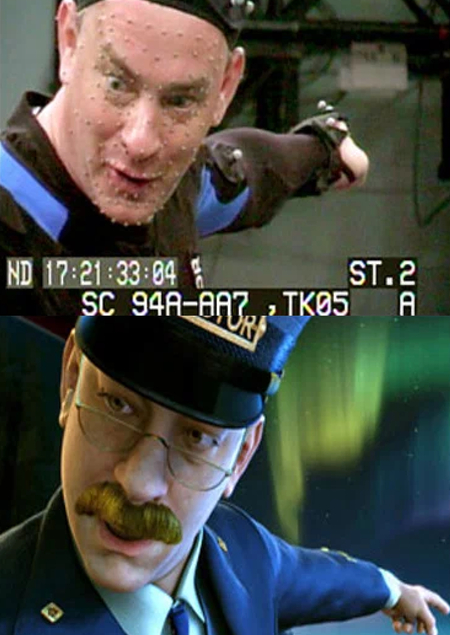
There was no set on the soundstage. The actors performed in tight-fitting suits marked with markers, and Hanks alone had 152 markers on his face. The wagon and benches were constructed from wire mesh so the set pieces wouldn’t obscure the markers from the capture cameras. A bare black studio with people positioned at marks, paired with a finished shot of a snowy train, best demonstrates how far the screen image deviates from the living actor.
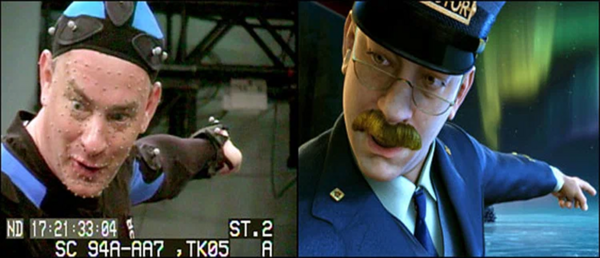
Photos from the shoot
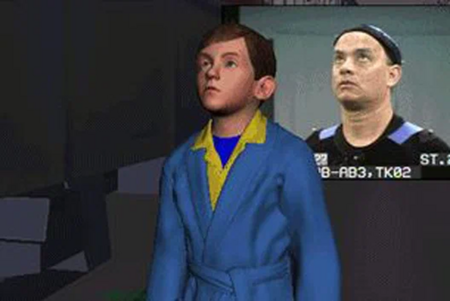
Hanks played several characters: a guide, a boy, his father, a vagrant, and Santa Claus. They all share the same face, and the difference between them is achieved through makeup designed by the computer. When the characters are placed side-by-side, it becomes evident how uniformly static their faces are.
Behind-the-scenes photo
The main problem was apparent in the eyes. Facial movements were tracked with markers, but the eyes were not: animators manually adjusted them against the actor’s gameplay footage. The face moved like a living being, but the gaze remained glassy and looked past the interlocutor. This very disconnect is what viewers and critics termed the «dead eyes.»
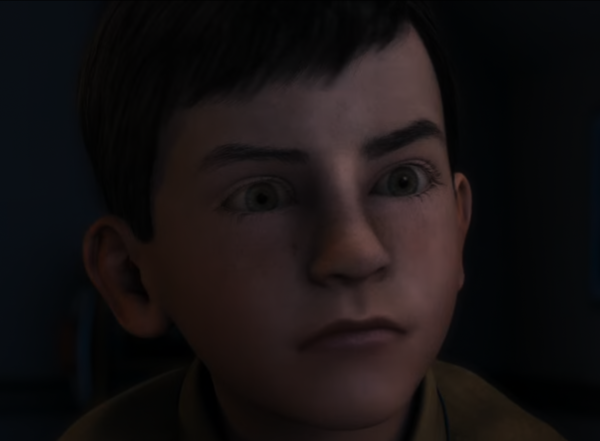
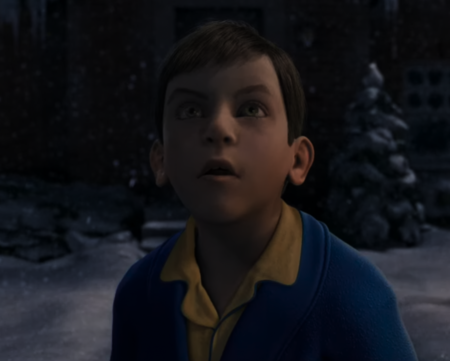
«Polar Express» (2004), Robert Zemeckis
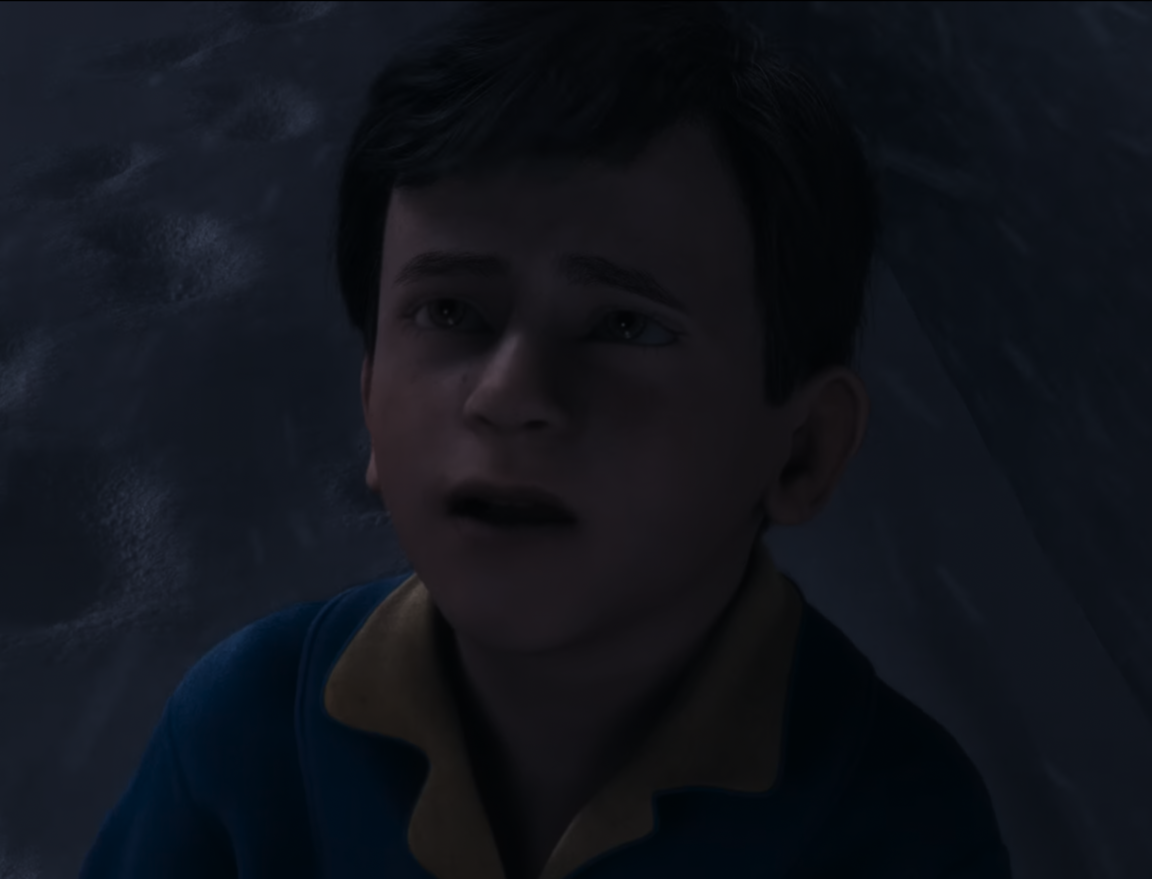
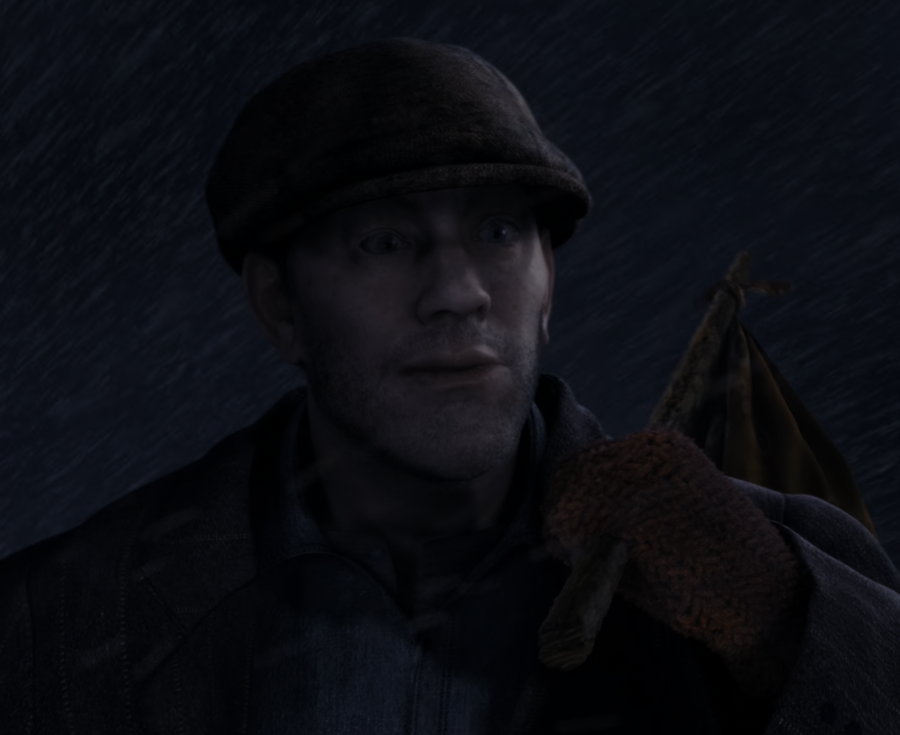
«Polar Express» (2004), Robert Zemeckis
Even when the main character sees a train that appears out of nowhere, his eyes still betray no emotion.
[2] Digital Head: Success and Failure
But on the «Polar Express,» Zemekis did not stop—he did not abandon the technology, and he decided to correct the main mistake, eyes.

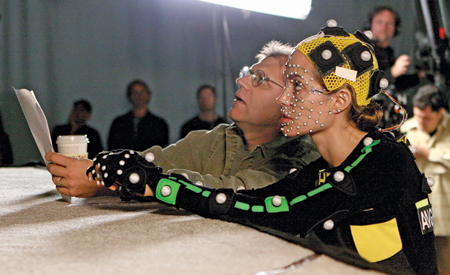
«Beowulf» (2007), directed by Robert Zemeckis. Set photo.
From makeup to pixels: Age retouching