Navigation
- Visual Research Concept
- Part I. A New Era: Historical Changes and Life in Eighteenth Dynasty Egyptian Society
- Part II. Vessels at the Beginning of the New Kingdom: Traditions, Changes, and Comparisons 3.1 Anthropomorphic Vessels Before the Eighteenth Dynasty 3.2 Anthropomorphic Vessels of the Eighteenth Dynasty 3.3 The Development of Anthropomorphic Vessels in the Eighteenth Dynasty: What Changed and Why
- Part III. People and Anthropomorphic Vessels: Creation, Use, and Cultural Value 4.1 Who Created the Anthropomorphic Vessels: Artisans and Their Work 4.2 Who Owned the Vessels: Wealth and Social Status 4.3 The Human Figure on the Vessel: Who Was Depicted and Why 4.4 Depictions of People and Their Cultural Significance in the Decoration of Anthropomorphic Vessels
- Research Conclusion
- Image Sources
- Bibliography
1. Visual Research Concept
Timeframe: approximately 1550–1292 BCE, 18th Dynasty of Ancient Egypt, beginning of the New Kingdom era Geographic Scope: Ancient Egypt, the Nile Valley and Delta, Northeast Africa Object of Study: anthropomorphic vessels of the 18th Dynasty Subject of Study: the functions, production context, and usage of anthropomorphic vessels, their cultural significance, and their role in the life of 18th Dynasty Egyptian society Selection Criteria: anthropomorphic vessels of the 18th Dynasty crafted in the form of the human figure, preferably complete. Primary focus is placed on objects that allow for the exploration of their purpose, methods of use, manufacturing technology, and cultural context. To identify shifts in material culture, individual vessels from preceding periods are also considered.
Research Goal: To identify the primary functions and cultural significance of anthropomorphic vessels from the Eighteenth Dynasty of Egypt, to study the characteristics of their creation and use, and to determine how the historical social changes of the early New Kingdom and dynasty might be reflected in their design, forms, and purpose.
Rationale for Topic Selection: My interest in this topic stems from the significant role of the human body as a medium for artistic expression in my view. I am particularly drawn to how familiar images and anatomical features can be reinterpreted, acquire new characteristics, and become integrated into everyday objects. This prompts a desire to examine such vessels not only in terms of their appearance but also as a part of the life of ancient Egyptian society—to understand why they were imbued with human features, what was inscribed upon them, who created them and for whom, how they were used, and what cultural significance they might have held. The Eighteenth Dynasty of Ancient Egypt, marking the beginning of the New Kingdom era, was chosen for this study. This period was characterized by major historical shifts that profoundly impacted societal life. I am interested in exploring how these changes might have manifested in the material culture and how this reflected in the appearance, function, and use of anthropomorphic vessels.
Research Question: What role did anthropomorphic vessels play in the life of Egyptian society during the 18th Dynasty, and what insights can we gain into the culture and historical changes of the New Kingdom through their unique creation, design, and use?
Part I. A New Era: Historical Shifts and Life in Egyptian Society of the Eighteenth Dynasty
The history of the New Kingdom begins around 1550 BCE. Prior to this, Egypt endured a period of political fragmentation: the northern part of the country, Lower Egypt, was under the control of the Hyksos, while the southern Upper Egypt retained the power of the Theban dynasty. The struggle to unite the country began under the rulers of the 17th Dynasty, but it was Ahmose I who succeeded in completing it by conquering Memphis, and later Avaris. Following the defeat of the Hyksos, Ahmose I regained control of the northern territories and once again unified Upper and Lower Egypt under his rule.
Surviving sculptural representations of rulers attest to the strengthening of royal power at the dawn of the XVIII Dynasty. One such monument is the limestone head of Yahmos I, on which the pharaoh is depicted wearing the white crown of Upper Egypt. Such images primarily aimed to emphasize affiliation with royal authority. Consequently, this sculpture is interesting for its use of the human form to express political status.
Head of Pharaoh Ahmose I, c. 1550–1525 BCE, Metropolitan Museum of Art, New York
Ahmos I was the first ruler of the 18th Dynasty, from whom the New Kingdom is dated. After unifying the country, he continued military campaigns to strengthen the state’s borders. In Egypt, centralized power was restored, state administration was reinforced, and construction projects resumed. These events marked the beginning of a new phase of the country’s political and cultural development. The historical changes at the start of the New Kingdom are important for studying anthropomorphic vessels because they affected not only Egypt’s political life but also the conditions under which artisans worked. Royal authority and temples served as major patrons for various artifacts. Specific skills, tools, and access to raw materials were required to produce these items.
3. Section II. Vessels in the Early New Kingdom: Traditions, Changes, and Comparisons
3.1 Anthropomorphic Vessels Before the XVIII Dynasty
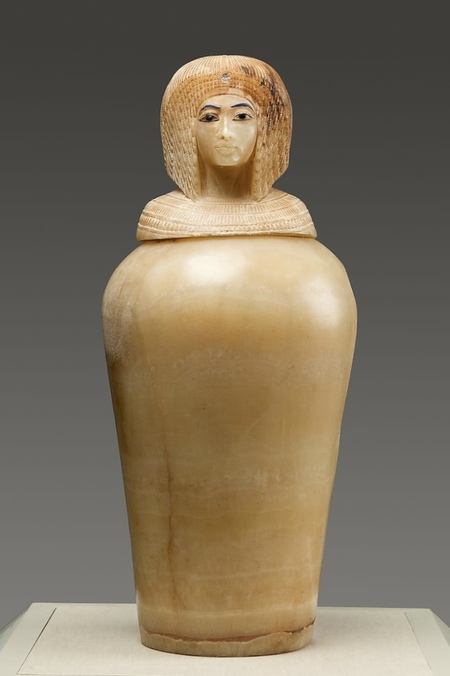
Anthropomorphic vessels existed in Ancient Egypt long before the New Kingdom. One of the most famous examples is the canopic jar—special containers used to store a deceased person’s internal organs. Initially, they had a simple shape, but later their lids began taking the form of human heads. The creation of such vessels was tied to the Egyptian belief that after death, a person continued to exist in another world, and preserving the body was essential for that continued existence. Therefore, during mummification, certain organs were removed from the body, treated, and placed into separate vessels, while the heart was usually left inside the body, as they believed it was the seat of the person’s thoughts and personality. Separate gods were responsible for each organ. The Egyptians appealed to these deities to protect the deceased, and their names and specific funerary spells were inscribed directly onto the vessels.
One preserved example is the four canopic jars of Princess Sitthathoruyunet, who lived during the Twelfth Dynasty. They were discovered in her tomb in Lahun and are made of travertine. All four jars featured lids shaped like human heads, and inscriptions on their surfaces addressed deities who protected the internal organs.
Canopic Jar of Princess Sithathoruenet (Kebeshenouf), 12th Dynasty, c. 1887–1813 BCE, Metropolitan Museum of Art, New York
One of the canopic jars mentions the goddesses Sekhet and Kebesennuph, who were responsible for protecting the intestines. For the ancient Egyptians, this object was part of a religious ritual in which the preservation of the body was accompanied by seeking divine protection.
Canopic Jar of Princess Sithathoriunet — Kebehsenuf, Metro Museum
Creating four stone canopic jars with individual lids and inscriptions required skilled craftsmanship and material resources. While the royal family could afford such a burial, for people with less wealth, this would have been significantly more difficult; therefore, social standing influenced access to specific funerary items and their quality.
3.2 Anthropomorphic Vessels of the XVIII Dynasty
With the arrival of the New Kingdom, Egyptians continued to use canopic jars topped with human heads, but the human form also appears in other objects unrelated to burial. For instance, vessels for cosmetic and aromatic substances. In the 18th Dynasty, artifacts shaped like a human figure or head appeared, where the depiction of a person became part of the object’s structure. Such vessels could be used to store precious substances, oils, or incense.
One example is a ceramic vessel in the shape of a female head, dating to the XVIII Dynasty and discovered at Saqqara, within the necropolis near the Pyramid of Teti. Similar vessels were made approximately between 1450–1350 BCE.
Vessel in the form of a female head, circa 1450–1350 BCE, Metropolitan Museum of Art, New York
The differences between these artifacts can be viewed within the context of the societal shifts in ancient Egypt during the New Kingdom. The human figure here does not merely adorn the object; it becomes an integral part of its structure. Anthropomorphic elements supplement the main form, and the particular emphasis on the breasts suggests a connection to motherhood and lactation. Furthermore, the female figure is depicted incompletely, with particular attention also drawn to the head. Scholars hypothesize that these vessels may have been used for storing breast milk in daily life. Since the Egyptians also associated a mother’s milk with sustaining life, the contents might have acquired symbolic significance even after death. Such vessels were placed in tombs, where their contents—whether literal or symbolic—were intended to facilitate the deceased’s daily rebirth.
Breast milk has been referenced in ancient Egyptian medical recipes. For example, in some instances, milk from women who had given birth to a boy was used. According to one papyrus, the milk should be left in a vessel until a thick layer formed, which was then applied to afflicted areas of the body. Therefore, researchers suggest that the depiction of a woman on such objects might indicate a connection between their contents and motherhood.
Anthropomorphic milk vessel, c. 1539–1479 BCE, Brooklyn Museum, New York
3.3 The Evolution of Anthropomorphic Vessels in the XVIII Dynasty: What Changed and Why
During the Eighteenth Dynasty, Egypt expanded its political and trade connections with neighboring territories. It can be assumed that temples, the royal family, and wealthy Egyptians might have commissioned more intricate objects from artisans. Craft workshops developed, producing items necessary for daily life, as well as anthropomorphic vessels. Previously, human features were used in the creation of canopic jars. In the Eighteenth Dynasty, among the surviving artifacts, there are more varied human figures associated not only with death but also with childbirth, nursing, and healing. Artisans began depicting women, mothers with children, and people engaged in various activities, transforming a simple container into an object that could hold additional significance for its owner. Unlike a vessel shaped like a female head, here the artisan depicted nearly the entire human figure. Her body simultaneously forms the main part of the vessel. Limbs and the tilt of the head help convey the person’s activity. Because of this, the vessel is perceived not only as an object for storing substance but also as an image of action.
Vessel in the form of a woman playing a lyre, XVIII Dynasty, c. 1400 BCE, Metropolitan Museum of Art, New York