1. Navigation
- Outline
- Concept 2.1. Relevance 2.2. Research Problem 2.3. Goal, Hypothesis, and Objectives 2.4. Methodology
- Theoretical Framework 3.1. The Smile as an Artistic Code 3.2. How the Viewer Perceives Facial Expressions 3.3. Facial Expressions and Social Norms
- Antiquity: The Archaic Smile 4.1. The Archaic Smile 4.2. The Smile in Female Sculpture 4.3. From Smile to Strict Style 4.4. Seriousness as a Symbol of Social Dignity
- The Middle Ages: The Smile in Religious Sculpture 5.1. The «Smiling Angel» of Reims Cathedral 5.2. How the Meaning of a Smile Changes
- The Renaissance and 17th Century: Individual Facial Expression 6.1. Reserved Faces in Renaissance Portraits 6.2. The Enigmatic Smile of the Mona Lisa 6.3. Scientific Explanation of the Mona Lisa’s Smile 6.4. The Smile as a Character Trait 6.5. Laughter as an Instant Emotion
- 18th Century: The Smile and Social Norms 7.1. The Smile as a Social Game 7.2. The Smile and Professional Self-Presentation 7.3. The Smile as a Violation of Artistic Norms 7.4. Colin Jones’s Study
- 19th Century: Photography and the Serious Face 8.1. Early Photographic Portraits 8.2. Seriousness as an Artistic Technique 8.3. The Serious Face as an Image of Elegance 8.4. Why People Rarely Smiled in Old Photographs?
- 20th Century: The Smile Becomes a Mass Standard 9.1. Kodak and the Spread of Amateur Photography 9.2. The Smile as an Advertising Standard 9.3. Seriousness in Documentary Photography 9.4. The Smile as an Image of Popular Culture
- Contemporary Art Photography 10.1. The Face Behind the Public Image 10.2. Facial Expression as an Artistic Role 10.3. Neutrality as an Artistic Method
- Comparative Analysis and Conclusion 11.1. How the Meaning of the Smile Has Changed 11.2. Conclusion
2. Concept
2.1. Relevance
The smile is considered one of the most recognizable expressions of the human face. In everyday life, it is most often associated with joy, pleasure, and goodwill. However, in works of art, the meaning of the smile does not always align with its usual emotional interpretation. In ancient Greek sculpture, it could serve as an artistic convention; in Renaissance painting, it was part of an individual character; and in 20th-century photography, it was an expected manner of posing for the camera. This study allows us to examine the smile not as an immutable symbol of happiness, but as a visual sign whose meaning depends on the era, artistic traditions, and social norms.
2.2. Research Problem
When viewing a portrait, the audience often connects the facial expression with the depicted person’s emotional state. A smiling face appears happy, while a serious one can be perceived as cold, contemplative, or stern. However, the artistic representation does not necessarily reflect the person’s real experience. Its expressiveness may be determined by the work’s purpose, aesthetic conventions, the subject’s social status, and artistic techniques. The research problem lies in the fact that the modern viewer interprets faces from past eras based on their own ingrained ways of expressing emotions. Therefore, historical images can be perceived differently than what their creator or original audience intended.
Research Question: How have the artistic functions and cultural meanings of the smile changed from ancient sculpture to contemporary photography?
2.3. Goal, Hypothesis, and Objectives
Hypothesis: A smile in a work of art does not always reflect a person’s emotional state. Its meaning is shaped by artistic conventions, cultural norms, and perceptions of the idealized human image. Goal: To trace the evolution of the depiction of the smile from antiquity to the modern era and to determine its primary artistic functions. Research Objectives:
- To identify the characteristics of the archaic smile in ancient Greek sculpture.
- To trace the methods of depicting the smile in European painting.
- To investigate the relationship between facial expression and social norms and status.
- To examine how mass photography has altered posing habits.
- To compare the significance of the smile versus a neutral facial expression in contemporary art.
2.4. Methodology
The work is built upon a comparative visual analysis of artworks from different historical periods. When examining the images, consideration is given to the nature of the smile, the position of the lips and eyes, the direction of gaze, composition, the work’s purpose, and the cultural context of its creation. Theoretical foundations include Angus Trumbull’s research on the history of the smile, Ernst Gombrich’s studies on the perception of the human face, Paul Ekman and Wallace Friesen’s work on nonverbal behavior, Colin Jones’s analysis of the changing attitude toward smiling in the 18th century, and Kristina Kotchemidova’s work on smiling in mass photography. Additional concepts drawn from Roland Barthes on photographic posing and Erving Goffman on social self-presentation are also employed. These approaches allow for examining facial expressions as the result of an interaction between individual behavior and societal expectations. The visual material spans ancient Greek and Roman sculpture, medieval religious imagery, European portrait painting, early photography, 20th-century advertising imagery, and contemporary fine art photography. The research does not presume that the smile gradually becomes more realistic or free. Its objective is to trace shifts in its use and interpretation, without viewing historical development as a linear progression from conventional representation to authenticity.
3. Theoretical Foundations
3.1. The Smile as an Artistic Code
A smile is composed of recognizable facial features, but its meaning is not limited to joy. It can express politeness, irony, shyness, or a desire to make a specific impression. In art, the viewer perceives not the person’s actual emotion, but the image created by the artist. Therefore, the same curve of the lips takes on different meanings depending on the era and the purpose of the work.Theoretical basis: Angus Trumbull, A Brief History of the Smile, 2003.
3.2. How an Audience Perceives Facial Expressions
Ernst Gombrich, in his work «Mask and Face,» examines how humans recognize likeness and facial expression in an image. The viewer pays attention not only to the lips. The expression is determined by the interplay of the eyes, cheeks, head position, and chiaroscuro. Therefore, even small changes in individual features can influence the overall impression of the face. This idea is particularly crucial when comparing archaic sculpture and Renaissance painted portraits.
3.3. Facial Expression and Social Norms
Paul Ekman and Wallace Friesen investigated nonverbal behavior and cultural rules for expressing emotion. A person might smile out of politeness or maintain a serious demeanor even while experiencing positive feelings. Erving Goffman viewed behavior as a means of managing one’s impression. Roland Barthes focused on how a person is aware of their own image at the moment of being photographed. These ideas help us understand why a facial expression in a portrait depends not only on emotion but also on the social role of the subject.
4. Antiquity: The Archaic Smile
4.1. Archaic Smile
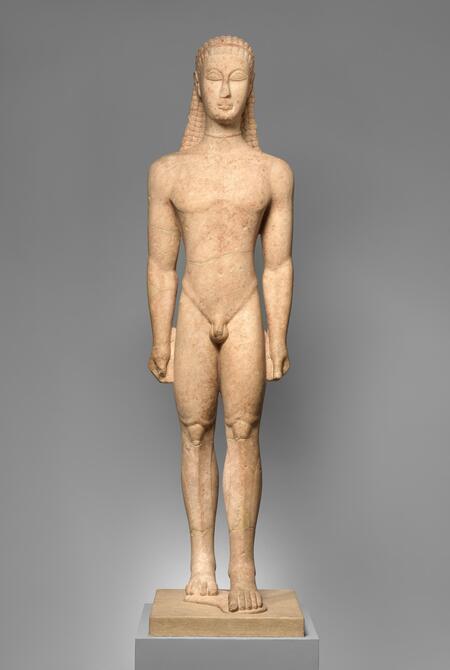
The archaic smile is a characteristic technique of 6th-century BCE ancient Greek sculpture. The raised corners of the lips create an impression of liveliness, but do not necessarily denote joy. The smile is integrated into a system of conventional representation characterized by the frontal posture of the figure, symmetry, and geometric forms.
Ancient Greek master. «Kouros Statue,» c. 590–580 BCE. Marble. The Metropolitan Museum of Art, New York.
4.2. A Smile in Female Sculpture
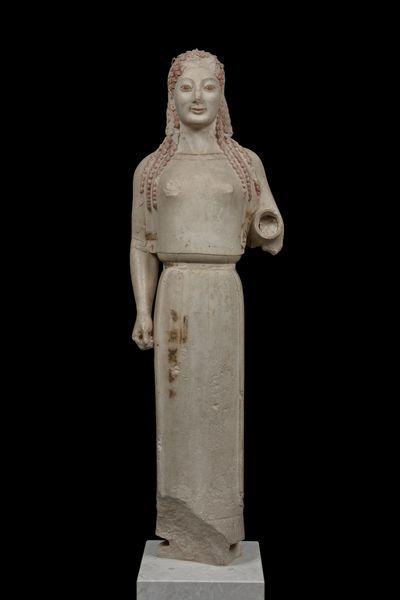
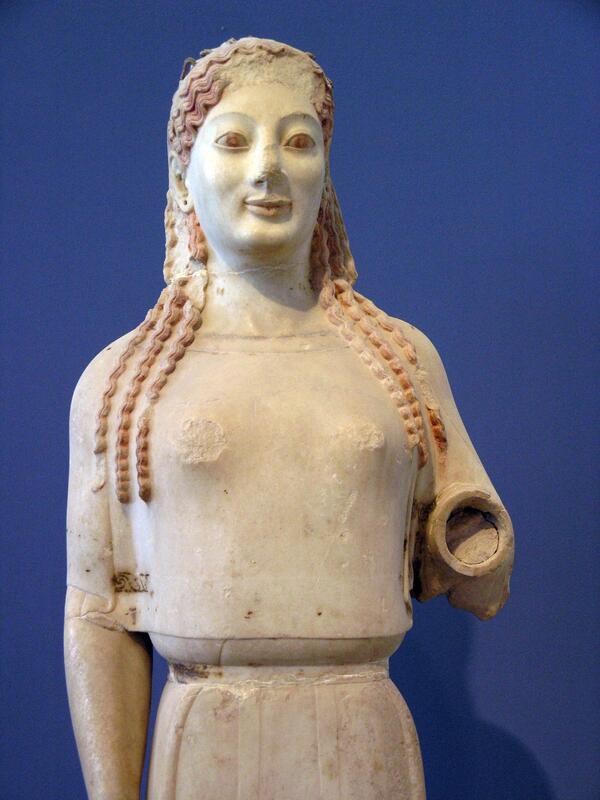
The archaic smile is also present in female statues—the Korai. In «Kora in a Peplos, ” the gentle curve of the lips combines with almond-shaped eyes, stylized hair, and a static pose. The facial expression is part of a single artistic whole. Originally, the statue was painted, so the modern viewer sees only a fraction of its historical appearance.
„Kora in a Peplos, ” circa 530 BCE. Marble. Acropolis Museum, Athens, Inv. 679.
4.3. From Smile to Strict Style
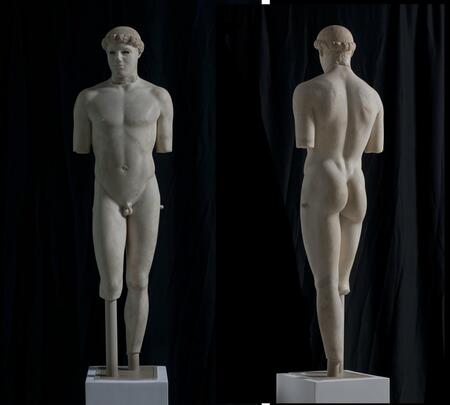
As the style moves toward classical art, the characterization of the face changes. The «Kritios Boy» lacks the characteristic archaic smile. The face becomes restrained, and the body posture becomes more natural. This shift in expression occurs alongside a reevaluation of the proportions and plasticity of the human figure.
«Kritios Boy, ” after 480 BCE. Marble. Acropolis Museum, Athens, Inv. 698.
4.4. Seriousness as an Image of Social Dignity
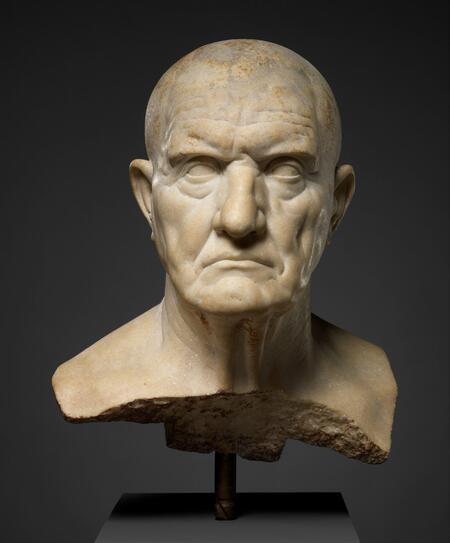
In Roman portraiture of the Late Republic, attention to individual facial features intensifies. Wrinkles, head shape, and a reserved expression can contribute to crafting the image of a mature individual. Here, the absence of a smile is tied to a different artistic objective—not an archaic convention, but the conveyance of individuality and notions of dignity.
Roman Master. «Marble Portrait of a Man, ” late 1st century BCE. Metropolitan Museum of Art, New York.
5. The Middle Ages: Smiles in Religious Sculpture
5.1. «Smiling Angel» of Reims Cathedral
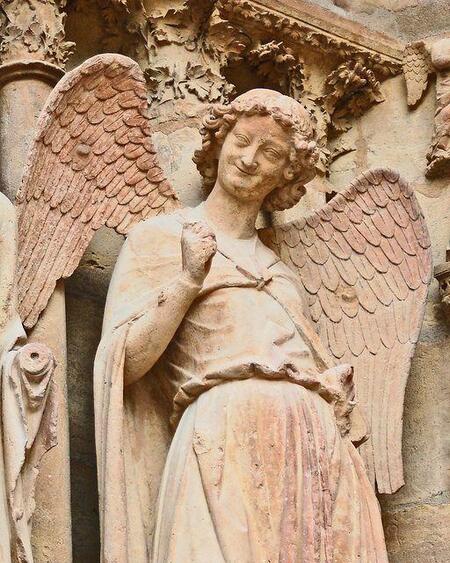
In Gothic sculpture, the smile acquires a different artistic significance. The gentle curve of the angel’s lips is combined with the tilt of the head, the movement of the figure, and the Christian narrative. Unlike the archaic kouros, the smile here is integrated into religious iconography. It cannot be considered separately from the cathedral’s architectural and semantic context.Unknown master. «Smiling Angel, ” 13th century. Reims Cathedral, France.