Navigation
- Index2. Concept3. The Empire as a World Structure4. Divine Right and Military Victory5. Signs of Royal Presence6. The Tsar, the Hunt, and Subjugated Nature7. The Court as a World Map8. Power within the Object9. The Tsar Becomes a Narrative Hero10. Wisdom, Ordeal, and Historical Memory11. Conclusion
Concept
The study, «The King as a World Image,» examines the visual language of power in Persian art from the Achaemenid period through the end of the 14th century. The focus is not on the biography of a single ruler or the chronological history of dynasties, but rather on the consistent depiction of the king. Over nearly two millennia, the ruler appears as an immutable center around which the empire’s peoples, courtiers, defeated enemies, hunting participants, and heroes of literary narratives are organized. Religions, state boundaries, materials, and artistic techniques change, yet the core compositional idea endures: the order of the world becomes visible through the arrangement of figures around the sovereign.
The topic was chosen because the representation of power allows us to trace connections between monuments that are usually examined in isolation. Achaemenid stone reliefs, Sasanian coins, silver platters, Sogdian murals, Seljuk ceramics, and Ilkhanid miniatures belong to different eras and artistic mediums. Yet, they repeatedly feature similar elements: the central placement of the ruler, a frontal or deliberately calm posture, symmetry, the throne, a specific crown, a halo, a procession, or a scene of reception or triumph. Comparing these works helps us see not a collection of random coincidences, but a long-standing tradition in depicting royalty.The choice of topic is also related to a characteristic of Persian art: the political idea is often expressed not through direct narration, but through the arrangement of figures, scale, gesture, and material. The ruler may be depicted without individual features, but their status is still discernible by how the space is organized. Therefore, such research demands a purely visual format. While text explains the historical context, the main argument emerges from comparing the images.
This research aims to identify the techniques through which power was transformed into a visible and recognizable image. The first technique is the compositional center. The Tsar is typically calmer and more immobile than his surroundings, while envoys move toward him, enemies bow down, beasts bend under a strike, and courtiers form a symmetrical enclosure. The second technique is the sign of legality: a ring with ribbons, a diadem, a crown, a nimbus, or a fiery altar indicates that power has not only a military but also a sacred foundation. The third technique is the demonstration of control. A procession represents a governed empire, a hunt signifies subdued nature, a diplomatic reception denotes an organized outer world, and a council scene portrays a rationally ordered court.
A separate objective of the research is to trace how one image changes alongside its medium. Rock relief is associated with a specific location and is designed for long-term memory. A coin miniaturizes the imperial portrait and disseminates it across the territory of the state. A silver platter transports the scene of a victory or a hunt into the space of a court feast. A ceramic bowl transforms a throne composition into a repeatable decorative motif. A manuscript embeds the ruler within history, where he can be assessed not only by his strength but also by his wisdom, justice, and capacity to heed counsel.
The material is arranged chronologically, yet each section reveals a distinct way of visualizing power. The narrative begins in Persepolis, where the empire is presented as the convergence of various peoples toward a unified center. Next, the Sasanian model is examined: power is conferred upon the ruler by a deity, confirmed through military victory, and reiterated in the individual form of the crown. The subsequent section focuses on the royal hunt—a symbolic scene where civil order is contrasted with the chaos of nature.
Following the decline of the Sasanian Empire, the study moves to East Iranian court culture and then to the art of Islamic Iran. Here, the ancient compositional formula does not vanish but adapts to different objects and situations. In Seljuk ceramics, the ruler becomes a generalized figure within the ornamentation. In works related to the Shahnameh, the royal image gains a narrative dimension: Bahram Gur hunts, endures trials, and confronts the consequences of his own decisions; Nusirvan receives envoys; Buzurdgmehr demonstrates wisdom at court. The final segment returns to the ancient theme of triumphing over chaos, but frames it as a fourteenth-century literary account.
The structure of the study operates on the principle of «one thematic thesis—one screen.» Each block includes a main title, body text, one or two thematically linked reproductions, and small museum captions. Paired images are not decorative; they are comparative. Two investiture scenes illustrate different modalities of transferring power; a coin and a relief demonstrate the scaling of the royal image; and monumental and object-based hunting scenes reveal the transfer of a single formula across different media.
In Achaemenid art of the 6th–4th centuries BCE, the king was depicted as the center of a multinational empire. The reliefs of Persepolis did more than just document the appearance of the subjects; they transformed the differences between peoples into an ordered procession. The relief above Darius I’s tomb developed this same concept, showing a throne literally supported by representatives from the empire’s lands.During the Sasanian era of the 3rd–7th centuries, the king’s image acquired a more pronounced sacred character. On the reliefs of Ardashir I and Narseh, the ruler receives the mark of royal dignity from a deity. In scenes of victory, the enemies confirm his supremacy through their own postures, and the individual crown links the king’s name to a specific visual symbol. Hunting scenes on reliefs and silver platters portrayed the ruler as the conqueror of beasts and the guardian of order.Following the Arab conquest of Iran, this system did not completely disappear. Its elements continued to exist in the court culture of Central Asia, in Islamic ceramics, and in Persian literary tradition. In the 12th–13th centuries, the throne figure became a common motif on ceramic vessels. Around 1300 and in the first half of the 14th century, the illustrated manuscripts of the Shahnameh linked ancient conceptions of the king with a continuous narrative. The ruler still occupies the center, conquers enemies and monsters, receives ambassadors and advisors, but now his actions can be compared and morally judged. Thus, the monumental image of power gradually transforms into historical memory and literary archetype.
The Empire as a Structure of the World
The Empire moves toward the center
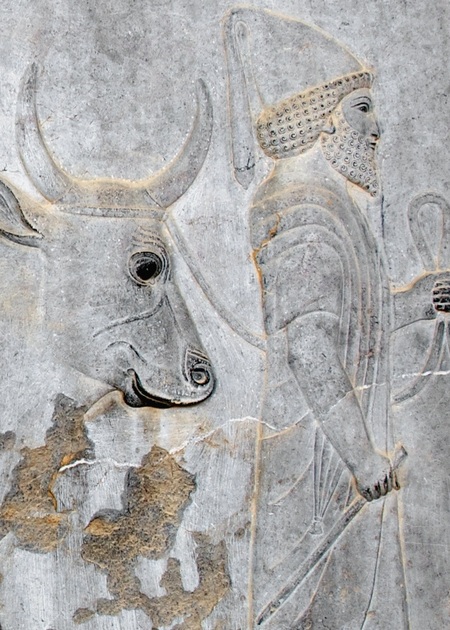
In Persian art, the depiction of power begins not with a portrait of the king, but with the movement toward him. On the stairs of the Apadana at Persepolis, representatives of the empire’s diverse peoples carry fabrics, vessels, weapons, and animals. Their distinctions are meticulously preserved: each group has its own attire, hairstyle, and set of tributes. However, all figures adhere to a single rhythm and move in one direction.The king may be absent from the chosen fragment, but the composition still speaks of him. The architecture transforms a multitude of peoples into an organized procession, and the empire’s diversity into proof of a stable order. Power is shown not as a moment of violence, but as the capacity to draw disparate lands around a single center.
Unknown masters of the Achaemenid court. “Delegations of the peoples of the empire on the Apadana Staircase, « circa 515–465 BCE. Persepolis, Iran.
The King holds the world
On the relief above the tomb of Darius I, representatives of the peoples of the Achaemenid Empire support the throne. This is not a depiction of actual furniture, but a model of the empire itself: the king’s power exists because of numerous lands united under his rule. The figures supporting the throne vary, but they collectively bear the same weight.Darius himself stands before the fire under the sign of the winged disk. He is not depicted as a giant, nor does he dominate the others by physical scale. His supremacy is established through his posture, ritual gesture, and strict symmetry. The king becomes the intermediary between the divine order, the state, and the memory of his ancestors. Even his tomb asserts that the empire is structured as a stable hierarchy.
Unknown masters of the Achaemenid court. “Relief over the tomb of Darius I, « circa 486 BCE. Naqsh-e Rustam, Iran.
Divine Right and Military Victory
Power can be transferred
In Sasanian art, the right to rule takes a tangible form. Ardashir I receives a ring with ribbons from Ormazd, and Narseh receives it from a female deity, usually equated with Anahita. The ring is not a crown in the literal sense; it is a symbol of royal dignity and divine acknowledgment.The king and the deity are nearly equal in scope. This parity does not elevate the ruler to the status of a god, but rather emphasizes his exceptional position among humankind. In the scene of Ardashir, defeated adversaries lie beneath the horses' hooves. The composition unites two foundations of power: one bestowed from above, and the other confirmed by victory. In the scene of Narseh, military aggression recedes, and the solemn moment of legitimate transfer of power becomes paramount.
Unknown Sasanian masters. “The Investiture of Ardashir I», c. 224–241 CE. Naksh-Rostam, Iran.
Unknown Sasanian Masters. «Investiture of Narseh, ” c. 293–303. Naksh-Rostam, Iran.
Victory as a Hierarchy of Gestures
In the relief of Shapur I, victory is primarily conveyed through the contrast in poses. The Persian king sits calmly on his horse. One Roman emperor kneels, another is shown captured, and the third is bound in a depiction of defeat. The king barely makes a movement—the surrounding figures confirm his superiority through their gestures.
The relief was carved near the tombs of the Achaemenid rulers. Because of this placement, Shapur’s military success is integrated into the memory of a much older empire. The new dynasty does not literally copy the Achaemenids, but it utilizes the location itself as proof of continuity. Victory ceases to be a distinct historical event and transforms into an eternal state of royal power.
Unknown Sasanian masters. «Triumph of Shapur I over the Roman Emperors, ” circa 260 AD. Naqsh-e Rostam, Iran.
Marks of Royal Presence
Corona as Biography
A Sasanian ruler could be identified by the shape of his crown. Various combinations of teeth, wings, crescents, and spherical elements were associated with specific kings. This allowed the small profile on the coin to correspond with monumental imagery, inscriptions, and court ceremonies.In the relief at Takht-e Bostan, Khosrow II is distinguished among the divine figures by his crown and nimbus. On the coin of Shapur II, the same principle operates in a highly condensed form: the profile, headwear, and inscription form a recognizable sign of power. The rock relief is static and tied to a specific location, whereas the coin travels between cities and people. It transforms the royal visage into a mass-produced image.
Unknown Sasanian Masters. “Enthronement of Khosrow II, « late 6th — early 7th century. Found in Bostan, Kermanshah, Iran.
Unknown mint master. «Shapur II Gold Coin, ” circa 320 CE. Sasanian Iran.
King, the Hunt, and Submissive Nature
Hunting—a small war