Concept
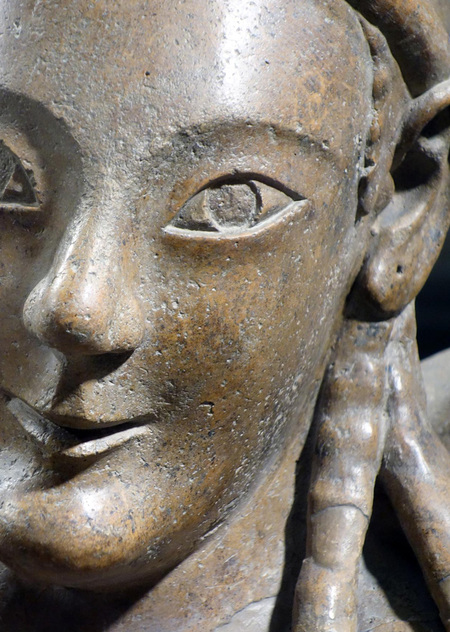
The human face is one of the most expressive elements of sculpture. Sometimes, a subtle shift in the position of the lips or a change in gaze is enough to completely alter the perception of the image. We are accustomed to seeking emotions, character, or a specific mood in facial expressions. But is the sculptor always aiming to convey exactly that?
In ancient Greek art, from the 6th to the early 5th century BCE, a feature emerges that prompts this question. On the faces of kouroi, korai, gods, and other figures, one can observe a light, almost imperceptible smile. This smile remarkably remains consistent regardless of who is depicted or the situation the character is in. Even in scenes where anxiety, tension, or sorrow might seem more appropriate, the faces remain serene.
This phenomenon is called the archaic smile. At first glance, it is just a minor feature of a human face in an image. However, it is precisely what makes many ancient Greek statues so unusual. The smile gives them a sense of life, yet it prevents us from understanding precisely what the depicted figure is feeling.
In this study, I would like to examine the archaic smile not merely as a characteristic artistic technique, but as a peculiar reflection of the ancient Greeks' conceptions of humanity and its place in the world.
The features of a face can conceal broader meanings: attitudes toward life and death, perceptions of beauty and harmony, religious beliefs, and the human connection to the divine.
The main object of study is not the smile itself as a lip movement, but the meanings that could be behind it. I want to track how it manifests across different works, whether its perception changes depending on the statue’s function or the character’s persona, and why the same facial feature appears in various artistic contexts. I am curious to understand why ancient Greek sculptors employed this technique and what role it played in perceiving the human form. Perhaps something much larger than simply trying to make the statue’s face more lifelike is concealed behind that smile.
Research Hypothesis: The archaic smile is not merely a conventional depiction of joy, but a multifaceted artistic trope through which ancient Greek sculpture could convey concepts of life force, the harmony of human existence, and proximity to the divine.
Navigation
1. Concept
2. Life Within a Static Form
3. Harmony Between Humanity and the World
4. The Smile as a Reflection of Divine Favor
5. Embodied Divinity: The Human Face as an Image of the Sacred
6. The Smile as Enigma: Disparity Between Situation and Expression
7. Conclusion
8. Bibliography and Image Sources
Life Within Still Form
Kuros from Anavissos (Croisos), c. 530 BCE
Archaic Greek sculpture does not aim to capture the individuality of a specific person—the image of the physically perfect human being is far more significant. One of the most common types of archaic sculpture is the kouros, which depicted not so much a specific individual as the ideal of youth, strength, and physical perfection. A good example is the Kouros of Anavyssos, known as the statue of Chrysos (circa 530 BCE). The figure seems to be on the threshold between movement and stillness. It appears the youth is about to take a step, but he remains forever in this immobile posture. Wide-open eyes and slightly lifted corners of the lips create an impression of inner vitality. The smile does not express a particular emotion, but it prevents the face from appearing completely static.
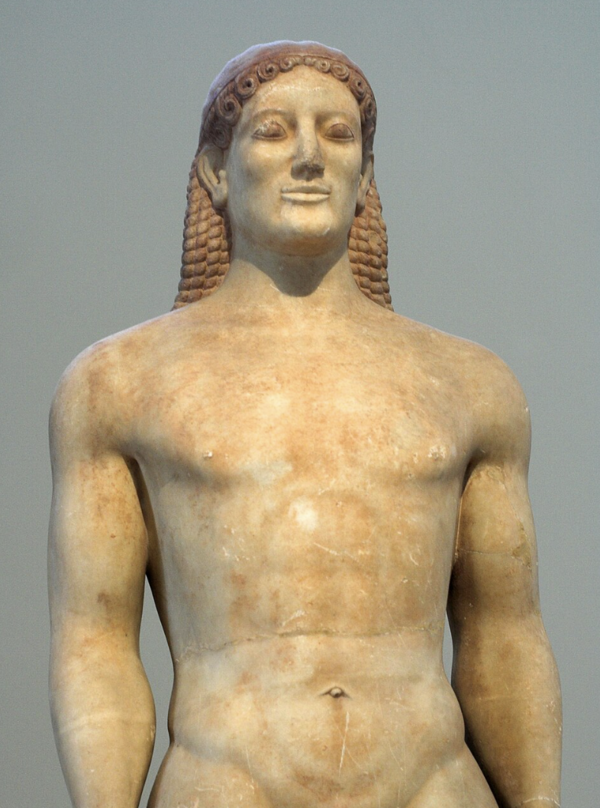
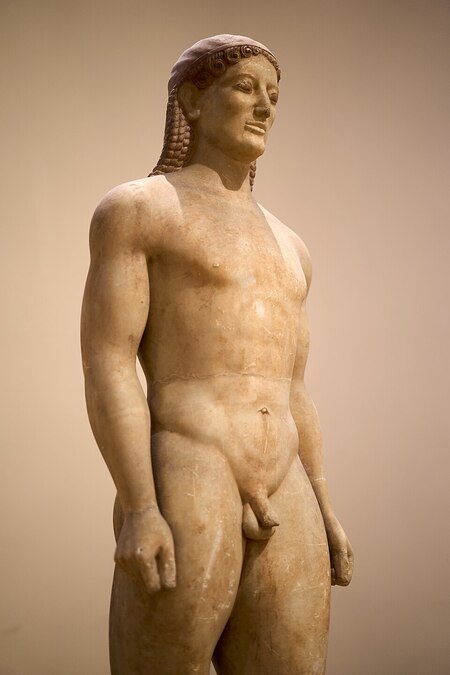
Kuros from Anavissos (Kroisos), c. 530 BCE.
It feels as though what the viewer is looking at is not merely a stone depiction of the human body, but the human presence itself. The smiling face doesn’t just create the illusion of life; it reflects an inner fire—a love for existence, a yearning to break free from the physical cage.
Moschophore — Telenosets, circa 570 BCE
Moschophor — Telenoset (c. 570 BCE) gives a similar impression. The man carries a calf on his shoulders, supporting its legs with his hands. The human and animal figures form a unified composition, and both their faces are turned toward the viewer. The man’s slight smile lends the image a special softness and tranquility. Here, it seems to unite the human and the animal, creating a feeling of wholeness and well-being. The smile doesn’t so much tell the character’s experience as it infuses the entire composition with life.
Moschophor — Telenoset, c. 570 BCE
It is important to note that in archaic sculpture, the inner world of the human being has not yet been revealed through complex facial expressions or individual character traits. The sculptor does not attempt to portray fleeting moods or contradictory emotions. Instead, they create a generalized image in which life itself is expressed through the perfection of the body, the clarity of form, and a specific facial expression.
The smile becomes a peculiar connection between stone and living being. It doesn’t depict a specific moment, but rather reminds us of humanity’s very capacity to be alive.
The Harmony of Humanity and the World
Archaic statues convey an impression of remarkable wholeness. The human body within them is perceived as an ordered system where everything is subordinate to a unified concept. In his article «Abstraction and Feeling» (1908), Wilhelm Worringer discusses various modes of human interaction with the surrounding world. One such mode involves seeking stability in strict, geometrically organized forms, while another relates to a sense of intrinsic kinship with the world, its organic shapes, and its life. In this state, the individual does not oppose the world but perceives themselves as a part of it.
Corinthian in Peplos, circa 530 BCE
Kora in Peplos (c. 530 BCE) maintains the characteristic frontality of Archaic sculpture. Her figure appears static and reserved, but a slight smile noticeably alters the perception of her face. This smile becomes part of a larger idealized image where youth, beauty, and dignity seem to exist in equilibrium.
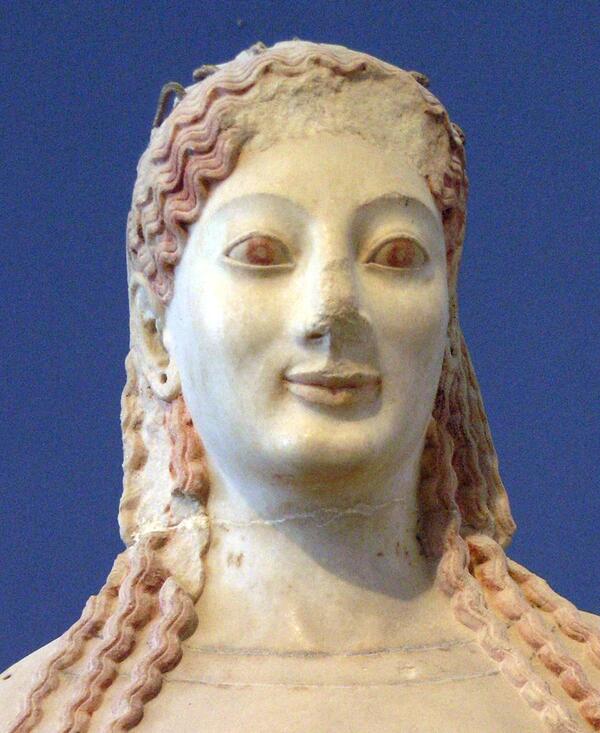
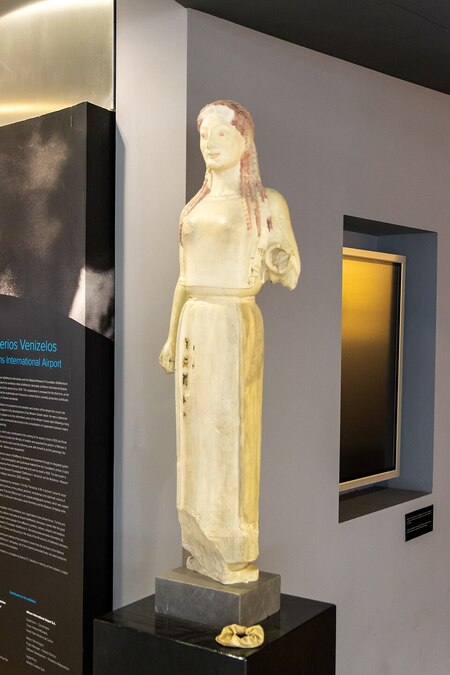
Kora in a Peplos, circa 530 BCE
This conception of humanity can be linked to the broader worldview of the ancient Greeks. Order, measure, and proportion gradually become crucial principles for understanding reality. The sculptor perceives symmetry and order within themselves and confidently projects this onto the surrounding world.
The Smile as a Reflection of Divine Grace
Adorant figures, dating to the 6th–5th centuries BCE.
One possible interpretation of the archaic smile connects it to humanity’s participation in the divine world. This smile may have appeared not only in the depictions of the gods themselves but also in images of their devotees (adorants), reflecting the connection between them.
Sarcophagus of a couple from Cerveteri, circa 520 BCE.
The Sarcophagus of the Spouses from Cerveteri (circa 520 BCE) is noteworthy. It should be used as a comparative example because it is Etruscan sculpture, yet it was created in close interaction with Greek artistic tradition.In the figures of the funerary statues and adorants, the smile stemmed from an encounter with the gods, reflecting divine favor and energy.